Why Arch Support Orthotics Can Make Shoes More Comfortable
Arch support orthotics are inserts that support the curve of your foot inside a shoe. They can spread pressure more evenly, steady your heel, and make walking or standing more comfortable. If your feet ache in otherwise good shoes, the right insert may help.
The key is fit, not the tallest arch you can find. Choose support that feels comfortable under your foot and leaves enough room in your shoe. Sneakers and work shoes may fit a full-length insert; snug dress shoes may need a thinner, shorter one. If pain is severe or keeps coming back, see a foot care professional rather than relying on inserts alone.
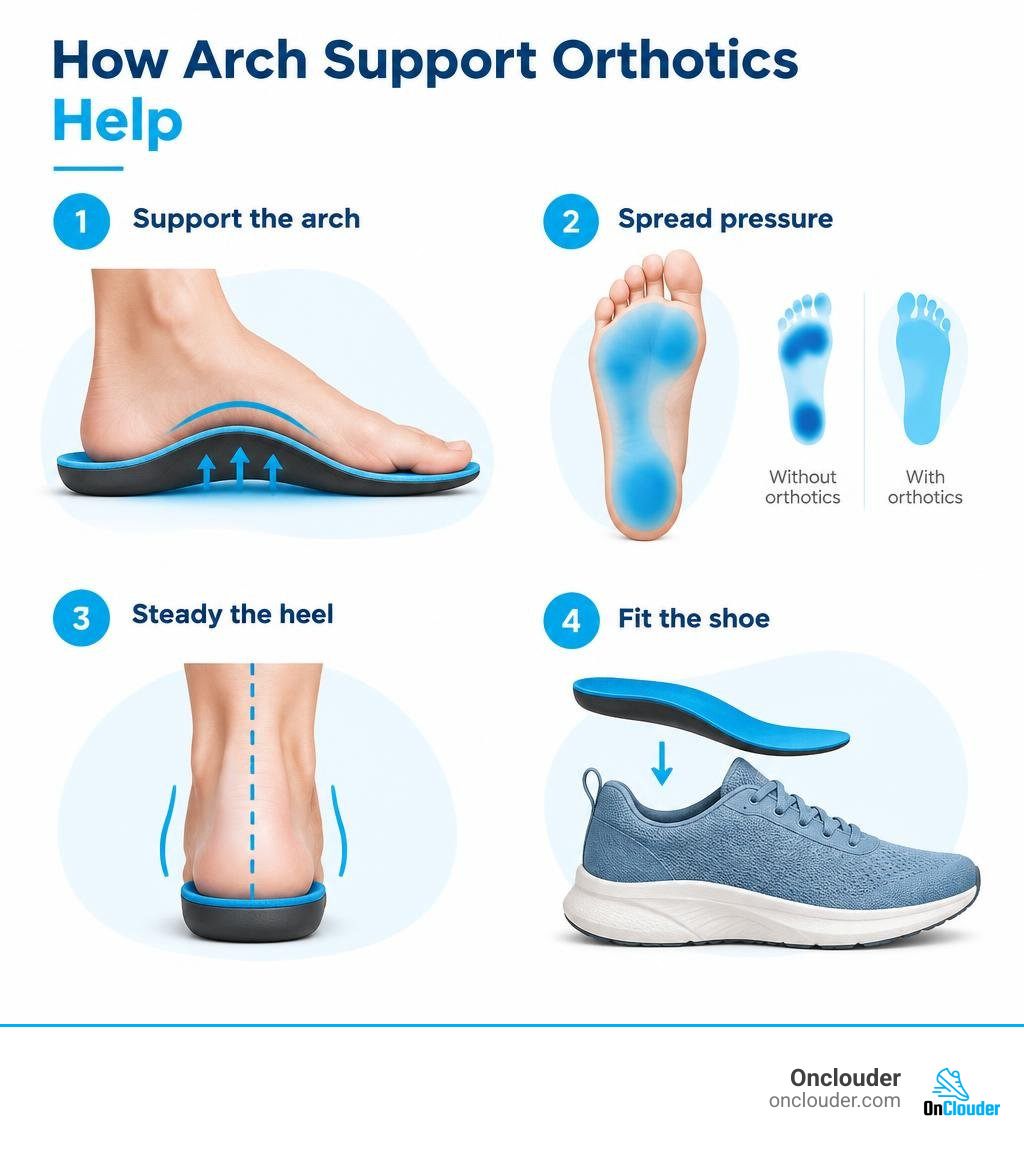
Simple arch support orthotics glossary:
Understanding Arch Support Orthotics and Biomechanical Alignment
Your foot is a marvel of biological engineering. Packed into a relatively small area are 26 bones, 33 joints, and over 100 muscles, tendons, and ligaments working together with every step. When you walk, run, or stand, your arches act as natural shock absorbers. However, standard factory insoles inside most footwear are flat, flimsy foam cutouts that do very little to maintain your foot’s natural shape under heavy loads.
When an arch collapses inward or lacks adequate contact, your entire body compensates. Adding arch support orthotics helps redistribute your body weight evenly across the entire plantar surface rather than concentrating pressure solely on your heel and the ball of your foot. By maintaining proper structural alignment, you can easily discover how arch orthotic insoles relieve back and knee strain as well as everyday foot soreness.
Biomechanics of the Foot and Kinetic Chain
Foot mechanics do not stop at the ankle. Every movement sends forces upward through your kinetic chain—the interconnected system of your feet, ankles, knees, hips, and lower back.
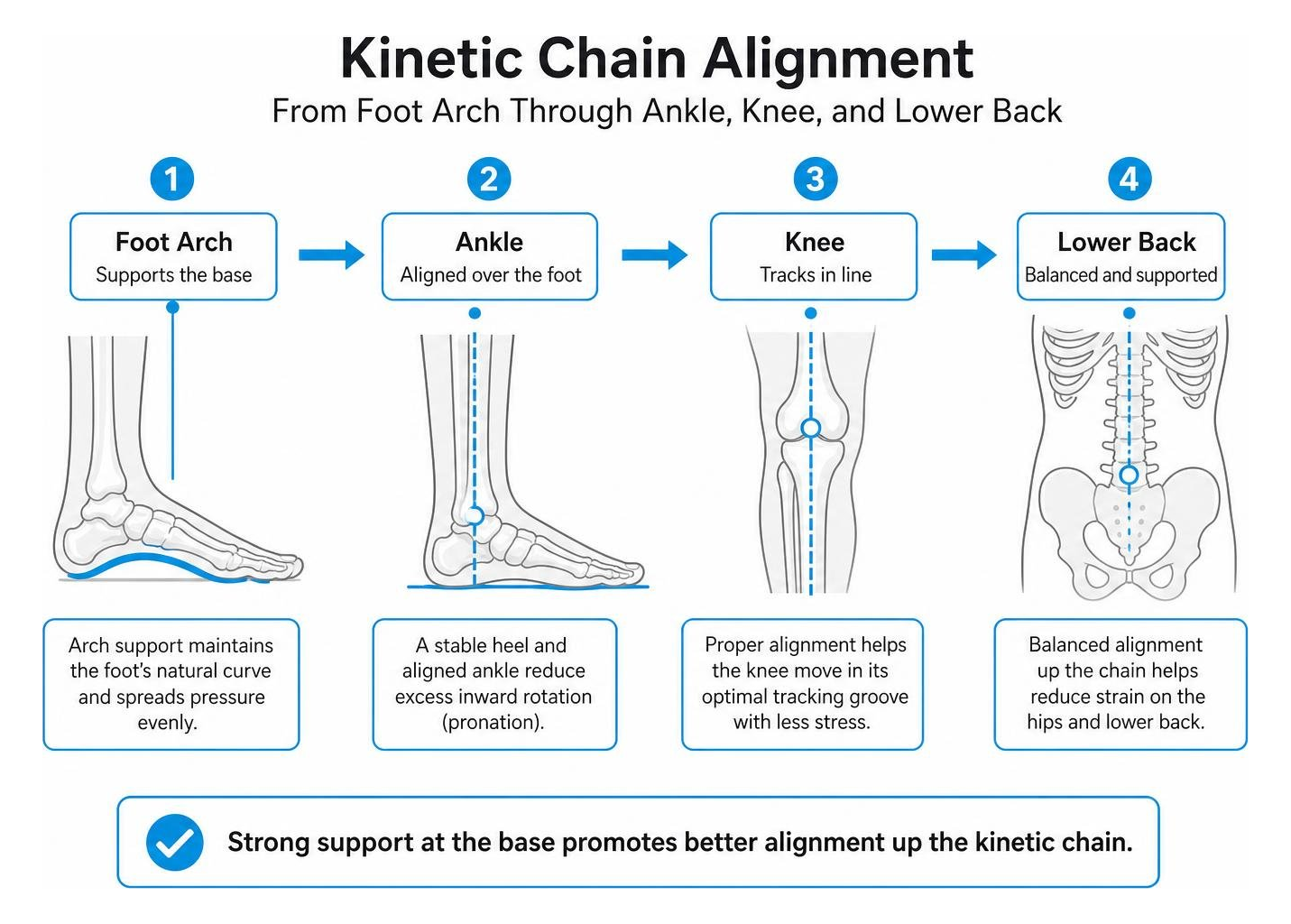
When your arch collapses excessively (overpronation), your lower leg rotates inward. This internal tibial rotation pulls your knee out of its optimal tracking groove, twists the hip joint, and tilts your pelvis forward, creating chronic tension in your lumbar spine.
A well-crafted insert featuring a structured medial arch bridge and a deep heel cup cradles the calcaneus (heel bone). This heel cup prevents rearfoot wobbling, stabilizes the subtalar joint, and keeps your ankle aligned directly over your foot. Laboratory motion analysis testing at the University of Edinburgh Olympic Facility showed that stabilizing heel cups like those found in advanced orthotics provide up to 50% more ankle alignment and stability compared to flat surfaces. Keeping the base steady offloads strain from the joints above it.
Custom vs. Over-the-Counter Arch Support Orthotics
When choosing an insert, you generally have two main paths: retail over-the-counter (OTC) inserts or custom prescription orthotics crafted by a podiatrist.
| Feature | Over-the-Counter (OTC) Orthotics | Custom Medical Orthotics |
|---|---|---|
| Average Cost | $20 – $80 | $300 – $600 (Out-of-pocket) |
| Insurance Coverage | Rarely covered (HSA/FSA eligible) | Often covered ($50 – $150 co-pay) |
| Lifespan | 6 to 12 months | 2 to 5+ years |
| Materials | Molded EVA foam, TPU shells, gel | Carbon fiber, high-density polypropylene |
| Customization | Standard arch curves / Heat-moldable | 3D laser scan or plaster cast matched to foot |
| Best For | General fatigue, mild pronation, aches | Severe deformities, limb discrepancies, chronic issues |
For most people dealing with daily fatigue, mild overpronation, or standard arch soreness, modern over-the-counter devices deliver exceptional structural relief at a fraction of the cost. However, if you are evaluating shoe inserts vs custom orthotics for plantar fasciitis and have severe structural abnormalities or stubborn pain, a podiatric consultation is worth the investment.
Selecting the Right Insole for Your Foot Arch and Footwear
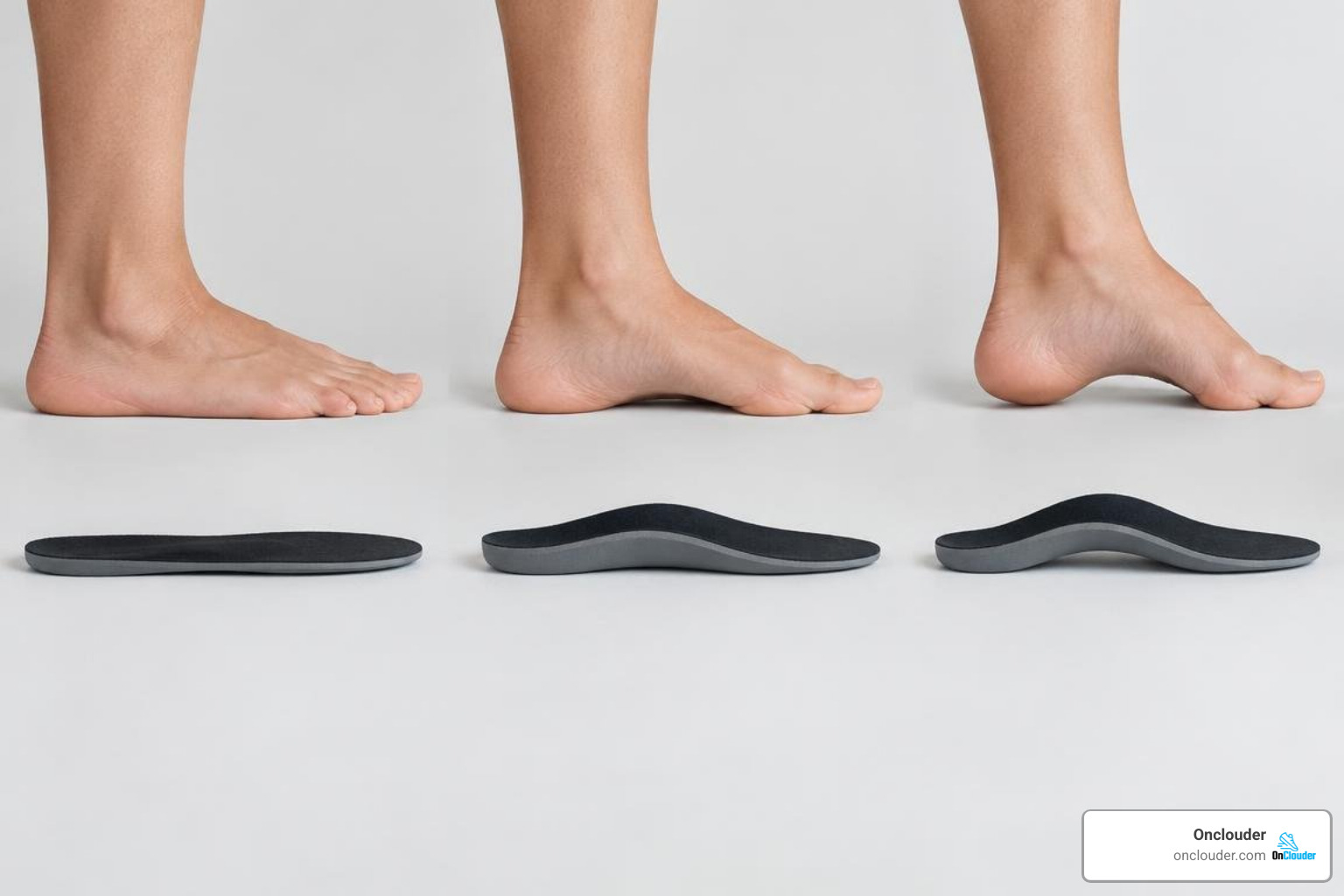
Finding the right support starts with knowing your specific arch profile. You can check this at home using the classic “wet paper test.” Wet the bottom of your bare foot and step onto a piece of dark cardboard or heavy paper:
- Low Arch (Flat Foot): Your footprint shows almost the entire bottom of your foot, with little to no inward curve along the middle.
- Neutral Arch (Medium): Your footprint shows a distinct inward curve along the inside edge, with the heel and ball connected by a solid band about half the width of your foot.
- High Arch (Cavus Foot): Your footprint shows only the heel and ball of your foot connected by a very narrow outer strip, or no connecting strip at all.
Using this profile, you can follow our detailed guide on how to choose insoles for foot pain and arch support to pick the ideal match.
Low, Neutral, and High Arch Configurations
Each arch configuration interacts with shoes differently and demands tailored structural support:
- Flat Feet and Low Arches: Flat feet tend to roll inward excessively, stretching the posterior tibial tendon. They need a semi-rigid medial arch post combined with firm pronation control. Selecting the best arch support insoles for flat feet helps prevent the arch from bottoming out under body weight.
- Neutral Arches: Neutral arches require balanced support with adaptive dynamic flexing and cushioned shock absorption to maintain natural gait efficiency.
- High Arches: Rigid high arches place heavy pressure directly onto the heel and metatarsal heads because the arch never touches the shoe bed. People with high arches benefit from finding high arch support insoles featuring elevated profiles that fill the empty space beneath the foot, paired with metatarsal pads to offload the forefoot.
Full-Length vs. Low-Profile 3/4-Length Inserts
Your footwear determines the physical profile of the insert you can comfortably use:
- Full-Length Inserts: Best for athletic sneakers, hiking boots, and work footwear where you can remove the existing factory insole. They replace the entire footbed from heel to toe, providing consistent cushioning throughout the shoe.
- 3/4-Length (Low-Profile) Inserts: Crucial for low-volume footwear, such as loafers, flats, and pointed dress shoes, where factory insoles are glued down. By ending just behind the ball of the foot, choosing low-profile 3/4 orthotic insoles leaves full vertical clearance in the toe box so your toes never feel pinched. Podiatric guidance highlights arch support insoles for dress shoes with thin 2mm to 4mm carbon fiber or leather bases as the gold standard for maintaining a sleek look without sacrificing support.
Proven Benefits for Plantar Fasciitis and Joint Pain Relief
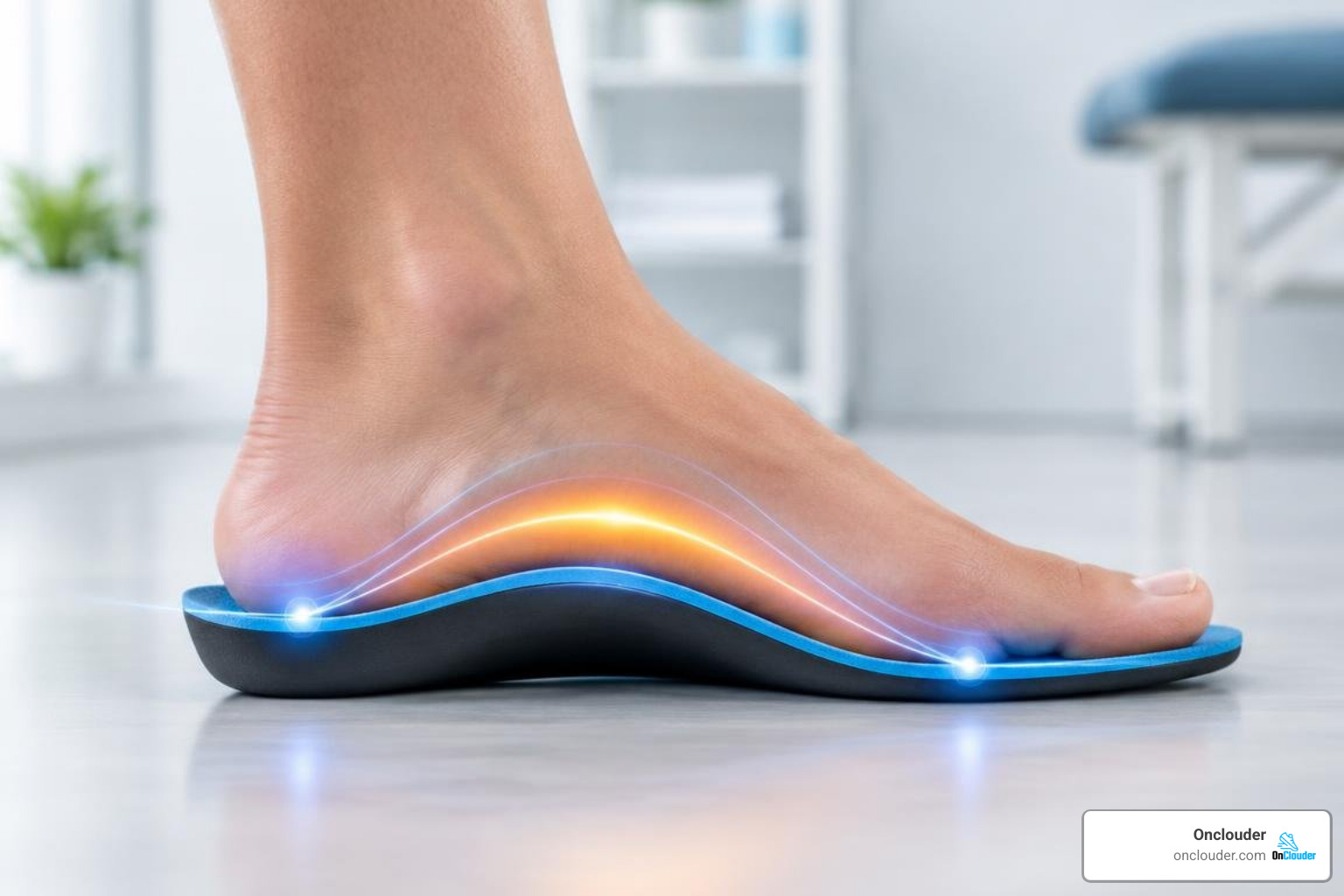
One of the greatest benefits of orthotic arch support is soothing stubborn soft-tissue inflammation, especially along the plantar fascia. The plantar fascia is a thick band of connective tissue running along the bottom of your foot from your heel bone to your toes. When the arch flattens repeatedly without support, this band experiences continuous traction stress, leading to microscopic tears, inflammation, and sharp morning heel pain.
Reading our practical guide to plantar fascia orthotic insoles will help you understand how structural arch cradling acts like a supportive bridge, preventing this tissue from over-stretching during push-off.
Pressure Redistribution and Plantar Fascia Unloading
When your arch collapses with each step, tensile strain along the plantar fascia peaks. Adding a contoured orthotic lifts the tissue into an anatomically neutral position. Research from Quinnipiac University’s Motion Analysis Lab demonstrated that dynamic arch-controlling systems like SelectFlex can deliver up to 89% more arch support compared to unsupportive standard foam insoles, actively dampening strain on the heel spur region and Achilles tendon.
Furthermore, combining arch contouring with a targeted metatarsal teardrop pad lifts the transverse arch. As shown with designs like the Aetrex Women’s Memory Foam Orthotics and the Aetrex Men’s Speed Posted Orthotics, this offloads forefoot pressure and relieves conditions like metatarsalgia and Morton’s neuroma while successfully managing plantar fasciitis with arch support insoles.
Alleviating Strain from Prolonged Standing and Athletic Impact
If you stand on concrete floors for eight to twelve hours a day, gravity places relentless downward pressure on your feet. Without structural reinforcement, the intrinsic muscles of your feet fatigue, forcing your ligaments and joints to absorb punishing ground impact.
Using effective insoles for standing all day gives those tired muscles an active rest. The supportive shell bears the load, while resilient top layers bounce back with every step, dramatically cutting down end-of-day fatigue in your legs and lower back.
Practical Care, Longevity, and Break-In Protocols
Getting new orthotics can feel unusual at first. Because your feet and postural muscles have grown accustomed to unaligned shoes, adjusting to correct anatomical alignment takes a few days.
Follow this progressive break-in schedule to let your feet adapt comfortably:
- Days 1 and 2: Wear your new orthotics for 1 to 2 hours during low-impact daily activities, then switch back to your original footbeds.
- Days 3 and 4: Increase wear time to 3 to 4 hours per day.
- Days 5 and 6: Extend wear to 5 to 6 hours, including moderate walking.
- Day 7 and Beyond: You are ready for full-day wear and athletic activities.
If you are using heat-moldable options like PowerStep Heat Moldable Insoles, pre-heating them in an oven at 225°F and molding them directly inside your shoes creates an exact anatomical fit in minutes.
Breaking In and Fitting New Arch Support Orthotics
When inserting a full-length insole, always remove the shoe’s existing factory insole first. Placing a supportive insert on top of an old footbed crowds your shoe and throws off your heel height.
If your new insole is slightly too long, use your original factory insole as a cutting template. Trace the toe contour with a pen and trim along the line using sharp kitchen shears. For localized ball-of-foot discomfort, pairing your setup with metatarsal arch support pads for targeted relief placed just behind the ball of the foot gives you extra pressure offloading.
Lifespan, Replacement Signs, and Maintenance
Most high-quality retail orthotics last between 6 and 12 months, depending on your body weight, mileage, and daily activity.
Signs it is time to replace your orthotics include:
- Visible Compression: The cushioning foam stays flat and no longer springs back.
- Shell Cracking: The firm plastic or composite arch base has hairline fractures or flexes too easily.
- Fabric Wear: The top cover has worn through around the heel or big toe.
- Return of Discomfort: Old aches in your heels, shins, or lower back begin to creep back.
To clean your inserts, spot-clean them using a damp washcloth and mild soap. Never submerge them in water or toss them into a washing machine or clothes dryer, as excessive heat breaks down supportive adhesives and structural EVA foams.
Frequently Asked Questions About Arch Support Inserts
How much do arch support inserts cost, and are they covered by insurance?
Over-the-counter arch support inserts typically cost between $20 and $80 per pair. Custom orthotics prescribed by a podiatrist generally range from $300 to $600 out of pocket. While private insurance and Medicare rarely cover standard retail inserts, custom devices are frequently covered when deemed medically necessary, which can reduce your out-of-pocket costs to a $50 to $150 co-pay. In addition, most over-the-counter orthotics qualify for purchase with Health Savings Accounts (HSA) and Flexible Spending Accounts (FSA).
Will wearing arch support weaken my foot muscles over time?
No, wearing proper arch support will not weaken your foot muscles. Research shows that orthotics realign your skeletal structure, allowing overworked foot muscles to fire properly and efficiently without fatiguing prematurely. Instead of immobilizing the foot like a cast, modern semi-rigid orthotics guide healthy, dynamic motion with every step.
How often should arch support inserts be replaced?
For regular daily use, high-quality inserts should be replaced every 6 to 12 months. Dedicated runners logging 20 to 30 miles per week, or workers standing on hard concrete all day, may need to replace them around the 6-month mark as high-impact forces compress the supportive foam.
Conclusion
You do not need to replace your entire shoe collection to enjoy all-day comfort. Adding the right orthotic arch support transforms stiff, flat shoes into stable, ergonomically aligned footwear. By steadying your heel, cradling your arch, and protecting your joints from excess impact, you can stay active and pain-free on your feet.
Take time to evaluate your unique arch height, match the insole profile to your favorite shoes, and give your feet a few days to adjust. Ready to upgrade your daily footwear? Explore our complete testing results to find the best arch support insoles for total foot relief.