Best Tennis Shoes for Ankle and Arch Support: Where to Start
Start with the ASICS Gel-Resolution X, Adidas Barricade 13, or Babolat Propulse Fury 3. All three are built for the side-to-side movement tennis demands. Look for a secure heel, a stable midfoot, enough cushioning for your court surface, and room for your toes. The best choice is the one that holds your foot in place without pinching it.
If you have high arches, pay close attention to cushioning as well as midfoot support. If your ankles feel unstable, prioritize heel lockdown and lateral stability. A supportive shoe should help you move with confidence, but it cannot replace a good fit or address persistent pain on its own.
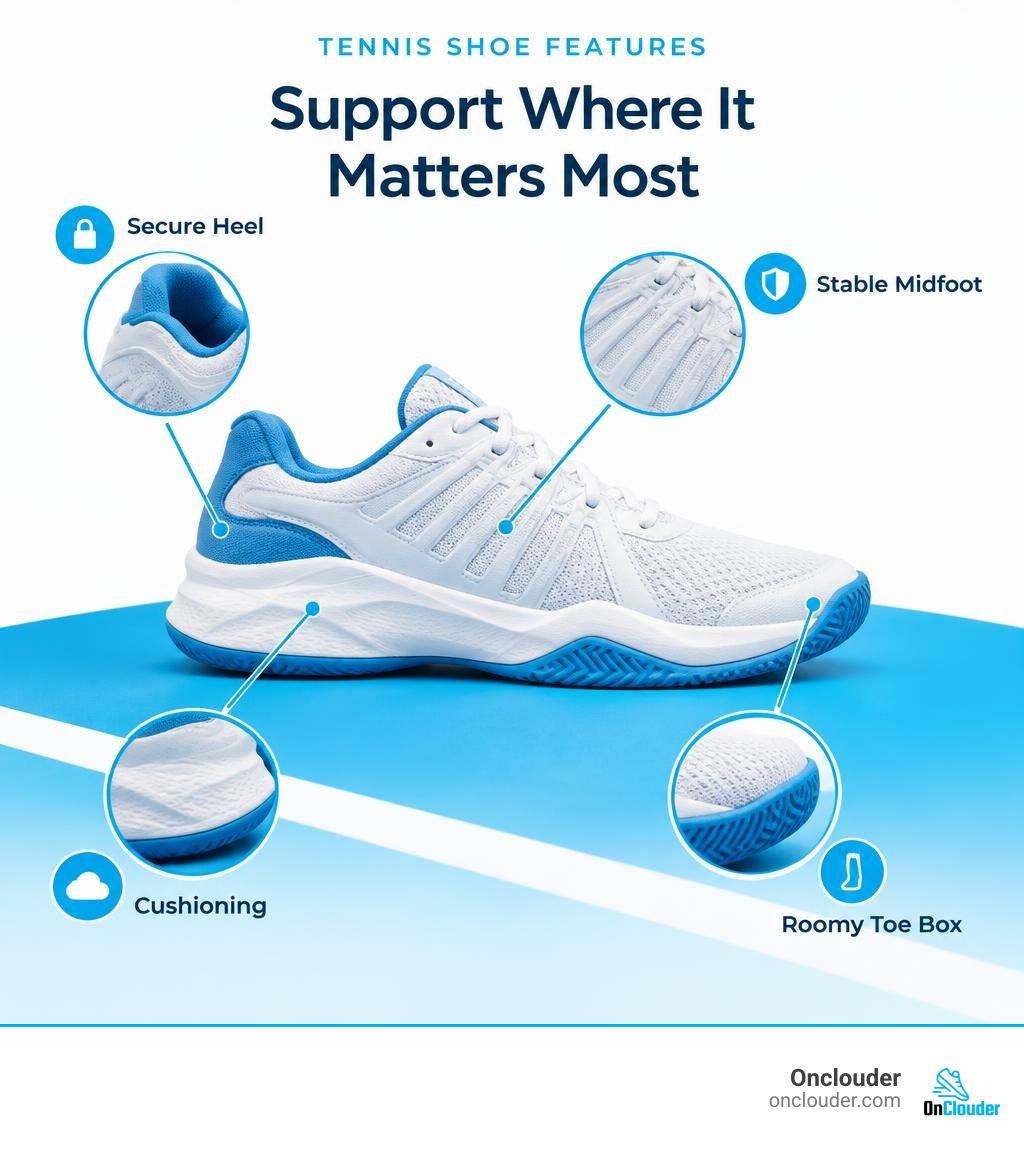
Basic best tennis shoes for ankle and arch support terms:
Tennis places unique, aggressive loads on your body. Unlike running in a straight line, court sports require sudden deceleration, explosive lateral cuts, and split-step landings. When your foot hits the court, forces ripple straight up the kinetic chain. Without structured support beneath your midfoot and around your ankle joint, your plantar fascia and ligaments absorb the brunt of that impact. Finding the right pair is not just about comfort; it is your primary defense against debilitating court injuries.
Essential Features in the Best Tennis Shoes for Ankle and Arch Support
When evaluating court footwear, we look far beyond aesthetic appeal or standard running foam. Tennis requires specialized engineering designed to resist torsional twist and reinforce your natural anatomy.
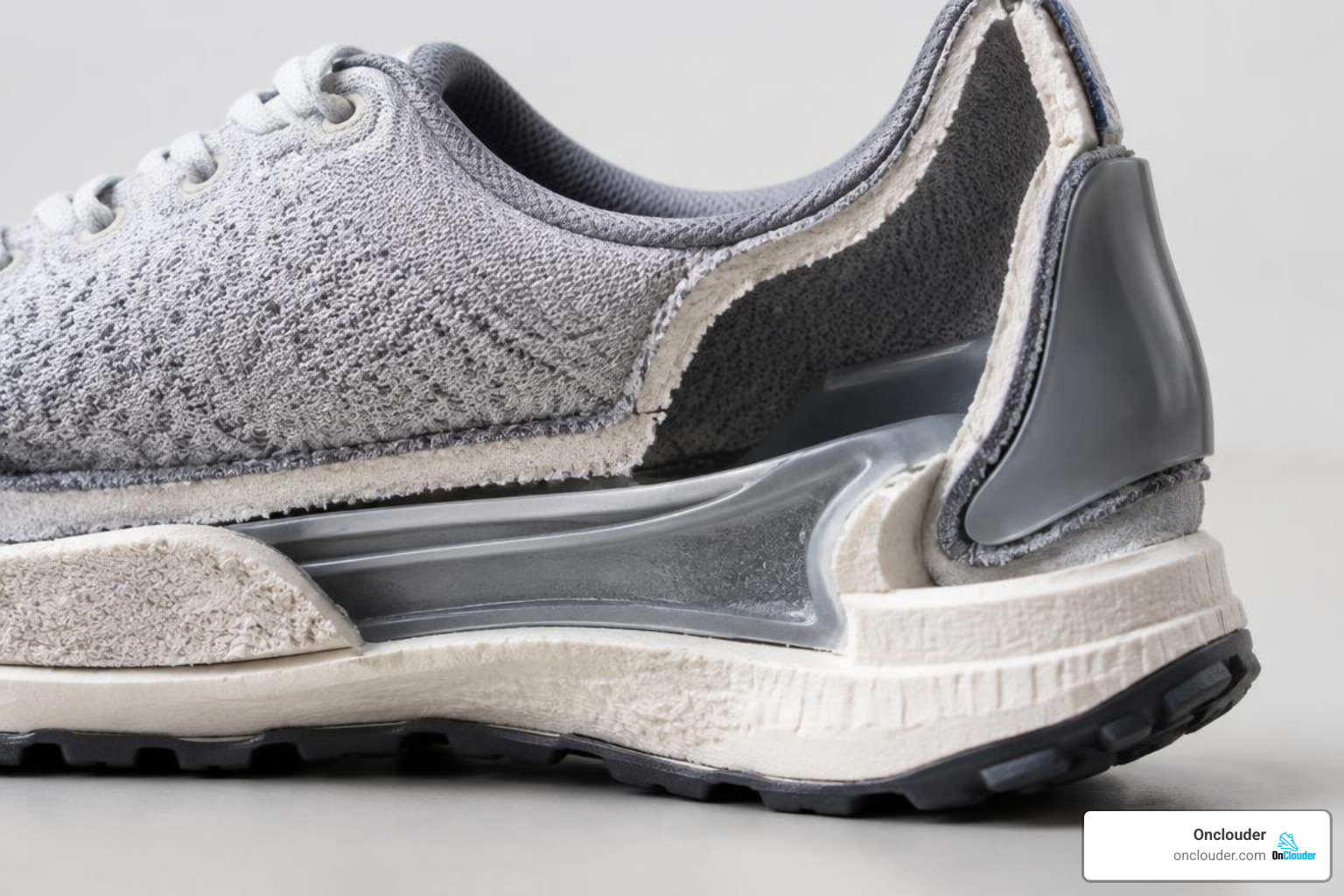
Industry studies show that footwear offering dedicated medial reinforcement can reduce peak plantar pressure significantly for lower arches, while structured lateral walls guard against the dreaded ankle rollover. For high-performance play, your shoe must blend rigidity with targeted impact dispersion. A well-designed stability frame works like scaffolding for your foot, keeping you aligned whether you are chasing down a drop shot or pushing off for a wide baseline forehand. For a wider perspective on everyday supportive footwear, exploring an essential guide to best shoes for arch support can help clarify how these chassis components work together.
Midfoot Shanks and Arch Support Systems
The midfoot shank is the backbone of any serious tennis shoe. Situated between the insole and outsole directly beneath the arch, this rigid insert—often crafted from thermoplastic polyurethane (TPU), carbon fiber, or dense composite resin—prevents the shoe from bending in half.
When you spring upward or plant hard laterally, an unsupported shoe can collapse under the arch, overstretching the plantar fascia band. A sturdy shank creates high torsional rigidity. This means when your forefoot twists, your rearfoot remains stable, directly protecting your arch from excessive flattening and shielding the surrounding tendons from acute strain.
Rigid Heel Counters and Lateral Stability Frames
Ankle stability in tennis rarely comes from high fabric collars; it comes from the foundation around your calcaneus (heel bone). A rigid heel counter is an internal plastic cup that locks the rearfoot in place. Research indicates that shoes featuring rigid heel counters noticeably reduce Achilles tendon strain compared to flexible heel designs.
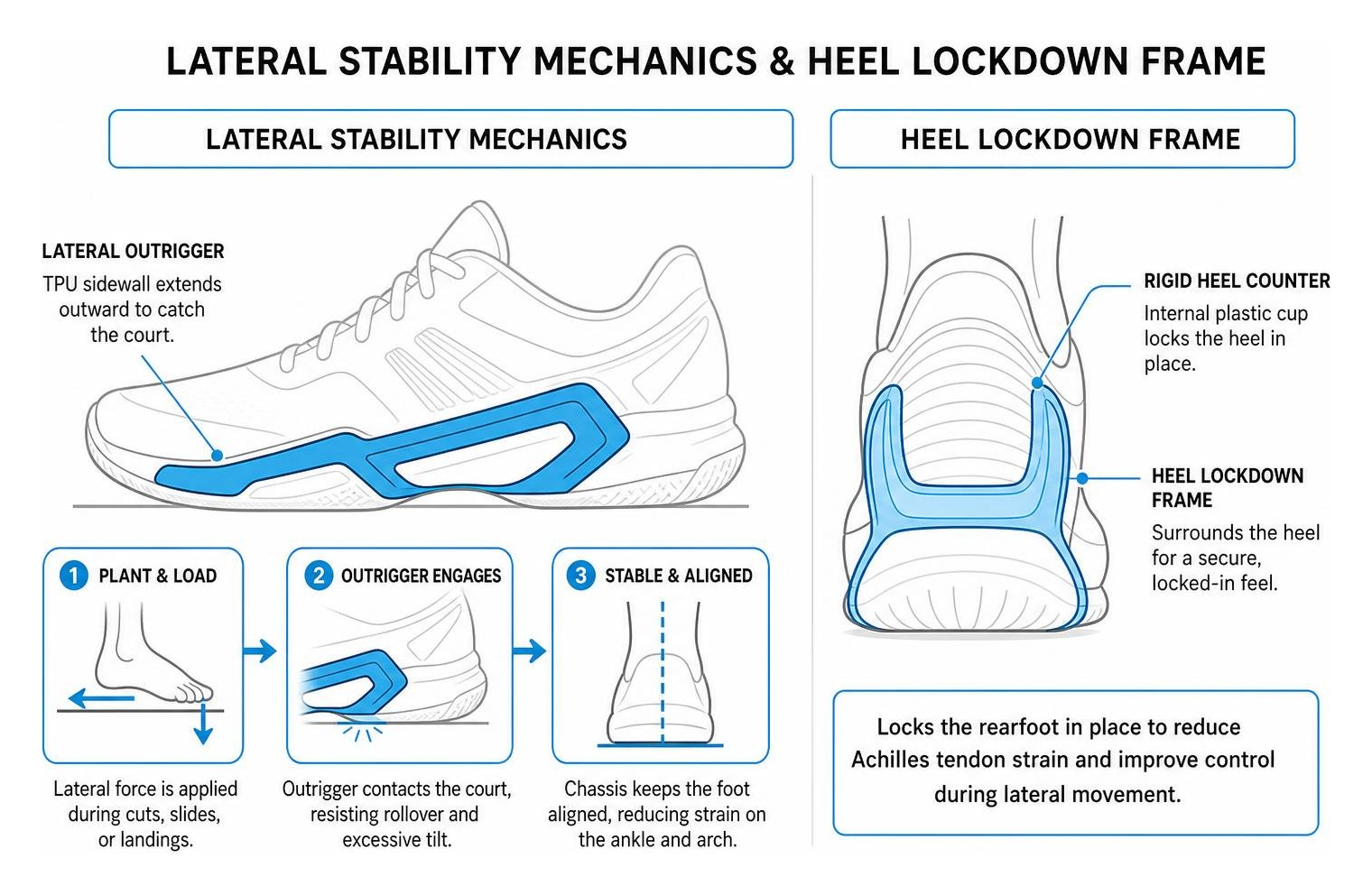
Surrounding this heel counter, modern tennis shoes integrate lateral stability frames—often called outriggers or sidewall walls. These external TPU structures extend outward along the pinky-toe side of the sole. When you slide or make a violent lateral stop, the outrigger catches the court, acting like a kickstand to stop inward or outward ankle rolling. If you struggle with overpronation during intense footwork, understanding how ASICS GT technology solves inward ankle rolling illustrates just how crucial specialized medial and lateral frames are for joint alignment.
Cushioning Technologies: EVA vs. Polyurethane Midsoles
The battle underfoot usually comes down to ethylene-vinyl acetate (EVA) versus polyurethane (PU) midsoles:
- EVA Foam: Lightweight, plush, and instantly comfortable right out of the box. EVA absorbs sharp ground shocks well, but it tends to compress permanently over time.
- Polyurethane (PU): Denser, heavier, and substantially more durable than EVA. PU provides a firm, springy platform that maintains its structural integrity through months of heavy court pounding.
That athletic shoe cushioning naturally degrades after 300 to 500 miles of equivalent use, even if the exterior rubber looks immaculate. On the court, extended play causes the forefoot foam to bottom out. Once this cushioning loses its elasticity, players often develop painful conditions such as metatarsal capsulitis, joint bursitis, and microscopic stress fractures.
Top Recommended Models by Foot Type and Court Demands
Finding the optimal shoe means matching its mechanical profile to your specific arch geometry and playing style.
| Tennis Shoe Model | Primary Arch Profile | Ankle Stability Mechanism | Weight (Men’s 10.5) | Best Court Surface | Key Tech Feature |
|---|---|---|---|---|---|
| Adidas Barricade 13 | Medium to High | Asymmetric Torsion System & Geofit Pods | ~14.3 oz | Hard / All-Court | Integrated lacing & rigid shank |
| ASICS Gel-Resolution X | Medium to High | Dynawall Midfoot & Dynawrap Eyelets | ~14.8 oz | Hard / Clay | FlyteFoam + Gel heel cushioning |
| Babolat Propulse Fury 3 | Medium | Power Belt Strap & Reinforced Shank Plate | ~14.4 oz | Hard / Clay | Michelin rubber & 360-degree lock |
| Wilson Rush Pro 4.5 | Low to Medium | 4D Support Chassis 2.0 | ~13.8 oz | All-Court | Dual-piece lateral propulsion frame |
| Diadora Blushield Torneo 3 | Medium to High | Blushield Shock Core & Medial Stabilizer | ~15.1 oz | Hard / Clay | Full-foot reactive cushioning grid |
Best Tennis Shoes for Ankle and Arch Support with High Arches
High arches naturally feature a smaller contact area with the ground, severely reducing your foot’s natural shock-absorption capacity. Because high-arched feet are rigid, the shock of hard-court play travels directly up your shins, knees, and lower back, leaving you vulnerable to stress fractures, ankle sprains, and plantar fasciitis.
For high arches, the Adidas Barricade 13 stands out as an exceptional performer. It is widely praised for its dense midfoot shank and Geofit heel pods that hug high insteps. Another top-tier alternative is the ASICS Gel-Resolution X, which combines plush rearfoot Gel technology with a Dynawall frame for unrivaled stability. You can explore our dedicated breakdown of supportive sneakers for high arches alongside top rated tennis shoes that save your arches.
Best Tennis Shoes for Ankle and Arch Support with Flat Feet
Flat feet, or fallen arches, tend to overpronate, rolling inward excessively during weight transfer. This excessive rotation twists the tibia and destabilizes the ankle joint. Flat-footed players need rigid arch counters, motion control, and secure midfoot lockdowns.
The Babolat Propulse Fury 3 is a powerhouse for players seeking stability. In comprehensive court testing, the Propulse Fury 3 consistently earns top marks for traction, arch support, and foot stability. Babolat managed to make this generation a full ounce lighter (14.4 ounces versus 15.4 ounces in a US men’s size 10.5) while reinforcing the underfoot shank plate. Its Power Belt wrapping system pulls the upper securely around your foot, eliminating interior sliding. For off-court recovery or daily conditioning, check out the definitive guide to best walking tennis shoes for flat feet to maintain healthy arch alignment.
Surface-Specific Considerations: Hard, Clay, and Grass Courts
The court surface dictates how your footwear interacts with your joints:
- Hard Courts: Made of asphalt or concrete covered in acrylic, hard courts provide zero natural give. They generate maximum friction and heavy impact forces. You need dense PU or multi-layered EVA midsoles, reinforced toe caps, and abrasion-resistant outsoles.
- Clay Courts: Clay allows you to slide into shots, meaning you need controlled lateral release rather than sudden, jarring stops. Clay shoes feature full herringbone (zigzag) tread patterns to clear loose dirt and prevent sudden slips that strain ankle ligaments.
- Grass Courts: Grass is slick and soft. Grass-court shoes feature pimpled or nubbed rubber soles to grip the turf without tearing it up, preventing sudden slips on quick directional shifts.
Footwear Categories: Stability vs. Cushioning vs. Motion Control
Understanding shoe categorization ensures you do not buy a plush model when your joints require structural bracing.
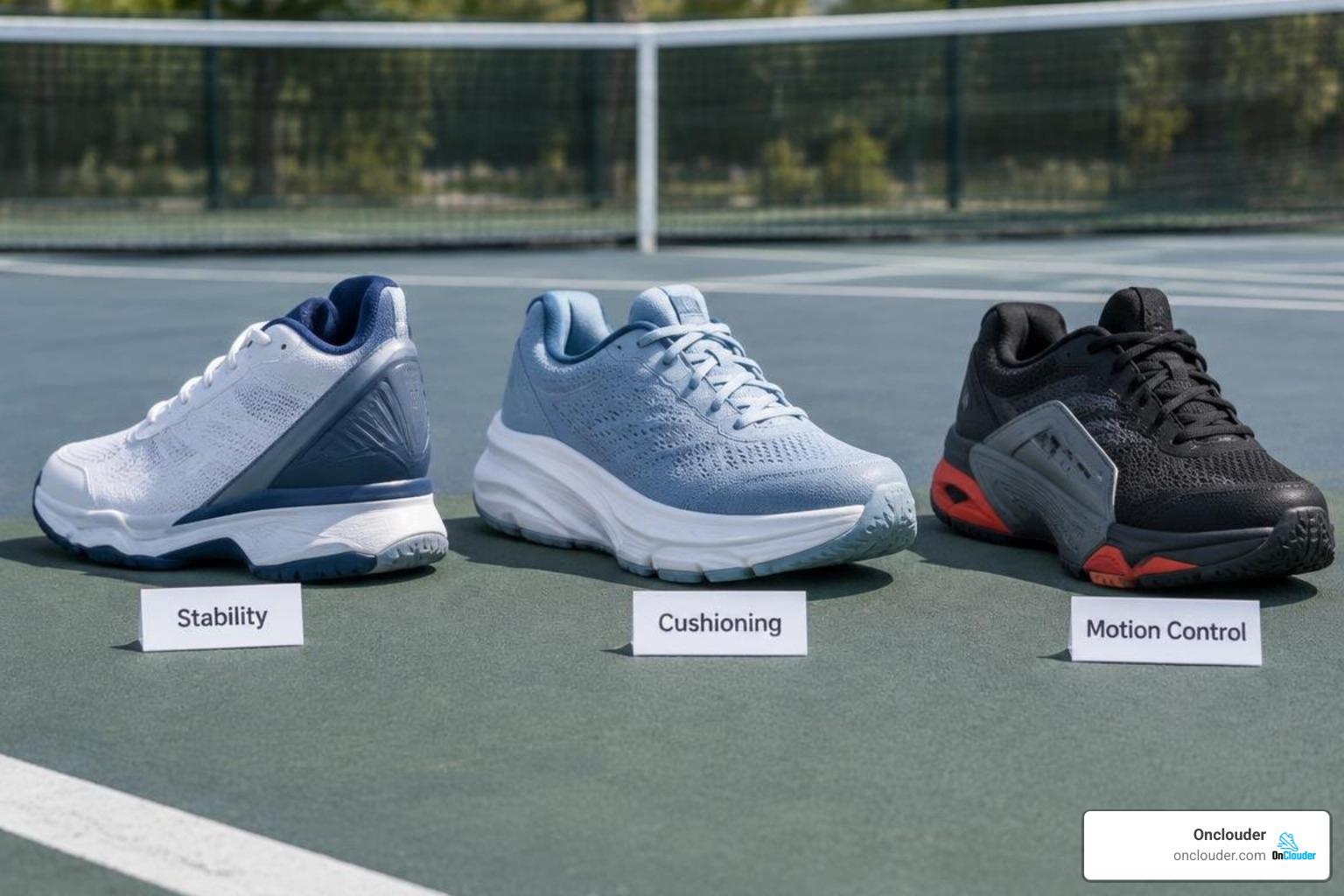
- Stability Shoes (e.g., ASICS Gel-Resolution, Adidas Barricade): Engineered specifically for tennis players who make aggressive lateral cuts. They feature reinforced sidewalls, TPU shanks, and firm outriggers. Clinical research shows that stability shoes can also decrease knee pain in athletes dealing with joint osteoarthritis by controlling rotational forces.
- Cushioning Shoes (e.g., Diadora Blushield Torneo, Nike GP Challenge): Prioritize plush shock absorption with softer foam compounds. They are ideal for high-arched players who need impact dampening on hard courts, though they sacrifice a small degree of lateral edge stiffness.
- Motion Control Shoes: The most rigid class of footwear, built with dense medial posts or double-density midsoles to physically block the foot from rolling inward. While more common in running, motion-control design elements are integrated into stability tennis shoes to protect players with severe overpronation and chronic ankle weakness.
Injury Prevention, Conditioning, and When to See a Podiatrist
Supportive footwear is half the battle; proper foot mechanics and physical conditioning complete the equation. Everyday footwear choices also matter—wearing unsupportive flip-flops or high heels off the court shifts body weight forward unnaturally (high heels can spike forefoot pressure by up to 80%), tightening the Achilles tendon and leaving you vulnerable during weekend matches. Furthermore, ensure your court shoes feature a roomy toe box. The American Podiatric Medical Association emphasizes leaving roughly a thumb’s width of space between your longest toe and the end of the shoe to avoid nerve compression, bunions, and bruised toenails.
Essential Warm-Up and Ankle Strengthening Exercises
Never step straight into a match cold. A 5- to 10-minute dynamic warm-up primes your stabilizer muscles:
- Dynamic Stretches: Perform high knees, butt kicks, and lateral shuffles across the service boxes.
- Ankle ABCs & Circles: Trace the alphabet in the air with each foot to mobilize the joint capsule in all planes of motion.
- Resistance-Band Eversion and Inversion: Loop an elastic band around your forefoot and pull outward and inward against resistance to strengthen the peroneal muscles that prevent ankle rolling.
- Single-Leg Balance Drills: Stand on one leg on a balance pad for 30 seconds while mimicking gentle swing mechanics to improve proprioception.
The Role of Custom Orthotics and Podiatric Evaluation
If you have tried premium stability footwear and continue to experience arch spasms, shin splints, or chronic joint tenderness, it is time to consult a podiatrist. A medical gait analysis can pinpoint structural abnormalities that off-the-shelf shoes cannot fix alone.
Most high-end tennis shoes come with removable factory insoles. A podiatrist can craft custom, rigid orthotics tailored precisely to your foot’s topography. Custom orthotics redistribute plantar loads, correct leg alignment, and provide structural support, allowing you to slide them directly into your favorite stability shoes for a personalized fit.
Frequently Asked Questions About Tennis Footwear Support
How often should I replace tennis shoes to maintain arch and ankle support?
Replace your tennis shoes every 45 to 60 hours of intense court play, or roughly every 4 to 6 months for regular players. Even if the outer rubber tread shows little wear, the internal EVA or PU midsole foam compresses permanently, losing its ability to absorb shock and protect your joints.
Can the wrong tennis shoes cause plantar fasciitis or ankle sprains?
Yes. Playing in flexible running shoes or worn-out court shoes allows the foot to twist abnormally during lateral cuts. High-arched players in under-cushioned shoes suffer excessive impact on the plantar fascia, while flat-footed players in non-supportive shoes experience severe overpronation that stresses the medial ankle ligaments.
Do I need high-top tennis shoes for ankle instability?
Not necessarily. While high-top court shoes offer some sensory feedback around the collar, true lateral stability in tennis comes from a wide base of support, a rigid internal heel counter, and a stiff TPU midfoot shank. A robust low-top stability shoe often provides equal or superior rollover protection compared to a soft high-top shoe.
Conclusion
Mastering your footwork starts with protecting your foundation. Whether you are dealing with high arches that demand plush shock absorption or flat feet that require heavy-duty pronation control, investing in top-tier court footwear keeps you agile, pain-free, and competitive. Look for rigid heel counters, robust TPU midfoot shanks, and responsive cushioning that matches your specific court surface.
Ready to find the ideal footwear setup for your lifestyle? Explore our comprehensive resources and check out the ultimate guide to best shoes with arch support to take the next step toward peak comfort and injury-free performance on and off the court.