How to Choose Arch Support Tennis Shoes
Start with a court shoe that fits your arch and holds your foot steady during side-to-side moves. Look for a supportive midfoot, a secure heel, enough cushioning for hard-court impact, and an outsole made for your playing surface. If you use orthotics, check that the insole is removable. If your feet are wide, choose a wide or extra-wide size rather than sizing up for more room.
Arch support should feel comfortable, not like a hard bump under your foot. The right shoe also depends on whether you need room for flat feet, cushioning for high arches, or a fit you can wear beyond the court. This guide will help you compare those needs without confusing support with softness.
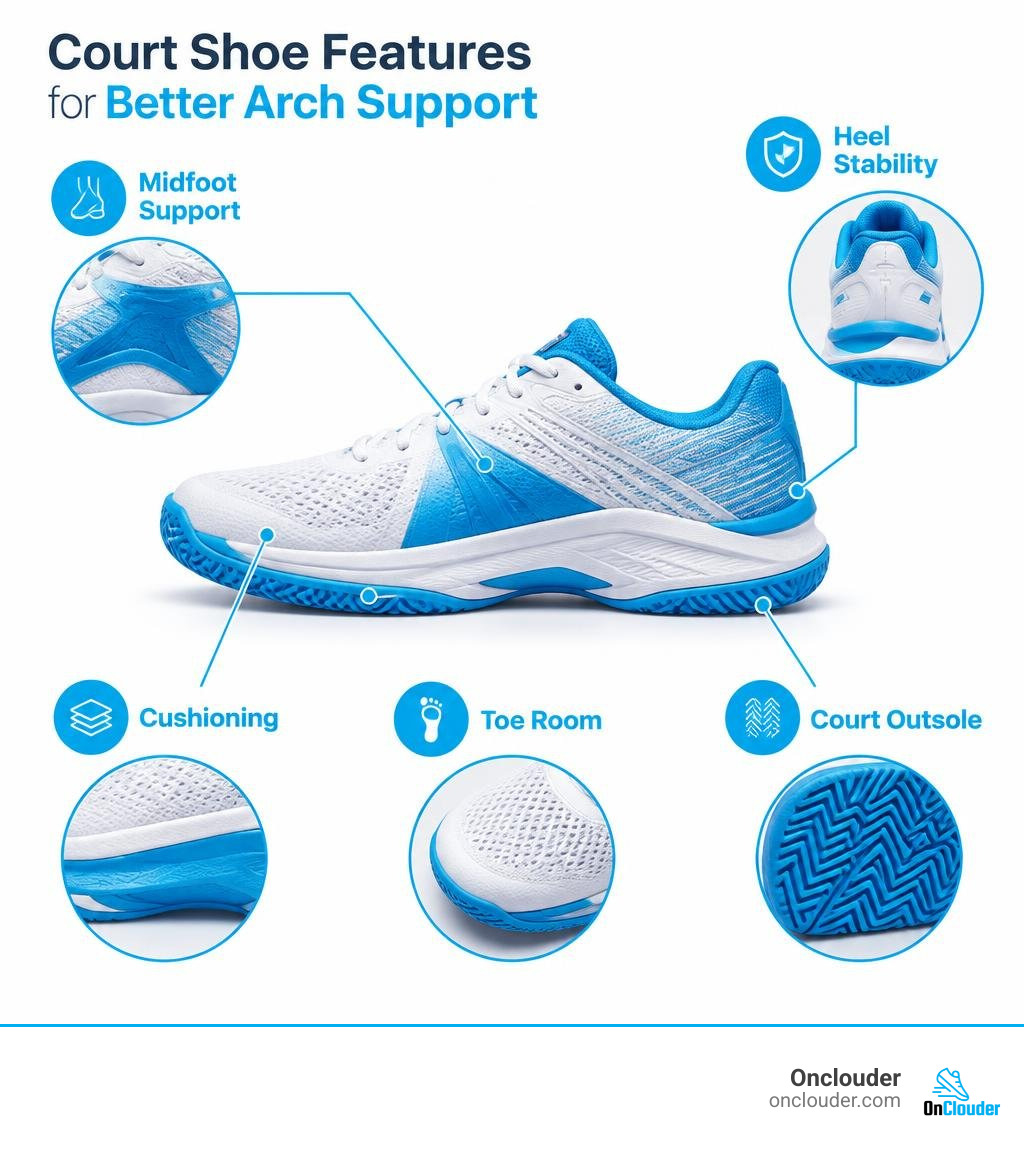
Key Features to Look for in Arch Support Tennis Shoes
When shopping for high-performance court footwear, you cannot simply pick an everyday running shoe and call it a day. The lateral cutting, sliding, stopping, and explosive pivoting required in racquet sports place extreme biomechanical demands on the midfoot and plantar fascia. Finding the right pair means understanding the fundamental features of supportive footwear designed specifically for tennis courts.
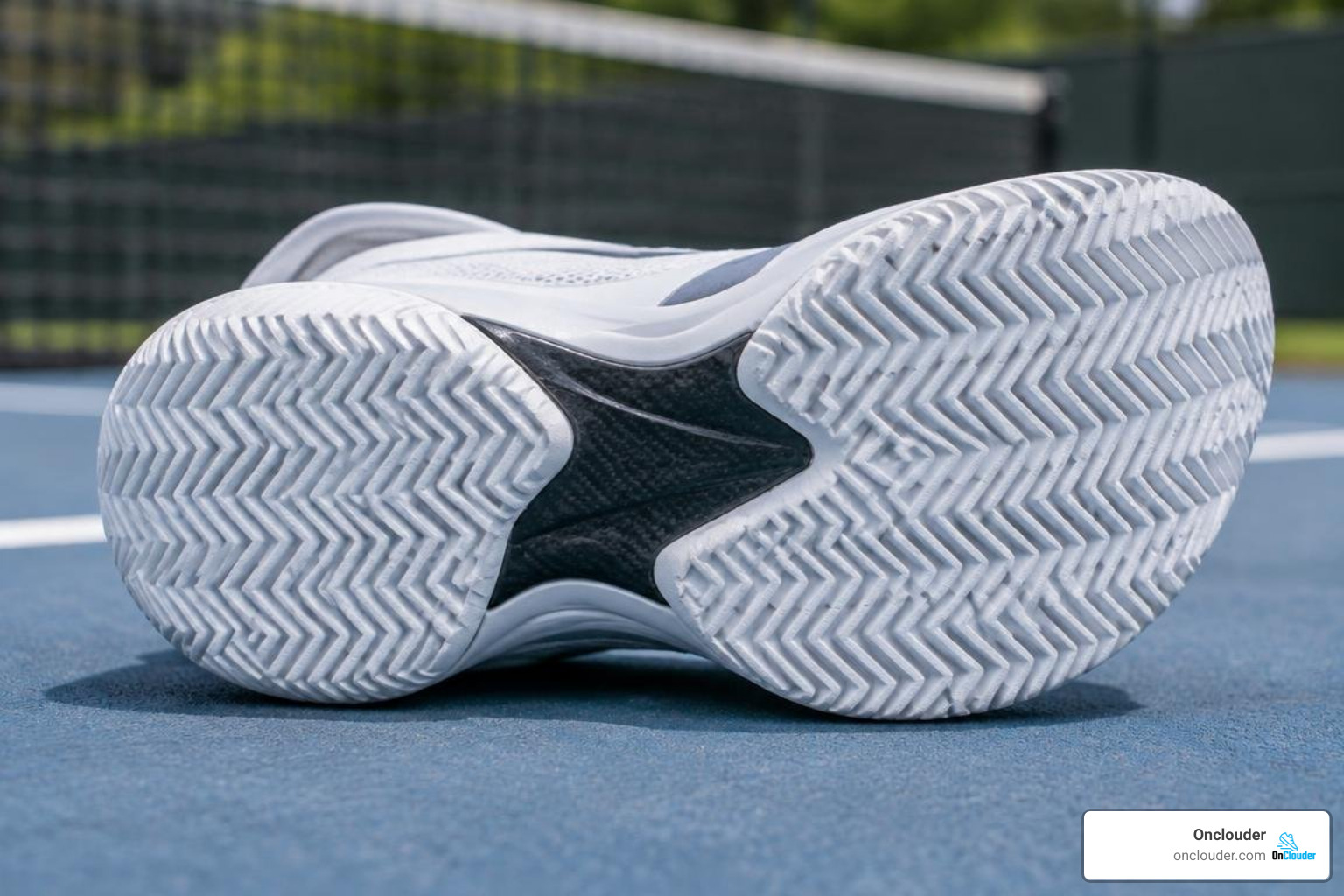
The primary component of any reliable court shoe is a rigid or semi-rigid midfoot shank. Unlike running shoes that flex freely right in the middle, a tennis shoe must resist twisting when you change direction. Midfoot shanks—often made from dense thermoplastic polyurethane (TPU) or carbon composite materials—bridge the gap between your heel and forefoot, keeping your arch from collapsing downward or twisting outward under load.
Key structural elements to evaluate include:
- Torsional Rigidity: The shoe should resist being wrung out like a wet towel. If you can easily twist the sole in opposite directions, it lacks the torsional control needed to protect your arches during lateral lunges.
- Medial and Lateral Stability Systems: Raised midsole sidewalls, outriggers, and reinforced heel counters prevent your foot from rolling over the shoe’s footbed during aggressive side-to-side slides.
- Anatomical Footbeds: Contoured insoles distribute your body weight evenly across the entire surface of the footbed rather than concentrating pressure on the heel and ball of the foot.
- Surface-Specific Outsoles: Durable rubber compounds (such as modified herringbone patterns) ensure high-traction grip on hard, clay, or indoor surfaces without allowing dangerous sticking that can torque your lower joints.
Cushioning Systems vs Midfoot Torsion Control
A common misconception among players is that maximum softness equals maximum arch support. In reality, soft foam without structural reinforcement can destabilize the foot. Tennis players require a balance between shock absorption and structural midfoot control.
High-impact hard courts generate ground reaction forces multiple times your body weight with every sudden split-step and sprint. Cushioning materials—such as molded EVA, responsive polyurethane midsoles, and proprietary gel or air systems—attenuate these shock waves before they travel up your kinetic chain. However, you also need firm midfoot components to keep the foot stable. Learning about the materials for high arch support can help you identify models that blend firm structural reinforcement with plush landing pads.
Orthopedic Tennis Sneakers vs Standard Court Shoes
While standard performance tennis shoes prioritize low-to-the-ground speed and lightweight agility, orthopedic sneakers prioritize joint alignment, pressure relief, and therapeutic roominess.
Orthopedic court designs often incorporate extra vertical depth, removable anatomical insoles, ergonomic rocker soles to assist your natural gait, and anatomical toe boxes that prevent bunion and toe friction. Standard tennis shoes, by contrast, tend to have tapered toe boxes and low-profile midsoles tailored for maximum court feel.
| Feature Category | Orthopedic Tennis Sneakers | Standard Performance Court Shoes |
|---|---|---|
| Midsole Depth | Extra depth accommodating custom orthotics | Low-to-the-ground profile for court feel |
| Arch Construction | Built-in anatomical contours + booster inserts | Integrated torsional TPU/carbon shanks |
| Toe Box Profile | Relaxed, anatomical width (D to 6E widths) | Snug, performance-tapered fit (Standard D) |
| Sole Dynamics | Mild rocker profile for joint load reduction | Flat, lateral outriggers for sharp edging |
| Target Use | Foot pain relief, recovery, hybrid daily wear | Tournament play, maximum speed, agility |
Advanced Arch Technologies and Podiatric Support Systems
Modern court footwear utilizes advanced structural engineering to protect player arches during intense rallies. Podiatrists and footwear developers collaborate to build advanced midsoles capable of managing multi-directional stress. Exploring the engineering behind arch fit footwear reveals how integrated technologies relieve foot fatigue over hours of continuous play.
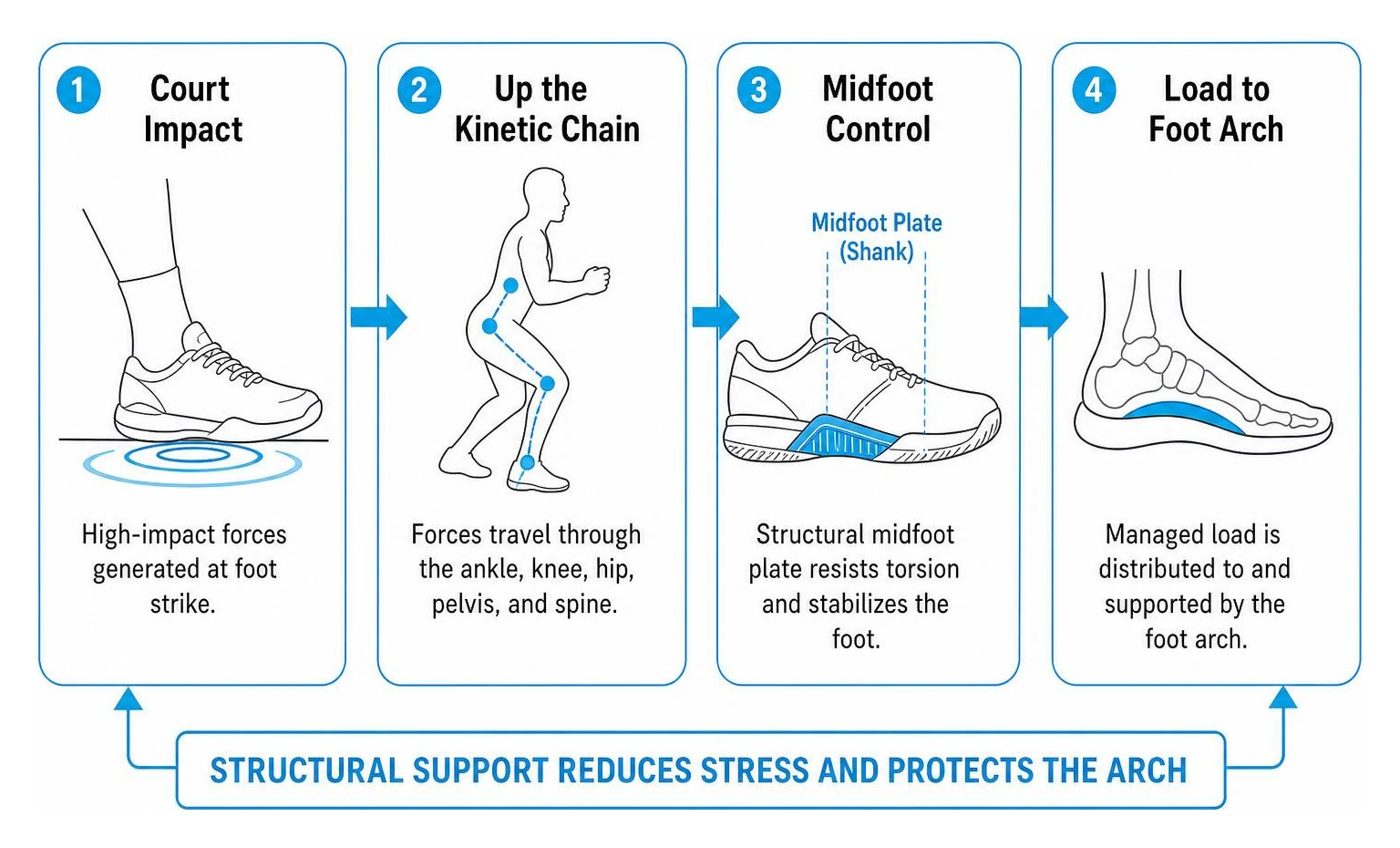
Midfoot Plates and Structural Shanks for Court Stability
Leading tennis shoe designs use structural midfoot plates to bridge the heel-to-toe transition. For example, the Yonex Sonicage Plus Men’s Tennis Shoes feature a lightweight Power Graphite plate engineered into the midfoot. Weighing just 310 grams (10.9 oz for a size 26.0 cm shoe), this shoe uses its graphite plate to stabilize the arch during prolonged rallies, reducing secondary fatigue and strain on the knees and hips.
Similarly, the Yonex POWER CUSHION AD-ACCEL (priced at $130.00) integrates POWER CUSHION+ technology with an ACCEL BOOSTER shank. This combination absorbs impact energy and returns it upward for explosive lateral recovery while locking the midfoot in place. High-performance models like the Asics Gel-Resolution series (regularly priced up to $179.95, frequently on sale between $119.95 and $139.95) and the premium Diadora B.Icon 3 All Ground ($180.00) also deploy rigid external stability chassis that cradle the arch during hard braking.
Anatomical Orthotics and Custom-Moldable Footbeds
For players managing acute foot conditions, standard foam sockliners often fall short. Orthopedic-focused athletic models solve this with modular insole systems. The Orthofeet Lava Athletic Shoe (available in sizes 7–15 and widths up to 4E) includes an anatomical orthotic insole along with a removable Arch Booster insert for customizable elevation. It also comes with heat-moldable inserts (an $80 value included free), allowing players to achieve a tailored, semi-custom footbed.
For players seeking to upgrade their existing court shoes, customizing with supportive inserts offers a practical way to add targeted arch cradling and deep heel cups to standard factory footbeds.
Matching Arch Structure to Common Foot Conditions
Every foot is distinct, and choosing the right tennis footwear depends on understanding your specific arch profile and its biomechanical tendencies.
Best Arch Support Tennis Shoes for High Arches and Plantar Fasciitis
High arches (pes cavus) naturally have a smaller ground-contact area, concentrating high pressure onto the heel pad and metatarsal heads. Because rigid high arches absorb shock poorly, the repetitive impact of hard-court tennis can strain the plantar fascia. Players dealing with heel pain should look for deep heel cups, ample under-arch fill, and targeted cushioning, as outlined in our guide on court shoes for plantar fasciitis.
Conversely, low arches and flat feet (pes planus) often lead to overpronation, where the ankle rolls inward during lateral movements. Flat-footed athletes benefit from sturdy medial posting, rigid midfoot shanks, and firm arch cradles. Exploring supportive sneakers for flat feet can help overpronators choose shoes that resist medial collapse.
Wide and Extra-Wide Width Solutions for Sensitive Feet
Squeezing wide feet into narrow court shoes pinches the metatarsals, restricts natural toe splay, and can cause painful arch cramps. Players with broader feet or bunions require dedicated wide-width models rather than simply sizing up in standard widths.
The Orthofeet Edgewater Stretch Knit Sneaker addresses this by offering widths up to extra-extra wide (6E) in a design weighing just 12.5 ounces. Its stretchable upper accommodates forefoot swelling, while a 4-ply heel counter and Ergonomic-Stride sole keep the midfoot securely aligned. Similarly, the Babolat SFX 4 All Court (frequently discounted from $109.00 to around $76.30) is built on a broader last to give wide-footed players generous forefoot volume without sacrificing midfoot lockdown.
Top-Rated Tennis and Court Shoes for Men and Women
Finding the best pair involves balancing arch support, lateral stability, overall weight, and durability. Here is a comparison of top-rated court shoes across price points and support categories:
| Model | Weight | Primary Support Tech | Widths Available | Best For | Price Point |
|---|---|---|---|---|---|
| Yonex POWER CUSHION AD-ACCEL | ~11.8 oz | POWER CUSHION+ & ACCEL BOOSTER Shank | Standard (D) | Aggressive speed & explosive cuts | $130.00 |
| Yonex Sonicage Plus | 10.9 oz (310g) | Power Graphite Midfoot Plate | Wide (4.5E) | Lightweight arch comfort for wide feet | ~CA$159.99 |
| Skechers Viper Court Pro | ~13.5 oz | Podiatrist-certified Arch Fit footbed | Medium (D), Extra Wide | Hard-court durability & knee relief | $115.00 |
| Orthofeet Lava Athletic Shoe | ~13.0 oz | Orthotic insole + modular Arch Booster | Medium (D) to Extra-Wide (4E) | Plantar fasciitis & custom orthotics | $146.95 |
| Orthofeet Edgewater | 12.5 oz | Ergonomic-Stride™ + 4-ply heel counter | D, 2E, 4E, up to 6E | Broad feet, bunions & all-day wear | $146.95 |
| Babolat SFX 4 All Court | ~13.8 oz | Multi-layer comfort insole & wide last | Wide Fit | Roomy forefoot & plush landing | $76.30 – $109.00 |
| Diadora B.Icon 3 All Ground | ~14.1 oz | CCB medial stabilizer & DD Anima foam | Standard (D) | Premium responsive court stability | $180.00 |
Top-Rated Arch Support Tennis Shoes for Men
Men’s court shoes must withstand aggressive lateral braking while keeping weight balanced across the sole. The Skechers Men’s Viper Court Pro (rated 4.4 out of 5 stars across 1,388 customer reviews at $115 USD) features a podiatrist-certified Arch Fit footbed combined with a Goodyear performance rubber outsole. Players frequently report that its balanced weight distribution and supportive arch cradle alleviate knee and foot pain during multi-hour matches on hard courts.

For men who want a shoe that transitions easily from practice sessions to daily recovery walks, exploring versatile arch fit shoes for active wear provides reliable, all-day stability.
High-Performance Supportive Court Footwear for Women
Women’s court shoes require distinct design considerations. On average, women possess a wider pelvic angle (Q-angle), which increases lateral forces on the knees and places greater stress on medial arch structures during sudden lateral stops.
Supportive women’s court shoes counter this by incorporating narrower heel counters to prevent slippage, firmer medial posts to limit excessive pronation, and tailored forefoot flex grooves. Reviewing women’s supportive shoe brands can help female athletes find models engineered to support these specific biomechanical requirements.
Transitioning from Court Play to All-Day Wear
Many recreational players wonder whether their court shoes can double as everyday walking sneakers. High-grade tennis footwear offers exceptional lateral stability and structured footbeds, but court-specific outsoles feature dense, abrasion-resistant rubber that can feel stiff on standard flooring.
If you plan to wear your shoes for both playing and daily errands, look for hybrid designs that feature breathable stretch uppers, shock-absorbing EVA midsoles, and non-marking outsoles. Models like the Orthofeet Edgewater and Lava excel in this role because their mild rocker soles and plush orthotic footbeds provide smooth heel-to-toe transitions whether you are serving on the court or walking on concrete.
Frequently Asked Questions About Tennis Shoes with Arch Support
Can you wear arch support tennis shoes all day for walking?
Yes, provided the shoes offer balanced cushioning and a natural heel-to-toe transition. While stiff tournament-level hard-court shoes may feel somewhat rigid for casual walking, hybrid court sneakers and orthopedic tennis models are well-suited for all-day wear, standing, and walking.
How do arch support court shoes reduce knee and hip pain?
Your feet form the foundation of your body’s kinetic chain. When arches collapse inward during lateral movements, your lower legs rotate internally, pulling the knees and hips out of their natural alignment. Arch support holds the midfoot in a neutral position, ensuring impact forces are distributed evenly across your joints rather than stressing the knees and lower back.
Why shouldn’t running shoes be used as tennis shoes on hard courts?
Running shoes are engineered exclusively for forward motion. They feature soft, flexible uppers and thick, elevated heels with minimal lateral support. Wearing running shoes on a tennis court increases the risk of rolling your ankle during side-to-side cuts. Furthermore, the abrasive grit of hard courts quickly shreds the softer blown rubber outsoles found on standard running footwear.
Conclusion
Finding the right arch support tennis shoes is an investment in your court performance, joint comfort, and long-term foot health. Whether you need a graphite-reinforced shank for quick lateral cuts, a wide-fitting stretch sneaker for sensitive feet, or a deep heel cup to calm plantar fasciitis, the ideal pair should lock your heel in place, stabilize your midfoot, and absorb hard-court shock.
At Onclouder, our hands-on testing focuses on helping you find footwear that keeps you active and pain-free. Explore our comprehensive footwear guide to compare top-rated supportive models and find the perfect fit for your game.