Understanding Overpronation and Gait Biomechanics
ASICS GT technology stabilizes inward ankle rolling by combining structured midsole geometries, LITETRUSS® medial support, and the 3D GUIDANCE SYSTEM™ to slow excessive pronation without rigid posts. These designs guide the foot through a more neutral stride while still allowing natural shock absorption.
During a standard gait cycle, our feet pass through three critical phases: initial contact (heel strike), midstance, and propulsion (toe-off). In a neutral stride, the foot naturally rolls inward about 15 percent to absorb shock and distribute weight evenly across the forefoot.
With overpronation, that inward foot roll becomes excessive. After the outer edge of the heel hits the pavement, the ankle twists inward and the arch collapses completely toward the ground. This creates heavy medial loading, forcing the inner edge of the foot, the big toe, and the second toe to handle almost all the propulsive force during push-off.
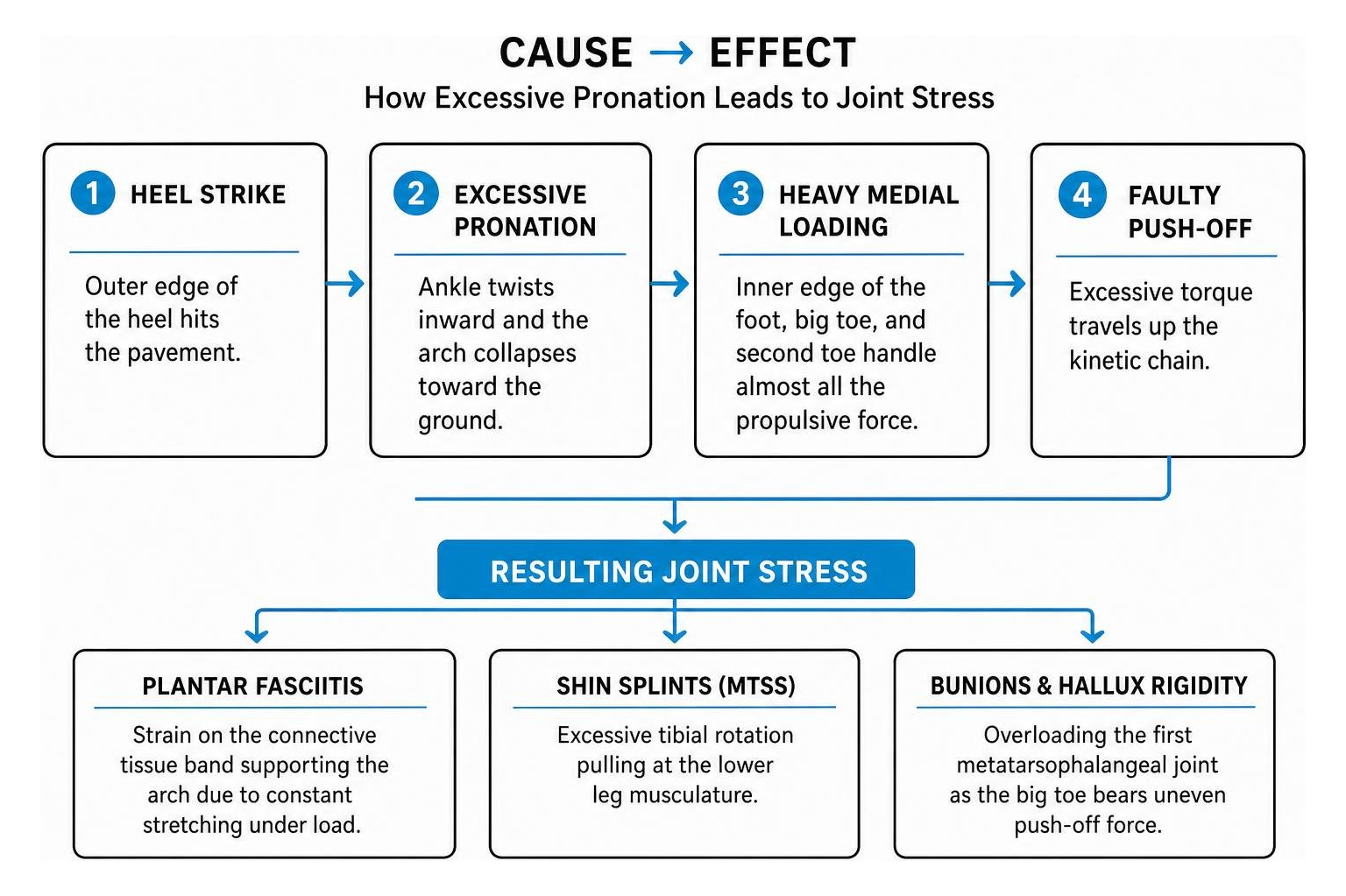
This faulty push-off mechanic places immense torque on the kinetic chain. When we dive into the biomechanics of running with overpronation, we regularly see this repetitive stress manifest as:
- Plantar Fasciitis: Strain on the connective tissue band supporting the arch due to constant stretching under load.
- Shin Splints (MTSS): Excessive tibial rotation pulling at the lower leg musculature.
- Bunions & Hallux Rigidity: Overloading the first metatarsophalangeal joint as the big toe bears uneven push-off force.
- Patellofemoral Pain Syndrome: Inward knee collapse driven by internal tibial rotation.
While low arches and flat feet are strongly correlated with overpronation, arch height alone is not the sole factor. Dynamic movement under fatigue often causes even moderate arches to collapse mid-run, making dedicated medial stability crucial.
Evolution of Stability Tech: DuoMax, LITETRUSS, and 3D GUIDANCE SYSTEM
For decades, the standard recipe for stability was simple: glue a piece of rock-hard, high-density gray foam under the medial arch. ASICS built its reputation on this method before completely transforming how stability shoes for runners guide your stride.
1. The DuoMax & Dynamic DuoMax Era
The traditional DuoMax® Support System utilized a firm, dual-density midsole positioned directly beneath the arch and heel. Dynamic DuoMax evolved this by angling the firmer medial post to blend more smoothly into the lighter FlyteFoam base. While remarkably effective at physically blocking inward collapse, it could sometimes feel rigid and intrusive underfoot.
2. LITETRUSS Integration
To reduce weight and eliminate abrupt density transitions, ASICS engineered LITETRUSS®. This design merged the medial post with the midfoot Trusstic shank into a single, cohesive unit along the inside angle of the midsole. It prevented arch collapse while maintaining a fluid heel-to-toe transition.
3. Modern 3D GUIDANCE SYSTEM™
Representing the latest leap in biomechanical engineering, the 3D GUIDANCE SYSTEM™ replaces rigid wedges with holistic platform geometry:
- Wider Base Nets: Broader platforms at the heel and forefoot provide passive stability.
- Lateral Beveling & Medial Flaring: Strategic midsole shaping slows the rate of inward roll naturally.
- Adaptive Foam Deformation: Combining softer PureGEL™ (which delivers 65% softer impact absorption than legacy GEL) with resilient FF BLAST™ PLUS foam allows the platform to cushion impact while resisting medial collapse purely through geometric design.
The ASICS GT Pronation Lineup: GT-1000, GT-2000, GT-3000, and GT-4000 Compared
Finding the best stability running shoes in 2026 requires matching your arch flexibility, running surface, and correction level to the right model in the lineup.
| Feature / Model | ASICS GT-1000 Series (e.g., 12 TR / 15) | ASICS GT-2000 Series (e.g., 13) | ASICS GT-3000 5 (Legacy) | ASICS GT-4000 4 |
|---|---|---|---|---|
| Target Runner | Mild overpronators & neutral runners | Mild-to-moderate overpronators | Late-stage overpronators | Severe overpronators & flat feet |
| Stability Tech | LITETRUSS® / 3D GUIDANCE SYSTEM™ | 3D GUIDANCE SYSTEM™ | Extended Dynamic DuoMax® | LITETRUSS® + Medial Support |
| Cushioning Tech | FLYTEFOAM® / FF BLAST™, PureGEL™ | FF BLAST™ PLUS, PureGEL™ | FluidRide® 2.0, Rearfoot GEL® | FF BLAST™, PureGEL™ |
| Heel Drop | 8 mm | 8 mm | 10 mm | 8 mm |
| Weight (Men’s 9) | 276 g – 278 g (9.7 – 9.8 oz) | 280 g (9.9 oz) | 310 g (10.9 oz) | 307 g (10.9 oz) |
| Best Surface | Road, light trails (TR version) | Paved roads, track, treadmill | Paved roads | Paved roads, walking paths |
| Arch Support | Low to medium | Low to medium | Low arches / flat feet | Very low / flat feet |
GT-1000 Series: Affordable Road-to-Trail ASICS GT Pronation Balance
The GT-1000 series delivers dependable, accessible stability without a premium price tag. In models like the GT-1000 12 TR, ASICS blends stability features with hybrid versatility.
- Weight & Geometry: Weighing in at 276 g (9.7 oz) with an 8 mm heel drop, it feels nimble underfoot.
- Dual-Surface Traction: The “TR” designation brings a specialized hybrid lugged outsole suited for transitioning seamlessly from asphalt to packed dirt paths.
- Support & Cushioning: Utilizing medial LITETRUSS® technology and lightweight FLYTEFOAM®, it offers gentle correction that serves both mild overpronators and neutral runners looking for extra support during late-run fatigue.
GT-2000 Series: Everyday Mileage with Adaptive ASICS GT Pronation Tech
The GT-2000 has long been the daily training benchmark for serious mileage. In the GT-2000 13 ASICS TRACK CLUB edition, the series fully embraces adaptive support.
- Adaptive Guidance: By incorporating the 3D GUIDANCE SYSTEM™, the shoe stabilizes your foot on demand without feeling like a rigid splint.
- Ride & Rebound: High-energy FF BLAST™ PLUS foam works alongside a discreet PureGEL™ internal heel pad, keeping the weight down to 280 g (9.9 oz) at an 8 mm drop.
- Sustainable Build: Featuring an upper constructed from at least 50% recycled textiles, it offers a breathable, locked-in fit capable of handling 500+ miles of marathon preparation.
GT-3000 and GT-4000: Maximum Medial Correction and Late-Stage Support
For runners whose feet roll inward with greater intensity, standard stability shoes are often not enough.
The legacy GT-3000 5 (310 g, 10 mm drop) was uniquely engineered for late-stage overpronation—a condition where the foot remains collapsed all the way through the forefoot push-off. It addressed this with an Extended Dynamic DuoMax® post stretching deep into the forefoot, paired with a Stability Trusstic plate.
Modern heavy pronation control is championed by the GT-4000 4.
- Maximum Support: As one of the most structured shoes in the ASICS stable (307 g / 10.9 oz, 8 mm drop), it combines reinforced LITETRUSS® medial blocking with a wide, straight-lasted base.
- Medical Endorsement: It has earned the Seal of Acceptance from the American Podiatric Medical Association, standing alongside top podiatrist-approved stability shoes for runners managing flat feet or severe overpronation.
Generational Shift: Comparing GT-1000 9, GT-1000 12 TR, and GT-1000 15
Tracking the GT-1000 across its key iterations showcases the broader evolution of stability running footwear.
| Specification | ASICS GT-1000 9 | ASICS GT-1000 12 TR | ASICS GT-1000 15 |
|---|---|---|---|
| Weight | 275 g (9.7 oz) | 276 g (9.7 oz) | 278 g (9.8 oz) |
| Heel Drop | 8 mm | 8 mm | 8 mm |
| Medial Stability | Traditional DuoMax® dual-density foam | Medial LITETRUSS® integration | Geometric 3D GUIDANCE SYSTEM™ |
| Midsole Cushioning | FLYTEFOAM® + Visible Rearfoot GEL® | FLYTEFOAM® + Rearfoot GEL® | FF BLAST™ + PureGEL™ (internal) |
| Outsole Rubber | Standard AHAR® rubber | Hybrid Trail/Road AHAR® | AHARPLUS™ (3x standard durability) |
| Support Feel | Firm, noticeable medial post | Balanced, supportive midfoot | Smooth, adaptive, non-intrusive |
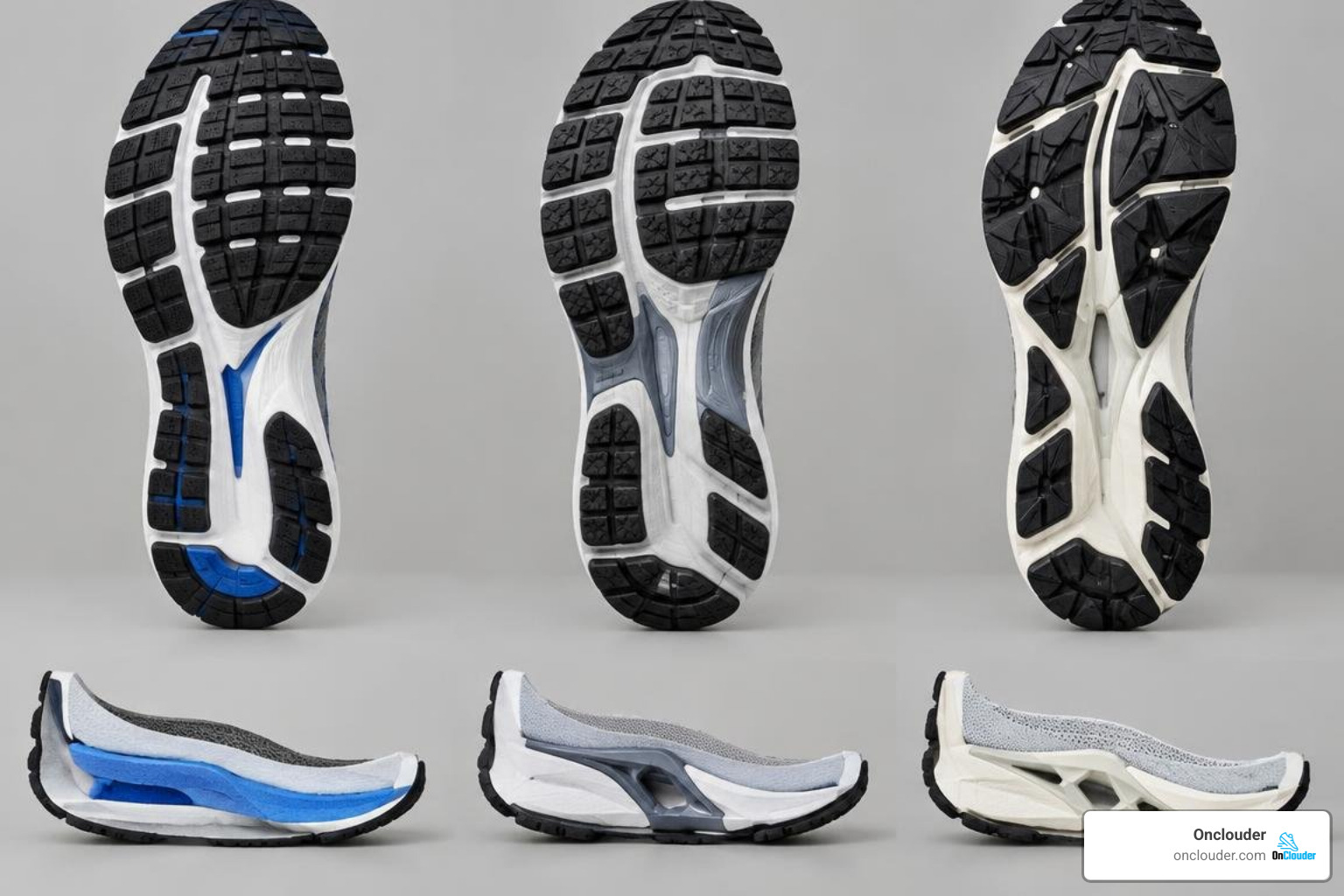
The classic GT-1000 9 relied on visible rearfoot GEL® pods and dual-density DuoMax® posting. While supportive, the transition through the gait cycle felt somewhat segmented.
Moving to the GT-1000 15, ASICS replaced firm posts with the adaptive 3D GUIDANCE SYSTEM™, internal PureGEL™, and high-durability AHARPLUS™ rubber. This shift provides natural medial correction without the stiffness of legacy stability running shoes.
Frequently Asked Questions About Stability Footwear
Can neutral runners wear ASICS GT stability shoes?
Yes, especially modern models equipped with the 3D GUIDANCE SYSTEM™ or LITETRUSS® (like the GT-1000 12 TR, GT-1000 15, and GT-2000 13). Because these newer platforms rely on geometry rather than rigid medial posts, they only engage support when your foot begins to roll inward. This makes them an excellent choice for neutral runners tackling longer distances, where fatigue often introduces late-run form breakdown.
What is the difference between late-stage overpronation and standard overpronation?
Standard overpronation occurs during midstance: the ankle rolls inward as the foot takes full body weight. Late-stage overpronation occurs much later in the gait cycle, continuing through propulsion where the arch remains collapsed and the big toe twists aggressively off the ground. Shoes like the GT-3000 5 were built with extended medial posting into the forefoot specifically to counter this late-stage collapse.
How do I choose between the GT-2000 and GT-4000?
Choose the GT-2000 if you have mild-to-moderate overpronation and want a lighter, livelier shoe (280 g) for daily training and tempo efforts. Choose the GT-4000 if you have flat feet, severe overpronation, or require substantial medical-grade stability (307 g) with a wide, structured platform that easily accommodates custom orthotics.
Conclusion
Understanding how different midsole designs address excessive inward rolling makes choosing the right stability shoe straightforward. The ASICS GT lineup provides a clear path forward for every level of pronation support:
- GT-1000 Series: Lightweight, budget-friendly stability with road-to-trail versatility for mild overpronators and neutral runners.
- GT-2000 Series: The daily mileage standard, blending adaptive 3D guidance with plush FF BLAST™ PLUS cushioning.
- GT-4000 Series: APMA-accepted maximum medial control engineered for flat feet and severe overpronation.
Matching your specific arch mechanics to the appropriate support platform helps keep your joints aligned and your training consistent. For an in-depth breakdown of stability designs across various brands, check out our essential guide to best overpronation shoes.