Best Walking Tennis Shoes for Flat Feet: What Matters Most
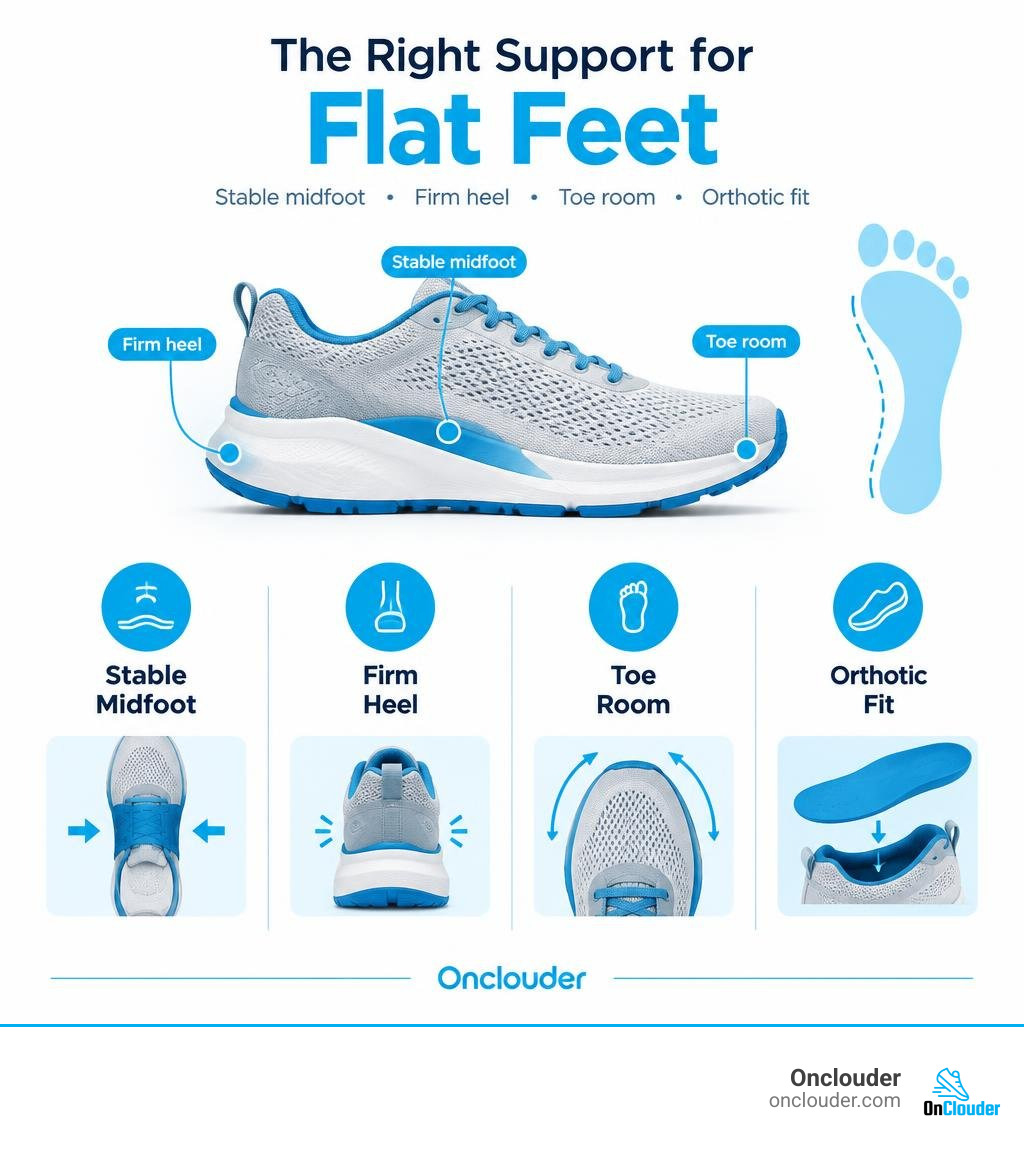
The best walking tennis shoes for flat feet have a stable midfoot, a firm heel, and enough room for your toes. Good options to try include the Brooks Addiction Walker, New Balance 847v4, Vionic Walker Classic, ASICS GT-2000, and HOKA Gaviota 5. The right one is the pair that feels secure and comfortable on your feet.
Flat feet do not always need the firmest shoe. Your choice depends on how much your feet roll inward and whether you use orthotics. This guide will help you compare shoes, check their support in the store, and find a fit that works for daily walks.
Whether you are clocking miles on neighborhood sidewalks or staying active on the court, your footwear dictates how your entire lower body feels. In fact, an active hour on a tennis court or a brisk walk can generate nearly 11,000 steps. That is a massive amount of cumulative impact transferred through your feet, ankles, knees, and lower back. Finding supportive footwear is essential to prevent chronic pain and maintain long-term mobility.
Key Features of the Best Walking Tennis Shoes for Flat Feet
When shopping for flat-foot footwear, soft cushioning alone is not enough. Shoes that feel like stepping onto a giant, squishy marshmallow often lack structural integrity. When a shoe collapses under your weight, your arch collapses right along with it.

To protect fallen arches, look for these foundational elements:
- Torsional Rigidity: The shoe must resist twisting through the midfoot.
- Firm Heel Counter: A stiff cup behind your heel keeps your rearfoot locked in a neutral alignment.
- Anatomical Arch Contouring: The midsole should actively fill the space under your medial arch to prevent inward rolling.
- Generous Toe Box: Flat feet naturally splay wider upon ground impact, requiring ample forefoot volume.
Exploring our dedicated breakdown of walking shoes for flat feet highlights how structured midsoles prevent joint fatigue during everyday wear.
Biomechanics of Flat Feet and Overpronation
Flat feet (pes planus) occur when the arches on the inside of the feet are flattened, allowing the entire sole to touch the floor when standing. When you take a step, your foot naturally pronates—rolling slightly inward to absorb shock.
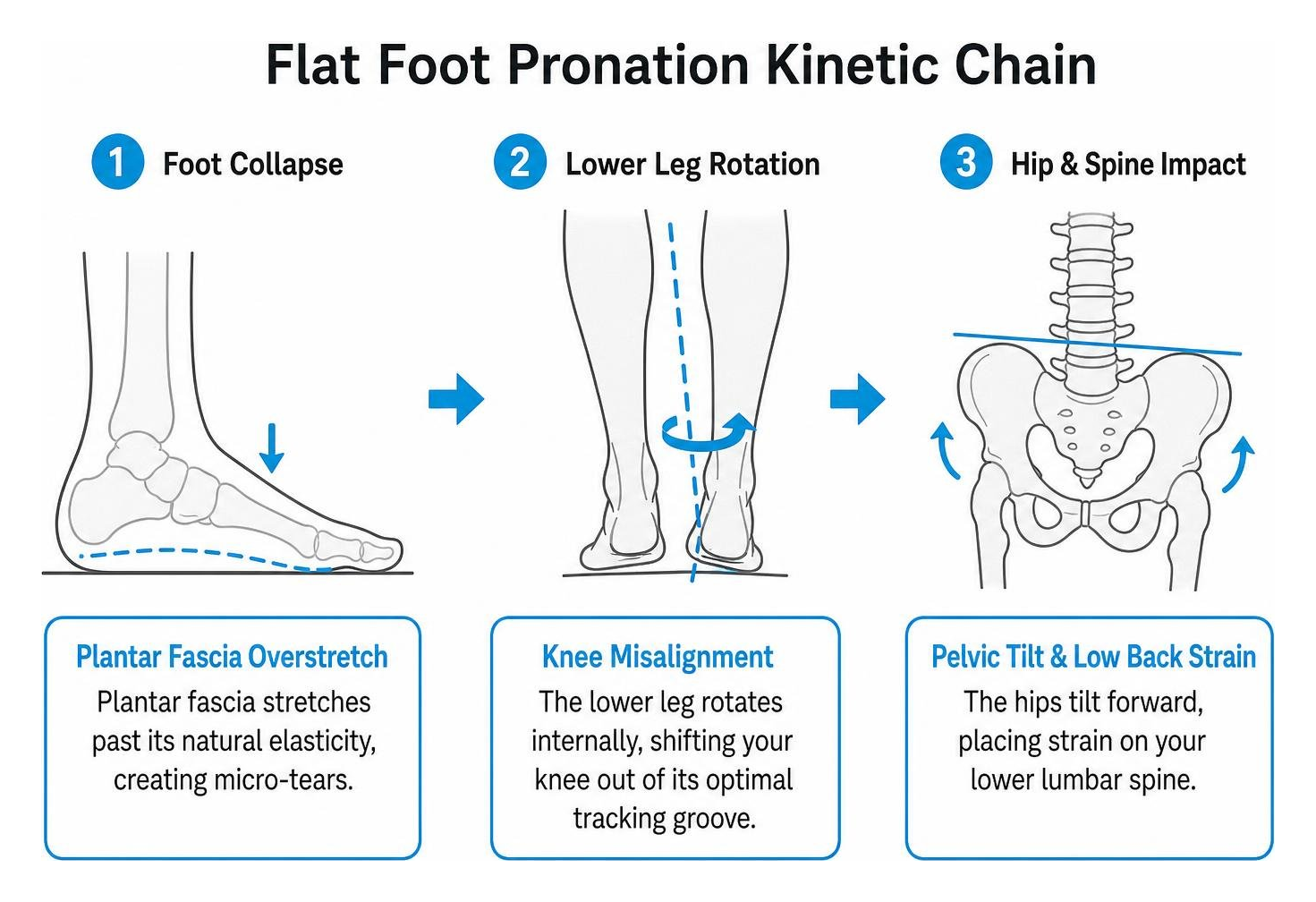
When an arch has structural deficits, this motion becomes excessive overpronation. As your arch collapses toward the ground:
- The plantar fascia stretches past its natural elasticity, creating micro-tears.
- The lower leg rotates internally, shifting your knee out of its optimal tracking groove.
- The hips tilt forward, placing strain on your lower lumbar spine.
Without proper support, overpronation can trigger plantar fasciitis, shin splints, and joint pain. Selecting shoes with integrated arch support for plantar fasciitis provides the structural foundation needed to maintain healthy kinetic chain alignment.
Essential Construction: Midsole Density and Upper Support
Modern footwear relies on specialized construction techniques to control excess motion without feeling stiff or heavy.
- Dual-Density Midsoles & Medial Posting: Brands embed firmer EVA foam or plastic shanks along the inner edge (medial side) of the midsole. This firmer compound acts as a physical barrier that slows inward roll.
- Polyurethane vs. Compression-Molded EVA: Polyurethane midsoles provide long-lasting stability that resists bottoming out over high mileage, while modern engineered EVA offers balanced shock absorption.
- Reinforced Lateral Uppers: Court-inspired walking tennis shoes feature supportive overlays and reinforced knit booties that hug your foot securely, preventing your foot from sliding off the footbed during side-to-side steps.
For an extensive review of motion-management engineering, consult our guide to overpronation footwear solutions.
Top Podiatrist-Recommended Walking Tennis Shoes for Flat Feet
Foot health professionals consistently recommend models that balance rigid control mechanisms with responsive cushioning. Podiatrist recommendations, such as those found on the Recommended Shoe List – Entire Podiatry, frequently highlight structured, motion-controlling designs.
| Shoe Model | Stability Level | Cushioning Profile | Best For | Standout Feature |
|---|---|---|---|---|
| Brooks Addiction Walker | Maximum Motion Control | Dense, Durable EVA | Severe overpronation & all-day standing | Extended Progressive Diagonal Rollbar (PDRB) |
| New Balance 847v4 | High Stability | Balanced Foam Core | Wide feet & custom orthotic users | ROLLBAR stability post system |
| Vionic Walker Classic | Built-in Orthotic Control | Firm Anatomical Support | Immediate arch realignment | Integrated Orthaheel technology |
| ASICS GT-2000 | Moderate Stability | FlyteFoam & GEL Cushioning | Brisk fitness walking & mild pronation | 3D Guidance System for smooth transitions |
| HOKA Gaviota 5 | Max Stability / High Plush | High-Stack Soft Foam | Joint protection & long distances | J-Frame™ / H-Frame medial support |
How to Choose the Best Walking Tennis Shoes for Flat Feet for Daily Walking
Selecting the ideal pair involves balancing walking volume, daily routines, and foot shape:
- For High-Mileage Pavement Walking: Choose shoes with durable rubber outsoles and balanced shock absorption, such as the ASICS GT-2000 or HOKA Gaviota 5.
- For All-Day Standing & Workplace Shifts: Look for dense, supportive polyurethane midsoles like those in the Brooks Addiction Walker or New Balance 847v4, which do not degrade under constant body weight.
- For Court Play Combined with Walking: Classic court-inspired models reviewed in resources like The Best Tennis Shoes 2021: Nike, New Balance, Adidas, K-SWISS, Asics emphasize rigid lateral outriggers and reinforced toe caps that withstand abrasive court surfaces.
If you are looking to cover serious ground, see our best walking shoes long distance guide for tips on keeping your feet fresh.
Motion Control vs. Cushion Neutral for Fallen Arches
Understanding shoe categories ensures you pick the right level of correction for your specific gait pattern:
- Maximum Motion Control Shoes: Built on straight lasts with broad bases, firm medial posts, and rigid heel counters. These are engineered specifically for low or collapsed arches that overpronate heavily.
- Moderate Stability Shoes: Utilize guide rails or subtle dual-density foams to gently steer the foot without aggressively blocking natural movement.
- Cushion Neutral Shoes: Designed with uniform midsole density and high flexibility. While great for high, rigid arches or supinated gaits, neutral shoes typically allow flat feet to collapse inward, causing joint fatigue.
Review the ultimate 2026 walking shoe guide for a detailed comparison across all support categories.
Practical Testing, Orthotics, and Specialized Foot Care
You do not need laboratory equipment to assess whether a shoe provides adequate structure for your flat feet.
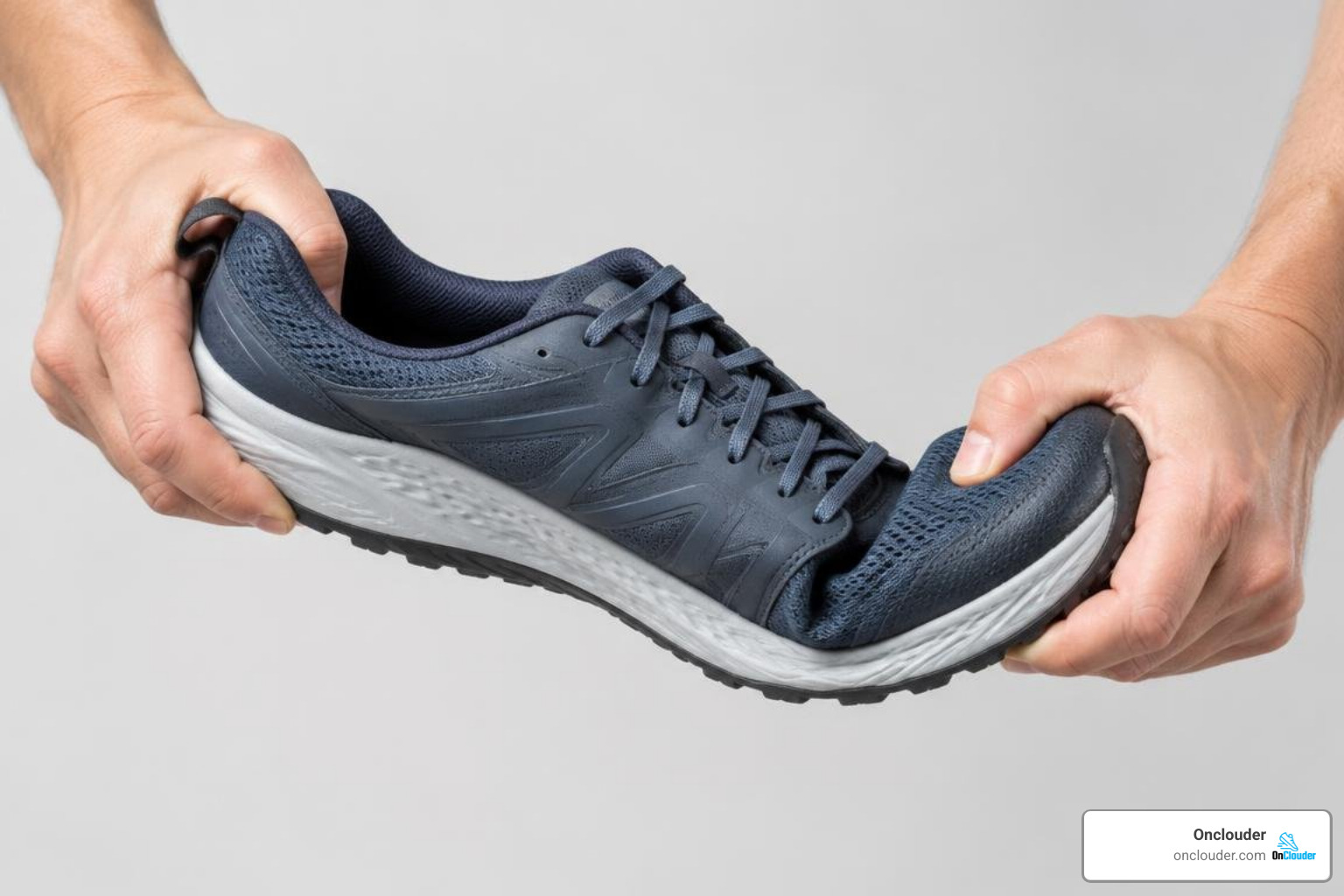
How to Test Shoe Stability Before Buying
Whenever you try on a prospective pair of walking or tennis shoes, perform these three physical checks:
- The Torsional Twist Test: Grasp the heel with one hand and the toe box with the other. Try to wring the shoe like a wet towel. A supportive shoe will resist twisting through the middle. If it wrings easily, it lacks the midfoot shank needed for flat feet.
- The Forefoot Bend Test: Push the toe upward toward the heel. The shoe should bend only at the ball of the foot where your toes naturally flex. If it folds in half directly under the arch, put it back on the shelf.
- The Heel Counter Squeeze: Pinch the sides of the heel collar with your thumb and forefinger. It should feel firm and rigid, not soft and collapsible.
For more real-world testing advice from everyday walkers, check out the best arch support shoes according to reddits most opinionated walkers.
Accommodating Custom Orthotics and Diabetic Foot Needs
Many walkers with flat feet use custom medical orthotics or over-the-counter inserts.
- Removable Insoles: Ensure the shoe features a fully removable factory footbed so your custom orthotic sits flush on the midsole base without raising your heel out of the shoe.
- Depth and Volume: Look for shoes marked as having “extra depth” to accommodate high-profile orthotic posting without pinching your instep.
- Diabetic Foot Care: Individuals managing diabetes alongside flat feet must prioritize seamless interiors, soft linings like plastizote, and pressure-offloading inserts. These features eliminate friction points, prevent blisters, and protect sensitive areas from ulceration.
To learn more about pairing over-the-counter supports with supportive footwear, read our guide to the ultimate guide to arch pads for flat feet and pronation.
How to Select the Best Walking Tennis Shoes for Flat Feet by Brand and Fit
Fit is just as critical as construction. A properly structured shoe in the wrong width will fail to support your arch correctly.
Optimal Fitting Strategies and Durability Milestones
Follow these best practices to ensure your walking shoes perform well over time:
- Shop Late in the Day: Feet naturally swell by up to half a shoe size after hours of walking and standing. Fitting shoes in the late afternoon ensures you will not buy a pair that feels tight during long walks.
- Choose Technical Socks: Avoid pure cotton socks, which absorb and hold sweat against your skin. Instead, choose moisture-wicking synthetic or merino wool blends to reduce friction and blister risks.
- Track Midsole Life: Even if the rubber outsole shows minimal wear, typical EVA cushioning degrades after 300 to 500 miles (or roughly 6 to 8 months of regular walking). Once the medial support compresses permanently, your flat feet will begin to overpronate again.
Check our roundup of top sneakers with arch support designed specifically for flat feet to find the ideal width and volume profile for your feet.
Frequently Asked Questions About Walking Tennis Shoes for Flat Feet
Can I wear court tennis shoes for everyday walking with flat feet?
Yes, court-specific tennis shoes work well for everyday walking because they are built with stiff lateral counters, firm torsional shanks, and durable outsoles. However, true running or walking shoes provide a smoother heel-to-toe rocker transition for straight-line fitness walking.
How do I know if my walking shoes have enough arch support for flat feet?
If a shoe has adequate arch support, your foot should feel evenly planted across the sole without excessive pressure on the inner ball of your foot. If you experience aching along the bottom of your feet, shins, or knees after a short walk, the shoe likely flexes too much through the midfoot.
Do all flat feet require maximum motion control shoes?
No. Flat feet exist on a spectrum. A “flexible flat foot” that collapses only during weight-bearing often benefits from moderate stability or structured cushioning. A “rigid flat foot” that lacks an arch even when non-weight-bearing may need softer cushioning and custom orthotics to redistribute pressure rather than rigid medial posts.
Conclusion
Finding the right footwear for flat feet comes down to stability, torsional stiffness, and proper fit. Moving away from overly flexible shoes in favor of models with firm heel counters, supportive midfoot shanks, and wide toe boxes will keep your lower body comfortable and aligned.
At Onclouder, we test shoes across daily walking and athletic activities to help you find the right fit for your feet. For a complete look at supportive footwear options, explore our comprehensive the ultimate guide to best shoes with arch support and keep every step pain-free.