Are Archline Orthotic Insoles Worth Trying?
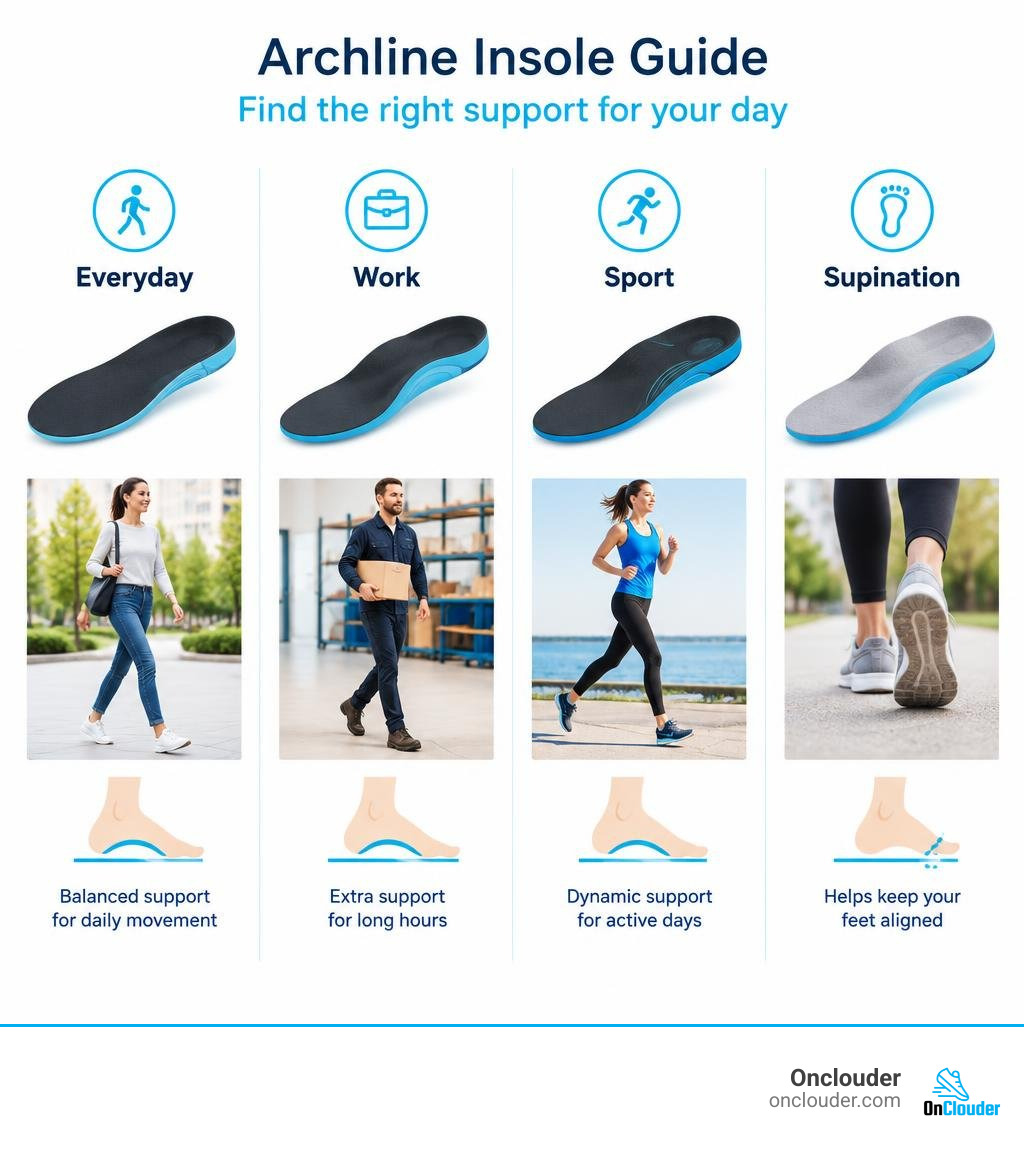
Archline orthotic insoles are a reasonable option if you want more arch support than a basic cushioned insert. The Balance model is the everyday starting point. Work Active is built for long shifts, Sport Active for exercise, and Supination for feet that roll outward. Their contoured arches and heel cups may improve comfort, but they are not a guaranteed fix for foot pain.
The best choice depends on your foot shape, activity, and shoe fit. This review looks at those differences so you can choose support that suits your day, not just the strongest-sounding insole.
Archline orthotic insoles word list:
What Are Archline Orthotic Insoles and How Do They Work?
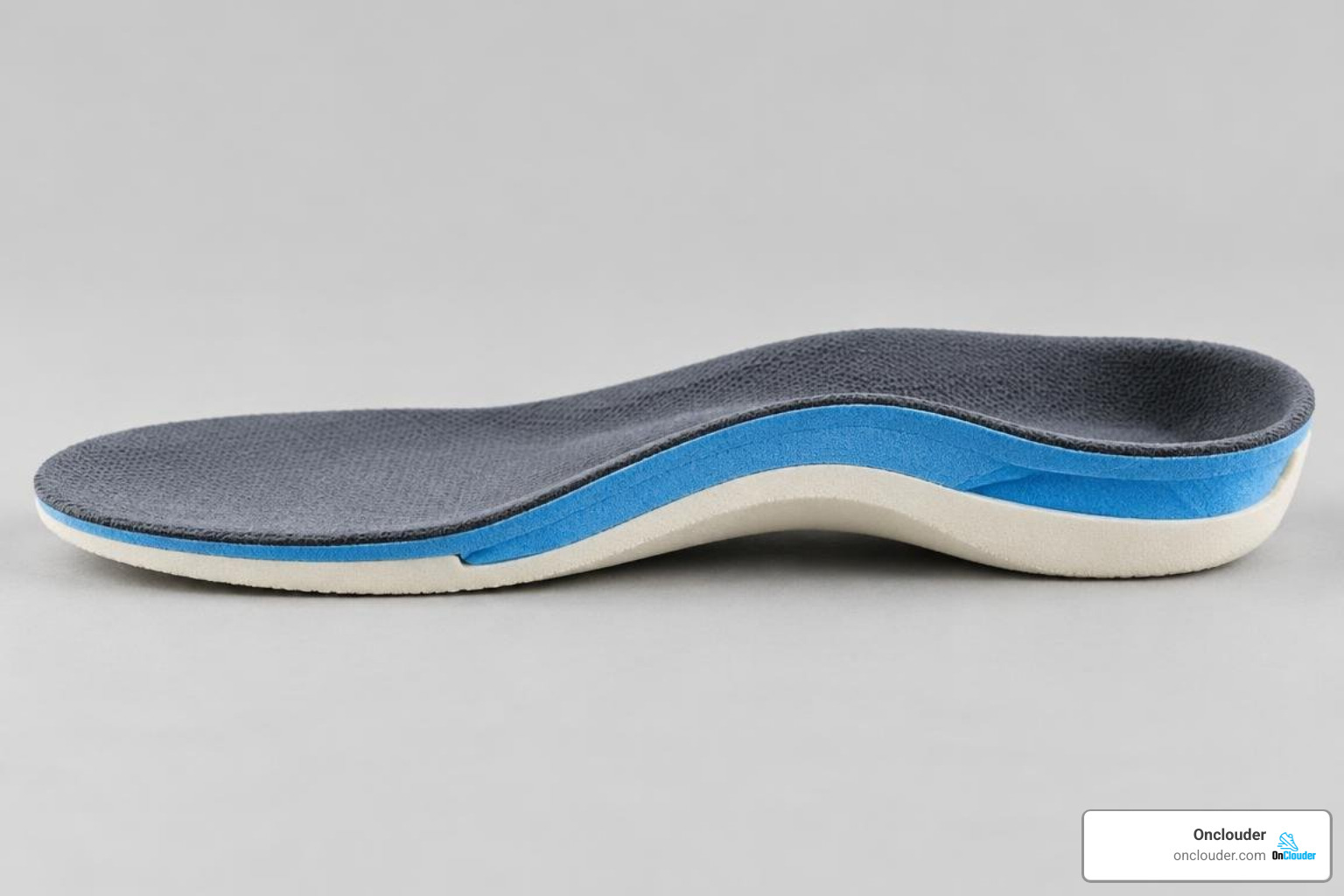
When we test over-the-counter footbeds, we look beyond simple foam cutouts. Most factory insoles included in casual or athletic shoes are flat foam liners designed solely for out-of-the-box step-in comfort. Archline orthotic insoles, developed under the Australian footcare brand Axign, are engineered as functional biomechanical devices rather than passive padding.
The core working principle behind these footbeds is structural load redistribution. When your foot strikes the ground, your medial longitudinal arch naturally lowers to absorb impact. If your foot overpronates (rolls excessively inward) or if you have a rigid, high arch that fails to disperse pressure, the plantar fascia and surrounding joints bear disproportionate mechanical strain. Archline addresses this by placing a pre-molded supportive bridge directly beneath the tarsal and metatarsal joints, paired with a stabilizing heel seat that centers your calcaneus (heel bone).
Biomechanical Design and Medical-Grade Construction
Archline models incorporate a multi-layered material build tailored to balance rigidity with daily step cushioning:
- Thermoplastic Supportive Shell: A contoured thermoplastic shank provides the primary biomechanical skeleton. It resists torsion and prevents the arch from flattening under body weight.
- 60° Shore Hardness EVA Base: The underlying chassis is crafted from flexible Ethyl Vinyl Acetate foam with a 60° Shore durometer rating. This density prevents bottoming out while absorbing rebound shock during repetitive strides.
- Ortholite Cushioning Mid-Layer: A breathable polyurethane open-cell foam layer delivers long-term rebound cushioning that resists compression fatigue over months of daily use.
- Antimicrobial Microfibre Top Cover: The upper lining manages internal shoe heat and wicks away sweat, preventing friction hotspots and combating odor build-up.
This dual-layer approach bridges the gap between ultra-rigid prescription devices and flimsy drugstore foam pads. The brand’s classification reflects this focus; the ARCHLINE trademark registration encompasses Class 10 (Medical Apparatus) alongside Class 25 (Clothing/Footwear), reflecting its clinical design heritage.
Podiatrist Recommendations and TGA Approval
A key differentiator for Archline in the ready-to-wear orthotic market is its regulatory status. In Australia, Archline insoles are listed as Class 1 Medical Devices approved by the Therapeutic Goods Administration (TGA).
Because they are developed in consultation with podiatrists, physiotherapists, and allied health professionals, these orthotics are widely stocked in clinical practices across Australia as an accessible intervention. While they do not replace customized carbon-fiber devices for severe structural deformities, comparing over-the-counter inserts vs custom orthotics shows that prefabricated medical-grade orthotics offer a cost-effective, clinically grounded option for common alignment-related aches.
Evaluating the Lineup: Which Archline Insole Fits Your Foot Type?
Not all feet require the same arch height, shell rigidity, or shock-absorption profile. Archline manufactures several distinct full-length and specialized configurations.
| Model | Target User / Foot Profile | Key Structural Features | Weight Guide | Approximate Price (AUD) |
|---|---|---|---|---|
| Balance Full Length | Neutral to flat feet, everyday walking | Thermoplastic shell, Ortholite foam, microfibre top | Under 110 kg | $39.95 |
| Work Active | Occupational use, safety boots, hard floors | Firmer TPU skeleton, deep heel cup with gel pad | Best for 110+ kg or heavy strain | $49.95 |
| Sport Active | High-impact running, dynamic athletics | High-density EVA base, high arch rebound | Best for 110+ kg or impact sports | $49.95 |
| Supination | High arches, underpronators, outer edge wear | Built-in lateral forefoot/rearfoot wedge | All weight classes | $41.95 |
| Met Dome | Forefoot pain, metatarsalgia, Morton’s neuroma | Integrated metatarsal mound for toe splay | All weight classes | $41.95 |
| Diabetic Arthritis | Sensitive soles, neuropathy, joint stiffness | Soft-contact top layer, gentle contouring | Under 110 kg | $39.95 |
| Slimline 3/4 | Low-profile dress shoes, non-removable insoles | Shortened length, thin profile, arch bridge | Under 110 kg | $39.95 |
| Balance Kids | Growing children, juvenile flat feet | Scaled pediatric arch support, flexible EVA | Children | $24.95 |
Archline Orthotic Insoles Balance for Everyday Support
The Balance Full Length is the brand’s flagship daily insert. It is specifically calibrated for users weighing under 110 kg who need reliable arch support in casual sneakers, running shoes, or everyday work shoes.
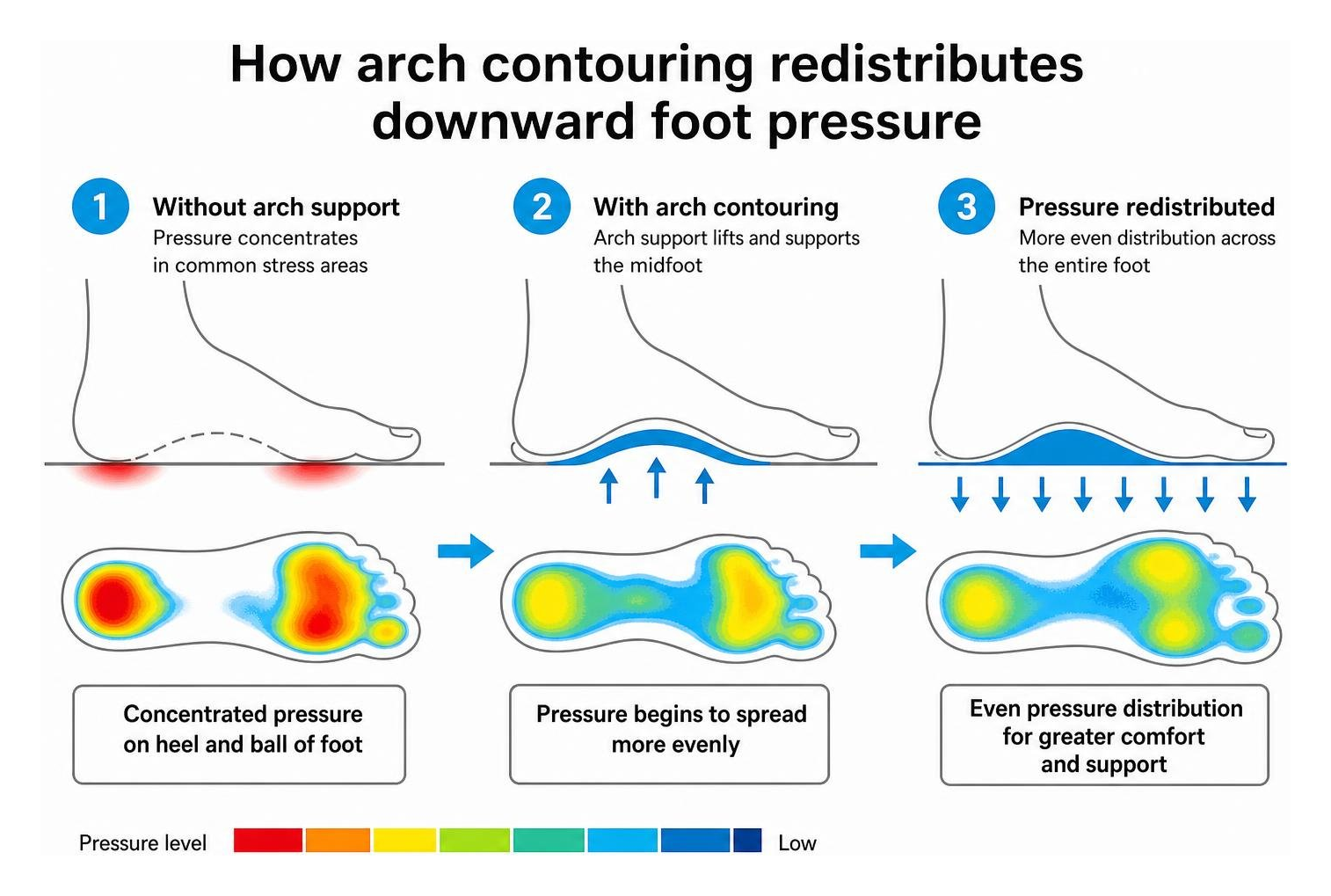
The arch contour on the Balance provides positive medial contact without feeling like an aggressive, rigid plastic bump. It stabilizes the foot during normal heel-to-toe transitions, helping prevent early fatigue during routine errands or light fitness walking. If you are exploring the best arch support insoles for total foot relief, the Balance serves as a solid baseline model.
Archline Orthotic Insoles Work Active and Sport Active for Heavy Duty Use
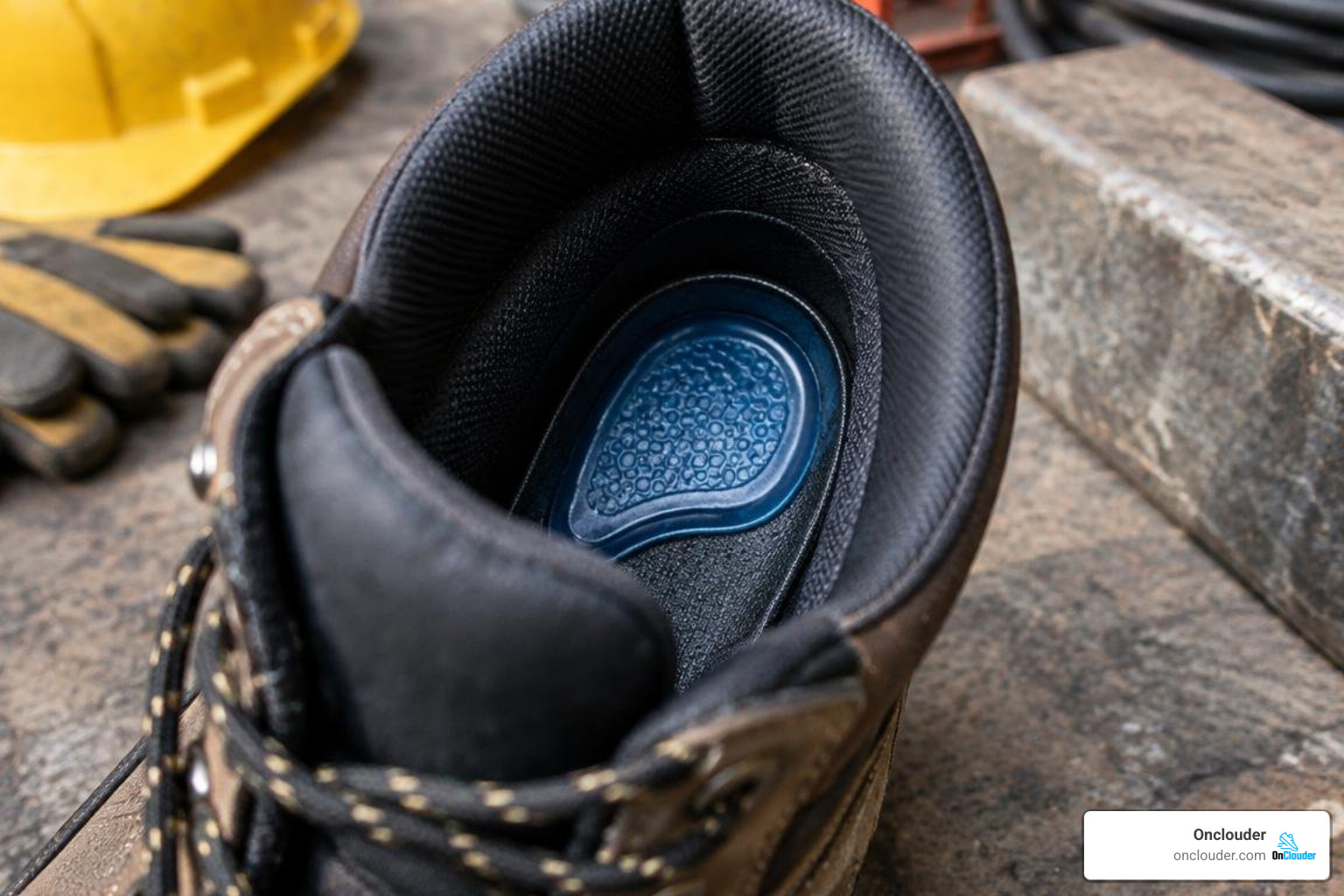
When mechanical loads increase—either due to body weight, heavy tool belts, or running impacts—the standard Balance model can flex too much. That is where the Work Active and Sport Active models come in.
Priced at $49.95 AUD, both models feature a noticeably stiffer TPU (thermoplastic polyurethane) structural cage and a denser EVA foundation. They are particularly suitable for individuals weighing over 110 kg who require heavy duty arch support insoles.
The Work Active is optimized for steel-toe work boots, safety footwear, and occupational footwear worn by trade workers, warehouse staff, and healthcare professionals standing on concrete slabs. It features a reinforced heel cup with an integrated shock-absorbing gel pad. For long shifts on concrete floors, using insoles for standing all day helps reduce muscle fatigue and heel pressure.
The Sport Active, by contrast, provides dynamic energy return and high torsional rigidity to withstand lateral cutting, fast road running, and court sports.
Specialized Solutions: Supination, Met Dome, and Diabetic Relief
Archline also designs targeted orthotics for specific foot conditions:
- Supination Orthotic ($41.95 AUD): While around 90% of the population displays neutral mechanics or overpronation, roughly 10% supinate (underpronate), rolling onto the outside edge of their feet. This model features an integrated lateral wedge that gently guides the foot inward toward a neutral axis, making it an effective insole for high rigid arches.
- Met Dome ($41.95 AUD): Designed with a raised metatarsal pad behind the ball of the foot, this insert lifts the transverse arch, offloading pinching pressure from pinched nerves (Morton’s neuroma) and general ball-of-foot burning.
- Diabetic & Arthritis Relief ($39.95 AUD): Crafted for delicate, friction-sensitive feet, this model eliminates abrasive top seams and pairs mild structural support with protective cushioning. It complements specialized footwear found in Axign’s arthritis footcare collection.
Biomechanical Benefits for Common Foot Conditions
Understanding how an orthotic insert helps begins with the kinetic chain. When your foot hits the ground, any instability at the foundation travels upward through your ankle, knee, hip, and lower back.
Plantar Fasciitis and Heel Pain Management
Plantar fasciitis occurs when repetitive micro-tears inflame the thick band of fibrous tissue running beneath your foot. This tension is often most severe during the first morning steps or after extended rest periods.
Archline inserts combat this through two synchronized mechanisms:
- Deep Heel Cradle: The calcaneal cup holds the natural fatty pad of your heel directly beneath the bone, optimizing natural shock absorption.
- Continuous Medial Arch Bridge: By physically supporting the arch peak, the insert prevents the plantar fascia band from overstretching, allowing tissue irritation to calm down. Pairing these inserts with dedicated plantar fascia orthotics helps manage chronic heel pain.
Don’t Let High Arches Boot You Out of Comfort
Overpronation and Flat Feet Correction
Flexible flat feet often collapse inward under weight-bearing loads, rotating the tibia internally and pulling the knees out of alignment. Archline's pre-curved medial bridge provides a firm foundation that helps resist arch collapse.
By stabilizing the subtalar joint, these arch support inserts for flat feet help reduce inward foot roll. For individuals with pronounced inward rolling, choosing targeted overpronation insoles can also help alleviate downstream stress on the knees and lower back.
Sizing, Trimming, and Practical Everyday Performance
An orthotic can feature high-grade materials, but if the arch contour rests too far forward or backward against your foot, it will feel uncomfortable.
Finding Your Size and Proper Forefoot Trimming
Archline uses fixed European whole sizing, spanning from EU 36 through EU 48 (covering women’s US 5–12 and men’s US 7–15).
Because the thermoplastic support bridge is engineered for specific foot lengths, you should match your purchase to your standard shoe size so the arch apex aligns with your tarsal joint. To fit them into your footwear, follow this simple process:
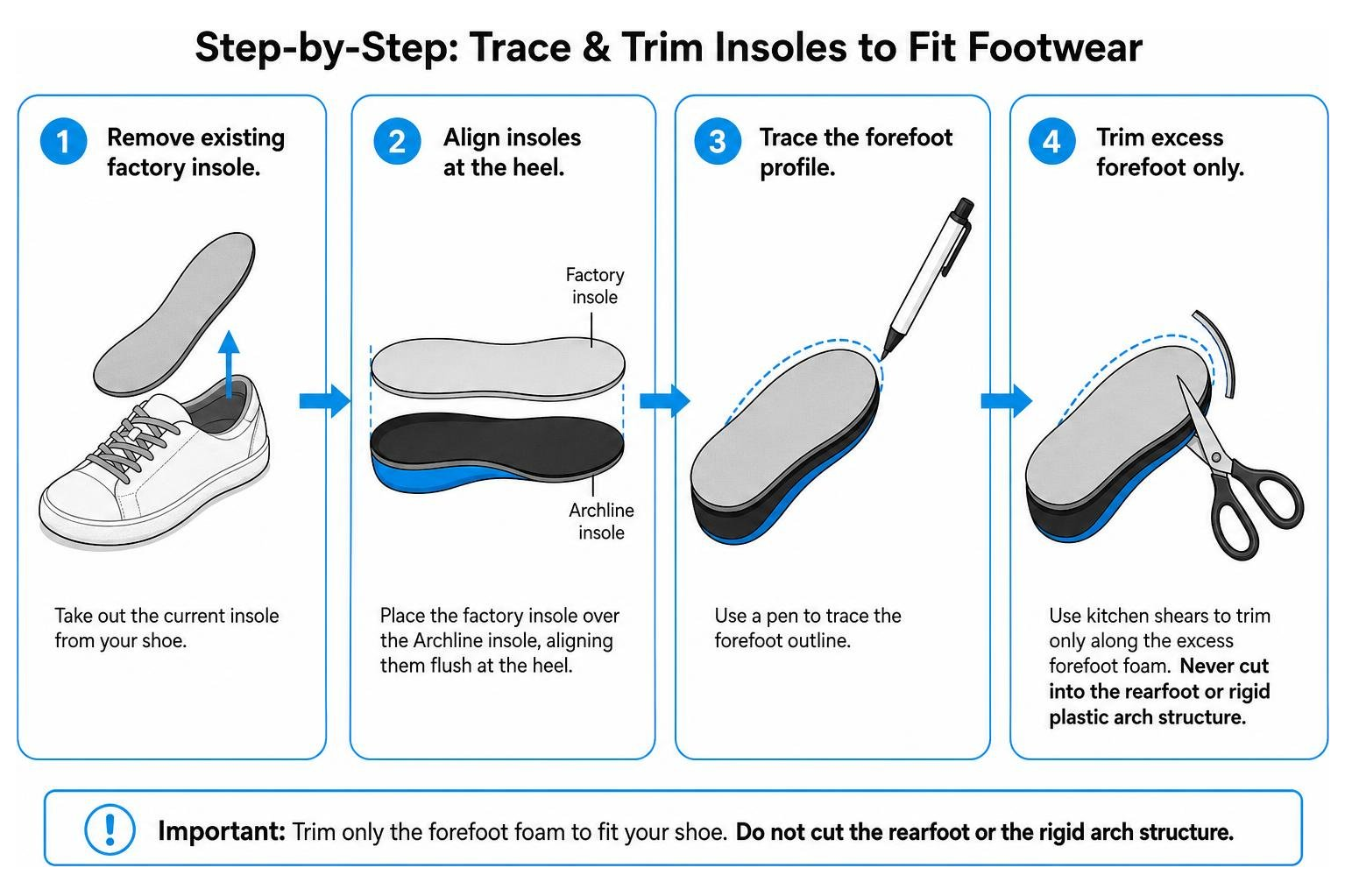
- Remove the existing factory insole from your shoes.
- Align the factory insole over the Archline footbed, aligning them flush at the heel.
- Trace the forefoot profile using a pen.
- Use kitchen shears to trim only along the excess forefoot foam. Never cut into the rearfoot or rigid plastic arch structure.
Shoe Compatibility and All-Day Durability
Full-length Archline inserts require moderate internal shoe depth. They perform best in running shoes, trainers, and work boots featuring removable factory footbeds.
If your footwear lacks a removable footbed or features a tight, narrow toe box (such as low-profile loafers or dress flats), the Slimline 3/4 Length model is the more suitable option, as it delivers arch support without crowding the forefoot.
In terms of lifespan, under standard daily walking loads (8,000–10,000 steps per day), the 60° Shore EVA base and Ortholite top layer generally maintain their structural integrity for 6 to 12 months before requiring replacement.
Frequently Asked Questions About Archline Orthotic Insoles
Can Archline insoles be transferred between different shoes?
Yes. As long as your secondary shoes have a removable factory insole and sufficient interior depth, you can easily switch your Archline insoles between work boots, running sneakers, and casual shoes.
What is the Archline return and exchange policy?
Archline products come with a 45-day return or swap policy. This window allows you to test the arch profile inside your shoes and request a size exchange or refund if the fit is unsuitable.
Who should choose supination insoles over the standard Balance model?
The Supination model is designed for the estimated 10% of people with rigid, high arches whose feet roll outward during movement. If the outer edges of your shoe soles show heavy wear or you feel excess pressure on the outside border of your foot, the Supination model's lateral wedge will suit you better than the Balance model.
Conclusion
Archline orthotic insoles offer a balanced, medically certified solution for common foot aches and everyday fatigue. By combining a supportive thermoplastic frame with shock-absorbing EVA foam and Ortholite cushioning, they deliver reliable structural stability without feeling excessively harsh underfoot.
While the standard Balance model serves everyday sneaker wearers under 110 kg well, the firmer Work Active and Sport Active models provide the extra durability needed for heavier loads and demanding work environments.
For additional comparisons and expert buying advice across top-rated foot support solutions, explore our comprehensive guide to the best arch support insoles for total foot relief.
Best Inserts for High Arches: Support That Hits the High Notes