Find the Best Zero Drop Flip Flops for Your Day
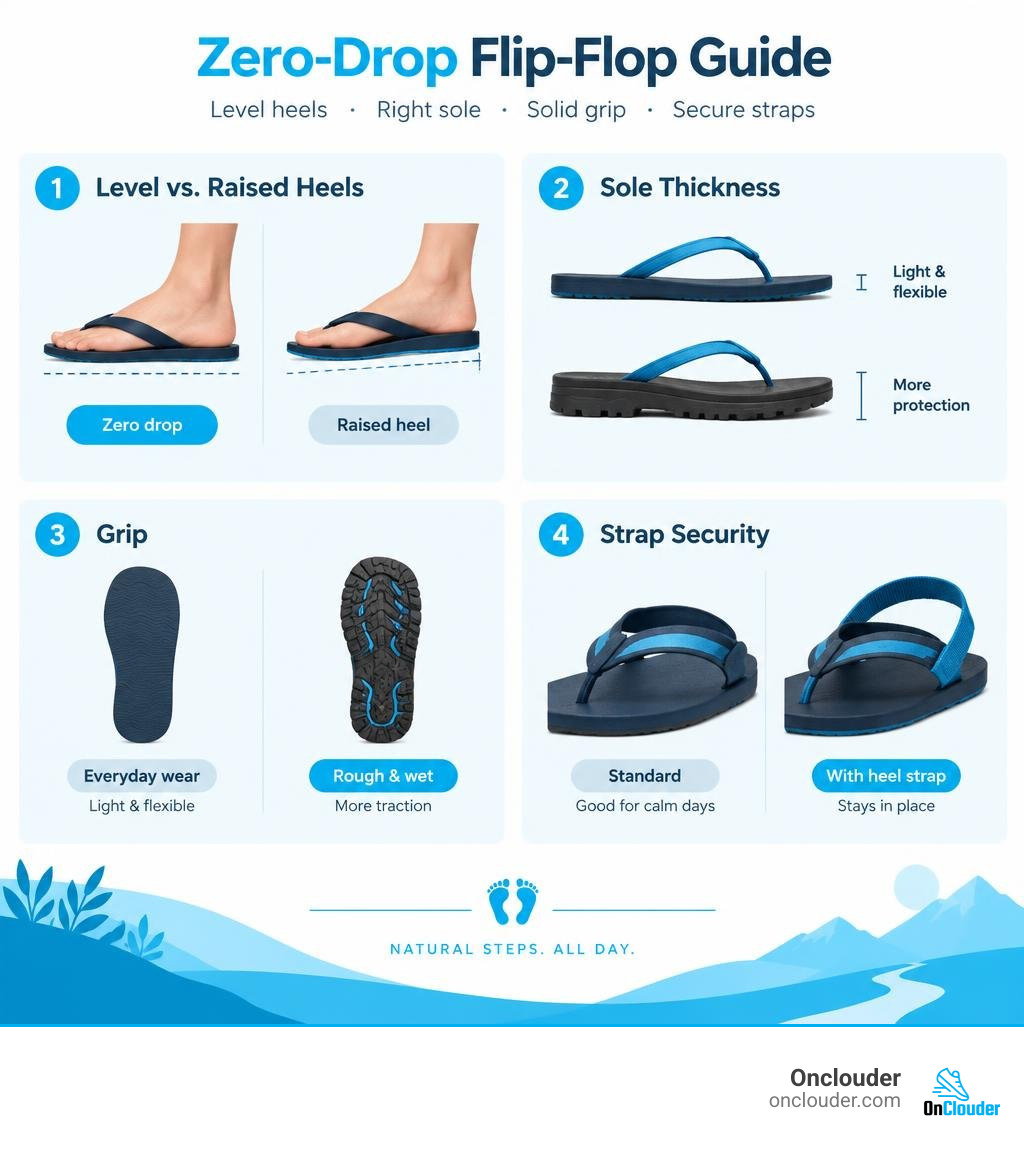
The best zero drop flip flops have a level footbed, enough room for your toes, and a sole that suits where you walk. For everyday wear, look for a light, flexible sole. For rocky paths or wet ground, choose more protection, reliable grip, and a heel strap that keeps the sandal in place.
Zero drop means the heel and forefoot sit at the same height. It can feel different from a flip-flop with a raised heel, so start with short walks if you are new to it. This guide will help you find a pair that fits your feet and your plans.
What Are Zero-Drop Flip-Flops and Why Do Your Feet Need Them?
Standard summer footwear often looks innocent enough, but most conventional thong sandals hide a subtle wedge. Even a slight pitch changes how you step, pushing your weight forward and altering your natural gait. Zero-drop sandals eliminate this artificial angle entirely, keeping your heel and forefoot perfectly level relative to the ground.
When your heel is not elevated, your toes can splay naturally across the footbed. Traditional flip-flops frequently cause “toe curling” or clawing—a subconscious gripping action where your digits clench with every stride just to keep the loose slab of foam attached to your foot. Over time, that constant tension strains the intrinsic muscles of the foot. In our testing at Onclouder, we have explored how a flat, anatomical platform mirrors the biomechanics we outline in a practical guide to zero drop running shoes, encouraging an authentic, balanced stride rather than an unnatural shuffling pattern.
Understanding these mechanics is essential, especially when you consider why supportive flip flops might be your best defense against foot pain. True support does not always mean stiff plastic arches; often, the best support is simply giving your foot the level ground it evolved to walk on.
Zero-Drop Footbeds vs. Traditional High-Drop Sandals
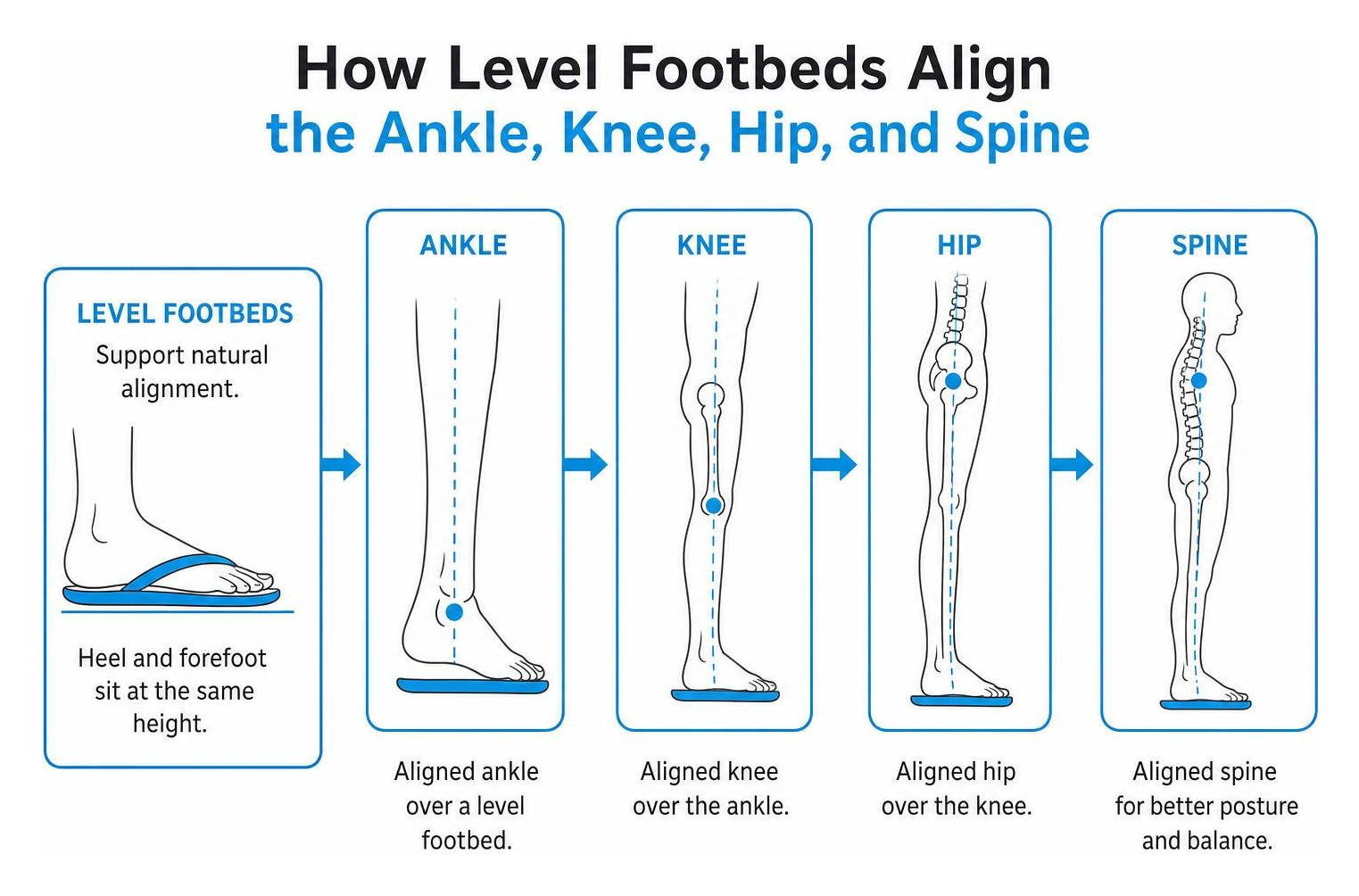
Elevated heels—even modest 10mm to 15mm drops found on popular beach thongs—shorten your Achilles tendon and place unnecessary load on your plantar fascia. When the heel rests higher than the ball of the foot, your calf muscles stay in a perpetual state of slight contraction.
This artificial tilt travels up the entire kinetic chain:
- Ankles: Restricted dorsiflexion alters normal shock absorption.
- Knees & Hips: Pelvic tilt increases, shifting your center of gravity forward.
- Arches: Instead of engaging your natural arch muscles to stabilize your body, the foot becomes passive and reliant on synthetic foam.
A completely flat footbed distributes your body weight evenly across the entire surface of the foot, waking up stabilizing muscles that have been snoozing inside rigid footwear.
Health Benefits for Foot Strength and Natural Alignment
Stepping onto a flat, minimalist sole reconnects your brain to your environment through rich sensory feedback, known as proprioception. Thousands of nerve endings in your soles instantly read the terrain, signaling micro-adjustments to your ankles and legs.
By allowing your feet to move, bend, and flex without an artificial wedge, you unlock noticeable health benefits:
- Restored Posture: Your spine and hips stack naturally without compensatory leaning.
- Improved Balance: A wide base and unrestricted toe splay create a stable, grounded foundation.
- Enhanced Joint Mobility: Free movement through the metatarsals strengthens intrinsic foot muscles, reducing long-term joint stiffness.
Top Picks: The Best Zero Drop Flip Flops for Every Activity
Finding the right minimalist footwear comes down to balancing stack height, outsole traction, and strap design. Whether you are wading across mountain streams, navigating technical singletracks, or lounging by the pool, there is a specialized design built for your movement.

| Sandal Model | Sole Thickness / Stack | Primary Feature | Best Use Case |
|---|---|---|---|
| Astral Filipe | ~17mm (Level Footbed) | Convertible heel strap & G.15 Rubber™ | Water sports, wet wading, boating |
| LUNA Oso / Mono | 11mm – 15mm | Mountain-boot Vibram rubber & wings | Trail running, rugged hiking, ultrarunning |
| Xero Shoes Genesis | 4mm – 5.5mm | Ultra-thin, lightweight DIY or ready-to-wear | Everyday walking, barefoot purists |
| Xero Shoes Z-Trail EV | 10mm – 12mm | Dual-layer TrailFoam™ protection | Mixed trail and travel use |
| Earth Runners | 7mm – 10mm | Conductive copper grounding plug & canvas lace | Outdoor adventure, grounding, lifestyle |
| Lems Switchback | 14mm (3mm gateway drop) | Cushioned, forgiving platform | Beginners transitioning to low-drop sandals |
Best Zero Drop Flip Flops for Water and Amphibious Adventure
If you spend your warm weekends near riverbeds, docks, or rocky coastlines, the Astral Filipe stands out as a unique amphibious design. While it slips on as a relaxed thong flip-flop around camp, it comes with an innovative, included accessory strap that wraps around your heel, converting it into a locked-in water sandal.
In our performance tests and in-depth field evaluations, such as this Astral Filipe Review | Tested & Rated, the sandal scored an impressive 76 overall, earning high marks for its 8.1 versatility, 7.9 stability, and industry-leading wet traction. Astral uses high-friction G.15 Rubber™ that grips slick river rocks like glue. Its “Level Footbed” maintains a zero-drop profile with subtle outer rim ridges that cradle your foot without forcing artificial arch support under your instep.
Best Minimalist Sandal for Trail Running and Rugged Hiking
When technical dirt, steep inclines, and loose gravel enter the picture, standard thong straps will not cut it. Trail-ready minimalist sandals, like those pioneered by LUNA Sandals, use secure winged strap designs and rugged mountain-boot outsoles to keep your foot firmly anchored.
Operating since 2006 as an original barefoot sandal craft brand, LUNA designs rugged options like the Oso and Mono series that have carried runners through 100-mile mountain ultramarathons. They back their footwear with a 30-day risk-free trial and a one-year MoonRock Guarantee against manufacturing defects. If you want a shoe that handles technical terrain while letting your toes breathe freely, an adventure sandal with a secure foot-harnessing system is unmatched.
Best Barefoot Flip-Flop Alternative for Everyday Comfort
For pure minimalist freedom during casual travel and urban strolls, Xero Shoes provides an extensive lineup ranging from ultra-thin 4mm barefoot soles to cushioned 12mm trail hybrids. Their versatile lineup includes:
- DIY Genesis Kit (4mm): An ultra-customizable build where you trim the sole to your exact foot tracing.
- Ready-to-Wear Genesis (5.5mm): A featherlight huarache-style sandal that rolls up to fit in a pocket.
- Z-Trail EV (10mm to 12mm): A cushioned, packable trail sandal that shields against jagged rocks while keeping a zero-drop geometry.
If you are exploring coastal boardwalks and prefer some subtle contouring instead of bare rubber, you might also consider comparing these with dedicated beach sandals with arch support to see how your body responds to varying footbed profiles.
Best Grounding and Custom-Fit Minimalist Sandals
For those who love natural textures and specialized wellness features, Earth Runners and Shamma Sandals offer exceptional hand-crafted options. Earth Runners are famous for their grounding capability, utilizing conductive stainless steel thread woven through the webbing attached to a copper plug under the ball of the foot. Their Vibram soles range from minimal 7mm profiles up to thicker 10mm adventure bases.
Shamma Sandals matches this dedication with models spanning from the ultra-thin Warrior line for maximum road feedback to the rugged, cushioned Omega series for rugged backcountry trails.
How to Choose, Fit, and Transition to Natural Footwear
Finding your perfect minimalist thong or adventure sandal requires a different mindset than buying traditional shoes. You cannot rely on plush internal padding to mask a poor fit; the sole outline must match your natural anatomy.
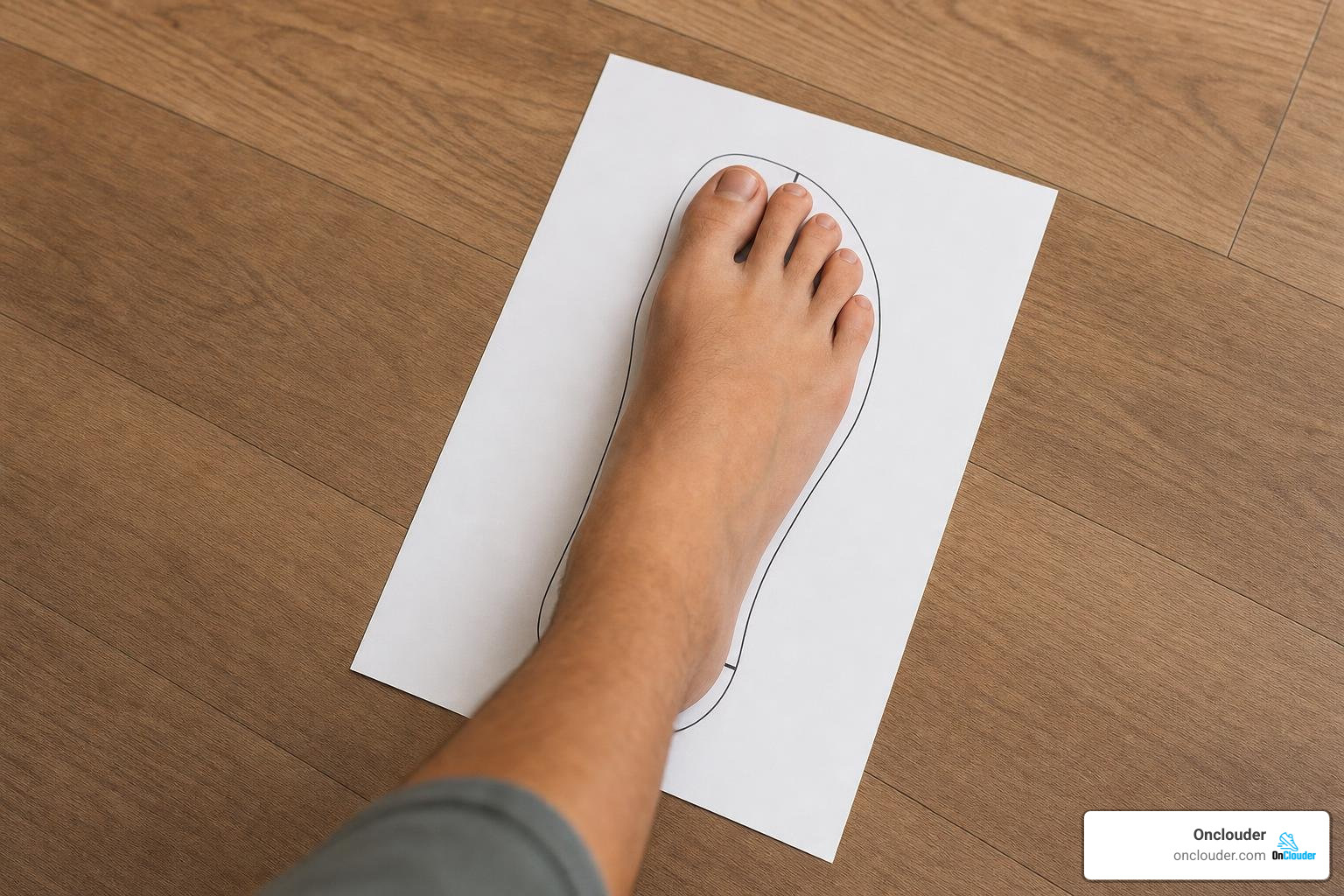
- Use Printable Sizing Templates: Most barefoot brands provide 1:1 printable sole templates. Place your foot on the paper to verify that your toes do not spill over the perimeter and that the toe-post hole aligns comfortably between your first two toes.
- Dial In the Strap Tension: Aim for snug security, not strangulation. The strap should hold the sole against your heel without pinching your instep.
- Evaluate Toe Post Materials: Look for soft tubular webbing or flexible cords rather than stiff plastic posts that cause friction blisters between your toes.
Choosing Sole Thickness and Ground Feel
Sole thickness directly dictates how much of the world you feel underfoot:
- Ultra-Thin (4mm – 6mm): Maximum ground feel and hyper-flexible movement. Ideal for smooth dirt paths, sandy beaches, and experienced barefoot walkers.
- Balanced All-Rounders (7mm – 9mm): A versatile middle ground offering moderate trail protection without sacrificing flexibility.
- Thick Trail Shielding (10mm – 12mm): Designed for jagged rocks, roots, and long-distance hikes where continuous stone bruising would cause fatigue.
- Transition Gateways: Sandal designs with a slight cushion or a subtle 3mm heel drop (such as the Lems Switchback) serve as an approachable stepping stone for those not quite ready for a fully paper-thin base.
Transitioning Safely to the Best Zero Drop Flip Flops
If you have spent decades walking on elevated heels, your calves and Achilles tendons will need time to lengthen and adapt. Rushing into 10-mile hikes on a 4mm flat sole can lead to intense calf soreness or Achilles strain.
Pairing your sandal transition with time spent in the best zero drop shoes for all day comfort and performance allows your lower leg muscles to strengthen gradually, ensuring a pain-free, sustainable shift to natural movement.
Frequently Asked Questions About Zero-Drop Sandals
Can you hike or run in zero-drop flip-flops?
You can hike and run in zero-drop sandals, provided they feature a secure strap system that anchors your heel. Traditional loose thong flip-flops are not recommended for running or technical hiking because your toes must claw the footbed to prevent the shoe from sliding off. However, convertible models like the Astral Filipe or dedicated adventure sandals from LUNA and Xero Shoes keep the sole glued to your foot, delivering fantastic agility and trail traction across uneven ground.
Are zero-drop flip-flops suitable for people with plantar fasciitis?
They can be very beneficial over the long term, but they require a careful, gradual transition. Zero-drop footbeds encourage the arches of your feet to engage and strengthen naturally, rather than relying on an artificial rigid plastic bridge. However, during acute plantar flare-ups, sudden movement on flat, unsupportive soles may irritate tender tissue.
Many walkers find success alternating between minimalist designs and the best flip flops for plantar fasciitis womens podiatrists recommend to ease inflammation while progressively building structural foot strength.
How do zero-drop thong sandals perform in wet conditions?
High-quality zero-drop water flip-flops excel in wet conditions because they are built with hydrophobic materials and specialized outsoles. Models engineered for water use feature non-marking, super-sticky rubber compounds that maintain grip on algae-covered rocks and slick boat decks. Quick-drying tubular webbing ensures the straps do not stretch, hold water, or cause chafing when submerged.
Conclusion
Switching to level, anatomical footwear is one of the simplest ways to restore your natural gait, strengthen long-neglected foot muscles, and enjoy warm-weather adventures with complete freedom. By selecting a sole thickness and strap system tailored to your favorite activities, you give your feet the space and flexibility they need to perform at their best.
At Onclouder, our decade of hands-on testing continues to prove that footwear should work with your body’s natural biomechanics, not against them. Ready to see how level footbeds transform your daily comfort across all types of footwear? Explore our comprehensive comparison of zero-drop footwear to find your next favorite pair for trail, road, and casual recovery.