Why High Arches Make Boot Comfort So Hard to Find
High arch boot inserts are the most effective solution for people whose feet don’t get enough natural contact with the ground inside a boot. Here’s a quick breakdown of the top picks:
| Insert | Best For | Arch Support Level | Cushion Type |
|---|---|---|---|
| Superfeet All-Purpose High Arch | Everyday & work boots | High | Firm |
| PowerStep Pinnacle High | Supination & heel pain | High | Dual-layer |
| Spenco Total Support Max | Hiking & long shifts | High | Moderate |
| Tread Labs | Custom fit & durability | Multiple heights | Firm |
| BRUNT High Arch CUSH’N | Work boots | High | Memory foam |
| Aetrex Memory Foam Medium-High | Comfort & odor control | Medium-high | Memory foam |
Your boots were probably not designed with your feet in mind.
Most boots are built for average or flat feet. If you have high arches, that creates a gap between your foot and the insole. No contact means no support. And no support means pain — in your heel, your ball of foot, your knees, and even your lower back.
High arches (also called pes cavus) tend to be rigid and inflexible. Unlike normal arches, they don’t absorb shock well. Every step sends impact straight up through your feet and joints. Over time, that leads to conditions like plantar fasciitis, Achilles tendonitis, and stress fractures.
The fix isn’t a new pair of boots. It’s what goes inside them.
I’m Faisal S. Chughtai, a footwear comfort specialist with years of experience helping people find the right support for their specific foot type — including testing and evaluating high arch boot inserts across work, hiking, and everyday wear scenarios. If you’re ready to stop tolerating pain and start moving comfortably, you’re in exactly the right place.
Understanding High Arches and Boot Performance
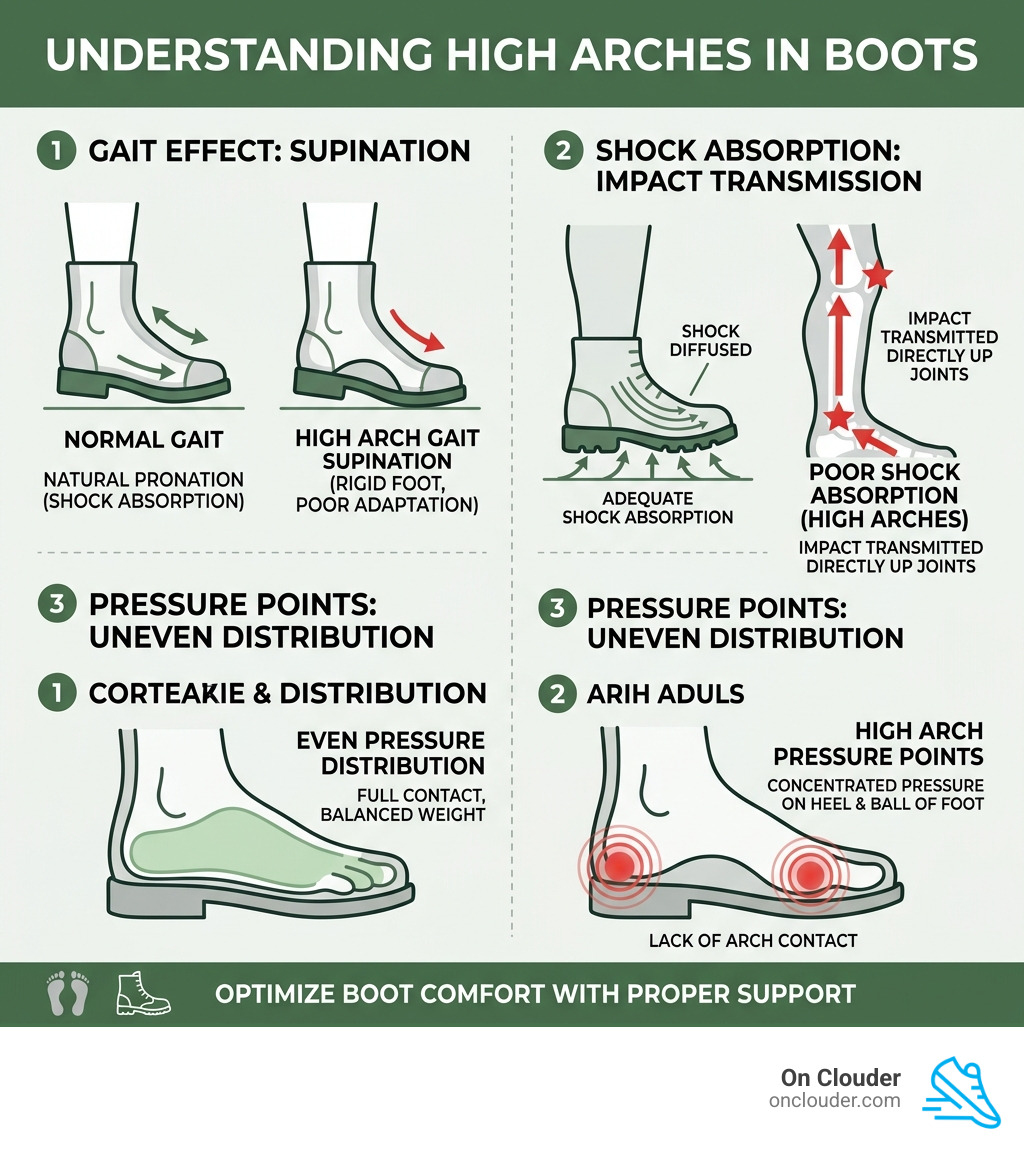
When we talk about high arches, we aren’t just talking about a “pretty” foot shape. In podiatry, high arches—or pes cavus—often signal a rigid foot structure that struggles with mobile adaptation. Unlike a neutral foot that rolls slightly inward to absorb shock (pronation), a high-arched foot often stays tilted outward. This is known as supination or underpronation.
Because the middle of your foot doesn’t touch the bottom of the boot, your body weight is concentrated entirely on two small areas: the heel and the ball of the foot (the metatarsals). This uneven pressure distribution is a recipe for disaster in heavy boots. For more on how different foot shapes require specific care, check out An Essential Guide To Best Shoes For Arch Support.
The lack of shock absorption in a rigid foot means that every time your boot hits the pavement or the trail, your bones and tendons take the full force. This frequently leads to:
- Plantar Fasciitis: Intense heel pain caused by the overstretching of the tissue connecting your heel to your toes.
- Metatarsalgia: Inflammation and pain in the ball of the foot.
- Stress Fractures: Small cracks in the bone caused by repetitive impact.
- Ankle Instability: Because supinators roll outward, they are at a higher risk for ankle sprains.
Using specialized high arch boot inserts, such as the PowerStep Pinnacle High Insoles for Supination, helps fill that hollow gap. By creating “total contact” with the sole of your foot, these inserts redistribute weight away from the high-pressure zones, finally giving your heels and forefeet the break they deserve.
Key Features of Effective Support
Not all insoles are created equal. If you walk into a drugstore and grab a generic gel pad, you might feel a few minutes of “squish,” but you won’t get the structural correction your high arches need. Real support comes from engineering, not just padding.
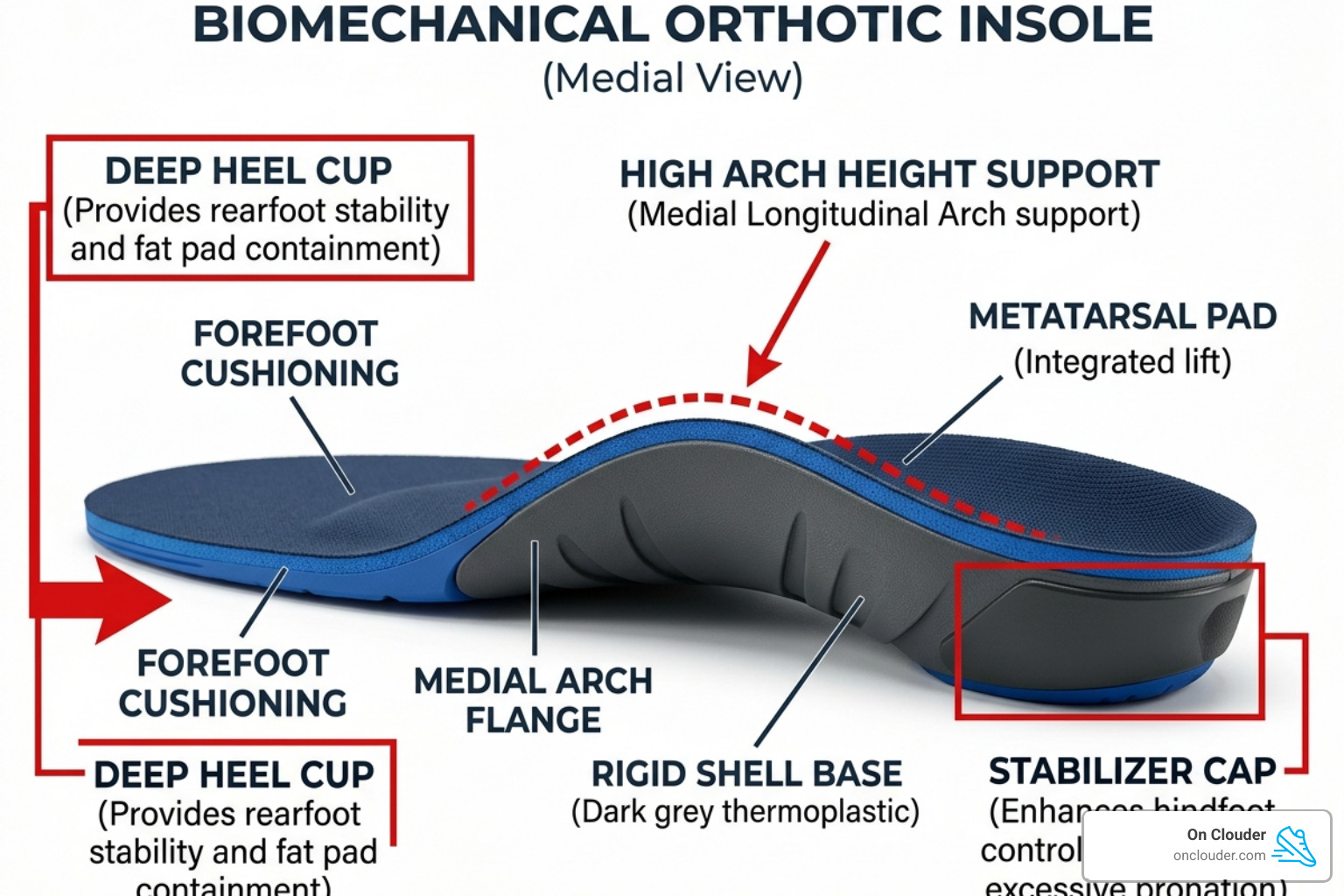
When shopping for high arch boot inserts, we look for these specific “must-have” features:
- True Arch Height: This is the most critical factor. The insole must be tall enough to actually reach your arch. If there is still a gap between the insole and your foot, it isn’t doing its job.
- Deep Heel Cup: High-arched feet are prone to rolling. A deep, sculpted heel cup cradles the fatty pad under your heel bone, maximizing natural shock absorption and stabilizing the rearfoot against supinating.
- Semi-Rigid Materials: Most experts prefer semi-rigid EVA or high-density foam over soft gel. You need a firm foundation that won’t collapse under your weight. As we discuss in Arch Support Inserts 101, a firm arch acts like a spring, returning energy rather than just absorbing it.
- Stabilizer Caps: Brands like Superfeet use a hard plastic “cap” on the bottom of the insole. This provides a functional structure that keeps the insole from twisting inside a rugged boot.
- Moisture-Wicking and Odor Control: Boots are notorious for trapping heat. Look for top covers treated with antimicrobial tech or copper fibers to keep things fresh during a 12-hour shift.
- Cushioning Layers: While the base should be firm, a top layer of memory foam or specialized polyurethane (like Poron) adds that “step-in comfort” that makes long days bearable.
Top Recommended High Arch Boot Inserts for Every Activity
Choosing the right insole depends on what you’re doing in your boots. A hiker needs different support than a construction worker or someone wearing fashion boots to the office.
The Comparison Table: High Arch Support at a Glance
| Brand/Model | Material | Best Use Case | Key Benefit |
|---|---|---|---|
| Superfeet All-Purpose High Arch | High-density foam | Work & Hiking | APMA approved; maximum durability |
| PowerStep Pinnacle High | Dual-layer EVA | Supination Relief | #1 Podiatrist recommended brand |
| Tread Labs | Two-part system | Custom Fit | Replaceable top covers; forever guarantee |
| BRUNT High Arch CUSH’N | Polyurethane/Memory Foam | Heavy Work Boots | Built-in 3/4″ contoured support plate |
| Spenco Total Support Max | Rigid EVA | High-Impact Sports | Advanced motion control |
| Aetrex Memory Foam | IQ150 Memory Foam | All-Day Comfort | Molds to foot shape; odor control |
Superfeet All-Purpose Support High Arch
Formerly known as the “Green” insole, the All-Purpose Support High Arch – Superfeet is a legend in the industry. It features a high-profile shape and a heavy-duty stabilizer cap. It’s designed for roomy footwear like work boots and hiking boots. Superfeet is clinically proven to reduce fatigue and is a favorite among those who need professional-grade support without the price tag of custom orthotics.
PowerStep Pinnacle High
If you struggle with outward foot roll, the PowerStep Pinnacle High Insoles are designed specifically for supination. They feature a firm but flexible shell that provides medical-grade support. Because they don’t require trimming, they are an easy “drop-in” solution for most boots.
BRUNT High Arch CUSH’N
For the blue-collar professionals, the BRUNT High Arch CUSH’N is a game-changer. These are built specifically for work boots, featuring a 3/4” contoured support plate that reduces strain on both the feet and the lower back. They even include a “grippy” toe coating to prevent your foot from sliding around and causing blisters while you’re on the move.
Tread Labs
Tread Labs offers a unique two-part system: a molded arch support (the “honeycomb” part) and a replaceable top cover. They offer four different arch heights, making them ideal if you find that standard “high” insoles are either too short or too aggressive. Their molded supports are even guaranteed for life.
How to Choose and Break In Your Insoles
Buying the insole is only half the battle; you have to make sure it fits your foot and your boot.
Step 1: Determine Your Arch Height
The easiest way to check your arch is the Wet Footprint Test.
- Wet the bottom of your foot.
- Step onto a piece of cardboard or a dark paper bag.
- Look at the print. If you only see your heel and the ball of your foot with a very thin line (or nothing at all) connecting them, you have high arches.
Step 2: Sizing and Trimming
Most high arch boot inserts come in size ranges (e.g., Men’s 8-9). If the insole is full-length, you may need to trim the toe area to fit your boot perfectly.
- Pro Tip: Remove the factory insole from your boot and use it as a template. Trace the outline onto your new insole and trim with sharp scissors.
- Note: Some orthotics, like the Natural Foot Orthotics Original Stabilizer, are 3/4 length and do not require trimming.
For a deeper dive into sizing, check out our guide on How To Choose The Best Insoles For Foot Pain And Arch Support.
Step 3: The Break-In Period
This is where most people go wrong. Because a high arch insole is literally reshaping how your foot interacts with the ground, it can feel like you have a “golf ball” in your shoe at first. This is normal!
- Day 1: Wear them for 1 hour.
- Day 2: Wear them for 2 hours.
- Day 3-7: Gradually increase time until you can wear them all day. If you experience sharp pain, stop and rest. But stick with the gradual process; it usually takes 3-5 days for your muscles and tendons to adjust to the new support.
Maintenance and Lifespan
High-quality insoles like PowerStep or Superfeet typically last about 6 months with regular daily wear. You’ll know it’s time for a replacement when:
- The arch support feels “soft” or collapses easily.
- The top fabric is peeling or worn through.
- You notice your old foot or back pain returning. To keep them fresh, spot clean with mild soap and a damp cloth. Never submerge them in water or put them in the dryer!
Frequently Asked Questions about Boot Support
How long do high arch boot inserts last?
On average, expect 6 months of reliable support from a high-quality pair of insoles. If you are a heavy-duty worker or a long-distance hiker, you might need to replace them every 4 months. Premium options like Tread Labs allow you to keep the plastic support and simply replace the foam top cover, which is more cost-effective in the long run.
Can I use high arch boot inserts in hiking boots?
Absolutely. In fact, hiking is one of the best use cases for them. Hiking boots are often stiff to protect you from rocks, which can be brutal on high arches. An insole provides the necessary “fill” to keep your foot stable on uneven terrain. Just ensure your hiking boots have enough “volume” (internal space) to accommodate a thicker insole.
Do high arch boot inserts help with supination?
Yes, this is one of their primary functions. By supporting the arch and cradling the heel, these inserts prevent the foot from rolling outward. This realigns your ankles, knees, and hips, which can significantly reduce the “aching” feeling in your joints after a long day of walking.
Conclusion
At On Clouder, we believe that your footwear should work for you, not against you. High arches shouldn’t be a sentence for daily foot pain or a reason to give up your favorite boots. By investing in the right high arch boot inserts, you are doing more than just adding cushion; you are investing in your long-term mobility and comfort.
Whether you choose the rugged durability of Superfeet, the podiatrist-approved alignment of PowerStep, or the work-ready comfort of BRUNT, the goal is the same: total contact and total relief. Don’t let your arches “boot” you out of the activities you love.
Ready to find your perfect fit? Step up your comfort with our expert comparisons and find the gear that keeps you moving.