Best Carbon Plate Marathon Shoes for Your Race
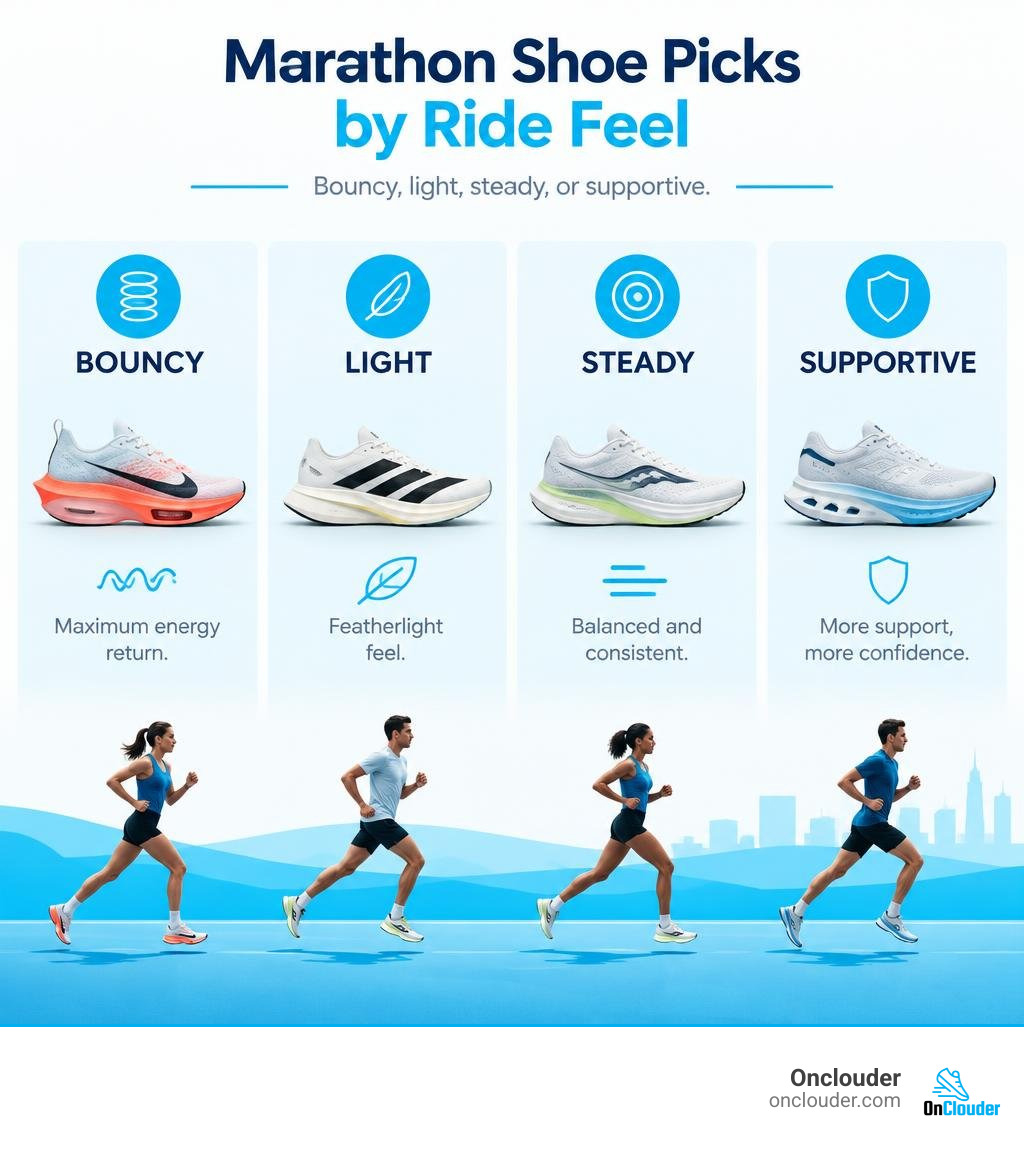
Start with the fit and ride you want. The Nike Alphafly 3 is a pick for a bouncy race-day feel. The Adidas Adizero Adios Pro 4 suits runners who prefer a light, smooth ride. If you want a steadier platform, try the Saucony Endorphin Pro 5. The On Cloudboom Max is a roomier, more supportive option, though it weighs more than a pure racer.
The best carbon plate marathon shoes pair springy foam with a stiff plate and a curved sole. That mix can help you run more efficiently, but the fastest shoe on paper may not feel best at mile 20. Our 2026 top 10 compares speed, comfort, and stability so you can find a pair that works for your marathon.
Similar topics to best carbon plate marathon shoes:
Introduction
There is a distinct line dividing marathon history: before 2016 and after 2016. One era saw world records stand for years, while the modern era sees them tumble routinely. At the 2026 Chicago Marathon, 64% of all finishers crossed the line wearing carbon-plated super shoes, while the New York City Marathon saw 62% adoption. At the 2026 London Marathon, Sabastian Sawe made history by becoming the first person to break the two-hour barrier in an official race, clocking 1:59:30.
These milestones are powered by major shifts in footwear engineering. Independent analyses across hundreds of thousands of marathon results show that runners wearing top-tier plated racers consistently run between 3% and 4% faster than comparable athletes in standard shoes. For anyone targeting a personal record or simply wanting fresher legs at mile 22, understanding how these shoes work is the first step toward choosing the right pair.
The Anatomy of Super Shoes: Foam, Geometry, and Plates
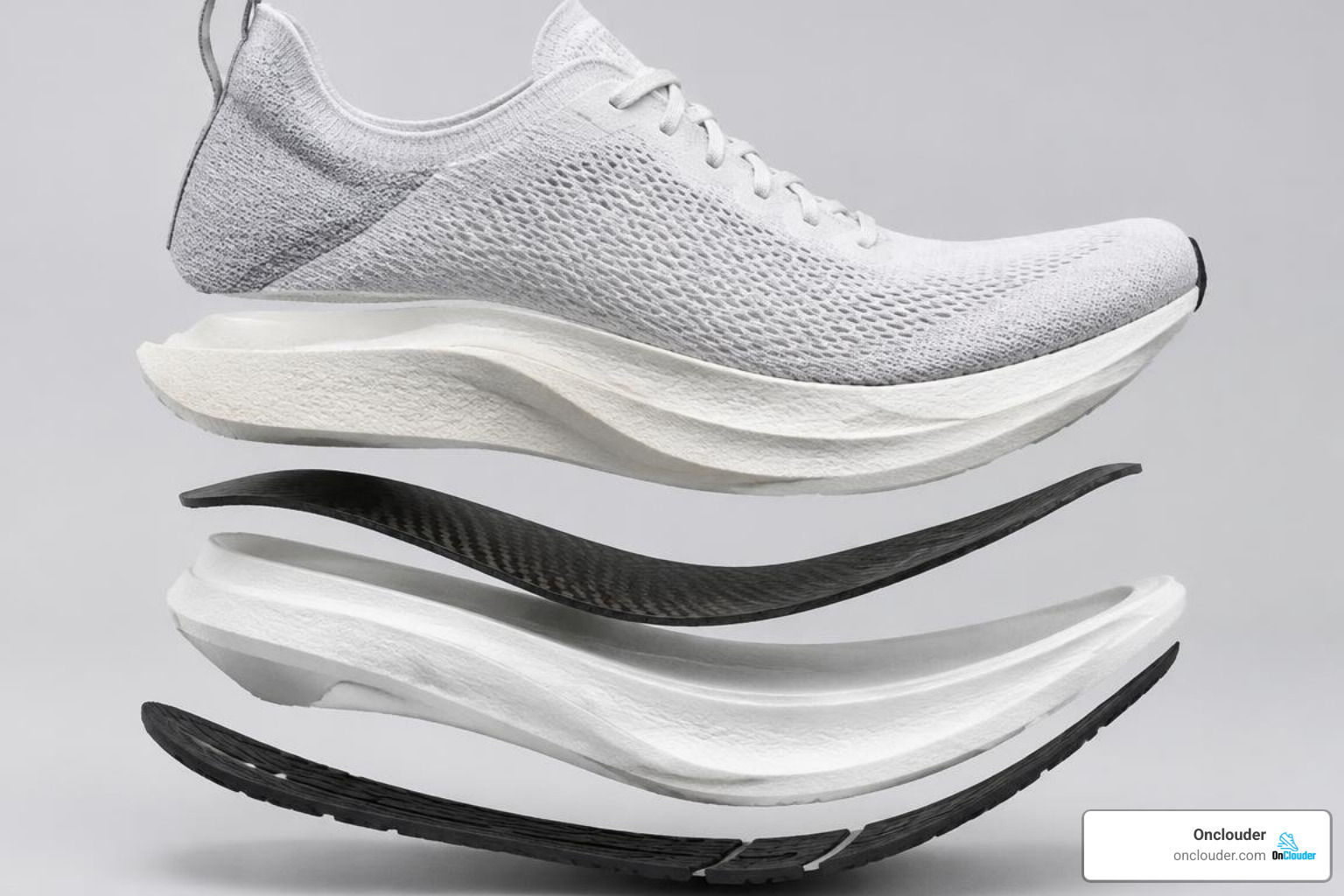
A modern marathon racer relies on a tri-part system: compliant foam, a stiffening element, and curved rocker geometry.
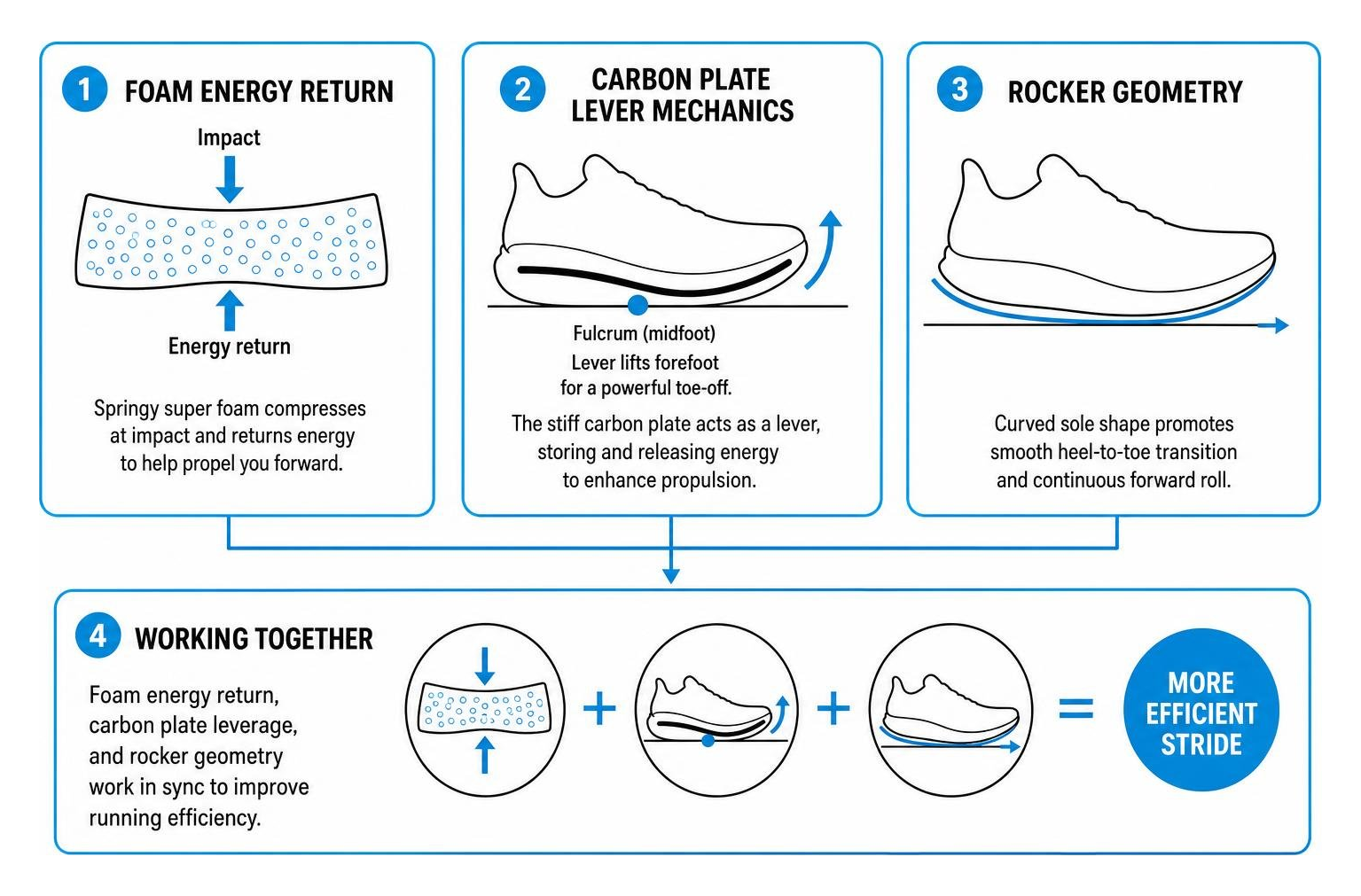
Why the Best Carbon Plate Marathon Shoes Rely on Super Foams
While the carbon plate gets top billing in marketing campaigns, the foam does the heavy lifting. Elite racing shoes use polyether block amide (PEBA) or specially autoclaved supercritical foams. Interestingly, raw PEBA is the same lightweight polymer used for commercial airplane insulation.
Standard EVA foam absorbs impact but returns only about 60% to 65% of that energy. PEBA foams return between 80% and 87% of stored mechanical energy while remaining significantly lighter. This low density allows designers to build tall stack heights—up to the 40 mm legal limit—providing maximum cushioning without weighing down your stride.
Carbon Plate Dynamics vs Alternative Propulsion Systems
The carbon fibre plate serves three main mechanical roles:
- Stabilising the foam: Supercritical PEBA is so soft that without internal reinforcement, it would collapse laterally under load.
- Acting as a lever: The curved, spoon-shaped contour stiffens the longitudinal axis, reducing the mechanical work required from your metatarsophalangeal (toe) joints.
- Optimising ankle torque: By guiding the foot through an aggressive toe-spring rocker, the shoe redirects vertical landing forces into horizontal forward propulsion.
Different brands tune this stiffness uniquely. Exploring the mechanical differences between speedboard and carbon plates highlights how On uses specialized Pebax- or carbon-infused boards to balance aggressive snap with smooth transitions.
The 10 Best Carbon Plate Marathon Shoes Ranked for 2026
We road-tested and biomechanically evaluated the leading models in our lab to rank the top 10 marathon options for 2026:
| Shoe Model | Weight (Men’s 9) | Heel / Forefoot Stack | Drop | Stability Profile | Best For |
|---|---|---|---|---|---|
| Nike Alphafly 3 | 218 g (7.7 oz) | 40 mm / 32 mm | 8 mm | Moderate (Neutral) | Max energy return & bounce |
| Nike Vaporfly 3 | 198 g (7.0 oz) | 40 mm / 32 mm | 8 mm | Low-Moderate | 10k to marathon agile racers |
| Adidas Adizero Adios Pro 4 | 205 g (7.2 oz) | 39 mm / 33 mm | 6 mm | Moderate | Smooth, dynamic forefoot strikers |
| Adidas Adizero Adios Pro Evo 3 | 97 g (3.4 oz) | 39 mm / 33 mm | 6 mm | Minimal (Pure Race) | Elite sub-2:30 podium contenders |
| ASICS Metaspeed Sky Paris | 183 g (6.4 oz) | 39.5 mm / 34.5 mm | 5 mm | Moderate | Stride-style runners who lengthen gait |
| Saucony Endorphin Pro 5 | 206 g (7.3 oz) | 39.5 mm / 31.5 mm | 8 mm | High (Inherent) | Balanced speed & mild overpronation |
| On Cloudboom Strike LS | 170 g (6.0 oz) | 39.5 mm / 35.5 mm | 4 mm | Moderate | Precision fit & ultra-light turnover |
| On Cloudboom Max | 296 g (10.4 oz) | 40 mm / 32 mm | 8 mm | Very High | Overpronators & long-haul comfort |
| Hoka Cielo X1 | 264 g (9.3 oz) | 39 mm / 32 mm | 7 mm | Moderate-High | Aggressive rocker & mechanical rebound |
| Nike Zoom Fly 6 | 265 g (9.3 oz) | 40 mm / 32 mm | 8 mm | High (Trainer/Racer) | Training durability & fast marathons |
Elite Record Chasers and Pure Speed Racers
For athletes hunting personal records, the sharpest end of the super shoe spectrum offers maximum efficiency:
- Nike Alphafly 3: Combining dual Zoom Air pods under the forefoot with continuous ZoomX foam and a wide carbon Flyplate, this shoe delivers explosive energy return. It provides unmatched protection against late-race leg fatigue.
- Nike Vaporfly 3: The lightweight benchmark for agile racers who want a closer connection to the road without sacrificing peak PEBA energy return. You can check our detailed best marathon nike shoes ranked from daily training to sub-3 chases guide to see how these two compare across varying distances.
- Adidas Adizero Adios Pro 4: Utilizing updated Lightstrike Pro foam and curved EnergyRods 2.0 that mirror foot anatomy, the Pro 4 offers a silky, consistent ride from start to finish.
- Adidas Adizero Adios Pro Evo 3: Weighing an astonishing 97 grams, this engineering marvel is the first running shoe to break the sub-100 gram threshold. It improves running economy by an additional 1.6% over the Pro Evo 2, though its minimalist build makes it an exclusive race-day luxury.
- ASICS Metaspeed Sky Paris: Built specifically for runners who extend their stride when increasing pace, using ultra-light FlyteFoam Blast Turbo Plus.
Finding the Best Carbon Plate Marathon Shoes for Overpronation
High stack heights and ultra-soft foams can challenge runners needing stability. Excessive medial compression often causes unstable inward rolling. However, recent designs incorporate wider baseline footprints and cupped sidewalls.
- Saucony Endorphin Pro 5: By embedding a spoon-shaped plate inside a structured PWRRUN PB cradle, Saucony provides torsional rigidity that resists medial roll, making it a reliable racer for mild overpronators.
- On Cloudboom Max: Specifically designed with wide baseline geometry, cupped midsole sidewalls, and a longitudinal split-toe plate that centers foot strike, delivering exceptional support over 42.2 km.
- Nike Zoom Fly 6: Serving as a sturdy plated trainer-racer hybrid, this model uses a firmer carrier foam surrounding a core ZoomX insert to maintain alignment.
Versatile Speed Trainers and Long-Haul Super Racers
Not everyone wants an ultra-fragile race shoe. These hybrid options offer broader versatility:
- On Cloudboom Strike LS: Features a robotic LightSpray upper that creates an ultralight, seamless fit over a responsive Helion HF hyper-foam midsole.
- Hoka Cielo X1: Utilizes deep active foot frames, dual-layer PEBA cushioning, and an aggressive early-stage rocker to roll you effortlessly through late-stage marathon miles. For complete prep, check out our marathon shoe recommendations for training and race day.
Real-World Performance: Economy Gains and Pace Differences

How much faster do carbon-plated shoes actually make you? The performance boost is real, though it scales with your speed.
In lab testing, elite and sub-elite runners moving between 3:20 and 4:17 per kilometer experience an average running economy improvement of 4.0%, with individual results ranging from 1.59% to 6.26%. A 4% boost in economy translates to roughly an 8-minute improvement for a 4-hour marathoner.
Running Economy Gains Across Different Pace Groups
- Paces under 4:15 min/km (Sub-3:00 Marathoners): 3.0% to 4.5% running economy improvement. High forward ground-reaction forces fully compress the super foam and load the plate.
- Paces around 5:00 min/km (Sub-3:30 Marathoners): ~1.6% economy improvement. Runners still gain substantial leg fatigue reduction over the final 10 kilometers.
- Paces around 6:00 min/km (Sub-4:15+ Marathoners): ~0.9% economy improvement. While mechanical plate rebound is lower at slower cadences, the impact-damping qualities of max PEBA foam still help preserve muscle integrity.
World Athletics regulations mandate that race-legal road shoes have a sole stack height no greater than 40 mm and contain no more than one rigid embedded plate. This standard keeps competitive racing fair while driving brands to refine foam chemistry.
Direct Super Shoe Head-to-Head Comparisons
Runners often ask how top racers compare directly:
- Alphafly 3 vs. Adios Pro 4: The Alphafly delivers a distinct trampoline pop from its front Zoom Air pods, making it ideal for cadence runners. The Adios Pro 4 provides a smoother rolling transition across the full foot.
- Alphafly 3 vs. Saucony Endorphin Pro 5: The Endorphin Pro offers a firmer, more grounded platform, whereas the Alphafly feels softer and higher off the ground.
- To explore how brand designs differ across varied lineups, read our breakdown on saucony vs nike vaporfly.
Race-Day Strategy, Durability, and Safe Transition Protocols
Super shoes provide clear performance advantages, but training in them exclusively can lead to issues.
Shoe Lifespan, Degradation, and Cost Per Kilometre
Most carbon-plated marathon shoes maintain their peak energy return for 240 to 400 km (150 to 250 miles). While the outsole rubber and carbon plate stay intact, the supercritical PEBA foam gradually loses its cell resilience and rebound capacity.
If a top racer costs $285 and delivers 300 km of peak performance, running in it costs roughly $0.95 per kilometer. To manage costs, reserve your carbon super shoes for key marathon-pace workouts and race day. For daily mileage, rotate in high-durability options from our guide to the best marathon training shoes of 2026.
Injury Risks and Safely Transitioning to Carbon Footwear
The stiffness of carbon plates alters lower-leg biomechanics. Research indicates that stiff plates reduce the workload on your calves and metatarsals while increasing load on the Achilles tendon, plantar fascia, and hips.
To transition safely without picking up an overuse injury:
- Build a baseline: Run 80% of your weekly volume in non-plated daily trainers or high-mileage options like the models in our best long run shoes 2026 guide.
- Introduce them gradually: Introduce your carbon shoes 8 to 10 weeks before your target race during short tempo sessions.
- Run your tune-up long run: Complete one 25–30 km long run at goal marathon pace in your race shoes to test fit, blister points, and tendon adaptation.
- Targeted strengthening: Perform bent-knee and straight-leg calf raises alongside foot-arch strengthening drills to build resilient tendons.
Frequently Asked Questions About Carbon-Plated Shoes
How much faster will carbon plate shoes make my marathon finish time?
On average, runners see between a 1% and 4% improvement in running economy. For a 3:30 marathoner, this can mean a 3- to 6-minute personal best, depending on individual biomechanics, foot strike pattern, and race-day execution.
Can overpronators safely run marathons in carbon-plated footwear?
Yes, provided you choose models with supportive platform geometry. Look for designs with wide soles, dual-density foam layers, and structured sidewalls—such as the Saucony Endorphin Pro 5 or On Cloudboom Max—while avoiding narrow-waisted, highly unstable racers.
How long do carbon plate racing shoes last before losing their bounce?
Most elite plated shoes retain peak rebound for 240 to 400 km (150 to 250 miles). Beyond 400 km, the plate remains functional, but the super foam loses compliance. At that stage, they make great warm-up or tempo trainers, even if they’ve lost their race-day pop.
Conclusion
Finding the right super shoe comes down to balancing mechanical pop, fit, and stability. While featherlight racers like the Nike Alphafly 3 and Adidas Adios Pro 4 dominate record boards, stable options like the Saucony Endorphin Pro 5 and On Cloudboom Max ensure runners with diverse gait patterns can chase big marathon goals safely.
Ready to find the ideal footwear pairing for your marathon block? Explore our comprehensive marathon footwear comparison guide to lock in your race-day setup.