Why Finding the Best Inserts for High Arches Can Change How You Move
The best inserts for high arches are ones that fill the gap under your foot, distribute pressure evenly, and stop that outward rolling (supination) that causes so much pain.
Here’s a quick look at the top options:
| Insert | Best For | Price Range |
|---|---|---|
| Superfeet All-Purpose Support High Arch | Everyday shoes, work, walking | ~$59.99 |
| PowerStep Pinnacle High | Supination, all-day wear | ~$54.95 |
| Superfeet Run Cushion High Arch | Running, athletic use | ~$59.99–$89.72 |
If you have high arches, you already know the feeling. By midday, your heels ache. The balls of your feet burn. And no matter how good your shoes look, they never quite feel right.
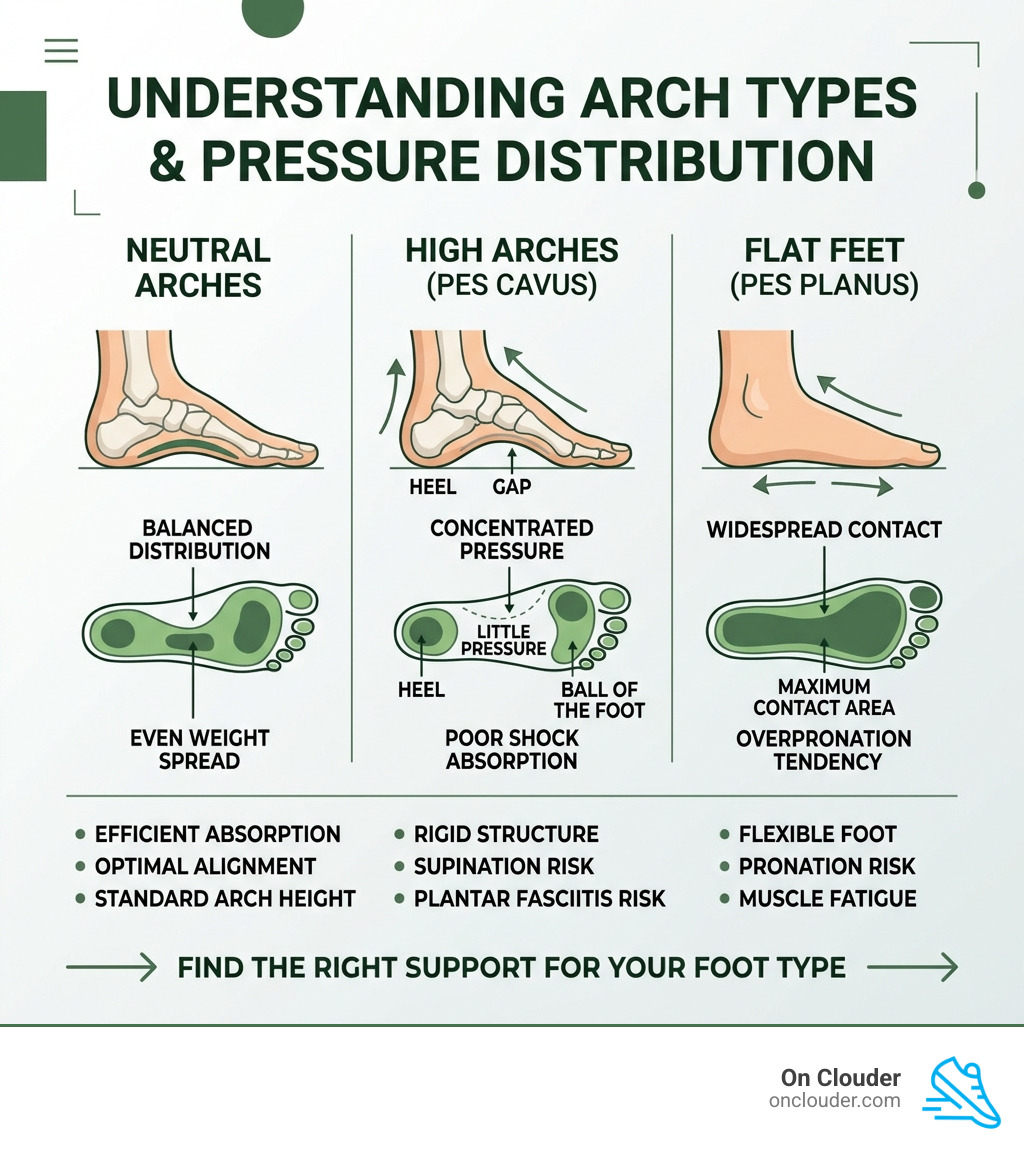
That’s because high arches — also called pes cavus — are rigid. They don’t absorb shock the way a neutral arch does. Instead, pressure piles up on two spots: your heel and the ball of your foot.
Without the right support, that pressure adds up fast. It can lead to supination (your foot rolling outward), plantar fasciitis, ankle instability, and serious fatigue — especially if you’re running, standing all shift, or logging miles on hard surfaces.
The good news? The right insole can make a real difference. And you don’t need expensive custom orthotics to get there.
I’m Faisal S. Chughtai, a footwear expert with a career built around helping people find the right fit for comfort and performance — including tracking down the best inserts for high arches across brands, activities, and budgets. Let’s get your feet the support they deserve.
Best inserts for high arches further reading:
Understanding Pes Cavus: Why You Need the Best Inserts for High Arches
High arches, medically known as pes cavus, are more than just a “tall” foot shape. Unlike flat feet, which collapse inward, or neutral arches, which flex to absorb impact, high arches are often rigid and inflexible. Because the arch doesn’t lower when you step down, your foot fails to absorb the shock of each stride.
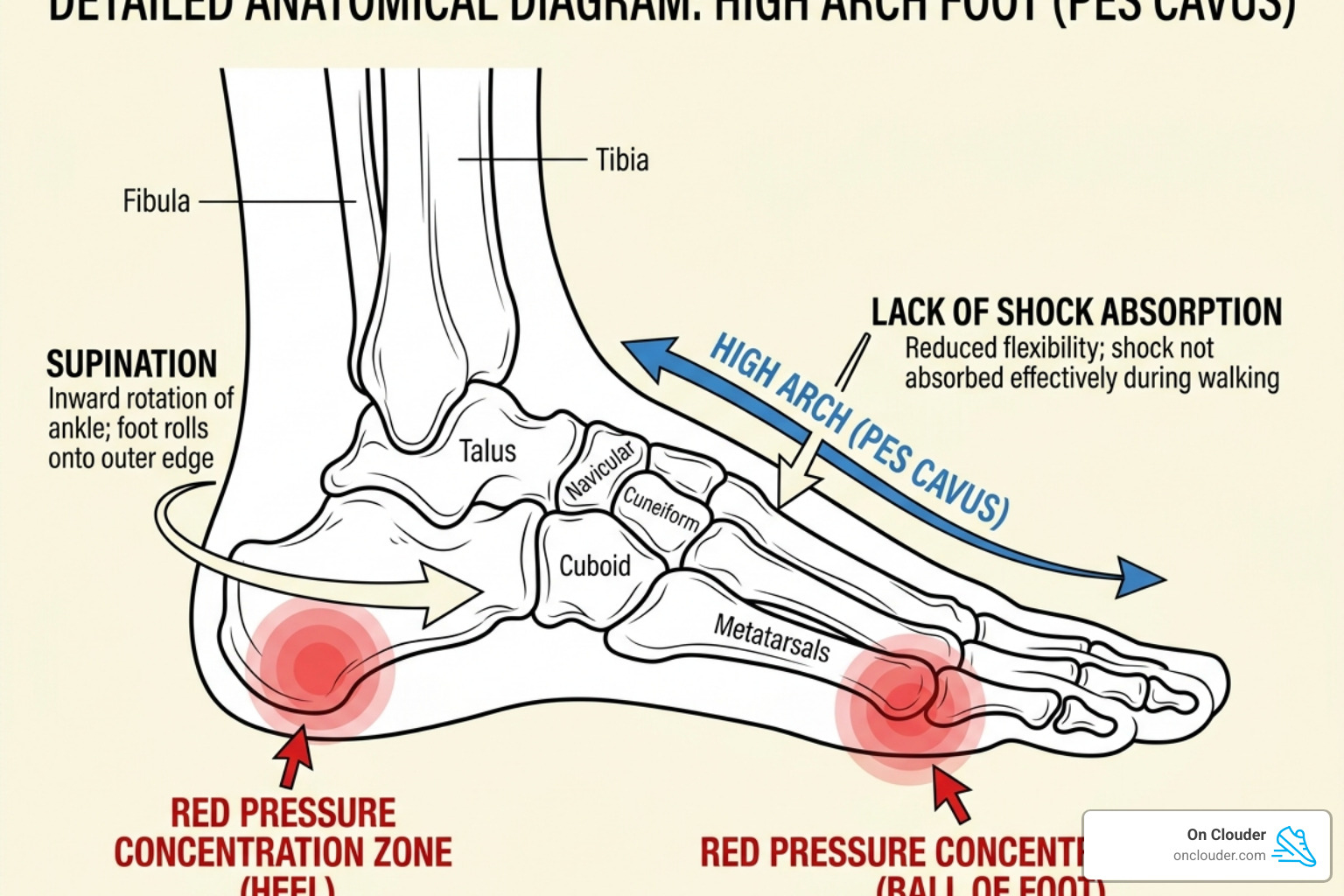
This lack of shock absorption creates a “bridge” effect. Your weight isn’t distributed across the entire sole of your foot; instead, it is concentrated heavily on the heel and the ball of the foot (the metatarsal heads). Over time, this localized pressure can lead to several painful conditions:
- Metatarsalgia: Inflammation and pain in the ball of the foot.
- Plantar Fasciitis: Excessive strain on the connective tissue running along the bottom of the foot.
- Callusing: Thickened skin forming under the high-pressure zones of the heel and forefoot.
- Stress Fractures: Small cracks in the bone caused by repetitive impact that the rigid arch cannot dissipate.
When you use the best inserts for high arches, you aren’t trying to “fix” the arch. Instead, you are filling that cavernous gap between your foot and the shoe. This creates a supportive “cradle” that allows the entire foot to share the workload. We’ve seen many readers find that the right support keeps them moving without the midday “screaming” feet. If you want to dive deeper into the mechanics, check out our high arches tag for more specialized advice.
How to Identify High Arches and Supination
How do you know for sure if you have high arches? While a podiatrist can give you a formal diagnosis, you can perform a simple “Wet Foot Test” at home to get a clear picture of your footprint.
- The Wet Foot Test: Wet the bottom of your foot and step firmly onto a flat, dry surface like a piece of cardboard or a concrete walkway.
- Analyze the Print:
- Flat Foot: You see a full footprint with almost no curve on the inside.
- Neutral Arch: You see a distinct curve along the inside, with the middle part of the foot about half the width of the heel.
- High Arch: You see the heel and the ball of the foot, but the connection between them is very thin or non-existent.
High arches are often synonymous with supination (or underpronation). This is when your foot rolls outward during movement. Because the arch is too rigid to roll inward (pronate) and absorb shock, the weight stays on the outer edge of the foot. This puts immense strain on the smaller toes and the outer ankle, significantly increasing the risk of ankle sprains.
You can also check your shoes. If the outer edges of your soles are worn down much faster than the inner edges, you are likely supinating. Finding the best insoles for foot pain starts with recognizing these alignment issues.
Choosing the Best Inserts for High Arches Based on Activity
Not all high arch inserts are created equal. The level of support you need changes based on what you’re doing:
- Running: High-impact activities multiply your body weight force by 2-3 times per footstrike. You need inserts with “adaptive” technology that flexes with the foot while providing deep heel cups for stability. Check out our arch support for runners section for performance-specific gear.
- Walking & Everyday Wear: For daily commutes or errands, a “firm foundation” is key. You want something that provides consistent support without being overly aggressive.
- Work Boots: If you spend 10+ hours on concrete, you need maximum cushioning paired with a rigid stabilizer cap to prevent foot fatigue.
Key Features of Effective High Arch Orthotics
When shopping for the best inserts for high arches, don’t get distracted by “pillowy” soft foam. While it feels good for five minutes, soft foam collapses under weight and provides zero actual support. Instead, look for these four essential components:
- Deep Heel Cup: This is non-negotiable. A deep cup cradles the heel’s natural fat pad, maximizing shock absorption and preventing the foot from rolling outward (supination).
- Firm Stabilizer Cap: This is the “skeleton” of the insole. It provides the structure needed to support a high arch and ensures the insole keeps its shape for months, not weeks.
- High-Density Foam: High-quality EVA or specialized foam provides long-lasting cushioning that doesn’t flatten out under pressure.
- Moisture-Wicking Top Cover: Look for materials like MoistureWick™ that reduce friction, heat, and odor—essential for keeping feet fresh during long days.
Many of the top-tier options we recommend carry the American Podiatric Medical Association (APMA) Seal of Acceptance, meaning they have been reviewed by a committee of podiatrists to ensure they promote foot health. Using high-quality arch support inserts is often the first step toward long-term relief.
Best Inserts for High Arches for Maximum Support
For those who need a firm, “no-nonsense” level of support, two brands consistently lead the pack: Superfeet and PowerStep.
Superfeet All-Purpose Support High Arch (Formerly Superfeet Green) This is arguably the most famous insole in the world for high arches. It features a high-profile shape and a heavy-duty stabilizer cap. It’s designed for roomy to moderate-fitting footwear where you can remove the existing liner. It’s a firm, professional-grade orthotic alternative that is clinically proven to decrease fatigue and improve comfort.
- Price: ~$59.99
- Best For: Work boots, hiking boots, and roomy sneakers.
- Link: All-Purpose Support High Arch
PowerStep Pinnacle High Insoles PowerStep is frequently cited as the #1 podiatrist-recommended brand. The Pinnacle High features a firm but flexible support shell. It’s particularly effective for those struggling with supination, as the deep heel cradle and specialized arch shape help stabilize the ankle. Many users report feeling relief within just 1 to 3 days of wear.
- Price: ~$54.95
- Best For: Everyday alignment and supination relief.
- Link: PowerStep Pinnacle High Insoles
Best Performance and Running Specific Options
Running requires a different kind of support—one that can move with you. Rigid inserts can sometimes feel too “clunky” during a run.
Superfeet Run Cushion High Arch Insoles These are specifically engineered for the gait cycle of a runner. They utilize “Adaptive Comfort Technology™,” which allows the insole to flex naturally with your foot as you transition from heel to toe. They also feature an Aerolyte™ dual comfort layer for responsive cushioning that doesn’t sacrifice stability.
- Price: ~$59.99–$89.72
- Best For: Distance running, sprinting, and zero-drop athletic shoes.
- Link: Superfeet Run Cushion High Arch Insoles
For more detailed comparisons, you can see our breakdown of the top high arch support insoles reviewed to see how these stack up in real-world testing.
Fitting, Maintenance, and Longevity
Buying the best inserts for high arches is only half the battle; you have to fit them correctly. Most high-quality insoles are “trim-to-fit.”
How to Trim and Fit
- Remove the Factory Liner: Never put a high-profile insole on top of the existing shoe liner. It will create too much bulk and could cause blisters.
- Use the Old Liner as a Template: Place the factory liner on top of your new insole, aligning the heels. Trace the toe area with a pen.
- Trim Carefully: Use sharp scissors to trim along the line. It’s always better to trim too little than too much—you can always take more off later.
- Test the Fit: Slide the insole into your shoe. It should lay flat without bunching or “swimming” around.
The 500-Mile Rule
Just like running shoes, insoles have a lifespan. Most high-quality inserts like Superfeet or PowerStep are designed to last about 12 months or 500 miles, whichever comes first. If you notice the cushioning has flattened, the fabric is peeling, or your old foot pain is returning, it’s time for a replacement.
Value and Guarantees
Quality insoles generally fall in the $50 to $90 range. While this may seem high compared to $10 drugstore brands, the longevity and medical-grade support offer much better value. Plus, many brands offer a 60-day comfort guarantee. If you don’t feel a difference in two months, you can often get a full refund.
Additionally, many of these are HSA/FSA eligible, making them a tax-free investment in your foot health. For more basics on getting started, read our arch support inserts 101 guide.
Frequently Asked Questions about High Arch Support
Can high arch insoles help with plantar fasciitis and supination?
Yes, absolutely. Plantar fasciitis is often caused by the arch stretching too far or being unsupported. By filling the gap, the insole prevents the plantar fascia from overstretching. For supination, the deep heel cup and firm arch structure provide a “railing” that prevents the foot from rolling onto its outer edge, keeping you in a neutral alignment.
How do I know when it is time to replace my high arch inserts?
The most obvious sign is the return of foot fatigue or pain. Visually, look for:
- Compression of the foam (it no longer “springs” back).
- Cracking in the plastic stabilizer cap.
- The top fabric wearing through to the foam.
- Usually, this happens every 6–12 months depending on your activity level.
Are custom-molded orthotics better than over-the-counter high arch insoles?
“Better” depends on your needs. Custom orthotics are tailored to your exact foot shape and are great for severe deformities or neurological conditions. However, for the vast majority of people with high arches, high-quality over-the-counter (OTC) inserts like Superfeet or PowerStep provide 90% of the benefit at 20% of the cost. You should consider custom options if OTC inserts fail to provide relief after a consistent break-in period.
Conclusion
Living with high arches doesn’t have to mean living with foot pain. By choosing the best inserts for high arches, you are giving your body the foundation it needs to stand longer, run further, and recover faster. Whether you opt for the firm, all-purpose support of Superfeet or the supination-fighting power of PowerStep, the goal is the same: even pressure distribution and proper alignment.
At On Clouder, we believe that the right gear is the best injury prevention. Don’t wait until you have a stress fracture or a chronic case of plantar fasciitis to take action. Invest in your feet today, and they’ll carry you for miles to come.
Ready to take the next step? Step up your game with the best arch support inserts and find the perfect match for your favorite pair of shoes.