Best Arch Support Inserts for Plantar Fasciitis: Where to Start
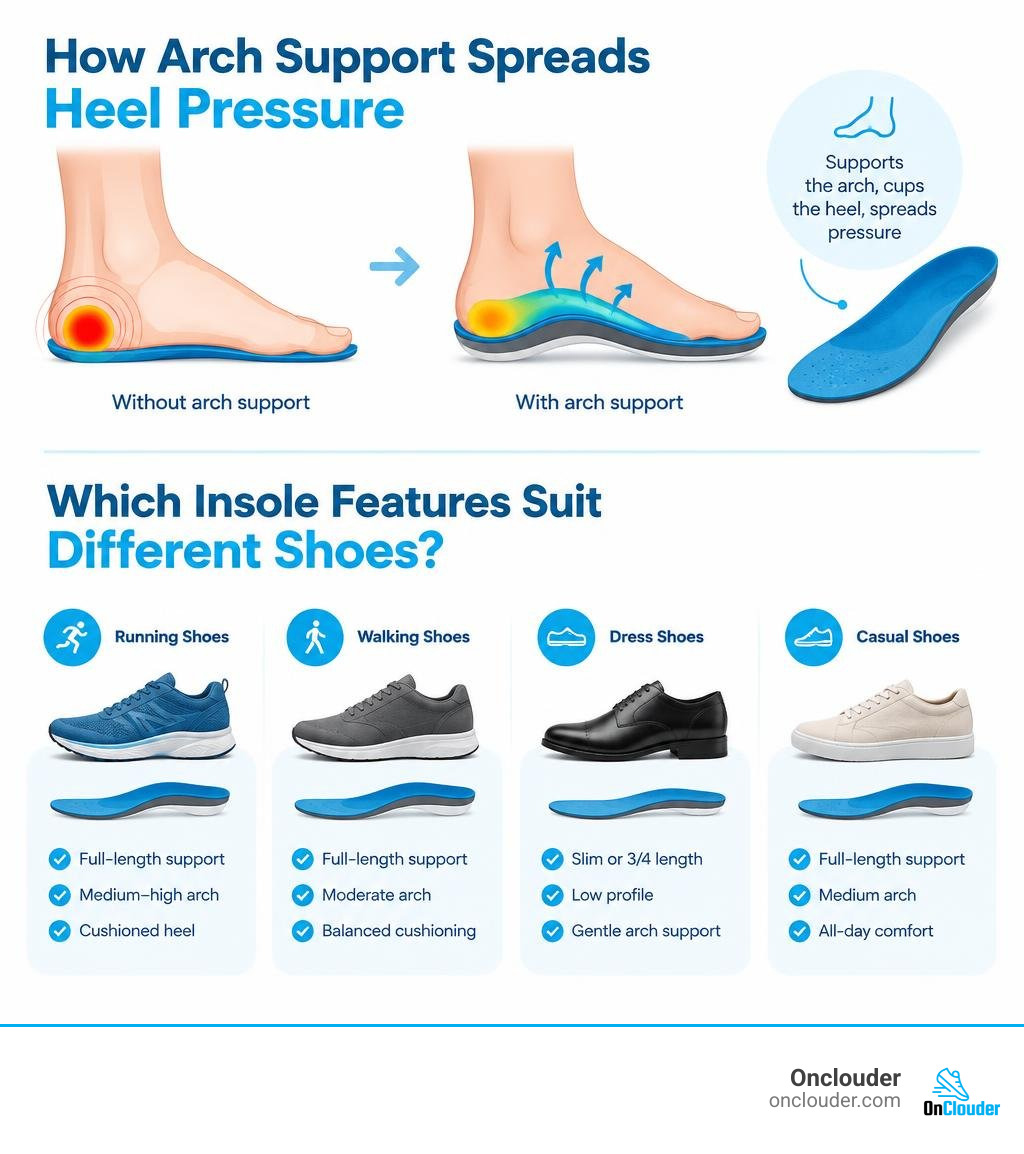
Start with an insole that supports your arch, cups your heel, and fits your shoes without crowding your toes. PowerStep Pinnacle is a strong all-around OTC choice. Tread Labs Pace offers more arch-height options, while WALKHERO is a lower-cost option for daily walking. For dress shoes with less room, look for a slim or 3/4-length insert instead of forcing in a full-length one.
The right fit matters more than the biggest promise on the box. Arch support inserts for plantar fasciitis can ease heel pain by supporting the arch and spreading pressure, but they work best alongside supportive shoes and gentle stretching.
Relevant articles related to arch support inserts plantar fasciitis:
- plantar fascia orthotic insole
- shoes with good arch support for plantar fasciitis
- supportive shoes for plantar fasciitis
How Arch Support Inserts Relieve Plantar Fasciitis Pain
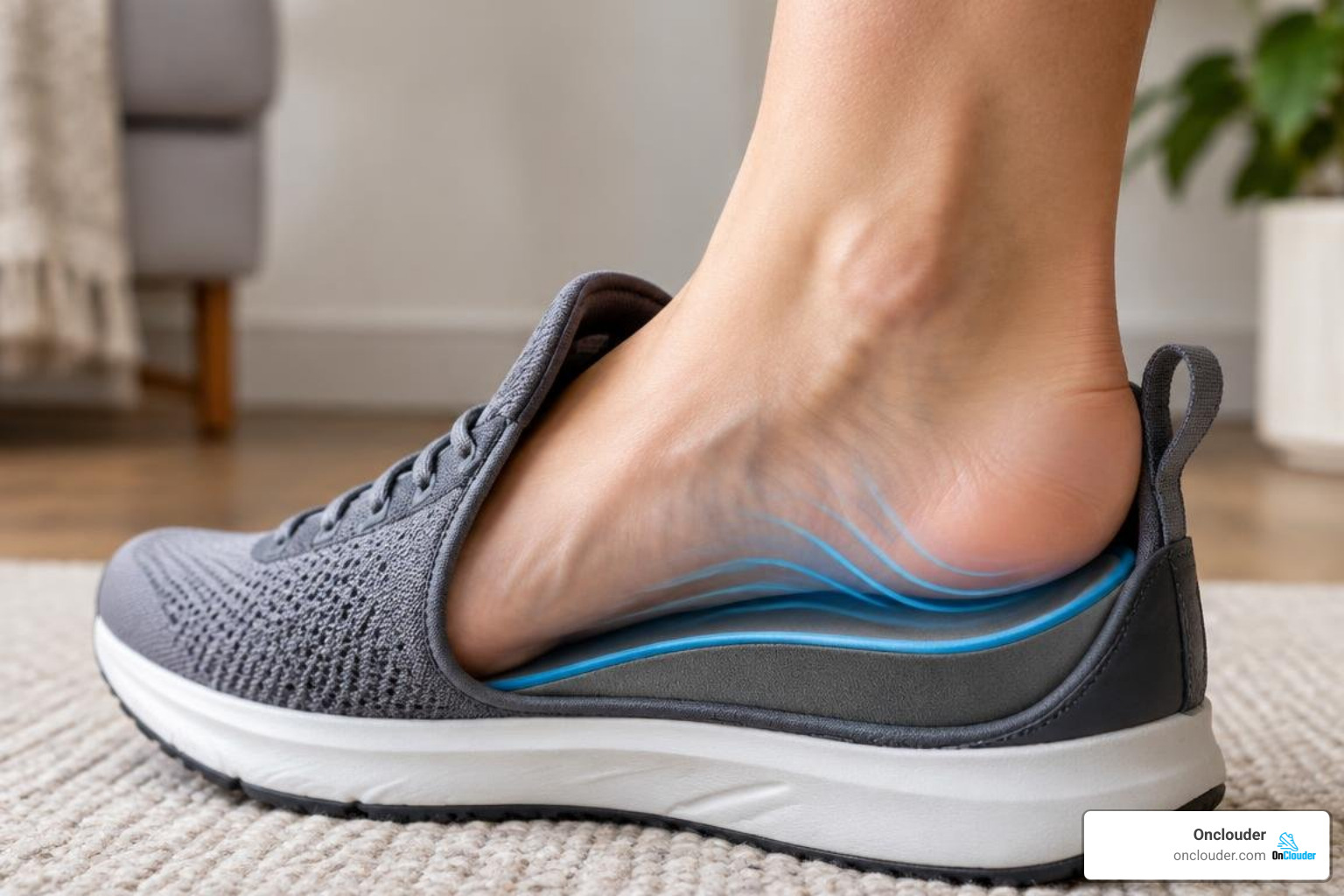
Plantar fasciitis affects roughly 10% of people at some point in their lives. The condition stems from repeated strain on the thick band of connective tissue running along the bottom of your foot, known as the plantar fascia. This fibrous band connects your heel bone (calcaneus) to your toes and acts as a dynamic shock absorber. When your foot flattens excessively or absorbs repetitive impact without adequate structural support, micro-tears develop near the calcaneal attachment, leading to sharp, stabbing heel pain that is notoriously severe during your first steps in the morning.
Arch support inserts do not simply add soft padding; their primary therapeutic mechanism is structural tension management. When you walk, your foot engages the windlass mechanism: as the big toe extends during push-off, the plantar fascia winds around the metatarsophalangeal joint, tightening the arch. If your arch collapses or lacks support during mid-stance, the tensile load on the fascia spikes dramatically.
A clinical trial published in the Journal of Experimental Orthopaedics demonstrated the physical impact of structured support [[ADAPTIFYMEDICALCITATION:mcdoi6967af9f1a68:INLINE]]. In this study, arch-support insoles increased navicular height and medial longitudinal arch elevation while reducing peak heel stress by 34.7% and average heel stress by 14.6%. By redistributing body weight across the entire plantar surface, structured inserts unload the calcaneal attachment. Combining this biomechanical unloading with a deep, stabilizing heel cup keeps the natural fat pad centralized beneath your heel bone, preventing painful tissue flattening upon ground strike. To better understand these biomechanics, review our practical guide to plantar fascia orthotics.
Top Arch Support Inserts Plantar Fasciitis Comparisons and Reviews
Finding the right balance between cushioning, rigid shell support, and shoe volume is essential for genuine pain relief. Drugstore gel pads often flatten within days, functioning like useless pancakes under load. In contrast, effective orthotics rely on semi-rigid polypropylene or durable composite materials to preserve arch architecture.
| Insole Model | Arch Profile Suitability | Shell Rigidity | Heel Cup Depth | Standout Feature |
|---|---|---|---|---|
| PowerStep Pinnacle | Neutral to Low | Semi-Rigid Polypropylene | Deep (approx. 15mm) | Dual-layer cushioning, podiatrist gold standard |
| Tread Labs Pace | 4 Heights (Low to Extra High) | Rigid Molded Composite | Very Deep (approx. 18mm) | Replaceable foam top covers, Million Mile Guarantee |
| WALKHERO All-Purpose | Neutral to Flat | Semi-Rigid TPU Base | Deep Contoured Cup | Budget-friendly EVA/PUR blend with silicone heel pad |
| PowerStep Pinnacle Plus | Neutral to High | Semi-Rigid Polypropylene | Deep Cradle | Integrated metatarsal pad for ball-of-foot relief |
| Dr. Scholl’s Plantar Fasciitis | Neutral | Flexible Composite | Moderate Heel Cradle | Sized-to-fit Relyx365 foam with ShockGuard heel zone |
To see how these styles compare across different footwear categories, explore our guide to shoe insoles for arch support and plantar fasciitis.
PowerStep Pinnacle: Best Overall Arch Support Inserts Plantar Fasciitis Choice
The PowerStep Pinnacle remains one of the most trusted non-prescription orthotics available. Clinicians regularly recommend it because approximately 60% to 70% of individuals with moderate plantar fasciitis achieve noticeable relief through its balance of structural stability and shock attenuation.
The Pinnacle utilizes an encapsulated, semi-rigid polypropylene arch support shell that resists collapsing under full body weight. Paired with a deep heel cradle, it stabilizes the subtalar joint and reduces excessive pronation. Above the firm shell sits dual-layer cushioning featuring Variable Cushioning Technology (VCT) and high-density EVA foam. This combination cushions high-impact zones without dampening the underlying biomechanical correction.
Tread Labs Pace: Best Medical-Grade Semi-Custom Support
Tread Labs Pace takes a semi-custom approach to over-the-counter arch support. Rather than forcing a single generic arch curvature on every foot, Tread Labs manufactures its rigid composite arch supports in four distinct heights: Low, Regular, High, and Extra High.
This tiered sizing allows you to match the contours of your medial longitudinal arch with high precision, avoiding the painful under-support or aggressive arch digging common in generic designs. The Pace model features a two-part system: an ultra-durable composite arch shell backed by a Million Mile Guarantee, paired with a replaceable polyurethane top cover. The APMA-accepted design provides a deep 18mm heel cradle that concentrates your natural fat pad beneath the calcaneus for reliable impact protection.
WALKHERO All-Purpose: Best Budget Insole for Daily Walking
For those seeking an accessible entry point to structured foot support, the WALKHERO All-Purpose Insole delivers solid value. Built from a 70% EVA and 30% polyurethane (PUR) material blend, it blends firm support with sufficient resilience for everyday walking and prolonged standing shifts.
The insole incorporates a rigid thermoplastic arch bridge with a deep heel cup and a localized silicone cushioning pad at the base of the heel. While the arch geometry is slightly more forgiving than the stiff composite shells of Tread Labs or medical-grade devices, it provides dependable alignment control for mild-to-moderate arch fatigue without breaking the bank.
PowerStep Pinnacle Plus: Best for Combined Arch and Metatarsal Pain
If your heel pain is accompanied by tingling, burning, or aching across the ball of your foot, the PowerStep Pinnacle Plus is engineered specifically for your needs. This model takes the proven semi-rigid polypropylene foundation of the classic Pinnacle line and embeds a permanent, raised metatarsal pad just behind the metatarsal heads.
This raised pad gently spreads and elevates the forefoot bones, relieving pinched interdigital nerves and taking tension off the anterior fibers of the plantar fascia. The dual-layer VCT foam top layer dampens forefoot impact during running or brisk walking, making it a reliable pick for individuals dealing with both plantar fasciitis and Morton’s neuroma or metatarsalgia.
Dr. Scholl’s Plantar Fasciitis Pain Relief: Best Sized-to-Fit Drugstore Option
For quick, convenient access at local retail stores, Dr. Scholl’s Plantar Fasciitis Pain Relief Sized to Fit Insoles offer a solid step up from basic gel pads. They feature a full-length design tailored to standard shoe sizes, eliminating the need to trace and trim foam with scissors.
These insoles feature a 3D targeted arch bridge constructed from a flexible composite, paired with proprietary ShockGuard technology in the heel cup. The cushioning layer uses Relyx365 foam, engineered to absorb ground impact before it reaches an inflamed calcaneal attachment. While less rigid than PowerStep or Tread Labs models, they provide accessible, day-one relief for lighter daily use in work boots and sneakers.
How to Choose the Right Insole for Your Arch Profile and Shoes
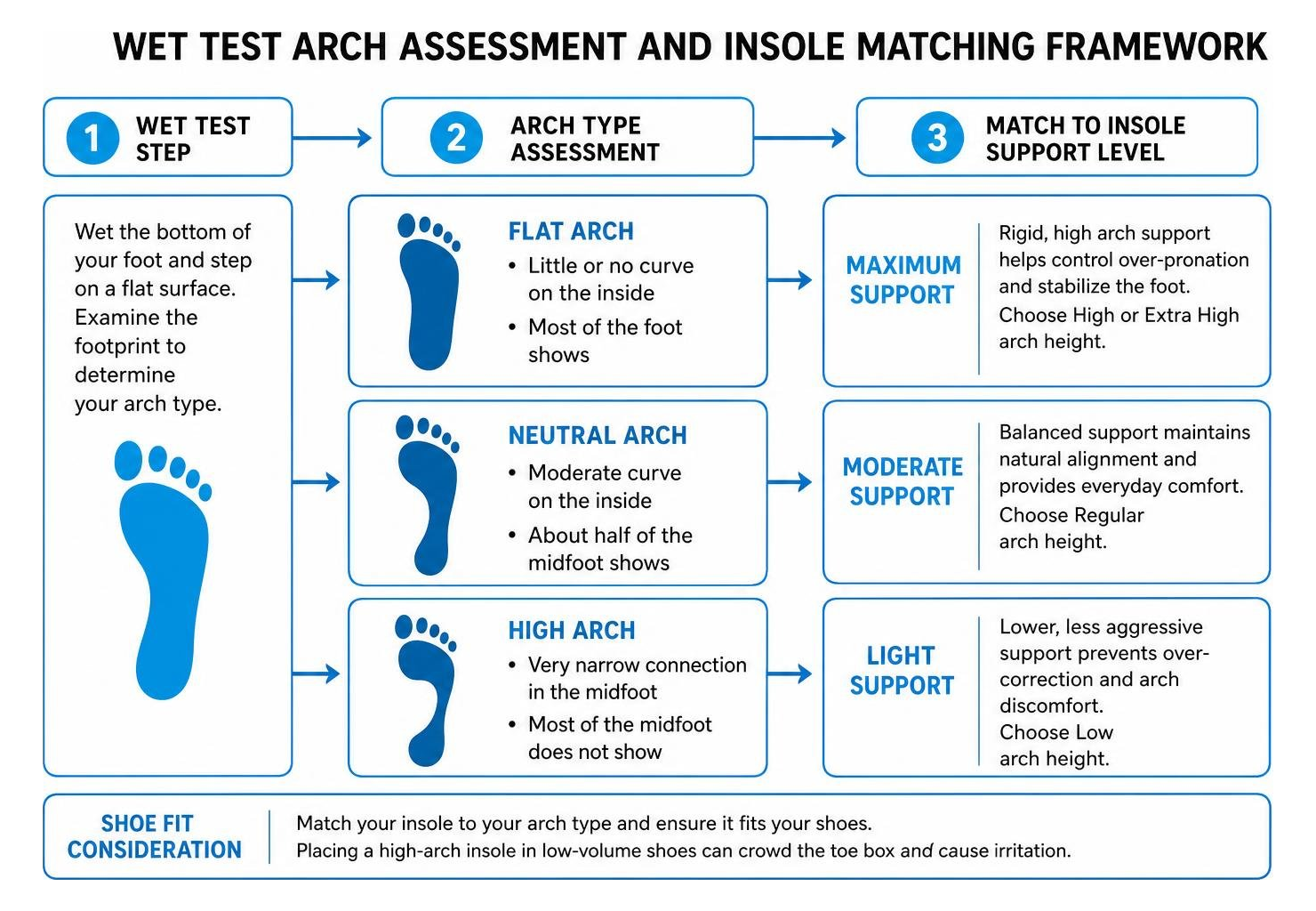
Selecting the right insert requires evaluating your foot anatomy alongside the specific footwear you wear every day. Placing an aggressive high-arch insole into a low-volume shoe can crowd the toe box and push your foot against the upper, causing irritation elsewhere.
For a broader evaluation of how distinct orthotic shapes interact with foot pain, consult our guide on how to choose the best insoles for foot pain and arch support.
Matching Your Arch Type: Flat Feet, Neutral, and High Arches
You can identify your arch type using a simple wet-footprint test or by looking at wear patterns on old footwear:
- Flat Feet / Low Arches (Overpronation): When weight is applied, your arch collapses inward, placing severe tensile stress across the medial band of the plantar fascia. Look for a semi-rigid medial arch bridge with strong pronation control. If you require higher load-bearing capacity, examine heavy duty insoles for plantar fasciitis relief.
- Neutral Arches: Your arch flexes moderately during dynamic movement. A semi-rigid, medium-height arch shell combined with standard dual-layer foam distributes plantar pressure evenly across the forefoot and rearfoot.
- High Arches (Underpronation / Supination): High arches are rigid and absorb shock poorly, creating extreme pressure points on the heel and ball of the foot. You need high-profile arch contouring that physically fills the empty space under the medial arch to redistribute ground reaction forces.
Full-Length vs. 3/4-Length Inserts for Different Footwear Styles
The construction of your shoes dictates the profile of insole you should buy:
- Full-Length Insoles: These require removing your shoe’s factory liner. They are best suited for athletic running shoes, roomy walking sneakers, and work boots with removable footbeds. Full-length models deliver cohesive cushioning from heel to toe.
- 3/4-Length Inserts: These stop just behind the metatarsal heads, leaving the toe box open. They are ideal for narrow dress shoes, loafers, or low-profile flats where the factory insole is glued down. Look for rigid rearfoot control options that fit without pinching your toes.
Custom Orthotics vs. Over-the-Counter Arch Support Inserts Plantar Fasciitis Options
When weighing non-prescription insoles against custom devices, consider how much structural correction you need. For a deeper breakdown of this choice, read our analysis on comparing over-the-counter inserts versus custom orthotics.
OTC orthotics are built around population-average contours. Priced between $25 and $75, they provide sufficient biomechanical correction for the vast majority of mild-to-moderate plantar fasciitis cases. In contrast, custom prescription orthotics ($300 to $600+) involve 3D laser scanning or plaster casting using CAD/CAM fabrication to capture your foot in a neutral subtalar joint position. Custom devices are typically reserved for severe structural abnormalities, significant limb-length discrepancies, or cases where standard OTC inserts fail to yield results after consistent use.
Insole Break-In Periods, Longevity, and Adjunct Therapies
Adapting to a firm orthotic shell requires a structured break-in schedule. Because the insert changes the way your foot, ankle, and calves recruit muscles during movement, jumping straight into an eight-hour shift can cause arch soreness.
Follow this gradual wear-in timeline:
- Days 1–2: Wear your new inserts for 1 to 2 hours during light daily activity.
- Days 3–4: Increase wear time to 3 to 4 hours per day.
- Days 5–7: Expand usage to 5 to 6 hours, including moderate walking.
- Week 2 onward: Transition to full-day wear across all activities.
Even premium insoles have a finite lifespan. Insole foams and polymer shells experience mechanical fatigue from repeated ground impact. Most quality OTC insoles should be replaced every 12 to 18 months. Signs that your insoles are ready for replacement include compressed or bottomed-out top foam, visible cracks in the underlying plastic shell, uneven wear at the heel, or a return of morning heel pain.
Insoles are most effective when combined with other conservative therapies. Pair your orthotics with daily calf stretches against a wall, gentle plantar fascia stretches (pulling your toes upward toward your shin before getting out of bed), and rolling the bottom of your foot over a frozen water bottle for 5 to 10 minutes post-activity.
Frequently Asked Questions About Plantar Fasciitis Insoles
How long does it take for arch support insoles to relieve plantar fasciitis?
Most people notice reduced arch strain within 3 to 7 days of regular wear. However, clinical research indicates that substantial soft-tissue recovery and statistically significant drops in pain scores typically occur around the 4-week mark of continuous support. Chronic inflammation takes time to resolve, making consistency essential.
Can shoe inserts cure plantar fasciitis on their own?
Shoe inserts reduce mechanical strain on the plantar fascia, creating the physical environment needed for healing. However, they are part of a broader conservative recovery plan. For complete recovery, combine supportive inserts with daily gastrocnemius/soleus calf stretching, plantar fascia mobilization, avoidance of barefoot walking on hard surfaces, and supportive daily footwear.
What should I do if over-the-counter insoles do not relieve my pain?
If you have used high-quality, semi-rigid OTC inserts consistently for 6 to 8 weeks alongside stretching and supportive shoes without meaningful relief, schedule an evaluation with a podiatrist or orthopaedic specialist. A clinician can perform diagnostic imaging (such as ultrasound or X-rays) to rule out calcaneal stress fractures, nerve entrapment, or severe fascial tears, and assess whether you need custom-molded orthotics, physical therapy, night splints, or advanced therapies.
Conclusion
Plantar fasciitis is a mechanical condition that responds well to targeted mechanical support. By selecting an insole with a rigid or semi-rigid arch shell, a deep heel cup, and adequate shoe volume matching, you can lower peak tensile stress across your plantar fascia and encourage natural tissue healing.
At Onclouder, our hands-on testing shows that the right orthotic is only as good as the platform holding it. To pair your new insoles with stable, supportive daily footwear, explore our comprehensive best work shoes for plantar fasciitis guide.
References
[[ADAPTIFYMEDICALCITATION:mcdoi6967af9f1a68:REFERENCE]]