Best Boots for Plantar Fasciitis on Hard Surfaces
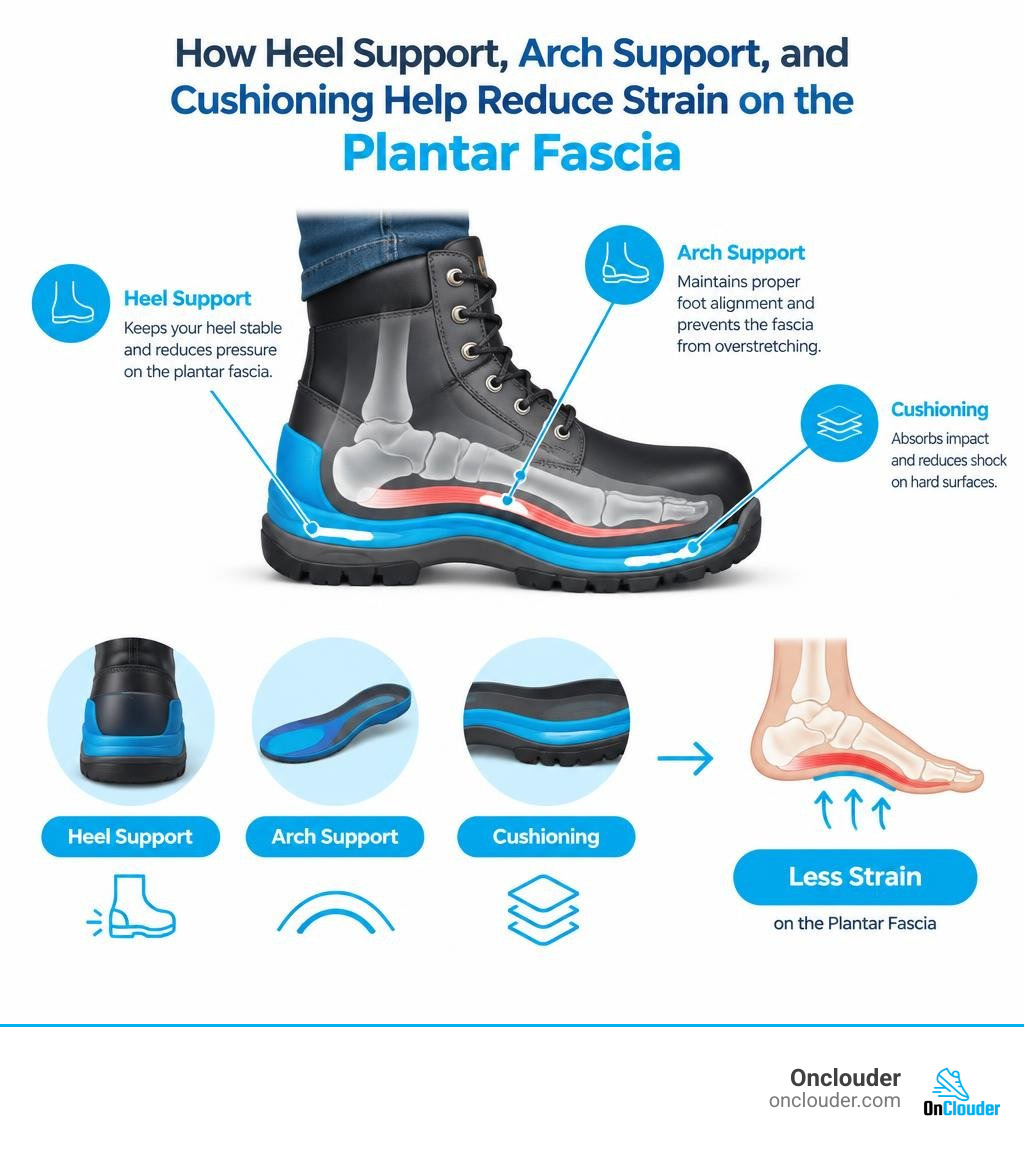
The best boots for plantar fasciitis have a firm heel cup, steady arch support, a cushioned sole, and enough room for your toes. Look for a removable insole if you use orthotics. For work, make sure the boots also meet your job’s safety rules and feel secure without pinching or letting your heel slip.
Hours on concrete can make heel pain harder to ignore. The right boots may ease pressure while you stand and walk, but they cannot heal plantar fasciitis on their own. In this guide, we’ll help you compare supportive boot features so you can choose a pair that fits your feet and your workday.
Glossary for best boots for plantar fasciitis:
- supportive shoes for plantar fasciitis
- plantar fascia orthotic insole
- shoes with good arch support for plantar fasciitis
Understanding Plantar Fasciitis: Causes and Risk Factors on the Job
Plantar fasciitis is one of the most frustrating foot conditions anyone can encounter, especially if your job demands being on your feet all day. It accounts for an estimated 11% to 15% of all foot-related medical complaints, and nearly 2 million Americans seek treatment for it every single year. The condition is slightly more prevalent in women than men, with older adults generally facing a higher risk than younger individuals. According to the American Academy of Orthopaedic Surgeons, plantar fasciitis is the most common cause of heel pain.

At its core, plantar fasciitis is the irritation and inflammation of the plantar fascia—a thick, web-like band of fibrous tissue running along the bottom of your foot. It connects your heel bone (calcaneus) to the base of your toes, acting as a natural shock absorber and bowstring that maintains your foot’s arch. Every time your foot strikes the ground, this band stretches under your body weight.
When you subject your feet to repetitive stress, excessive tension, or unyielding hard surfaces like concrete warehouse floors, tiny micro-tears can develop within the tissue. Over time, these micro-tears lead to localized swelling, stiffness, and that unmistakable, stabbing sensation in the base of your heel.
Several key risk factors increase your vulnerability to this strain on the job:
- Tight Achilles Tendons and Calves: A tight calf muscle or Achilles tendon limits ankle dorsiflexion (upward bend), forcing the plantar fascia to endure excessive mechanical strain during every step.
- Prolonged Standing on Concrete: Unforgiving industrial flooring offers zero shock attenuation, bouncing impact shock straight back into your heel pad.
- Biomechanical Imbalances: Both severe overpronation (inward foot rolling) and high, rigid arches alter natural weight distribution, placing uneven stress on the plantar aponeurosis. Consulting podiatrist approved best shoes for plantar fasciitis can give you a better sense of how your specific arch profile interacts with footwear.
- Hard, Flat Footwear: A cross-sectional study revealed that 55.5% of plantar fasciitis patients routinely wore shoes featuring hard, non-cushioned insoles lacking built-in arch structures.
- Excess Body Weight: Increased load places sustained downward pressure on the foot arch, stretching the fascia beyond its resting threshold.
Understanding these mechanics makes it clear why standard, unyielding footwear fails to protect workers. Without adequate support, every step on hard decking or asphalt compounds tissue fatigue.
Key Features of the Best Boots for Plantar Fasciitis
When we evaluate work footwear at Onclouder, we look past rugged marketing claims and focus squarely on structural biomechanics. If you are battling severe morning heel pain or burning arches after a 10-hour shift, your boots need to work as hard as you do to protect your musculoskeletal system.
Here is a side-by-side comparison of how specialized supportive footwear contrasts with standard, run-of-the-mill work boots:
| Feature Category | Standard Work Boots | Supportive Plantar Fasciitis Boots |
|---|---|---|
| Heel Counter | Soft, flexible, or cardboard-backed | Rigid, deep heel cup stabilizing calcaneus |
| Arch Support | Flat, minimal foam insert | Ergonomically contoured composite or dual-density arch |
| Midsole Cushioning | Basic hard rubber or thin foam | Multi-layer EVA or responsive polyurethane (PU) |
| Torsional Rigidity | Easily twists or bends in the middle | Stiff midfoot shank preventing excessive twisting |
| Toe Box Profile | Tapered, constricting natural toe splay | Broad, anatomical toe box reducing lateral strain |
| Footbed Versatility | Glued-down, non-removable liner | Removable footbed accommodating custom orthotics |
Transitioning to high-grade cushioned safety boots provides the foundation needed to protect your plantar fascia from high-impact loading day after day.
Anatomy of the Best Boots for Plantar Fasciitis
To appreciate why a boot alleviates plantar tension, it helps to examine its inner engineering. A boot built for arch protection functions as an external support frame for your foot’s complex network of 26 bones, 33 joints, and over a hundred muscles and ligaments.
- Deep Heel Cups and Firm Heel Counters: The natural fat pad under your heel bone is your body’s built-in cushion. A deep, supportive heel cup holds that fat pad directly beneath the calcaneus, preventing it from flattening out upon impact.
- Integrated Supportive Shank: Located between the insole and outsole, a rigid steel or composite shank provides torsional stability. This prevents the boot from bending in the middle under your arch—ensuring it only flexes where your foot naturally bends at the metatarsal joints.
- Engineered Midsoles (EVA vs. PU): Ethylene-vinyl acetate (EVA) offers lightweight, plush shock absorption that minimizes impact spikes. Polyurethane (PU) midsoles, on the other hand, provide slightly firmer, long-lasting energy return that resists bottoming out under heavy loads.
- Slight Heel Block (Heel-to-Toe Drop): A slight heel elevation relative to the forefoot takes passive tension off the Achilles tendon and calf, directly reducing the pulling force exerted on the plantar fascia.
- Anatomical Toe Box: A roomy toe area allows your toes to splay naturally during push-off. When toes are crammed, your foot cannot balance properly, which transfers excess stabilization work back to the arch. Reviewing our ultimate checklist for plantar fasciitis supportive shoes provides additional checkpoints for evaluating everyday footwear fit.
What Makes the Best Boots for Plantar Fasciitis Effective on the Job?
The best boots for plantar fasciitis do not merely cushion your heel—they actively preserve your body’s energy and improve natural gait mechanics throughout a long workday.
By stabilizing your foot against excessive pronation and supination, supportive footwear minimizes unnecessary micro-movements inside the boot. This structural stability reduces the workload on the small intrinsic muscles of your feet and lower legs, dramatically delaying the onset of muscle fatigue.
Furthermore, lightweight boot designs constructed with modern composite safety toes and advanced polymers prevent that sluggish “dragging your feet” sensation by hour eight of a shift. When paired with slip-resistant outsoles that secure traction across oily or wet surfaces, you maintain a confident, natural stride. For those needing maximum durability on tough job sites, exploring dedicated durable work shoes for plantar fasciitis ensures your footwear meets both safety compliance and therapeutic demands.
Footwear Styles and Boot Designs to Avoid When Suffering from Heel Pain
Just as the right pair of boots can set you on the road to recovery, the wrong footwear will actively sabotage your healing process. Wearing unsuitable boots keeps the plantar fascia in a chronic state of micro-trauma, preventing inflamed tissues from repairing themselves.
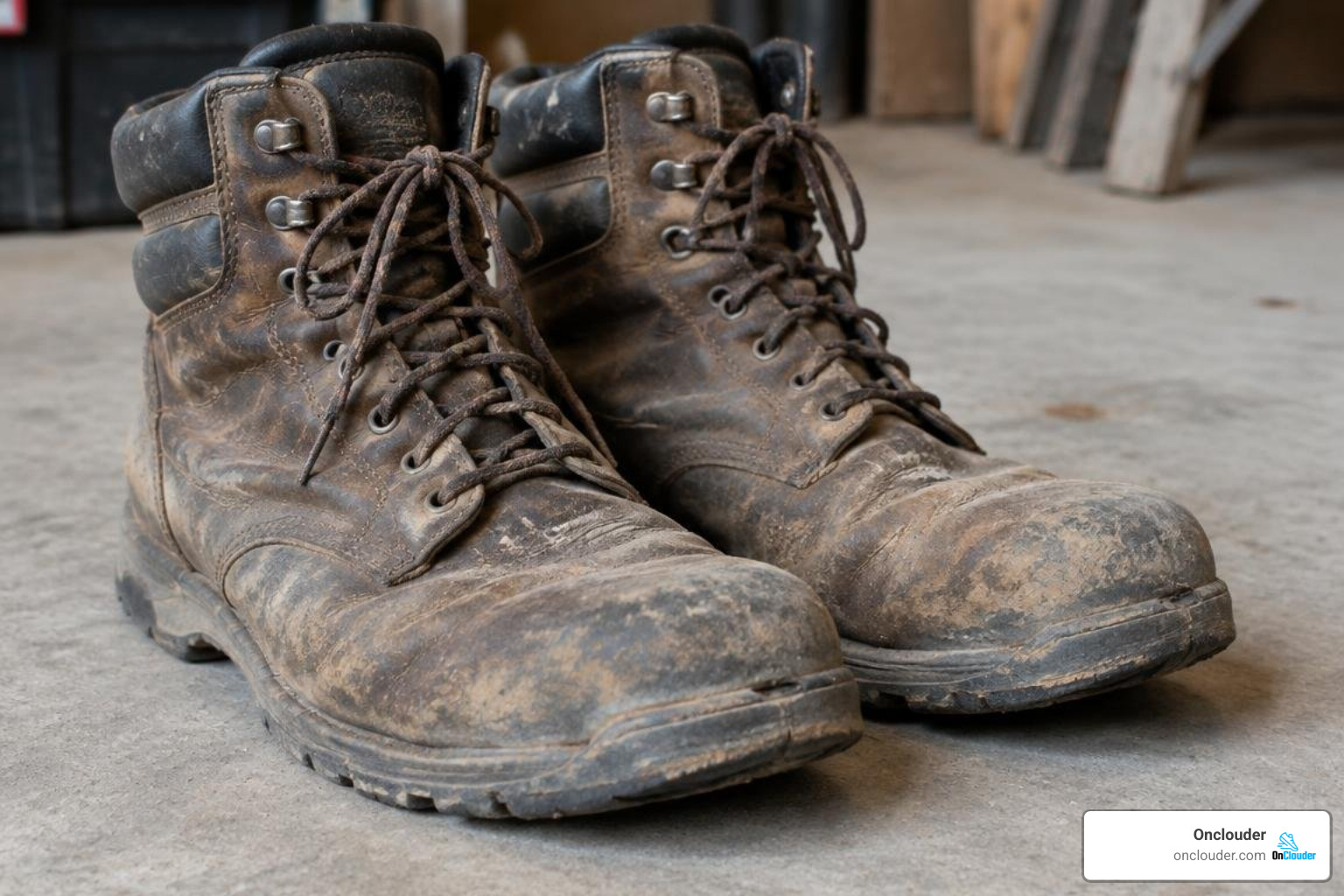
When shopping for work footwear or evaluating your current pair in the closet, avoid these major design pitfalls:
- Completely Flat, Non-Cushioned Footbeds: Boots with unpadded, board-like footbeds offer zero arch contours. They force the entire impact of your body weight directly onto your heel pad and metatarsal heads with every stride.
- Excessively Flexible Midsoles: If you can take a work boot and easily fold it in half or twist it like a wet towel, it lacks midfoot torsional rigidity. A boot that bends under the arch forces your plantar fascia to act as the primary structural beam, accelerating tissue exhaustion.
- Overly Worn-Out Treads and Compressed Foams: Footwear cushioning has an expiration date. Over 6 to 12 months of constant wear, midsole foam loses its elasticity and permanently compresses (a phenomenon known as “packing out”). Once dead foam stops absorbing shock, your heel absorbs the brunt of every step.
- Zero-Drop or Minimalist Work Footwear (Without Transition): Dropping abruptly to a completely flat profile without adequate heel elevation stretches tight Achilles tendons, placing immediate, severe tensile stress on the plantar fascia.
- Narrow, Pointed Safety Caps: Boots that squeeze the forefoot prevent your big toe from stabilizing your arch during the windlass mechanism (the natural tightening of the fascia during step push-off).
If you are currently wearing worn-out or unsupportive boots, set them aside. Exploring broader footwear options for sore arches will help you find designs that protect your recovery rather than hinder it.
Managing Foot Pain on Shifts: Recovery Timelines and Workday Tips
You cannot always take several weeks off work to rest your feet. Fortunately, combining supportive footwear with targeted daily habits allows many workers to manage discomfort effectively while staying productive on the job.
To keep pain under control throughout your shifts, incorporate these practical self-care strategies into your daily routine:
- Rotate Between Two Pairs of Boots: Alternating between two pairs of supportive work boots allows the midsole cushioning of each pair 24 to 48 hours to decompress and regain its original shock-absorbing shape. It also ensures the interior dries thoroughly, extending boot longevity.
- Upgrade with High-Performance Insoles: If your boots feature removable footbeds, consider swapping standard factory liners for dedicated arch support shoe inserts. For workers carrying heavy gear or weighing over 200 pounds, selecting heavy duty supportive insoles provides the reinforced arch density necessary to prevent bottoming out.
- Perform Targeted Calf and Plantar Stretches: Before getting out of bed in the morning and right before starting your shift, gently stretch your calf muscles and plantar fascia. Stand on the edge of a step and lower your heels, or pull your toes backward toward your shin using your hand or a towel. Hold stretches for 30 seconds without bouncing.
- Use Frozen Water Bottle Massages: After your shift, roll the arch of your foot over a frozen water bottle for 10 to 15 minutes. This delivers a dual benefit: deep myofascial release along the plantar band combined with cold therapy to suppress active inflammation.
- Wear Supportive Footwear at Home: Walking barefoot on hard tile, hardwood, or laminate floors at home can immediately re-aggravate recovering tissue. Keep a pair of cushioned indoor recovery slides or supportive slippers near your door to ensure your arches remain supported off the clock.
- Try Compression Socks: Graduated compression socks can improve localized blood circulation, reduce workday swelling around the lower ankle, and provide gentle structural support to the plantar fascia during long standing intervals.
Frequently Asked Questions About Plantar Fasciitis Footwear
What is the difference between plantar fasciitis and heel spurs?
While plantar fasciitis and heel spurs frequently occur together, they are distinct anatomical conditions.
Plantar fasciitis refers specifically to the soft-tissue inflammation and micro-tearing of the fibrous plantar fascia ligament.
A heel spur, by contrast, is a bony protrusion (calcium deposit) that forms on the underside of the heel bone (calcaneus). Heel spurs typically develop over many months as a secondary response to chronic, repetitive traction where the plantar fascia anchors to the bone.
Interestingly, medical imaging shows that many people with heel spurs never experience pain, while countless individuals with agonizing plantar fasciitis have no spurs whatsoever. The primary source of sharp, daily pain is almost always the inflamed soft tissue, not the bone spur itself.
How long does it take to recover from plantar fasciitis while working?
Recovery timelines vary depending on the severity of the initial micro-tearing, your daily activity level, and how consistently you implement supportive interventions.
- Mild to Moderate Cases: With proper supportive footwear, daily calf stretching, and ice massage, noticeable pain reduction often occurs within 6 to 12 weeks.
- Chronic or Severe Cases: If the condition has persisted untreated for months, full tissue remodeling can take anywhere from 6 months to a full year.
Because completely resting your feet is rarely realistic for active workers, wearing boots with rigid shanks and deep heel cups is essential to offload strain so healing can occur while on the job. In cases of persistent, severe pain that resists conservative management, clinical options like physical therapy or corticosteroid injections—which show a 71% success rate in providing targeted short-term pain relief—may be considered under medical supervision.
What are the potential complications of untreated plantar fasciitis?
Ignoring chronic heel pain and continuing to work in unsupportive boots can lead to serious, long-term complications:
- Plantar Fascia Rupture: Continued high-impact loading on severely weakened, torn tissue can cause a complete tear or rupture of the fascia, requiring extended immobilization or surgical intervention.
- Plantar Fat Pad Degeneration: Chronic impact against unyielding insoles can wear down the natural adipose cushioning beneath your calcaneus, permanently reducing your heel’s shock absorption.
- Compensatory Gait Injuries: To avoid sharp heel pain, workers naturally alter their walking stride—limping, walking on their toes, or rolling onto the outer edges of their feet. This unnatural gait places abnormal mechanical stress on other joints, frequently leading to secondary tendonitis, knee pain, hip dysfunction, and lower back misalignment.
Conclusion
Plantar fasciitis does not have to dictate your workday or cut your career short. By understanding the biomechanical forces at play and investing in footwear built with deep heel cups, rigid midfoot shanks, and responsive cushioning, you can dramatically reduce arch strain on unforgiving concrete surfaces.
At Onclouder, we test and review footwear across every work environment to ensure your feet receive the structural protection they deserve. Supportive boots work best as part of a complete foot-care routine: stretch your calves, roll your arches, replace compressed insoles every 6 to 12 months, and give your feet time to recover.
Ready to upgrade your workday footwear and take the next step toward lasting relief? Explore our comprehensive work shoes for plantar fasciitis comparison guide to find the ideal balance of all-day support, durability, and on-the-job safety.