Why Your Work Shoes Could Be Making Your Plantar Fasciitis Worse
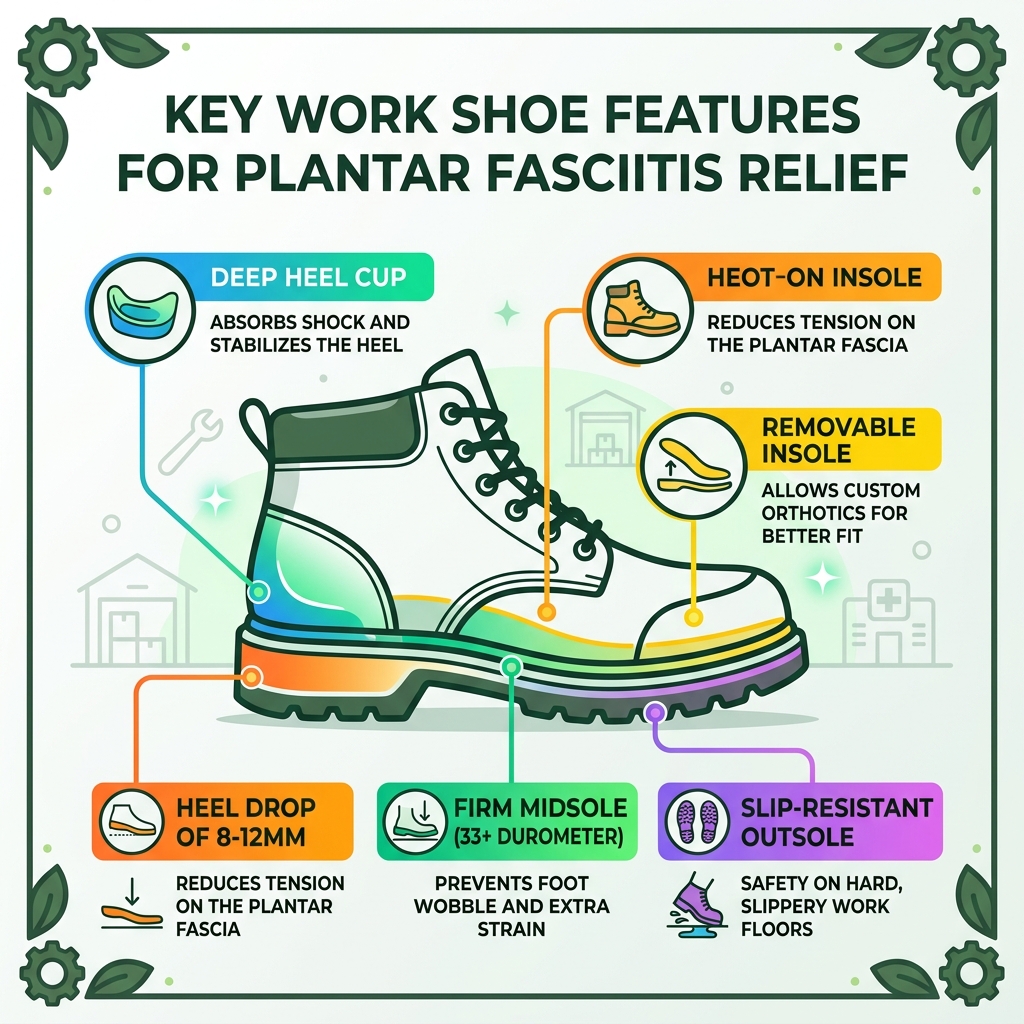
If you’re looking for the best work shoes for plantar fasciitis, here are the top features to prioritize right now:
| Feature | Why It Matters |
|---|---|
| Heel drop of 8-12mm | Reduces tension on the plantar fascia |
| Deep heel cup | Absorbs shock and stabilizes the heel |
| Firm midsole (33+ durometer) | Prevents foot wobble and extra strain |
| Removable insole | Allows custom orthotics for better fit |
| Slip-resistant outsole | Safety on hard, slippery work floors |
Every morning, millions of workers take their first step out of bed and feel a sharp, stabbing pain in their heel. That’s plantar fasciitis — inflammation of the thick band of tissue running along the bottom of your foot.
It’s one of the most common causes of heel pain. And for people who spend 8 to 12 hours on their feet — nurses, construction workers, kitchen staff, warehouse workers — the wrong shoes can make it significantly worse.
The hard truth? Most standard work shoes are not designed with plantar fasciitis in mind. They’re built for safety compliance or basic comfort, not targeted foot pain relief. Very soft midsoles, flat soles, and poor heel support can actually increase the load on your plantar fascia throughout a long shift.
The good news is that the right pair of shoes — with the right combination of arch support, heel drop, and cushioning — can meaningfully reduce that pain, even on concrete floors, even after hour ten.
I’m Faisal S. Chughtai, a footwear expert with years of experience helping people find the most comfortable and supportive shoes for demanding daily use, including identifying the best work shoes for plantar fasciitis across job types and foot types. In this guide, I’ll walk you through exactly what to look for — and which shoes actually deliver.
Key Features of the Best Work Shoes for Plantar Fasciitis
When we talk about Plantar Fasciitis, we are dealing with a structural issue. The plantar fascia is a shock-absorbing bowstring that supports the arch of your foot. If your work shoes are too flat, too flexible, or too soft, that “bowstring” gets overstretched every time your foot hits the concrete.
To find the best work shoes for plantar fasciitis, we need to look past the marketing fluff and focus on technical specs.
1. Optimal Midsole Firmness and Heel Drop
You might think a “cloud-like” soft shoe is the answer, but lab tests suggest otherwise. A midsole that is too soft allows the foot to wobble, which actually increases the strain on the fascia. We look for a midsole durometer (firmness) of at least 33. This provides a stable platform that doesn’t collapse under your weight.
Additionally, a heel-to-toe drop of 8mm to 12mm is crucial. This slight elevation shifts your weight toward the forefoot and utilizes your calf muscles more effectively, unloading the tension on your heel. If you have flat arches, this drop is even more vital. You can learn more about how this works in our guide to Everything About Arch Fit Footwear.
2. Torsional Rigidity and Heel Stability
A good work shoe shouldn’t twist like a pretzel. If you can grab the heel and the toe and easily wring the shoe out, it lacks torsional rigidity. For plantar fasciitis relief, we want a shoe that resists twisting (aim for a 3/5 or higher on a rigidity scale). This prevents the arch from collapsing inward (overpronation).
A rigid heel counter—the stiff cup at the back of the shoe—is also a non-negotiable. It locks your heel in place, preventing the side-to-side movement that causes micro-tears in the fascia.
3. Rocker Bottom Soles and Shock Absorption
Rocker bottom soles are a game-changer for long shifts. These soles are curved, helping your foot “roll” through the gait cycle. This reduces the force required from your foot muscles and minimizes the “stabbing” impact when your heel strikes the ground. High-quality shock absorption (measured at ≥100 SA in lab settings) ensures that the hard floor doesn’t vibrate straight up into your inflamed tissue.

Top-Rated Safety Boots and Heavy-Duty Footwear
For those in construction, warehousing, or trades, a sneaker just won’t cut it. You need PPE compliance alongside pain relief. The challenge is finding Comfortable Work Shoes that feature steel or composite toes without adding unnecessary weight that worsens fatigue.
One of our top recommendations for heavy-duty environments is the Wolverine Overpass. It features “ContourWelt” technology, which allows the boot to flex at the toe while remaining rigid at the arch. It’s a favorite for concrete-heavy shifts because it combines a shock-absorbing midsole with a stable heel.
If you prefer a classic look with modern tech, the Men’s DynaForce 6-inch Work Boot 4215 | Red Wing Shoes is a powerhouse. It uses a specialized insole that distributes pressure evenly across the foot, which is exactly what a plantar fasciitis sufferer needs to avoid “hot spots” of pain.
For those who need extreme orthopedic intervention, the Prime Workboot – Safety Toe | Z-CoiL Pain Relief Footwear is unique. It features a literal coil spring in the heel to absorb impact and a built-in rigid orthotic to protect the plantar ligaments. It might look different, but for severe chronic pain, it has a massive following.
Best Heavy-Duty Work Shoes for Plantar Fasciitis (220+ lbs)
If you are a larger-framed worker (220+ lbs), the physics of footwear change. Standard foam midsoles will compress much faster, losing their supportive properties within weeks. You need reinforced shanks and high-density materials.
| Boot Model | Safety Toe Type | Key Strength for PF |
|---|---|---|
| Wolverine Overpass | Composite | Best for concrete floors |
| Orthofeet Granite | Composite | Best for wide feet/bunions |
| Red Wing DynaForce | Steel | Best for pressure distribution |
| Ariat Groundbreaker | Steel | Best for farm/ranch stability |
For workers in this category, we highly recommend checking out Why Your Flat Feet Crave These Arch Support Insoles. Often, the stock insoles in even the best boots aren’t enough for heavy-duty use.
The Groundbreaker Work Boot | Ariat is another excellent choice. It uses 4LR technology for lightweight support and stability, and its Duratread outsole is highly resistant to barnyard acids and oils, making it a durable pick for Orthopedic Footwear needs in rugged environments.
Specialized Footwear for Service and Healthcare Professionals
Healthcare and service workers face a different beast: 12 hours of constant movement on hard, often slippery, tile or laminate floors. Here, the best work shoes for plantar fasciitis need to be lightweight, breathable, and slip-resistant.
Nurses often swear by the Ultimate Guide to Clogs That Won’t Quit. Professional clogs, like the Dansko XP 2.0, offer a rocker bottom and a very firm arch that doesn’t quit halfway through a double shift. They are essentially a “hard-floor survival kit.”
For those who prefer a sneaker feel, the Orthora Pro – 12-Hour Shift Shoes are engineered specifically for this demographic. They feature a wide toe box to accommodate the natural foot swelling that happens after hours of standing, along with podiatrist-designed alignment to reduce inflammation.
Best Work Shoes for Plantar Fasciitis in Kitchens and Clinics
Kitchen environments require high-level slip resistance and waterproofing. The LARNMERN Non-Slip Work Shoes are a popular budget-friendly choice, boasting a 4.1-star rating from over 3,800 reviews. They offer the water resistance needed for spills while providing the arch support necessary for heel pain.
If you are looking for something more premium, Designed for comfort from the inside out by BRUNT is a fantastic option. Their boots, like the Marin, use a triple-layer insole system that provides a memory foam feel without sacrificing the structural integrity needed to Stop the Foot Pain with Top-Rated Standing Shoes.
We also suggest looking into Plantar Fasciitis Shoes | Dr. Scholl’s Shoes. Their “Beyond Comfort” collection is specifically designed with cushioned heel cups to absorb the shock of every step on clinic floors.
Maximizing Relief with Insoles and Maintenance
Even the best work shoes for plantar fasciitis can benefit from a little help. Most high-end work boots come with “stock” insoles that are designed to feel good in the store but compress within 60 to 90 days of hard use on concrete.
The Power of the Right Insole
Integrating Arch Support Inserts for Flat Feet can transform a standard boot into a pain-relief machine. Look for “Heavy Duty” options if you are over 220 lbs, as these are designed with high arch posts that won’t flatten out. If you’re new to this, our Shoe Inserts for Flat Feet 101 guide is a great place to start.
Break-In and Rotation
Never take a brand-new pair of work boots and wear them for a full 12-hour shift on day one. Even the best Arch Support shoes need a break-in period. Wear them around the house for a few hours first to let the leather and midsoles adapt to your foot shape.
A pro tip we always share: rotate your shoes. If you can afford two pairs, swap them every other day. This allows the foam in the midsole to fully decompress and “rebound,” extending the life of the shoe and providing better shock absorption for your feet. Check out our 10 Expert Foot Health Tips & Best Shoes to Prevent Pain for more advice on maintaining your gear.
Frequently Asked Questions about Plantar Fasciitis Work Shoes
How do I know if my work shoes provide enough arch support?
A simple test is the “twist test.” If you can easily twist the shoe or bend it in half at the arch, it’s not providing enough support for plantar fasciitis. The shoe should only flex at the toe (where your foot naturally bends). You should also feel a firm “cradle” under your arch that doesn’t collapse when you put your full weight on it.
Can I use steel-toe boots if I have severe heel pain?
Yes! The steel toe itself doesn’t typically cause heel pain. However, steel-toe boots are often heavier, which can lead to leg fatigue. If you have severe pain, consider a composite toe boot, which meets the same ASTM safety standards but is significantly lighter. This reduces the overall strain on your lower body throughout the day.
How often should I replace my work shoe insoles?
If you work on concrete, you should replace your insoles every 3 to 6 months. While the shoe itself might look fine on the outside, the internal cushioning and arch support “fatigue” over time. If you start feeling that familiar morning heel sting again, it’s usually a sign that your insoles have given up the ghost.
Conclusion
Finding the best work shoes for plantar fasciitis isn’t just about comfort—it’s about protecting your long-term mobility. Whether you’re in a high-stakes ER, a busy kitchen, or a rugged construction site, your feet are your foundation. By choosing footwear with a firm midsole, a supportive heel drop, and proper arch alignment, you can stop the cycle of pain and focus on the job at hand.
At On Clouder, we are dedicated to helping you navigate the complex world of footwear. For more tips on keeping your feet healthy during those marathon shifts, check out our Web Story: Standing All Day – Foot Health Tips & Best Shoes. Your feet do a lot for you—make sure you’re returning the favor.