
How to Choose Hiking Sandals for Plantar Fasciitis
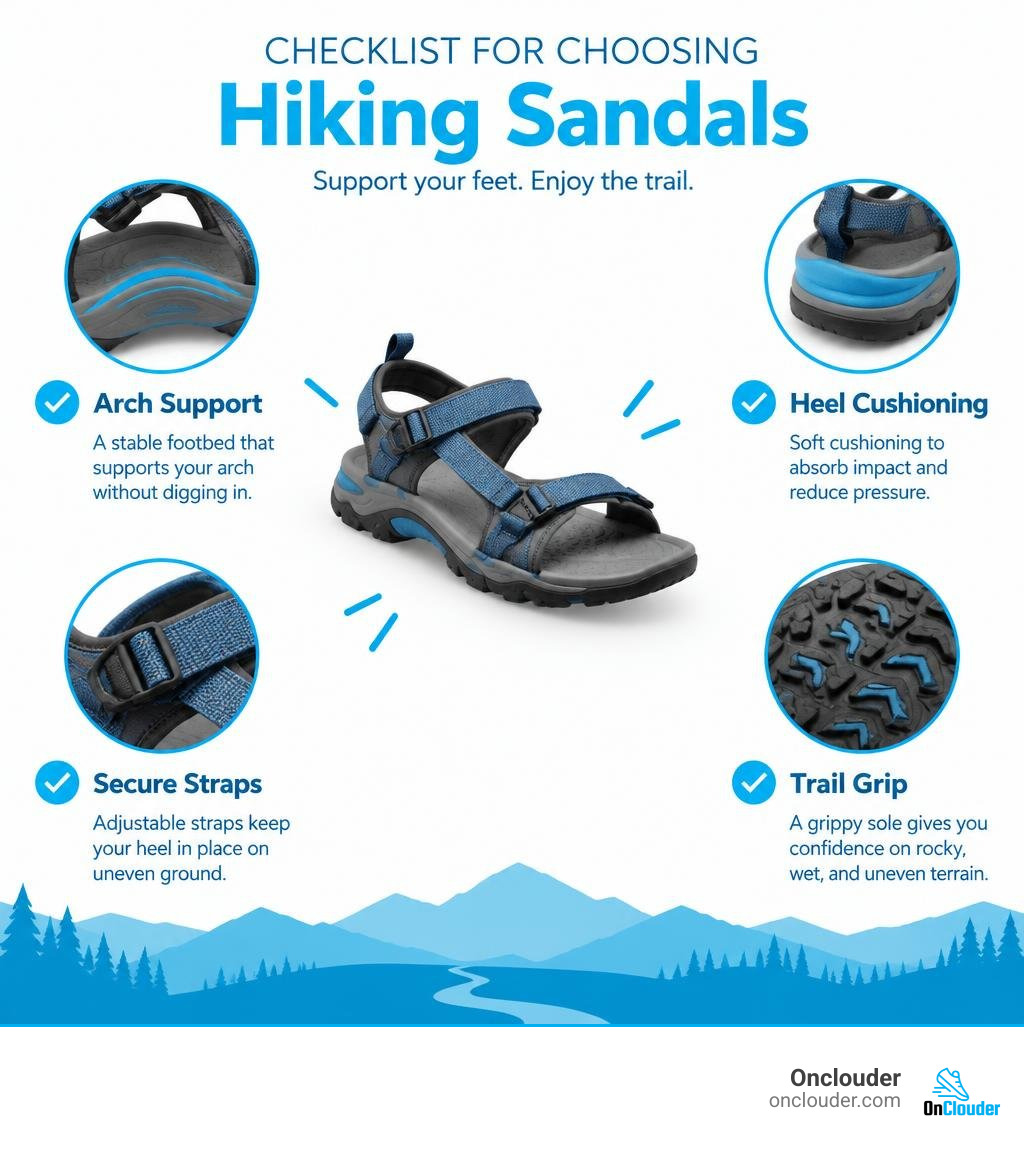
The best hiking sandals for plantar fasciitis have a supportive arch, a cushioned heel, a secure fit, and a grippy sole. Look for a footbed that feels stable under your arch without digging into it. Adjustable straps should keep your heel from sliding on uneven ground.
If your heel hurts with your first steps in the morning, start with a supportive sandal rather than a thin, flexible barefoot style. A sandal may make hiking more comfortable, but it will not treat the cause of heel pain on its own.
Essential best hiking sandals for plantar fasciitis terms:
- best flip flops with arch support for men
- best flip flops for plantar fasciitis women’s
- best adidas shoes for plantar fasciitis
Understanding Trail Heel Pain and Plantar Fasciitis
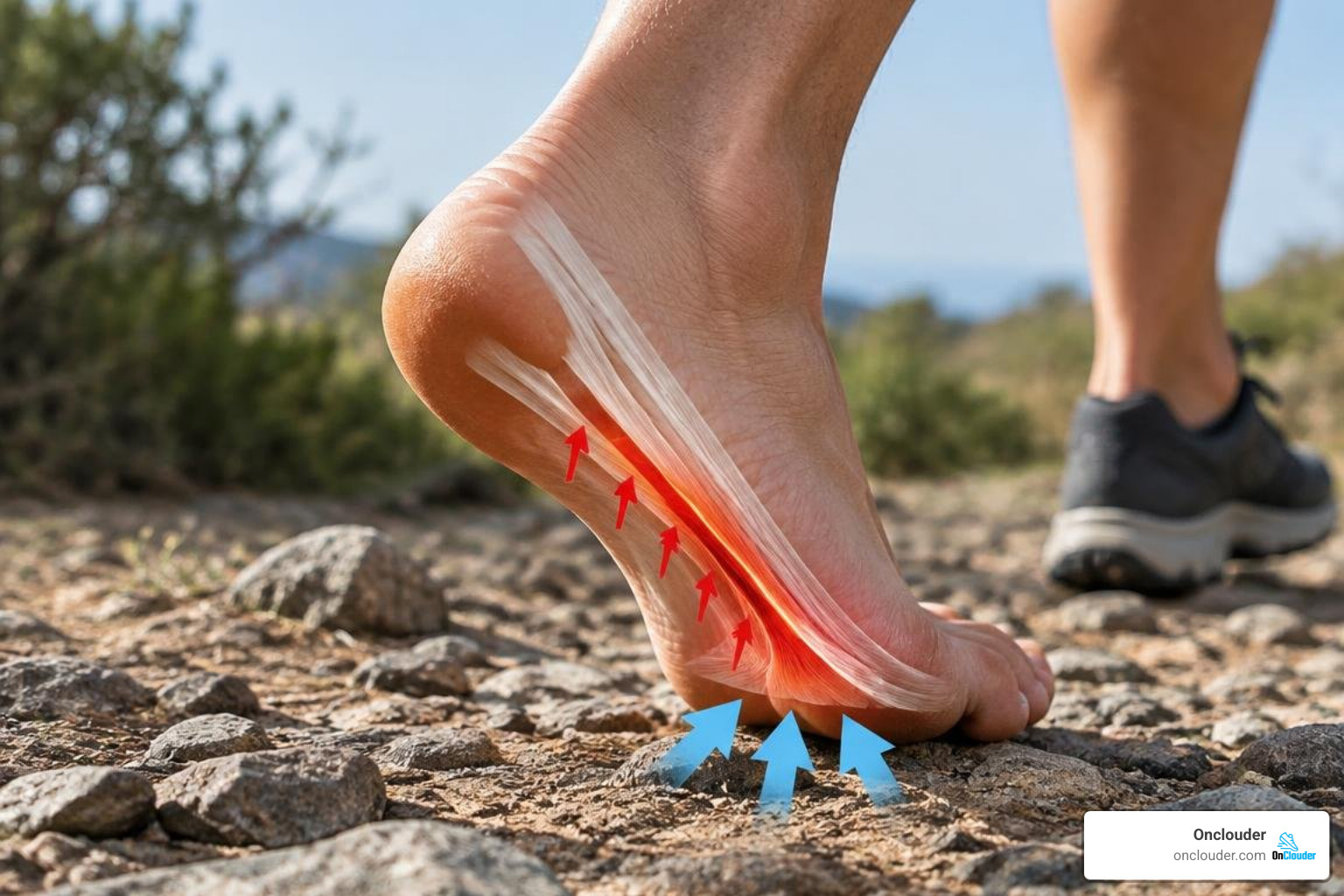
Nothing cuts a backcountry excursion short quite like a stabbing pain in your heel. Plantar fasciitis occurs when the thick band of tissue running along the bottom of your foot—the plantar fascia—experiences excessive mechanical strain, leading to irritation, microtears, and debilitating morning stiffness. This fibrous band acts as a primary shock absorber, supporting your longitudinal arch every time your foot strikes the earth.
Plantar fasciitis is remarkably common. It affects over three million people each year, with estimates suggesting that up to one in six Americans will experience it at some point. It is particularly prevalent among active adults between the ages of 40 and 60, as natural elasticity decreases and cumulative impact takes a toll. In the United States alone, the condition accounts for roughly one million ambulatory patient care visits annually. Interestingly, clinical research shows that only 7.1% of diagnosed patients ever receive a formal physical therapy evaluation (Fraser et al., 2017).
When hiking, rocky ascents and uneven descents stretch the fascia repeatedly under heavy loads. If your foot lacks structural support, this repetitive pulling aggravates the attachment point at the calcaneus (heel bone). Over time, what begins as acute inflammation can transition into chronic plantar fasciopathy, where the tissue degenerates and thickens with disorganized scar tissue. While many trail enthusiasts rely on closed-toe shoes designed for plantar fasciitis relief, warm-weather trekking requires an open, breathable design that delivers identical biomechanical control.
Essential Features in the Best Hiking Sandals for Plantar Fasciitis
Heading into the outdoors with open footwear requires rigorous structural engineering. Fluctuation in trail gradients amplifies torsional stress across your midfoot. To protect recovering connective tissue, you need sandals built around stabilizing footbeds and durable outsoles.
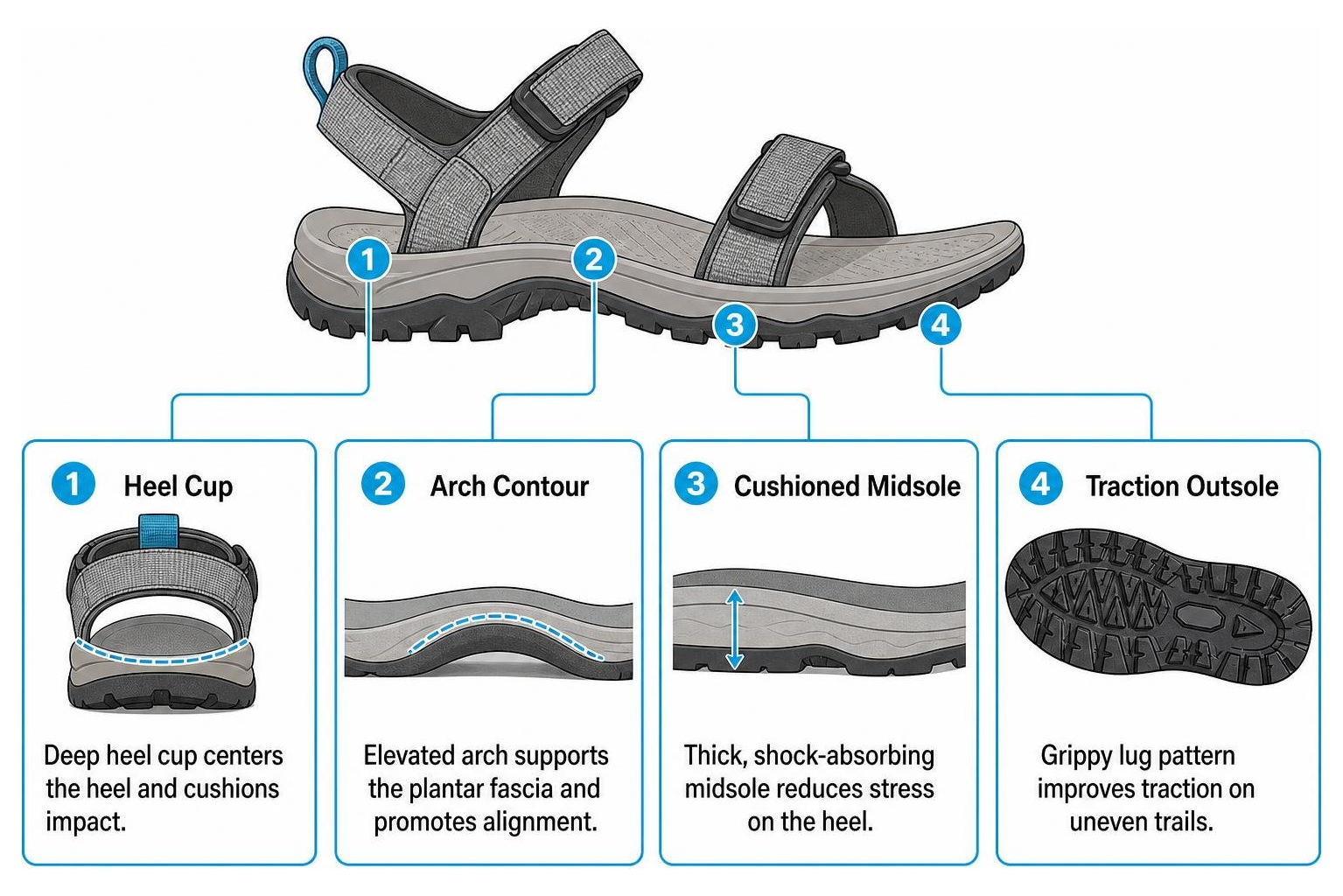
When we evaluate trail footwear, we look for four critical components:
- Torsional Rigidity: The sole should not bend entirely in half across the midfoot. It must flex only at the ball of the foot to facilitate a natural toe-off without collapsing your arch.
- Impact-Absorbing Midsole: Dense ethylene-vinyl acetate (EVA) or dual-density polyurethane compounds attenuate ground-reaction forces before they reach the heel.
- Multi-Point Adjustable Straps: High-density webbing locks the heel firmly against the rearfoot counter, preventing micro-slippage that causes secondary tendon friction.
- Deep Heel Cups & Roomy Dimensions: A contoured cup centers the natural subcalcaneal fat pad beneath your heel bone, while wide toe box hiking footwear prevents forefoot cramping and allows your toes to splay naturally.
Why Rigid Arch Support Defines the Best Hiking Sandals for Plantar Fasciitis
Your plantar fascia is mechanically linked to the “windlass mechanism.” When your big toe extends during a stride, the fascia tightens, elevating the arch and turning the foot into a rigid lever for propulsion. If your arch collapses under body weight on loose scree or hard dirt, the fascia stretches past its elastic threshold.
Anatomical contouring cradles the medial longitudinal arch, physically halting overpronation and reducing tensile stress on the heel insertion point. Exploring podiatrist recommendations for supportive open footwear reveals that structured footbeds maintain neutral ankle alignment, preventing secondary compensatory strain from radiating upward into your knees, hips, and lower back.
Cushioning, Deep Heel Cups, and Orthotic Compatibility
Heel cushioning is not just about soft foam; it is about preserving your body’s built-in padding. The human heel has a specialized fat pad designed to absorb shock. On hard, rocky trails, flat soles compress this fat pad outward, leaving the bone vulnerable.
A deep heel cup acts like a retaining wall, holding your heel fat pad directly beneath the bone to maximize natural shock absorption. Dense EVA foam midsoles disperse residual impact forces across the entire footbed. For those requiring clinical-grade biomechanical intervention, sandals with removable footbeds allow you to seamlessly insert custom orthotics without causing strap tightness, mirroring the structural benefits found when using supportive flip flops for foot pain defense.
Top Recommended Outdoor Sandal Reviews and Comparisons
To help you find the right trail companion, we have compared several distinct designs across cushioning depth, arch geometry, outsole traction, and overall weight.
| Sandal Model | Arch Profile | Cushioning Thickness | Outsole Grip | Best For |
|---|---|---|---|---|
| Hands-Free Supportive Trail Sandal | High (Includes Arch Boosters) | High (15mm Drop) | Aggressive Lug Rubber | Moderate-to-severe heel pain & mobility ease |
| Water-Friendly Trail Sandal | Medium-Firm Anatomical | Moderate (EVA Midsole) | All-Terrain TPR | River crossings & warm-weather day hikes |
| Orthopedic EVA Slide Sandal | 15° Anatomical Arch | Maximum (4cm Thick) | Moderate Tread EVA | Post-hike camp recovery & gentle trails |
| Minimalist Barefoot Trail Sandal | Flat / Zero-Drop Base | Minimal (Thin Soles) | High-Flexibility Tread | Late-stage rehabilitation & foot strengthening |
Hands-Free Supportive Hiking Sandal
For hikers who struggle with mobility issues, lower back tightness, or severe morning stiffness, this design combines orthotic-grade stability with effortless entry. Featuring an engineered hands-free spring heel, you can step directly into the sandal without bending down to fiddle with complex buckles.
The interior showcases an anatomical orthotic footbed paired with a 15mm heel-to-toe drop, an elevation that significantly slackens the Achilles tendon and relieves direct tension on the plantar fascia. The package includes customizable arch boosters and fitting spacers, allowing you to dial in medial arch height. A wide toe box accommodates bunions, while a rugged rubber tread ensures confident grip over wet roots and loose gravel. You can check out the Orthofeet Hands-Free Venus Hiking Sandals for this high-support, closed-toe trail design.
Water-Friendly Trail Sandal
When your hikes involve backcountry stream crossings and sudden summer rainstorms, you need open footwear that will not become waterlogged or slippery. Built with durable recycled polyester webbing and quick-dry lining, this all-terrain sandal locks your foot down with multi-point hook-and-loop straps.
The heart of the sandal is a resilient EVA midsole that absorbs sharp impact forces on rocky singletrack. It features a dedicated cushioned heel pad to eliminate friction hot spots, backed by a grippy TPR outsole that adheres to wet river stones. At approximately 255 grams per sandal, it balances lightweight packability with all-day arch stability. To explore colorways, take a look at the Zorali Trailblazer Sandal in Tan or the Zorali Trailblazer Sandal in Sage.
Orthopedic EVA Arch Support Sandal
If maximum shock absorption and cloud-like impact relief are your primary goals for mellow trails or post-hike camp recovery, a lightweight, thick-soled orthopedic slide is an exceptional choice. Engineered with an aggressive 15-degree arch-support footbed, this sandal redistributes pressure away from bruised heel bones directly into the midfoot.
The monolithic 4cm EVA platform provides substantial vertical cushioning that insulates your joints from hard ground impacts. Weighing just 180 grams per slide, its waterproof construction handles muddy trailheads, beach paths, and campsite lounging with ease. The double-buckle upper allows for customized volume adjustments over wide feet and bunions. You can review the Pimali Orthopedic Arch Support Sandals to see how this thick EVA construction relieves plantar tension.
Minimalist Barefoot Sandal
For hikers who have moved past the acute inflammatory phase of plantar fasciitis and want to rebuild intrinsic foot muscle strength, minimalist footwear offers a unique approach. Built on a completely flat, zero-drop platform, this sandal eliminates artificial arch scaffolding to allow the foot to move naturally.
An extra-wide toe box lets your metatarsals spread fully, while an ergonomic, ultra-thin footbed provides sensory feedback from the trail floor. Double-strap closures secure your instep and heel without compressing sensitive joints. While this style should not be used during acute flare-ups, it serves as an excellent tool for foot-strengthening walks on soft ground. Check out the Hike Footwear HF Baresandals IV to learn more about barefoot-style trail recovery.
Barefoot Trails vs. Supportive Soles: Transitioning Safely
The debate between high-support orthotics and minimalist zero-drop sandals is common in hiking communities. Understanding how each affects your connective tissue is crucial for staying pain-free on the trail.
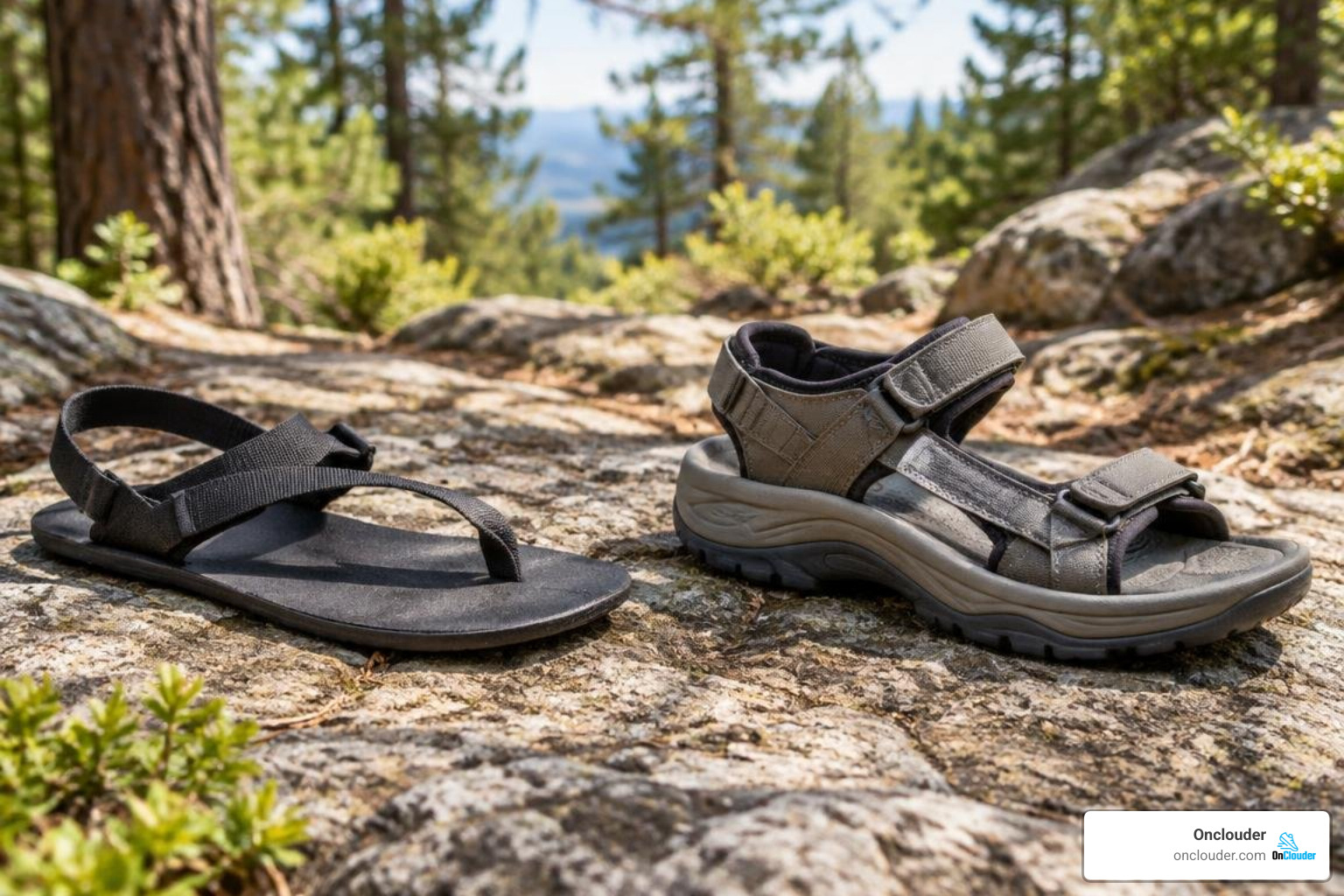
Structured, arch-supportive sandals offload immediate stress from the plantar fascia by mechanically propping up the longitudinal arch and absorbing shock through thick foam layers. In contrast, barefoot-style sandals force the intrinsic muscles of your foot, the posterior tibial tendon, and the calf complex to perform all stabilization and shock absorption unassisted.
If you jump straight into zero-drop, unpadded sandals while your plantar fascia is inflamed, the increased stretch on your Achilles tendon and the lack of heel cushioning will likely aggravate microtears. However, structured support can occasionally lead to long-term muscle deconditioning if used exclusively. The ideal approach for many hikers involves utilizing firm orthotic sandals on rocky, high-mileage treks, while gradually introducing minimalist footwear for short, relaxed strolls on soft grass to build natural resilience over time.
How to Transition into the Best Hiking Sandals for Plantar Fasciitis
Switching from rigid hiking boots to supportive open sandals requires a deliberate, step-by-step adaptation plan to avoid overloading unconditioned soft tissue.
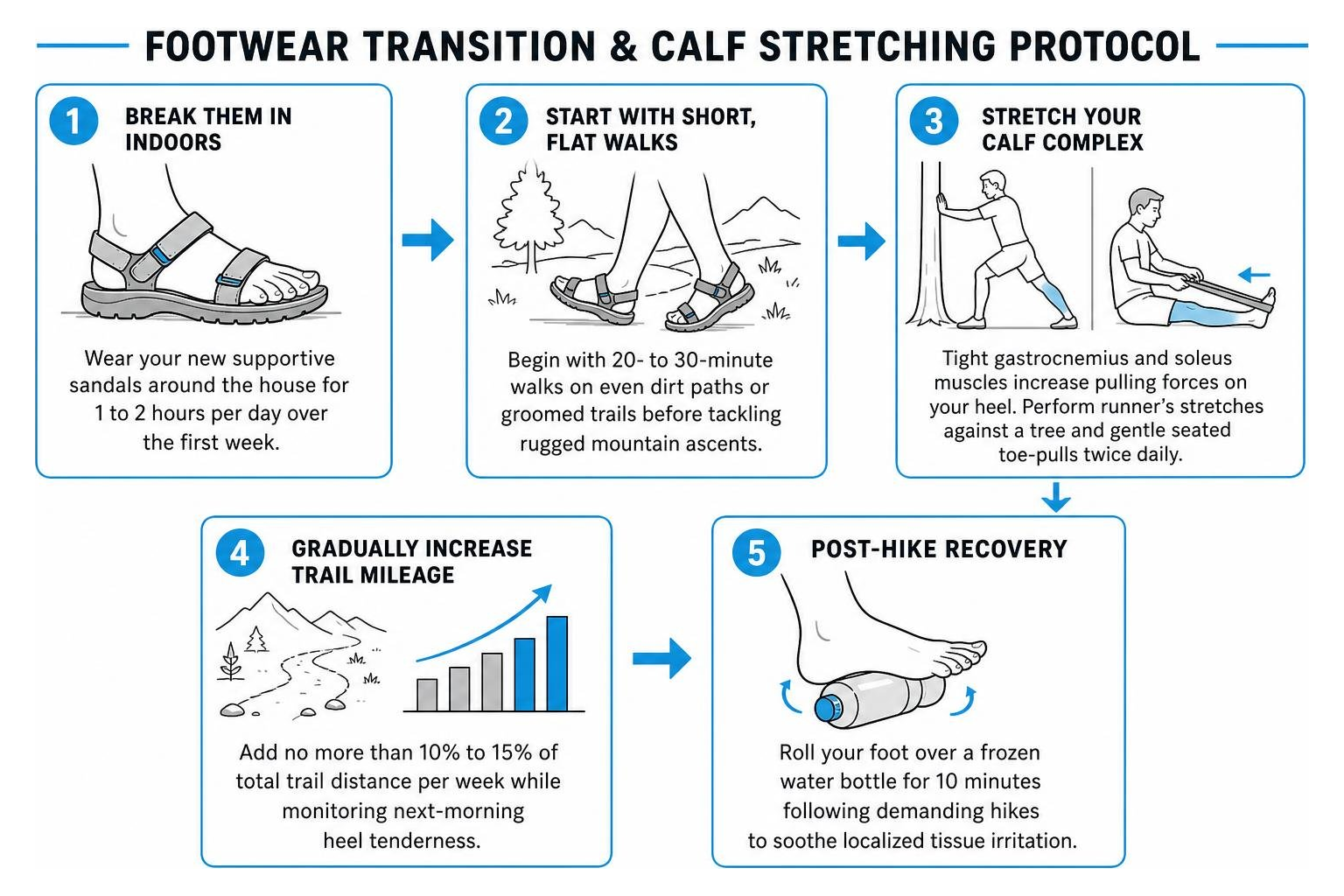
- Break Them In Indoors: Wear your new supportive sandals around the house for 1 to 2 hours per day over the first week to allow the footbed contour to mold to your arch.
- Start with Short, Flat Walks: Begin with 20- to 30-minute walks on even dirt paths or groomed trails before tackling rugged mountain ascents.
- Stretch Your Calf Complex: Tight gastrocnemius and soleus muscles increase pulling forces on your heel. Perform runner’s stretches against a tree and gentle seated toe-pulls twice daily.
- Gradually Increase Trail Mileage: Add no more than 10% to 15% of total trail distance per week while monitoring next-morning heel tenderness.
- Post-Hike Recovery: Roll your foot over a frozen water bottle for 10 minutes following demanding hikes to soothe localized tissue irritation.
Acute vs. Chronic Heel Strain on Uneven Ground
Choosing the right footwear depends on whether your condition is acute or chronic:
- Acute Plantar Fasciitis (< 6 Months): Characterized by active, localized inflammation, sharp morning pain, and sensitivity to direct pressure. During this stage, prioritize thick EVA cushioning, an elevated heel drop (10mm to 15mm), and rigid arch support to offload the irritated tissue.
- Chronic Plantar Fasciopathy (> 6 Months): Involves degenerative collagen breakdown, structural tissue thickening, and non-inflammatory aching. While arch support remains essential on steep terrain, chronic management benefits from structured stretching, deep tissue mobilization, and progressive loading exercises.
Frequently Asked Questions About Plantar Fasciitis Hiking Footwear
Can wearing unsupportive sandals make heel pain worse?
Yes. Walking on uneven outdoor terrain in flimsy, flat sandals allows your medial longitudinal arch to overpronate and collapse. This places severe, repetitive tensile loads on the plantar fascia attachment at the calcaneus, rapidly worsening microtears and triggering sharp inflammatory pain.
Can I fit custom orthotic inserts into hiking sandals?
Certain technical hiking sandals feature removable, contoured footbeds that allow you to slip in full-length custom orthotics. Ensure the sandal has deep side rails and adjustable instep straps to hold the orthotic securely in place without lifting your foot out of the footbed.
Are zero-drop minimalist sandals safe for hikers with active heel pain?
Not during the acute, highly painful stage. A zero-drop base drops the heel level with the forefoot, placing significant stretch on the Achilles tendon and pulling firmly on the plantar fascia. Wait until active inflammation has subsided before gradually introducing minimalist sandals on low-impact surfaces.
Conclusion
Hiking with plantar fasciitis does not mean you are permanently confined to hot, bulky mountaineering boots. By choosing sandals engineered with structured medial arch support, deep heel cups, multi-point webbing straps, and shock-absorbing midsoles, you can explore rugged summer trails without suffering from sharp heel pain the next morning.
Pay close attention to your body’s feedback, maintain a consistent calf-stretching routine, and choose the level of footbed support that matches your current stage of recovery. For a deeper look at keeping your feet properly aligned across all your daily activities, explore our comprehensive guide to supportive footwear for plantar fasciitis.
References
Fraser JJ, Glaviano NR, Hertel J. “Utilization of Physical Therapy Intervention Among Patients With Plantar Fasciitis in the United States..” The Journal of orthopaedic and sports physical therapy, 2017. PMID 28142368.
From the Alps to the Asphalt: How On Conquered the Commuter Wardrobe
