Best On Cloud Shoes for High-Arch Runners
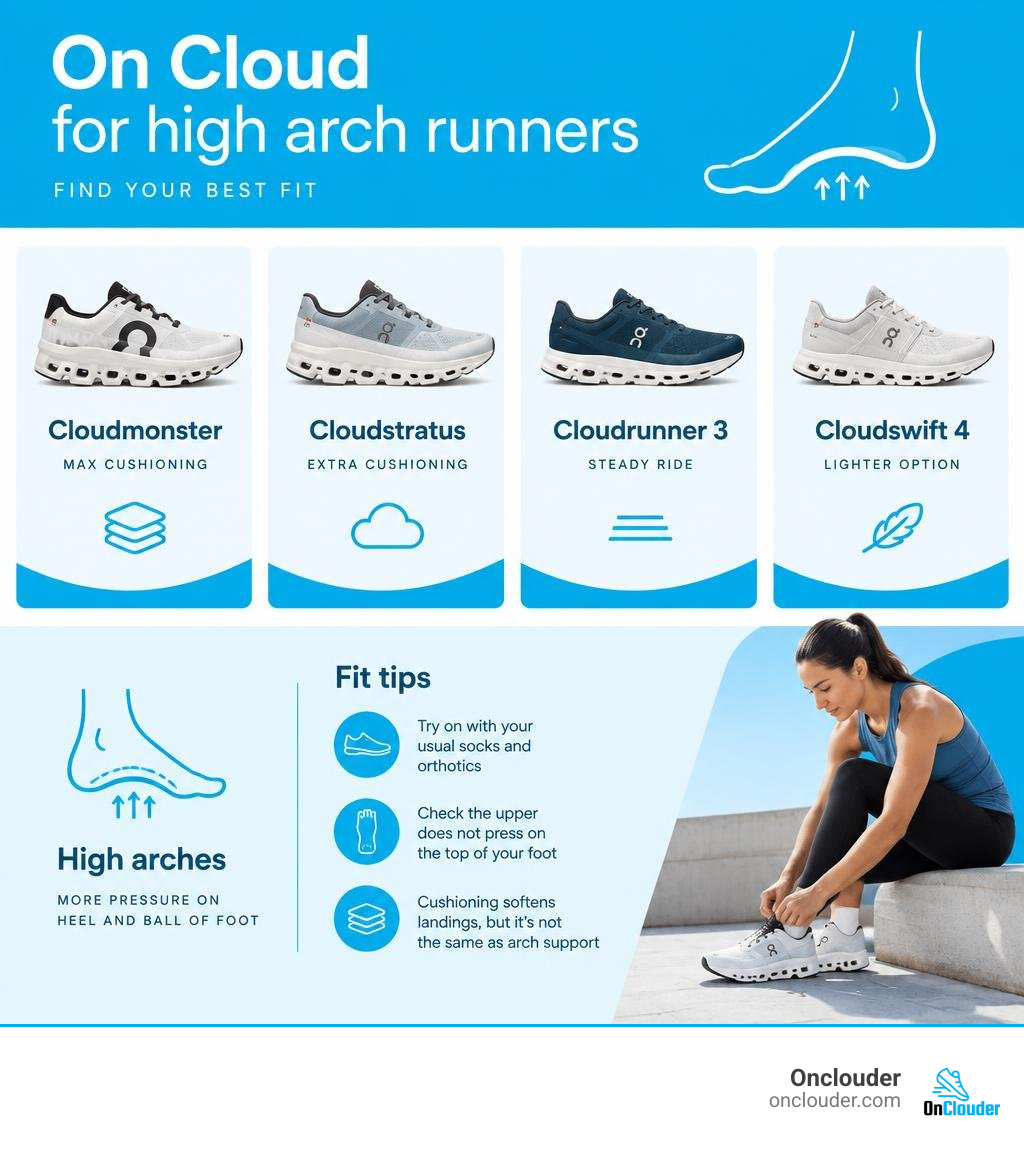
Start with the Cloudmonster or Cloudstratus if you want more cushioning or need room for an orthotic. Try the Cloudrunner 3 if you prefer a steadier ride, or the Cloudswift 4 if you want a less cushioned option. The Cloud 5 may work for casual wear, but its shallow fit and moderate arch support make it a less reliable choice for running with high arches.
High arches often put more pressure on the heel and ball of the foot. On’s CloudTec cushioning can soften landings, but cushioning is not the same as arch support. Try shoes on with your usual socks and orthotics, then check that the upper does not press on the top of your foot.
On Cloud for high arch runners terms to know:
- highly cushioned road running shoes
Choosing On Cloud for High Arch Runners: Biomechanics and Support
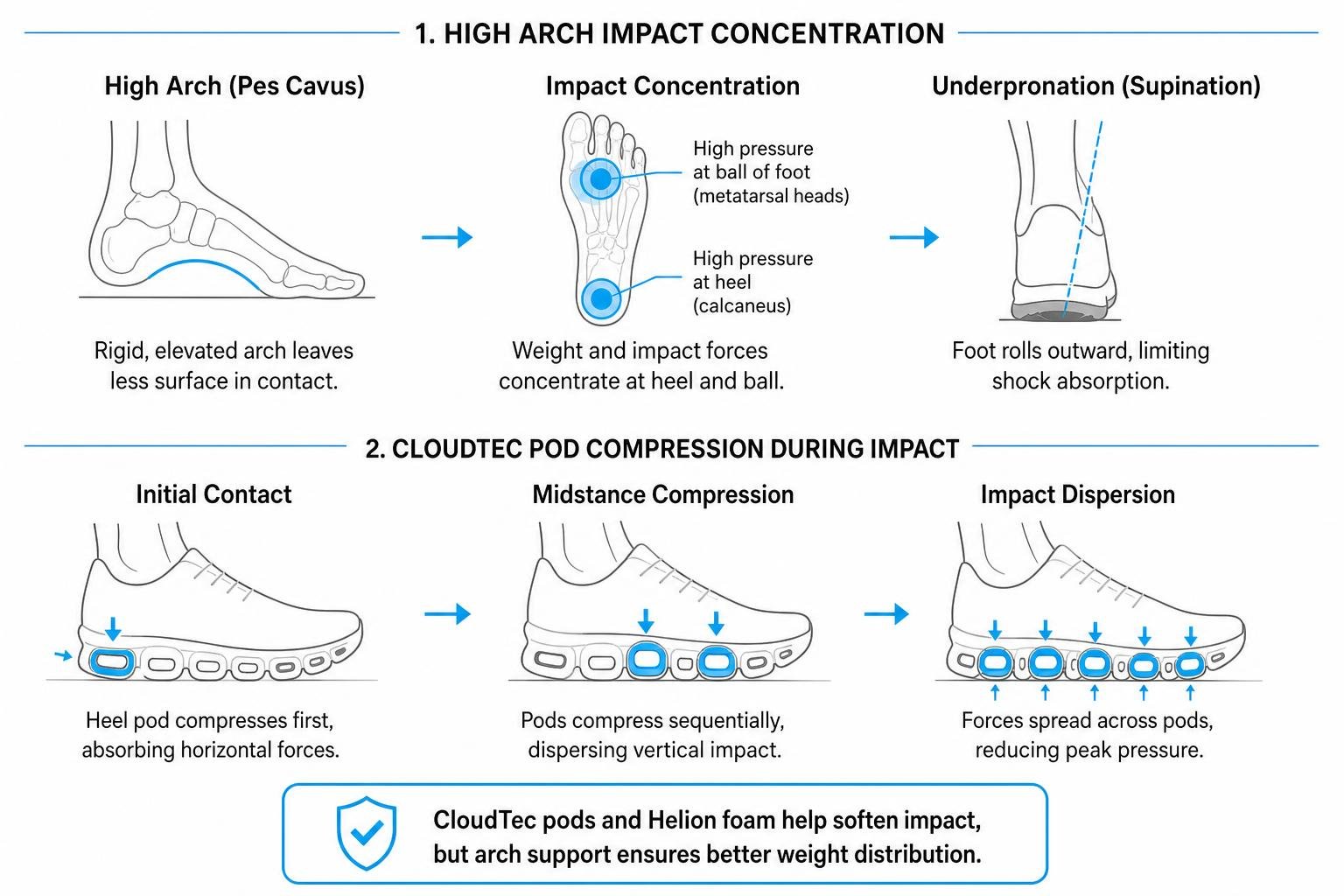
When you run with high arches (a pes cavus foot shape), your feet interact with the ground in a fundamentally different way than neutral or flat feet. A rigid, elevated arch sits higher off the floor, dramatically reducing the surface area that makes contact with your shoe. Instead of distributing your body weight evenly across the entire sole, impact forces concentrate at two critical strike zones: the heel and the ball of the foot (metatarsal heads).
Because a high arch tends to be rigid and inflexible, it rarely rolls inward enough to absorb shock naturally. This biomechanical trait—known as underpronation or supination—forces your lower legs, ankles, and knees to take the brunt of every footstrike. Over time, that concentrated pressure can trigger metatarsalgia, plantar fasciitis, and shin splints.
To help counter these issues, many runners look to Swiss-engineered CloudTec technology. The hollow pods (or “clouds”) compress under load to disperse harsh vertical impact. However, podiatrists emphasize that softness alone cannot fix poor weight distribution. According to a clinical review on On Cloud shoes for foot pain, On footwear is generally built on neutral to mild-stability platforms. This structure works well for high arches, provided the shoe matches your foot volume and you master finding your perfect fit with On Cloud arch support.
CloudTec Cushioning and Underfoot Pressure
The core appeal of On running shoes lies in how their individual CloudTec pods react under dynamic load. Rather than relying on a single, uniform slab of foam, the pods compress sequentially—first absorbing horizontal shearing forces as your foot touches down, then collapsing vertically under direct downward pressure.
When combined with On’s Helion superfoam, this pod compression helps mitigate the sharp point-loading that high-arched runners experience at the calcaneus (heel bone) and forefoot. High arches crave impact dispersion, and pairing responsive foam with dynamic pods helps spread the ground reaction force across a slightly broader contact area. If you want to explore how foam densities and mechanical pods interact to protect your feet, check out our guide to the most comfortable materials for high arch support.
Speedboard Stiffness and Instep Volume
Every On shoe incorporates a Speedboard—a flexible, snappy thermoplastic plate embedded directly above the CloudTec midsole. When your foot strikes the ground, the Speedboard flexes and harnesses kinetic energy, propelling you forward into your next stride.
For high-arched runners, the Speedboard provides a major mechanical advantage: torsional rigidity. It stops the shoe from twisting unnaturally beneath a rigid, supinating foot, maintaining a stable base through the transition phase.
However, the Speedboard also presents a distinct fit challenge. Because the plate creates a firm, unyielding floor inside the shoe, high-arched feet (which almost always have elevated, high insteps) can run out of vertical room. If a shoe upper has a shallow vertical profile, your instep presses hard against the tongue and lacing system. Understanding upper geometry and volume is critical, as detailed in our definitive guide to supportive sneakers for high arches.
The Best On Cloud Footwear for High Arches
Not every model in the On lineup fits a high-arched foot the same way. Some models feature low-volume racing cuts that squeeze high insteps, while others offer spacious cabins, rockered profiles, and widened platforms that comfortably seat elevated arches.
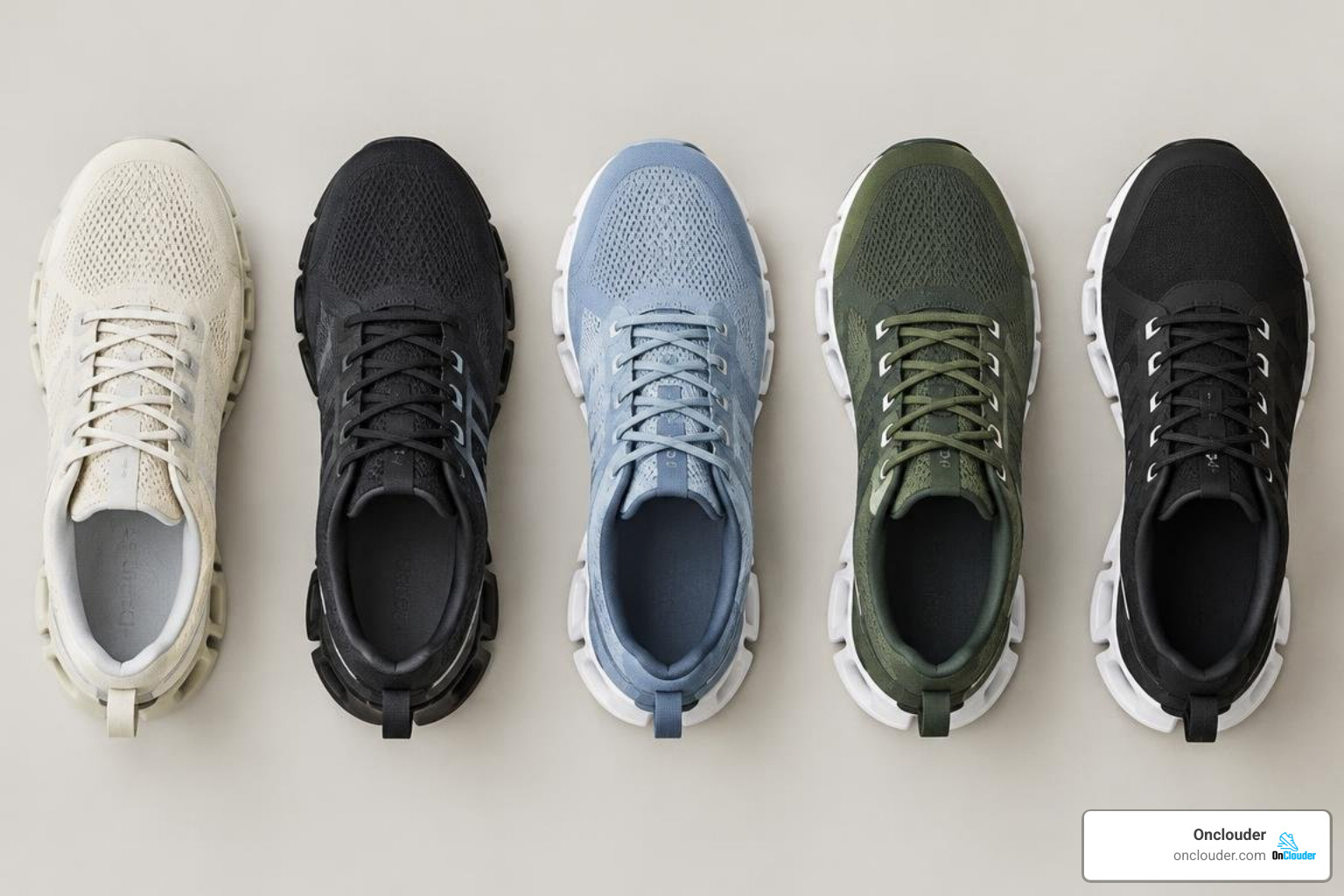
When selecting the best pair, high-arched runners should prioritize shoes that offer neutral stability, adequate vertical volume, smooth forefoot rocker transitions, and enough interior room to slip in an aftermarket footbed if needed. Exploring the best running shoes for high arches reveals that matching midsole thickness to your mileage is the key to lasting comfort.
| On Cloud Model | Cushioning Level | Native Arch Support | Instep / Upper Volume | Best Use Case |
|---|---|---|---|---|
| Cloudmonster | Maximum | Moderate | High (Spacious) | Long runs, road miles, max impact relief |
| Cloudstratus | High (Dual-layer) | Moderate | High (Accommodating) | Daily training, custom orthotics |
| Cloudrunner 3 | Mid-to-High | Moderate-to-Stable | Moderate-to-High | Structured road running, mild stability |
| Cloudswift 4 | Mid | Moderate | Moderate (Sock-like) | Shorter runs, gym sessions, urban walking |
| Cloudvista | Low-to-Mid | Mild-to-Moderate | Low (Shallow) | Light trail running, mixed terrain |
| Cloud 5 | Moderate | Moderate (86% user rating) | Low (Snug / Shallow) | Casual walking, lifestyle wear |
Top On Cloud for High Arch Runners: Model Breakdown
1. On Cloudmonster: The Maximum Cushion Protector
The Cloudmonster features the largest CloudTec elements of any On road shoe, paired with an aggressive forefoot rocker. For high-arched runners who land heavily on their heels or balls of their feet, the Cloudmonster provides a thick, protective Helion superfoam barrier that significantly softens landings. The rocker geometry smoothly rolls your foot through toe-off, relieving pressure from rigid arches that struggle to flex naturally. Furthermore, its upper offers generous vertical depth, making it comfortable for tall insteps.
2. On Cloudstratus: Dual-Layered Pod Cushioning
The Cloudstratus utilizes a unique dual layer of CloudTec pods that work in tandem to offer progressive cushioning. Light strikes engage the top layer, while heavier impacts engage the bottom layer. Because it is engineered with a slightly wider base and a roomy interior, the Cloudstratus easily accommodates tall insteps and replacement footbeds.
3. On Cloudrunner 3: Widened Platform and Guided Stability
If your high arches leave your ankles feeling wobbly or prone to rolling outward, the Cloudrunner 3 offers a stable, reassuring ride. It features a widened Speedboard and a cradle-shaped foam base that hugs the perimeter of your foot. According to real-world customer feedback on Women’s Cloudrunner sneakers, runners with very high arches praise its roomy toe splay, plush step-in feel, and forward-propelling rocker geometry.
Podiatrist-Approved Neutral Models: Cloudswift 4 and Cloudvista
On Cloudswift 4
Podiatrists frequently highlight the Cloudswift 4 for high-arched runners seeking an agile, versatile trainer. Priced around $135 (discounted from $170), it features mid-level Helion cushioning combined with a supportive integrated ankle collar. While it has less stack height than the Cloudmonster, its responsive midsole and snug midfoot wrap keep high-arched feet centered and secure during faster road miles or gym workouts.
On Cloudvista
For runners heading off-road, the Cloudvista provides lightweight trail performance with a Helion and CloudTec sole tuned for mixed terrain. However, fit data reveals important caveats. A comprehensive customer fit analysis on Cloudvista reviews shows that 86% of wearers rate its native arch support as moderate, but many note its shallow vertical instep and narrower toe box. Only 43% felt it was completely true to size, meaning high-arch runners should size up a half to full size or swap in a slim orthotic to avoid top-of-foot pressure.
Sizing, Orthotics, and Durability Considerations
Finding comfortable running shoes involves more than just picking the right model—you also need to match the shoe’s shape to your high-volume foot. Because high arches naturally elevate the instep, standard shoe sizing rules often need adjusting.
Taking time to explore the best arch fit shoes for running and walking can save you from blisters, bruised toenails, and unnecessary returns.
Sizing and Instep Guidelines for High Arch Runners
When high-arched runners buy shoes in their standard street size, they frequently run into two problems: tight instep collars and cramped toe boxes. A comprehensive On Cloud 5 customer fit and arch support survey (aggregating 2,173 reviews with a 66% 5-star rating) highlights that 86% of wearers experience moderate arch support, but multiple high-arched users noted the upper felt too shallow, causing the big toe to push against the top mesh.
Use this checklist when trying on On shoes:
- Size Up Half a Size: If a model has a shallow vertical instep (like the Cloud 5, Cloudvista, or Cloudflow), order a half size larger than your typical running shoe.
- Check Instep Pressure: Lace up the shoe completely and stand. If the tongue or speed laces dig into the top ridge of your foot, you need more vertical volume or a wider width.
- Examine Forefoot Splay: Ensure your toes can spread naturally without rubbing the upper mesh, which prevents early fabric blowouts.
- Evaluate Heel Cup Depth: Make sure the heel counter sits deep enough to secure your calcaneus without slipping during stride transitions.
Accommodating Custom Orthotics and Insole Replacements
Most On running shoes come standard with a lightweight, removable factory insole. While comfortable, these factory liners are relatively flat and offer only moderate passive arch contact. Podiatric experts point out that approximately 30% of runners with foot discomfort need structured arch support that standard running shoe footbeds simply cannot provide.
Fortunately, On shoes—especially higher-volume models like the Cloudmonster, Cloudstratus, and Cloudrunner—accommodate aftermarket orthotics seamlessly. Podiatrists often recommend replacing the standard insole with a rigid or semi-rigid orthotic, such as PowerStep Pinnacle insoles (which range from $130 to $200 for high-end medical lines), to fill the arch void and correct underpronation.
To explore top-rated insert options that fit cleanly inside performance running shoes, read our roundup of the top high arch support insoles reviewed and learn how to stop the arch enemy with high arch insoles.
Frequently Asked Questions About On Cloud Shoes for High Arches
Do On Cloud shoes provide enough native arch support for high arches?
On Cloud shoes feature neutral to mild-stability platforms with moderate native arch contours. While their CloudTec pods and Speedboards cushion high-impact forces, the factory insoles do not offer rigid medial arch contouring. High-arched runners who require strong, direct arch contact should plan to replace the factory insole with a structured aftermarket orthotic.
Which On Cloud shoe has the highest volume for tall insteps?
The On Cloudmonster and On Cloudstratus provide the most generous vertical instep volume and roomiest toe boxes in the road lineup. For runners who need extra width across the midfoot, the Cloudrunner 3 Wide offers a broadened Speedboard base and an accommodating upper that prevents lace pressure across high insteps.
How durable are CloudTec pods for high-impact road running?
Under standard road running conditions, On Cloud midsoles generally deliver 300 to 500 miles of performance life. However, because high-arched runners place concentrated pressure on the outer edges and heel strike zones of the outsole, pod wear may occur slightly faster on the lateral perimeter. Additionally, runners on gravel or uneven trails may find small stones occasionally lodging in the central sole channel of older pod configurations.
Conclusion
Choosing the right On Cloud shoe for high arches comes down to matching your foot’s unique shape with the right balance of volume, stability, and impact protection. High-arched feet demand superior shock absorption and torsional rigidity to protect rigid joints from harsh road impact.
If you want maximum impact protection, the Cloudmonster and Cloudstratus lead the pack with their deep cushioning and roomy instep profiles. If you need a more grounded, structured ride, the Cloudrunner 3 delivers a wide, supportive base that keeps high arches aligned. Whichever model you choose, replacing the flat factory insole with a supportive orthotic can turn a good run into a truly cloud-like experience.
Ready to see how On stacks up across all footwear categories? Take a look at our ultimate 2026 walking shoe guide to find your next favorite pair!