
Why a Flat Feet Running Shoe Guide Can Change How You Run
If you’ve been searching for a flat feet running shoe guide, here’s what you need to know right away:
Quick Answer: Best Shoe Features for Flat Feet
| Feature | Why It Matters |
|---|---|
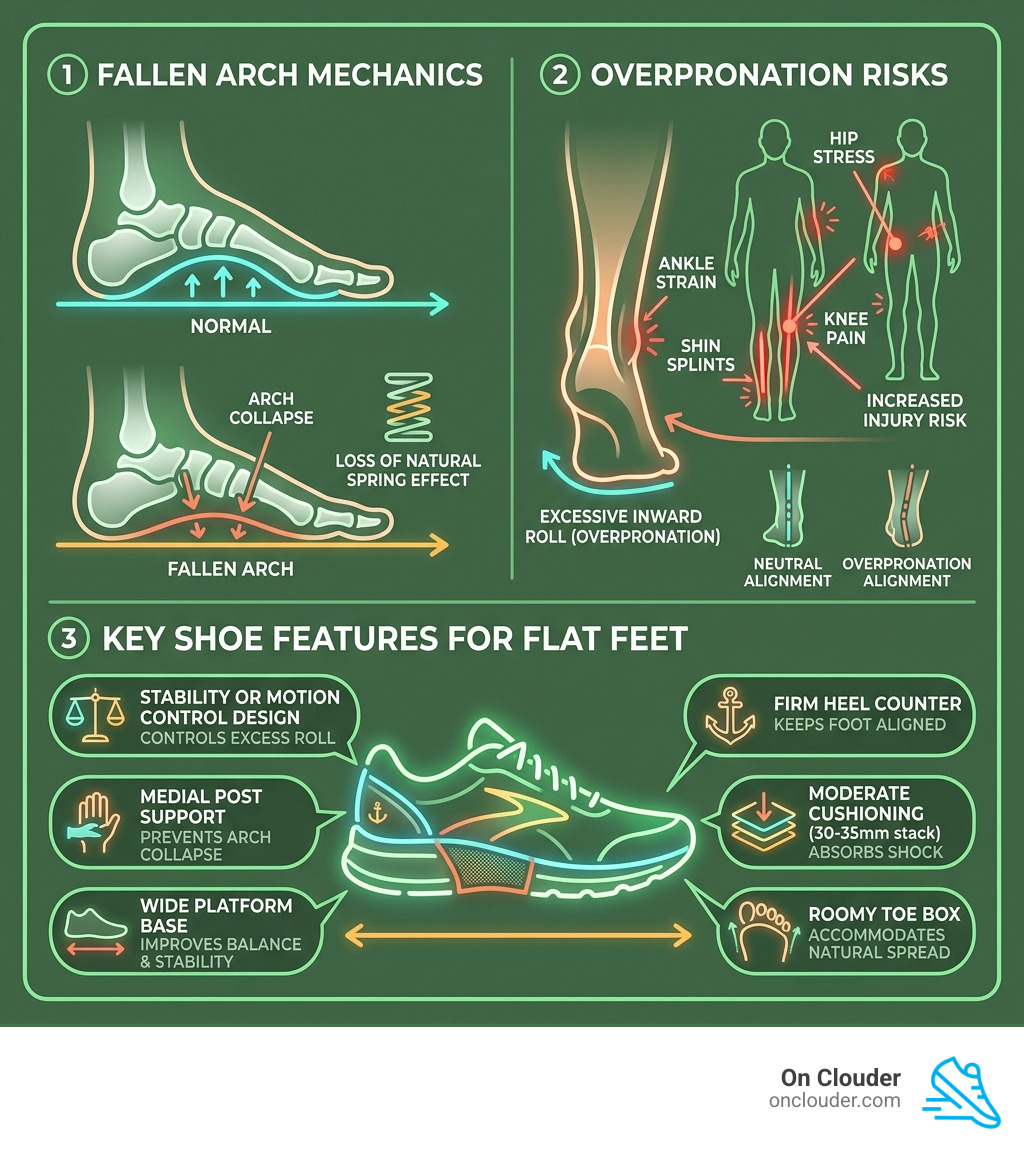
| Stability or motion control design | Controls excess inward rolling (overpronation) |
| Medial post or dual-density midsole | Supports the arch and prevents collapse |
| Wide platform base | Improves balance and reduces ankle strain |
| Firm heel counter | Keeps your foot aligned on landing |
| Moderate cushioning (30-35mm stack) | Absorbs shock without destabilizing your stride |
| Roomy toe box | Accommodates natural foot spread under load |
Flat feet affect somewhere between 20% and 30% of people — so if your arches sit low or touch the ground completely when you stand, you’re far from alone.
The real problem starts when you run. Without a proper arch to act as a natural spring, your foot tends to roll inward with each stride. That inward roll — called overpronation — puts extra stress on your ankles, knees, shins, and hips. Over time, that stress adds up to real injuries.
The frustrating part? There’s a lot of conflicting advice out there. Some experts say pile on the arch support. Others say it does more harm than good. Finding the right shoe can feel overwhelming.
That’s exactly what this guide cuts through.
I’m Faisal S. Chughtai, a footwear expert who has spent years helping people find the right shoes for comfort and performance — including building this flat feet running shoe guide from the ground up. In the sections ahead, I’ll walk you through everything you need to pick the right stability shoe with confidence.
Understanding Your Foot Type: Flexible vs. Rigid Flat Feet
Before we dive into the shoe racks, we have to look at your feet. Not all flat feet are created equal, and knowing which “flavor” you have is the first step in our flat feet running shoe guide.
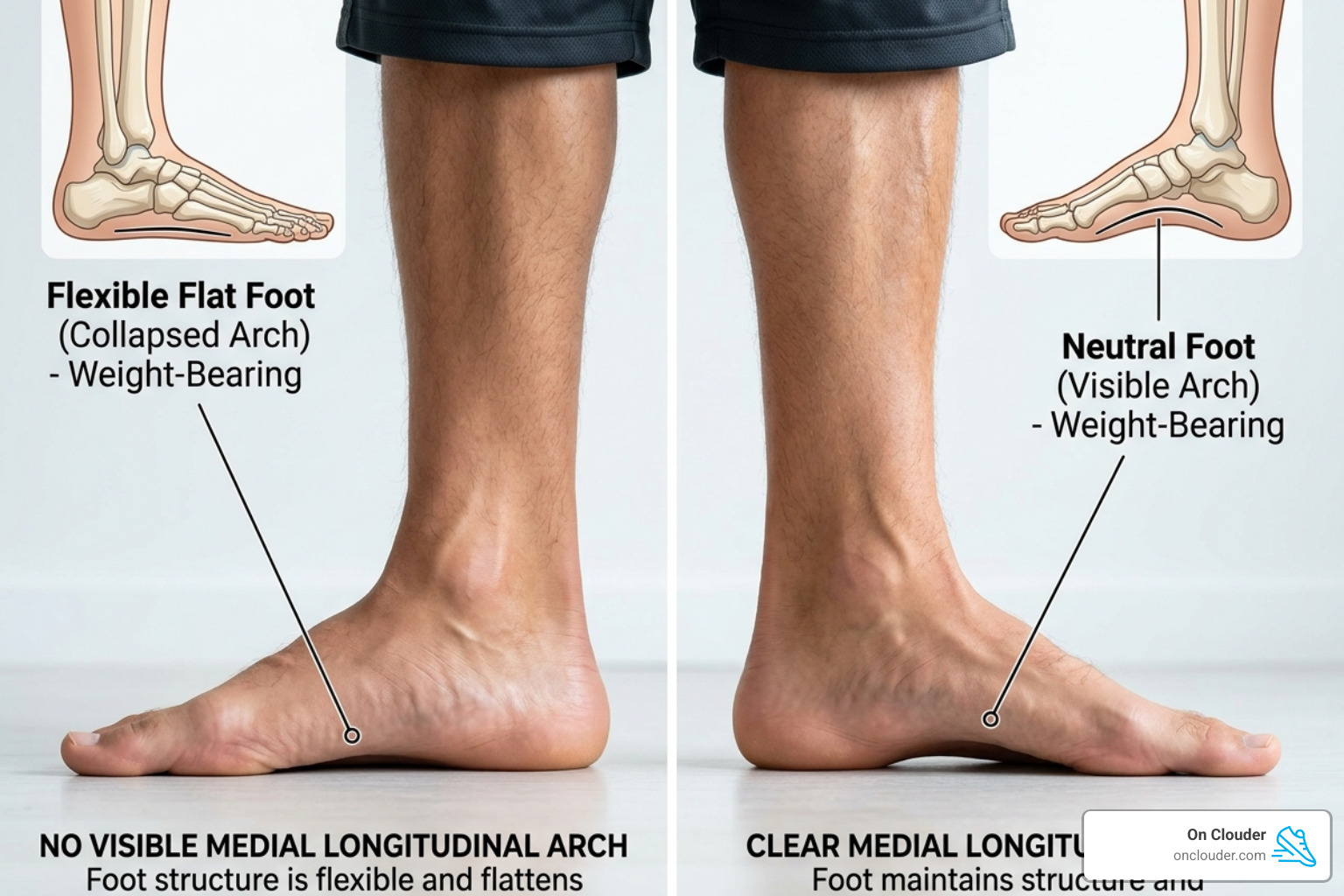
Generally, flat feet (scientifically known as pes planus) fall into two categories:
- Flexible Flat Feet: This is the most common type. If you sit down and dangle your feet, you might actually see an arch. But the moment you stand up and put weight on them? Poof. The arch disappears, and your foot flattens against the floor. Runners with flexible flat feet often benefit from stability shoes that provide a “nudge” to keep the foot aligned.
- Rigid Flat Feet: In this case, the foot is flat whether you are standing, sitting, or even on your tiptoes. This is often due to bone structure or joint issues. Rigid flat feet can be more challenging because the foot doesn’t absorb shock well.
To figure out where you stand, try these two quick tests:
- The Tiptoe Test: Stand on your tiptoes. If an arch appears, you likely have flexible flat feet. If it stays flat as a pancake, you have rigid flat feet.
- Jack’s Test: While sitting, have someone pull your big toe upward (dorsiflexion). If an arch forms in your midfoot during this movement, you have the flexible variety.
Understanding this distinction is vital because it determines how much “correction” you need. You can read more about why having No Arch No Problem Best Running Shoes For Flat Feet is a reality for many successful athletes.
Identifying Overpronation and Gait
The biggest challenge for us flat-footed runners is overpronation. When your arch collapses, your ankle rolls inward excessively. This sends a ripple effect up your leg—your tibia rotates, your knee dives inward, and your hips have to compensate.
You can check for this at home using the Wet Foot Test. Wet the bottom of your foot and step onto a piece of cardboard or a dark tile. If the footprint looks like a solid blob with no curve on the inside, you have flat feet.
Another clue is your old shoes. Look at the outsoles. Is the inner edge of the heel and the area under the big toe significantly more worn out than the rest? That’s a classic sign of overpronation. If you find you’re rolling inward too much, check out An Essential Guide To Best Overpronation Shoes to see how specific tech can straighten you out.
Key Features in a Flat Feet Running Shoe Guide
When you’re browsing for shoes in April 2026, you’ll see a lot of fancy marketing terms. Let’s demystify what actually helps a flat foot stay stable.
- Medial Posts: This is a piece of firmer foam (usually darker in color) located on the inner side of the midsole. It acts like a “speed bump” for your foot, slowing down that inward roll.
- GuideRails: Modern stability tech has moved toward “holistic” support. Instead of just pushing up the arch, GuideRails act like bumpers on a bowling alley, keeping your foot in its natural path only when you need it.
- H-Frame and CenterPath: These are newer geometries seen in brands like Hoka and Saucony. They use higher sidewalls and a broader base to cradle the foot, providing stability through shape rather than just stiff foam.
- Wide Platform: A wider base provides more ground contact, which is essential for balance if your feet tend to wobble.
- Torsional Rigidity: If you grab a shoe and try to twist it like a wet towel, it shouldn’t be too easy. A bit of stiffness in the middle helps prevent the arch from collapsing mid-stride.
For a deeper dive into these specs, our The Ultimate Guide To Good Running Shoes For Flat Feet breaks down the anatomy of a supportive trainer.
Stability vs. Neutral vs. Stable Neutral Options
Not every flat-footed runner needs a “Stability” shoe. Here is how they compare:
| Shoe Type | Best For | Key Features |
|---|---|---|
| Stability | Mild to moderate overpronators | Medial posts, GuideRails, firmer arch support |
| Neutral | Runners with rigid flat feet or those using orthotics | Uniform foam density, maximum flexibility |
| Stable Neutral | Runners who want support without the “stiff” feel | Wide base, side walls, flared outsoles |
Some runners with “anatomical” flat feet (feet that have always been flat but are strong) actually prefer neutral shoes. However, if your arches have “collapsed” over time due to muscle weakness, a stability shoe is usually the safer bet. You can find a curated list in The Ultimate List Of Running Shoes For Flat And Wide Feet.
Cushioning and Shock Absorption for Flat Feet Running Shoe Guide
There is a common myth that flat feet need the softest shoe possible. In reality, too much “mush” can be bad. If a shoe is too soft, your foot will just sink into it and collapse even further.
Look for “responsive” cushioning. Technologies like BioMoGo DNA or FF Leap foam are designed to provide energy return—meaning they bounce back after you compress them. Aim for a moderate stack height (around 30-35mm). This provides enough protection for your joints without making you feel like you’re running on marshmallows. If you’re looking to add support to your current favorites, see Why Your Flat Feet Crave These Arch Support Insoles.
Top Recommendations for Flat-Footed Runners in 2026
As we look at the landscape in 2026, the technology has never been better. We no longer have to wear “clunky” shoes that feel like bricks.
Best Daily Trainers in the Flat Feet Running Shoe Guide
For your everyday miles, you want a workhorse. The average stability shoe in 2026 weighs about 10 oz (285g), which is only slightly heavier than a neutral shoe (9.3 oz).
- The Reliable All-Rounder: Look for shoes with a 8mm to 10mm heel-to-toe drop. This helps take some of the load off your Achilles tendon, which is often under tension in flat-footed runners.
- The Grip Master: Some 2026 models, like the latest Supernova iterations, feature outsole traction scores as high as 0.72—making them 24% grippier than the average shoe. This is huge for staying stable on wet pavement.
- The Durability King: If you’re heavy on your feet, look for sturdier outsoles. Recent lab tests on the Glycerin GTS series showed outsoles that are 54.5% sturdier than average, meaning they won’t wear down as fast on the inner edge.
If you also struggle with a “boxy” foot shape, don’t miss The Az Guide To Running Shoes For Wide Feet.
Orthotics and Arch Support Integration
Should you use insoles? It depends. If you buy a top-tier stability shoe and still feel pain, an insole might be the missing piece.
Many runners find that off-the-shelf inserts provide that extra bit of “fill” for their low arches. When shopping, ensure the shoe has a removable insole and a roomy toe box to accommodate the extra volume. We’ve put together an Ultimate Guide Arch Support Inserts Flat Feet to help you choose.
If you’re feeling a “slump” in your energy or form during long runs, it might be time to Stop The Slump With The Best Arch Support Insoles For Flat Feet.
Frequently Asked Questions about Flat Feet Running
How can I tell if I have flat feet at home?
The easiest way is the Wet Test. Wet your feet and walk across a surface that shows your footprint (like concrete or a paper grocery bag). A “normal” foot will show a curve between the heel and the ball of the foot. A flat foot will show the entire sole. You can also check the Tiptoe Test: if an arch appears when you stand on your toes, you have “flexible” flat feet. For a deeper dive into the basics, check out Shoe Inserts For Flat Feet 101.
How often should I replace stability shoes?
Most runners should replace their shoes every 300 to 500 miles. However, for flat-footed runners, the timeline might be shorter. Because we put more pressure on the medial (inner) side of the shoe, the foam there can compress faster. Once that “support” foam is squashed, the shoe will no longer prevent overpronation. Dont Let Flat Feet Keep You Down With These Inserts can sometimes extend the comfort of a shoe, but never run in a shoe that has lost its structural integrity.
What injuries are common for flat-footed runners?
Overpronation is the “gateway drug” to several common injuries:
- Plantar Fasciitis: Heel pain that is usually worst in the morning.
- Shin Splints: Pain along the front or inner side of the lower leg.
- Achilles Tendonitis: Inflammation of the tendon at the back of the ankle.
- Runner’s Knee: Pain under or around the kneecap.
Proper footwear is your first line of defense. If you’re already feeling the twinge, The Ultimate Guide To Arch Pads For Flat Feet And Pronation might offer some relief.
Conclusion
At On Clouder, we believe that flat feet shouldn’t be a barrier to your running goals. Whether you’re training for your first 5K or your tenth marathon, the right gear makes all the difference. While this flat feet running shoe guide provides a solid foundation, everyone’s biomechanics are unique.
If you’re experiencing persistent pain, we always recommend getting a professional gait analysis at a local running store or seeing a podiatrist. They can give you a “frame-by-frame” look at how your feet move under pressure.
Don’t let low arches hold you back. With the right stability tech, responsive cushioning, and a bit of patience in the fitting room, you’ll be ready to How To Stand Your Ground With Flat Feet All Day Long. Happy running!
