Understanding Flat Feet and the Kinetic Chain
When we talk about flat feet, we aren’t just talking about the shape of your footprint in the sand. We are talking about a biomechanical foundation that affects every joint above it. In podiatry, flat feet are often referred to as “pes planus” or fallen arches. This condition occurs when the tendons in your foot do not pull together properly, leaving the entire sole of your foot to touch the ground.
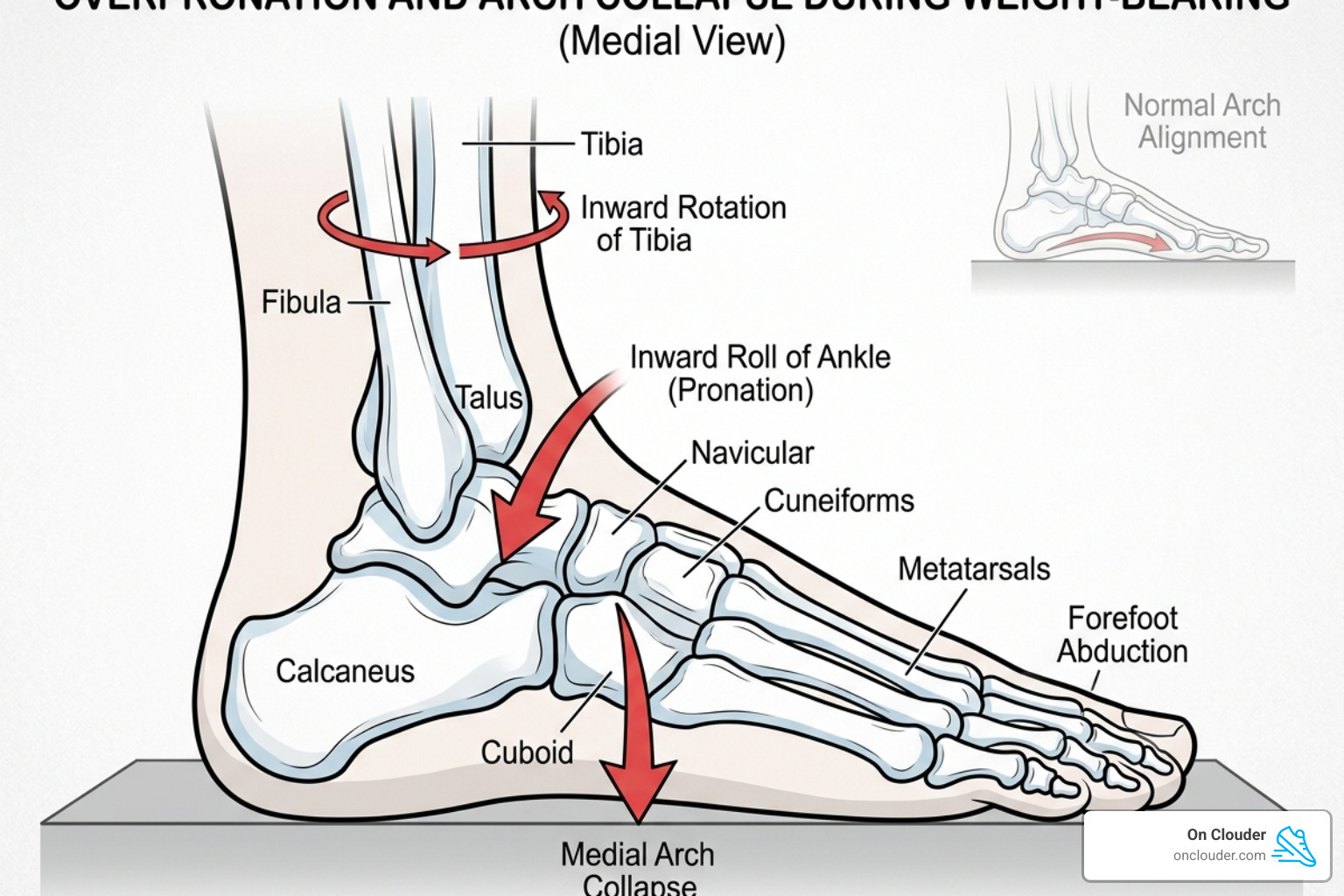
The real trouble begins with overpronation. This is the fancy term for your feet and ankles rolling inward during movement. Because the arch isn’t there to act as a natural shock absorber, your foot collapses inward to compensate for the weight of your body.
This inward roll doesn’t stay in the feet. It travels up the “kinetic chain”—the interconnected system of joints and muscles in your body. When the foot rolls in, the lower leg rotates, the knee twists slightly out of alignment, and the hips tilt to compensate. This is why many people with flat feet don’t just complain of foot pain; they often suffer from:
- Plantar Fasciitis: The strain on the connective tissue under the foot.
- Shin Splints: Caused by the overworked muscles trying to stabilize the collapsing arch.
- Knee Strain: Misalignment leads to uneven wear on the knee joint.
- Lower Back Pain: Postural shifts from the ground up put pressure on the lumbar spine.
By using arch support inserts flat feet sufferers can help restore biomechanical alignment and redistribute weight more evenly across the foot, preventing that painful domino effect.
The Science of Arch Support Inserts for Flat Feet
You might think a soft, squishy gel insert is the answer to foot pain, but science tells a different story. For flat feet, structure beats “squish” every time. Clinical trials and wear trials have shown that firm, medical-grade support is the key to long-term relief.
For instance, in wear trials for advanced bridge-style insoles, a staggering 98% of people felt less pain after just one week of use. Perhaps even more impressively, 63% of consumers reported taking less pain medication after they started wearing supportive orthotics. This isn’t just about comfort; it’s about a measurable improvement in quality of life.
Top-tier brands like those featured in our Ultimate Guide To Arch Pads For Flat Feet And Pronation focus on three scientific pillars:
- Shock Absorption: Reducing the impact force that travels through the heel.
- Energy Return: Using advanced foams (like those offering 55% energy return) to decrease fatigue.
- Injury Prevention: Maintaining the foot in a “neutral” position to prevent the micro-traumas that lead to chronic conditions.
Many of the best arch support inserts flat feet users swear by have earned the American Podiatric Medical Association’s (APMA) Seal of Acceptance, meaning they have been rigorously reviewed by podiatrists to ensure they promote foot health.
How Arch Support Inserts for Flat Feet Prevent Overpronation
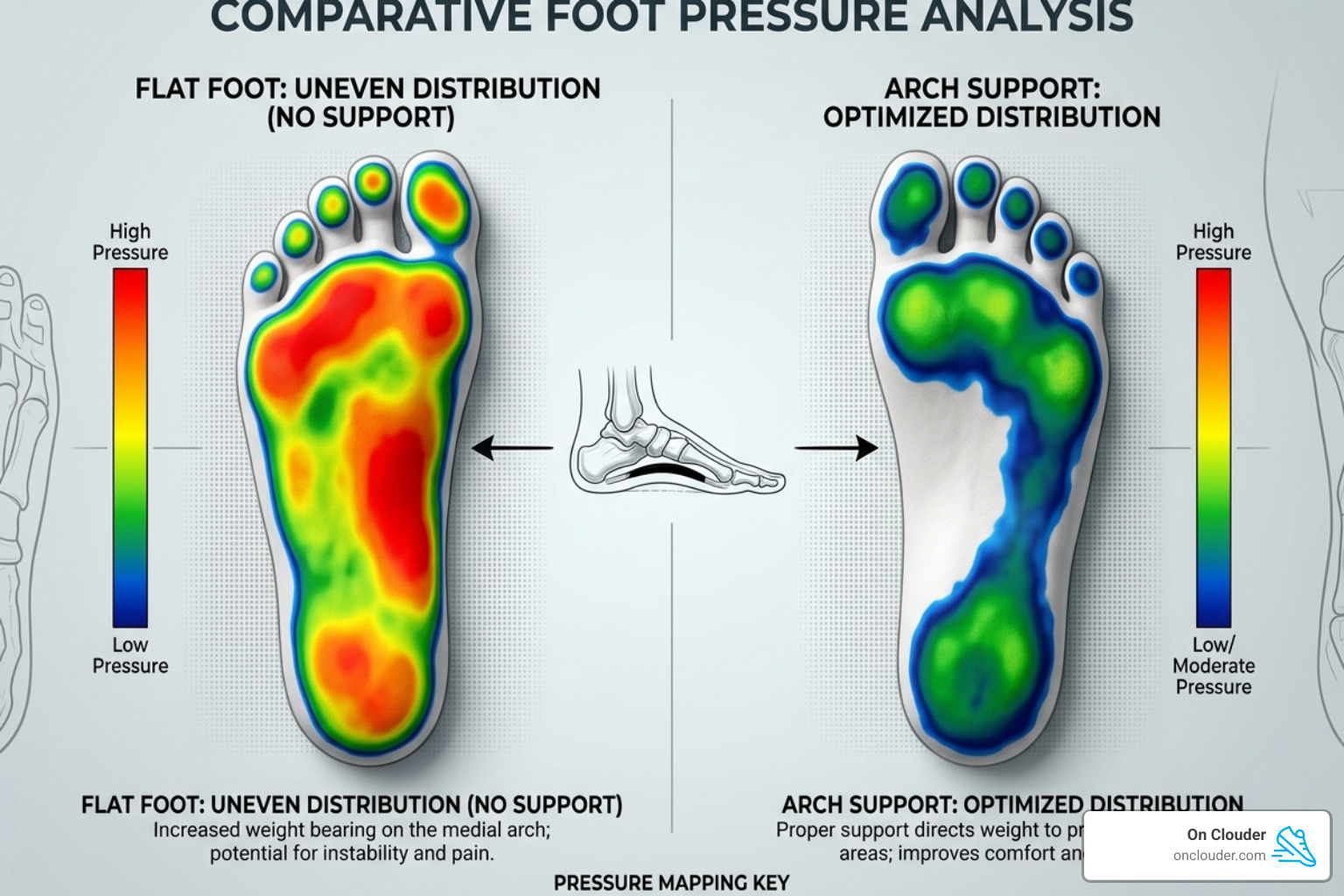
The primary job of an insole for flat feet is to stop the “slump.” When your arch collapses, the calcaneus (your heel bone) tends to tilt. A high-quality insole uses a deep heel cup or a U-shaped wrap to cradle the heel and keep it in a neutral position.
By stabilizing the heel and providing a firm (but flexible) arch shell, these inserts prevent the ankle from rolling inward. This structural realignment ensures that your gait—the way you walk—remains efficient. Products like the Superfeet All-Purpose Support Low Arch are specifically engineered with a low profile to provide this stabilization without being so bulky that they push your foot out of the shoe.
Choosing the Right Arch Support Inserts for Flat Feet
Choosing the wrong arch height is a common mistake. If you have very flat feet and you jam a “high arch” insole into your shoe, it’s going to feel like you’re walking on a golf ball. It can actually cause more pain.
For flat feet, we generally recommend:
- Low to Medium Arch Height: You want to meet the arch where it is, providing a gentle “shelf” rather than a steep mountain.
- Firm Support: Look for semi-rigid materials like TPU or high-density EVA foam. If you can fold the insole in half easily, it probably isn’t providing enough support for flat feet.
- Moisture-Wicking and Odor Control: Especially if you are standing all day, breathable covers are essential for foot hygiene.
For a deeper dive into materials, check out our Shoe Inserts For Flat Feet 101 guide.
Essential Features for Flat Foot Orthotics
When you’re shopping for arch support inserts flat feet, you should look at the insole as a piece of engineering. It’s not just a piece of foam; it’s a multi-component tool designed to fix your gait.
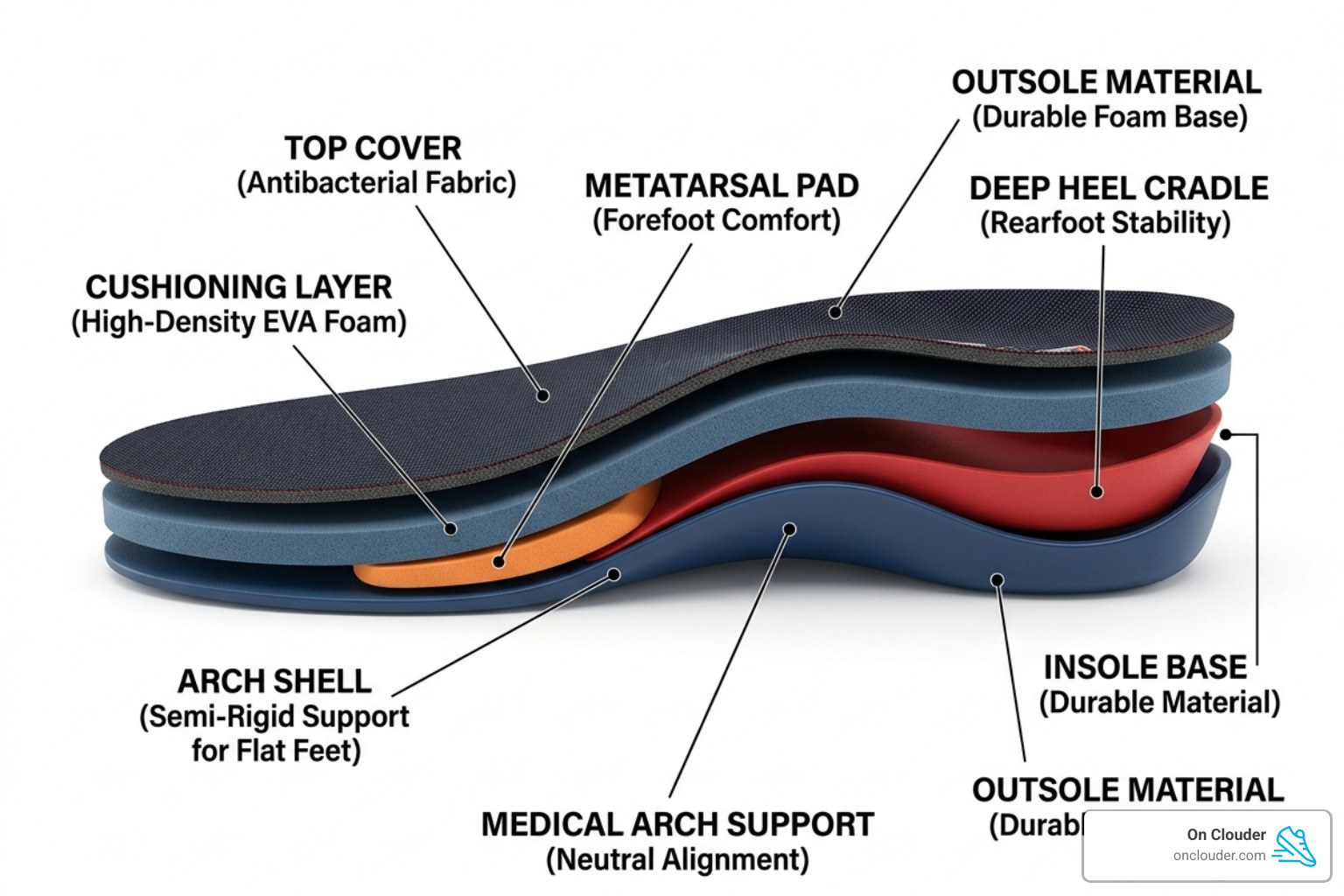
- Deep Heel Cradle: This is non-negotiable. It keeps the soft tissue under your heel bone gathered to maximize natural shock absorption.
- Metatarsal Pads: Some flat-footed individuals also suffer from “splayed” feet. A metatarsal pad helps lift the bones in the forefoot, relieving pressure on the ball of the foot.
- TPU Stabilizer Caps: This is the “skeleton” of the insole. It’s a hard plastic layer that provides the actual arch shape.
- Dual-Layer Cushioning: Usually a mix of a firm base (for support) and a plush top layer (for comfort).
Using the right features allows you to put your best foot forward and ensures that your footwear works with you, not against you.
Custom vs. Over-the-Counter Solutions
One of the biggest questions we get at On Clouder is: “Do I need to spend $400 on custom orthotics from a doctor, or will the $50 ones work?”
The answer depends on the severity of your condition, but for the vast majority of people, Over-the-Counter (OTC) medical-grade insoles are incredibly effective.
| Feature | OTC Medical-Grade Insoles | Custom-Fitted Orthotics |
|---|---|---|
| Cost | $50 – $100 | $300 – $600+ |
| Accessibility | Available immediately | Requires appointments/casting |
| Effectiveness | High (for 90% of users) | Highest (for complex deformities) |
| HSA/FSA Eligible | Yes (most brands) | Yes |
| Lifespan | 6 – 12 months | 2 – 5 years |
Many modern OTC brands now offer “3-step” systems or a variety of arch heights to mimic the custom experience. If you’re unsure where to start, our guide on how to choose the best insoles for foot pain can help you navigate the options. Most quality OTC insoles are also HSA/FSA eligible, making them a cost-effective health investment.
Maximizing Comfort and Durability
Once you’ve bought your arch support inserts flat feet, you need to know how to use them. You wouldn’t run a marathon in brand-new shoes, and you shouldn’t wear new orthotics for 12 hours straight on day one.
The Break-In Period
Your feet have been “slumping” for years. When you suddenly introduce a supportive arch, the muscles and tendons in your feet need to stretch and adapt.
- Day 1: Wear them for 1-2 hours.
- Day 2: Wear them for 3-4 hours.
- Day 3: Full day, if comfortable. Most people fully adapt within 1 to 3 days, though semi-rigid orthotics can take up to a week.
Lifespan and Maintenance
Even the best insoles don’t last forever. Most quality arch supports last about 6 months with daily use, or up to 12 months if rotated. Signs it’s time to replace them include:
- The arch shell feels “soft” or collapses easily.
- The top fabric is peeling or worn through.
- You start feeling that familiar knee or back pain again.
To extend their life, we recommend a multi-pair rotation. Keep one pair in your work boots and another in your running shoes. To clean them, simply spot clean with a mild detergent and air dry. Never put them in the dryer, as the heat can warp the plastic stabilizer caps!
Frequently Asked Questions about Flat Feet Support
How long does it take to get used to new arch supports?
As mentioned, the standard adaptation period is 1 to 3 days. You might feel a slight “pressure” in your arch area—this is normal. It’s the feeling of your foot being held in a healthy position. However, if you feel sharp pain, you may have chosen an arch height that is too high for your foot type.
Can I use flat feet insoles in dress shoes and boots?
Yes! Many brands offer low-profile or 3/4-length versions specifically for dress shoes that don’t have much room. For work boots, full-length insoles with high shock absorption are usually best. Always try to remove the factory liner that came with the shoe before sliding in your new insert to ensure there is enough room for your toes.
Are arch support inserts for flat feet covered by insurance?
While most standard health insurance plans don’t cover over-the-counter inserts, they are almost universally eligible for HSA (Health Savings Account) and FSA (Flexible Spending Account) reimbursement. This means you can use pre-tax dollars to purchase them, which effectively gives you a 20-30% discount depending on your tax bracket.
Conclusion
Your feet are the foundation of your entire body. When that foundation is flat, the rest of the “building” suffers. Investing in a pair of high-quality arch support inserts flat feet is one of the simplest and most effective ways to reduce pain, prevent injury, and stay active.
At On Clouder, we’ve seen thousands of people transform their daily lives—from nurses finishing shifts without throbbing heels to runners hitting new personal bests—just by adding the right support to their shoes. Don’t let flat feet keep you on the sidelines.
For more detailed reviews and to find the specific pair that’s right for you, check out our Shoe Inserts For Flat Feet 101 guide and start walking with comfort today.