
Why Cushioned Wide Toe Box Shoes Are the Smartest Upgrade for Tired Feet
Cushioned wide toe box shoes combine a roomy, foot-shaped front with thick, shock-absorbing midsoles — giving your toes space to spread naturally while protecting your joints from impact.
Best cushioned wide toe box shoes at a glance (April 2026):
| Shoe | Best For | Stack Height | Heel Drop |
|---|---|---|---|
| Hoka Bondi | Max cushion, all-day wear | 43mm | 5mm |
| New Balance Fresh Foam X More v5 | Road walking/running | 40mm | 4mm |
| Topo Atmos | Shock absorption, wide forefoot | 40mm | 5mm |
| Altra Torin | Zero-drop, natural feel | 30mm | 0mm |
| Brooks Ghost Max 3 | Stability, plantar fasciitis | High stack | Low drop |
These shoes are ideal if you spend long hours on your feet, run on hard surfaces, or deal with foot conditions like bunions, plantar fasciitis, or metatarsalgia.
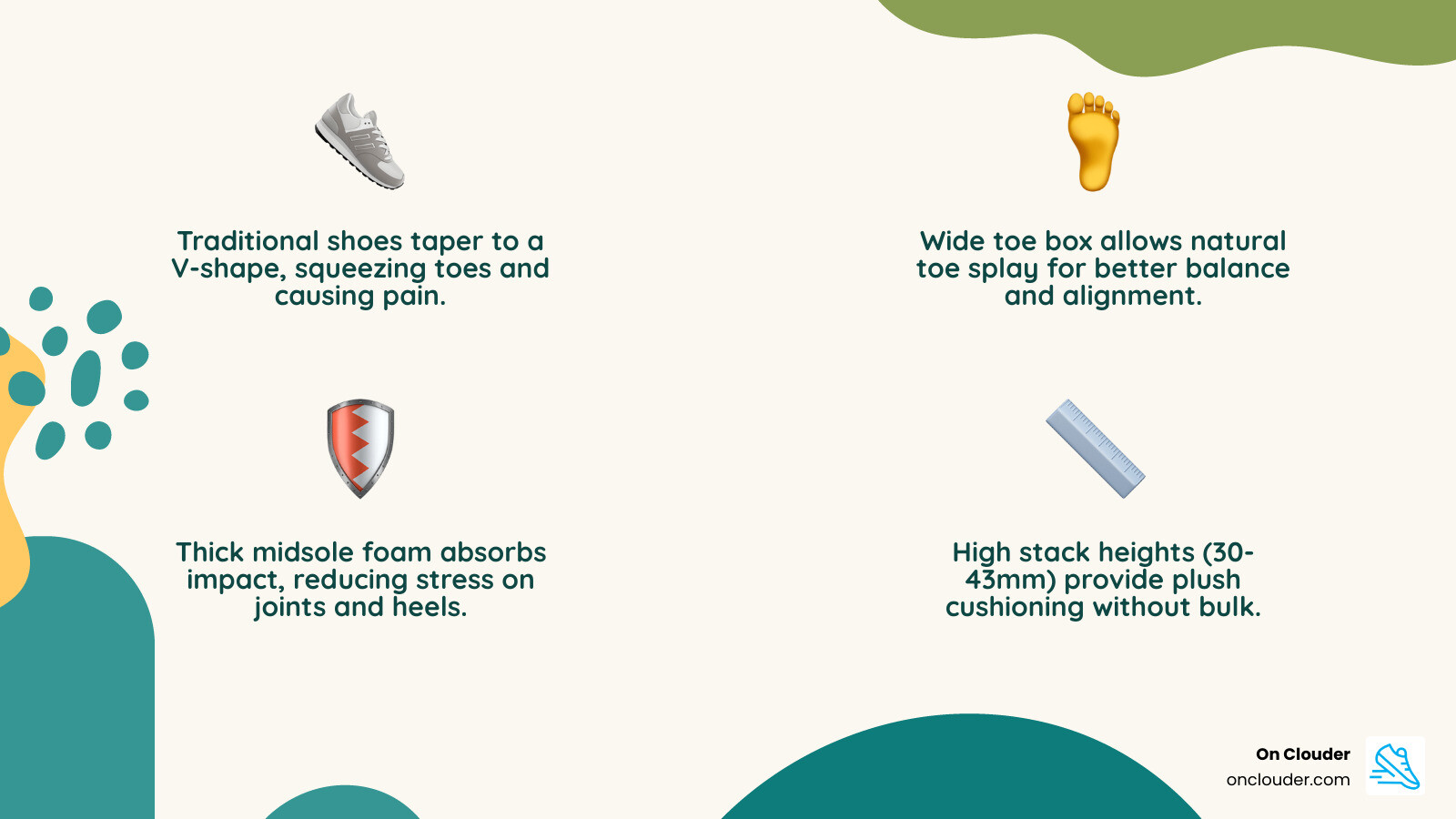
Most people don’t realize their foot pain isn’t about weak feet — it’s about shoes that are too narrow and too flat. A traditional shoe tapers toward the front, squeezing your toes together and forcing your foot into an unnatural shape. Do that for eight hours a day, and your feet will hurt.
Cushioned wide toe box shoes fix both problems at once: they let your toes splay naturally and absorb the impact that travels up through your heels and knees.
I’m Faisal S. Chughtai, a footwear comfort specialist who has spent years researching and testing cushioned wide toe box shoes to help people find relief from foot fatigue and pain. Below, I’ll walk you through everything you need to choose the right pair for your feet and your lifestyle.
What Are Cushioned Wide Toe Box Shoes?
When we talk about cushioned wide toe box shoes, we are looking at a specific hybrid in the footwear world. For years, you generally had two choices: “traditional” athletic shoes that were plush but pointy, or “barefoot” shoes that were wide but offered zero protection from the pavement.
Cushioned wide toe box shoes are the “Goldilocks” solution. They feature an anatomical shape, meaning the front of the shoe is widest where your foot is widest—at the toes. Unlike traditional shoes that taper into a V-shape, these allow for a natural foot-shaped design.
But the “cushioned” part is what sets them apart from minimalist gear. These shoes utilize advanced midsole foam and significant stack height (the amount of material between your foot and the ground). While a barefoot shoe might have a stack height of 10mm, a max-cushion model like the Hoka Bondi or New Balance Fresh Foam X More v5 can reach heights of 40mm to 43mm. This provides a “marshmallow” feel that absorbs the shock of every step.
To truly understand how these differ from what you’re likely wearing now, check out our Wide Toe Box Shoes Ultimate Guide.

The Health Benefits of Cushioned Wide Toe Box Shoes
Why does that extra room matter? It all comes down to toe splay. When your toes have room to spread out, your big toe can sit straight. This is “ground zero” for foot health. When the big toe is pushed inward by narrow shoes, it creates a cascade of problems.
By switching to cushioned wide toe box shoes, we can address several common issues:
- Bunion Relief: By removing the lateral pressure on the big toe joint, these shoes stop the “squeeze” that aggravates bunions.
- Plantar Fasciitis: Many of these shoes feature a “rocker” geometry or supportive foam that reduces the strain on the plantar fascia ligament.
- Metatarsalgia: High-stack cushioning provides a soft landing for the ball of the foot, which is essential for those feeling sharp pains in the forefoot.
- Shock Absorption: For those of us standing on concrete all day, the advanced foam acts as a personal floor mat, reducing fatigue in the ankles, knees, and lower back.
If you’ve ever dealt with black toenails or numbness after a long walk, your shoes are likely the culprit. For a deeper dive into why your toes need room to breathe, read An Essential Guide to Wide Toe Box Shoes.
Key Considerations for 2026
As we move through 2026, the technology in cushioned wide toe box shoes has reached new heights. We no longer have to choose between “clunky orthopedic” looks and comfort. Brands are now using bio-based foams and 3D guidance systems to provide a ride that is both energetic and stable.
When choosing your next pair, consider your primary activity. Are you a road runner, a nurse on a 12-hour shift, or a hiker hitting technical trails? Each requires a different balance of foam density and outsole grip. You can explore a variety of options in our guide: Give Your Feet a Break with the Best Wide Toebox Shoes.
Max Cushion for Road Running: Cushioned Wide Toe Box Shoes
For those of us hitting the pavement, max cushion is the name of the game. Road running involves repetitive, high-impact force. The ideal road shoe in 2026 features advanced cushioning foam like ASICS’ FF BLAST™ PLUS or Topo’s ZipFoam™.
These shoes often boast a high stack height of 38mm to 43mm. For example, the Topo Atmos uses a 40mm stack to take the load off your joints during long miles. The goal here isn’t just softness; it’s energy return. You want a shoe that feels like a “marshmallow” on landing but gives you a “trampoline” feel on toe-off.
For a ranked list of the best performers this year, see our Best Wide Toe Box Running Shoes Guide 2026.
Stability and Support: Cushioned Wide Toe Box Shoes for Standing
If your day involves standing rather than sprinting—think nurses, retail workers, or teachers—you need stability and support. While max cushion is great, too much “squish” can actually lead to muscle fatigue because your foot has to work harder to stay balanced.
Look for shoes with an advanced guidance system. Models like the ASICS GT-2000 14 or the GEL-KAYANO 32 Extra Wide use technologies like a 4D Guidance System™ to keep your foot in a neutral plane. This is especially helpful for those with flat feet or overpronation.
The combination of a wide toe box and a secure heel is the “secret sauce” for all-day comfort. To find a pair that won’t slip at the back while giving you room at the front, check out Stop the Slip with the Best Narrow Heel and Wide Toe Box Shoes.
Key Features to Look For: Stack Height and Heel Drop
Understanding the specs is the best way to shop smart. Two terms you will see constantly are stack height and heel drop.
- Stack Height: This is the total thickness of the shoe’s sole. In 2026, “Low” is typically 16-25mm, “High” is 32-37mm, and “Max” is anything over 38mm.
- Heel Drop: This is the difference in height between the heel and the forefoot. Traditional shoes have a 10-12mm drop (meaning your heel is much higher than your toes). Many cushioned wide toe box shoes use a “Low Drop” (3-5mm) or “Zero Drop” (0mm) to encourage a more natural gait.
| Feature | Low/Zero Drop (0-5mm) | High Drop (8-12mm) |
|---|---|---|
| Benefit | Natural alignment, better for midfoot striking | Relieves pressure on Achilles and calves |
| Best For | Improving posture, natural toe splay | People with tight calves or Achilles tendonitis |
| Example | Altra Torin, Topo Atmos | ASICS GEL-NIMBUS 27 Extra Wide |
Many modern shoes also utilize rocker geometry. This is a curved sole design that helps “roll” your foot forward, which provides excellent impact protection and reduces the work your ankles have to do.
Wide Shoes vs. Wide Toe Box Shoes: What’s the Difference?
This is the most common point of confusion for our readers. Are “wide shoes” the same as “wide toe box shoes”? The short answer is: No.
A standard “Wide” shoe (often labeled as D for women or 2E/4E for men) is usually built wider across the entire shoe. This means the heel and the midfoot are also wider. If you have a “duck-shaped” foot—a narrow heel but a wide forefoot—a standard wide shoe will often slip off your heel.
Wide toe box shoes, however, focus specifically on the forefoot volume and the big toe area. They are designed to be “foot-shaped.” This allows for maximum horizontal space for your toes to splay without the shoe feeling loose or sloppy in the back.
Brands like Topo Athletic are famous for this: they provide a secure, snug fit through the waist and heel of the shoe but open up significantly at the front. If you struggle with shoes that fit your toes but slip at the heel, read Finding the Perfect Match for Your Narrow Heels and Wide Forefoot.
Frequently Asked Questions about Cushioned Wide Toe Box Shoes
Are cushioned wide toe box shoes better than barefoot shoes?
It depends on your needs! Barefoot shoes are great for strengthening foot muscles, but they offer zero impact protection. If you work on concrete, have a history of stress fractures, or are dealing with a loss of the fat pad under your foot, the cushioning in these shoes is a lifesaver. Many people use “transitional” shoes—wide toe box with moderate cushioning—as a middle ground.
Can these shoes help with bunions and hammertoes?
Absolutely. Most bunion pain is caused by shoes that force the big toe toward the second toe. A wide toe box allows the big toe to stay straight. For hammertoes, look for shoes with a high “toe box ceiling” (vertical space) to prevent the tops of your toes from rubbing against the upper material.
Do I need to size up in wide toe box brands?
Not necessarily. Because these shoes are already designed with extra room in the front, many people find they can stick to their true size. However, your feet naturally swell during the day or during long runs. We always recommend measuring your feet in the afternoon and ensuring there is about a thumb’s width of space between your longest toe and the end of the shoe.
Conclusion
At On Clouder, we believe that foot pain should never be the “tax” you pay for being active or working hard. Transitioning to cushioned wide toe box shoes is one of the most effective ways to support your foot health and encourage natural movement without sacrificing the comfort of modern foam technology.
Whether you are looking for the cloud-like softness of a max-cushion runner or the stable support of a daily walker, there is a foot-shaped option waiting for you. Don’t let narrow shoes dictate your comfort—give your toes the space they deserve for long-term comfort.
Ready to find your perfect pair? Dive into our Wide Toe Box Shoes Complete Guide for a full breakdown of every brand and model we trust in 2026.
