

How to Choose the Best Arch Support Sneakers for Flat Feet
The best arch support sneakers for flat feet have a firm heel counter, stable midsole, supportive arch contour, and enough width for your foot to sit naturally. For walking, long work shifts, or light exercise, look for a shoe that controls inward rolling without feeling hard under the arch.
People with flat feet may be more prone to foot fatigue and overuse problems such as plantar fasciitis. If you also have joint hypermobility or Ehlers-Danlos Syndromes, stability matters even more: choose a secure heel fit, a structured base, and a removable insole if you use orthotics.
This roundup helps you compare supportive sneaker types for daily walking, active use, wide feet, and overpronation – without assuming that the stiffest shoe is automatically the right one.
I am Faisal Shahzad, an IT and communication solutions professional with more than 20 years of experience creating clear, useful online resources. In this guide to the best arch support sneakers for flat feet, I focus on the practical features that help readers make a more informed footwear choice.

Key Features of the Best Arch Support Sneakers for Flat Feet
Finding the right footwear when you have low or non-existent arches requires understanding how a shoe interacts with your entire kinetic chain. Flat feet (pes planus) affect an estimated 20% to 30% of the population, leading to biomechanical imbalances if unaddressed. Individuals with flat feet are up to 3 times more likely to experience foot pain and overuse injuries compared to those with neutral arches.
When searching for finding the best supportive sneakers for flat feet without the bulk, prioritize these core structural elements:
- Medial Posting and Guide Rails: A medial post uses denser foam along the inside edge of the midsole to physically prevent the arch from collapsing downward and inward during weight transition. Modern stability shoes often use subtle guide-rail systems that align your gait naturally without feeling obtrusive.
- Firm Heel Counter: The cup surrounding your heel must be rigid. Squeeze the back of the shoe: if it folds flat easily, it lacks the structure needed to prevent excessive rearfoot eversion.
- Torsional Rigidity: A supportive sneaker should resist twisting. If you can wring the shoe out like a wet towel, it will not support a flat foot during extended walking or standing.
- Deep Heel Cup: A sculpted, deep heel cup cradles the calcaneus, stabilizing natural fat pads beneath the heel bone and enhancing shock absorption.
- Broad Midfoot Base: Shoes that taper sharply at the waist leave flat arches hanging over the edge of the sole, causing pressure spots and tendon strain.
| Feature | Low Flexible Arches | Collapsed / Rigid Flat Arches | Hypermobile / EDS Feet |
|---|---|---|---|
| Midsole Support | Moderate medial posting or guide rails | Firm, broad base with linear support | High torsional stiffness with dynamic rails |
| Heel Counter | Semi-rigid | Stiff, reinforced | Deep, ultra-rigid with padded collar |
| Cushioning Type | Responsive, balanced foam | High-density shock absorption | Stable, non-mushy dual-density foam |
| Insole Requirement | Contoured factory insole | High-arch semi-rigid orthotic | Custom orthotic with heel stabilization |
Essential Support for Joint Hypermobility and Ehlers-Danlos Syndromes
Over 40% of people with flat feet also present with hypermobility spectrum disorders or connective tissue conditions such as Ehlers-Danlos syndrome (EDS). When collagen laxity is present, ligaments cannot hold the 26 bones of the foot in an optimal architectural dome. The foot flattens entirely upon weight-bearing, shifting stress upward into the ankles, knees, hips, and lower back.
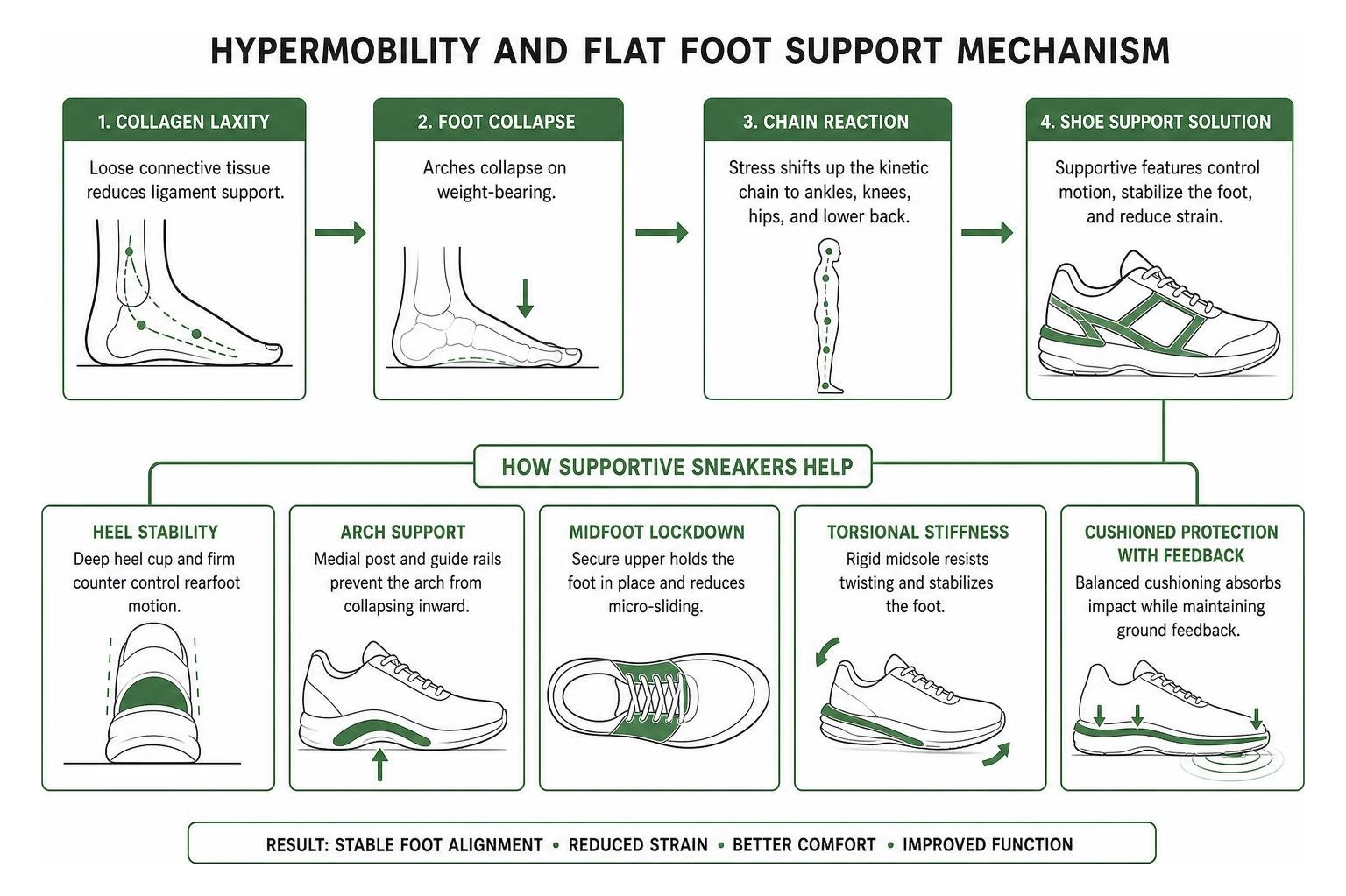
For walkers managing hypermobility, reviewing top podiatrist approved shoes for overpronation reveals why specific features are necessary:
- Extended Heel Bevel: Smooths out initial contact, preventing the heel from striking awkwardly and jarring lax ankle joints.
- Enhanced Proprioceptive Feedback: Soles must not be overly thick or disconnected from the ground; sensory feedback is vital for individuals with poor joint position awareness.
- Secure Midfoot Lockdown: Reinforced eyelets and padded tongues hold the foot firmly against the footbed, preventing micro-sliding that leads to joint subluxations and blisters.
Top Sneaker Categories for Flat Feet and Overpronation

Footwear designs vary depending on how much correction your gait requires. Understanding these categories ensures you select the right sneaker for your daily routine:
- Structured Cushioning Shoes: Designed for mild overpronators who need a blend of plush impact relief and subtle arch guidance.
- Guidance & Stability Sneakers: Built with dual-density foams and broader outsoles to prevent excessive inward rolling. We analyze these dynamics extensively in the 5 best running shoes for flat feet overpronation 2026 guide.
- Motion Control Footwear: The most rigid category, engineered for severe overpronation and fully collapsed, non-flexible arches that require maximum mechanical correction.
Casual Walking vs. High-Impact Active Support Needs
The forces exerted on your feet differ dramatically between casual strolling and high-impact workouts. Walking generates impact forces roughly 1.2 to 1.5 times your body weight, whereas running and active training can drive those numbers up to 3 times your body weight.
In our essential guide to best overpronation shoes, we highlight how dynamic energy return and impact distribution protect against plantar fascia strain. Active use requires firmer foams that bounce back quickly without bottoming out under high loads.
Evaluating Footwear with Orthotics
If you use orthotic inserts, your shoe acts as the chassis while the insole serves as the custom suspension. Choosing a sneaker that pairs seamlessly with inserts prevents fit issues:
- Removable Factory Insoles: Ensure the sneaker’s stock liner pulls out cleanly without tearing glue residue, leaving a flat, unshaped base.
- Adequate Internal Volume: Orthotics take up vertical space. Look for sneakers with deep insteps and wide toe boxes so your toes are not compressed against the upper ceiling.
- Insole Synergy: Detailed in the ultimate guide to buying orthotic insoles for flat feet, combining an aggressive, rigid orthotic with an overly stiff motion-control shoe can make your gait excessively rigid, leading to outer-foot strain.
Common Pitfalls to Avoid When Buying Flat Foot Footwear

Navigating sneaker options can be tricky. Avoid these common mistakes:
- Chasing Pillow-Soft Cushioning: While ultra-plush foams feel great for thirty seconds in a store, they allow flat, unstable feet to sink into extreme overpronation, exhausting leg muscles over hours of wear.
- Buying Narrow Midsoles: A wide upper does not compensate for a narrow sole base. Your arch must rest on the solid platform of the shoe rather than spilling over the side.
- Placing the Arch Apex Incorrectly: If the built-in contour of the shoe presses into your heel or ball of the foot instead of under the true arch, it can cause severe bruising.
- Sizing Up for Width: Buying a half-size larger to accommodate a wide, flat midfoot pushes the shoe’s engineered flex point forward, creating poor biomechanics and heel slippage.
- Ignoring Complete System Compatibility: Review our best arch support shoes insoles guide to confirm whether your shoes provide the right level of neutral stability before adding external orthotic inserts.
How to Test and Break In Supportive Sneakers
Breaking in supportive sneakers should be a controlled process to protect hypermobile joints and sensitive fascia:

- Shop in the Afternoon: Feet naturally expand throughout the day. Fitting shoes when your feet are slightly swollen guarantees they will not pinch during extended shifts.
- The Indoor Test: Wear your new sneakers indoors on clean floors for two to three hours. Check for friction points, pressure along the navicular bone, or calf fatigue.
- Gradual Progression: Wear them for 1 hour on Day 1, 2 hours on Day 2, and gradually increase duration over a week. In a survey of flat-footed individuals, 68% reported that wearing shoes with proper arch support significantly reduced their foot fatigue during daily walking once properly acclimated.
Frequently Asked Questions About Footwear for Flat Arches
How do I know if my flat feet need neutral shoes with insoles or structured stability sneakers?
The choice depends on whether your flat feet are flexible or rigid, as well as the severity of your overpronation. Flexible flat feet that roll inward heavily often benefit from structured stability sneakers. However, if you already have custom-molded medical orthotics, a neutral shoe with a wide, straight platform and a firm heel counter often works best because the insole handles alignment without clashing with the shoe’s internal posts.
Can sneakers with too much arch support cause foot pain for flat feet?
Yes. If an arch support is too tall, too hard, or positioned incorrectly relative to your navicular bone, it can cause arch bruising, inflammation of the plantar fascia, and unnatural outward rolling (supination). Support should match your foot’s natural contour and provide gentle upward guidance rather than a rigid, intrusive lump under the midfoot.
Why do people with Ehlers-Danlos Syndrome need specialized arch support?
People with Ehlers-Danlos Syndrome experience systemic collagen laxity, meaning the ligaments stabilizing their 33 foot joints are more prone to stretching. This causes midfoot collapse, micro-instability at the ankle, and secondary strain along the posterior tibial tendon. Specialized arch support combined with a stiff heel counter stabilizes these hypermobile joints, preventing joint subluxations and daily exhaustion.
Conclusion
Managing flat feet—whether from natural anatomy, age-related changes, or joint hypermobility—comes down to selecting shoes that offer firm structure, wide bases, and balanced shock absorption. Finding the right pair prevents chronic pain from radiating into your knees, hips, and spine.
For more community-tested recommendations and honest feedback from long-distance walkers, explore the best arch support shoes according to reddits most opinionated walkers to find your next reliable pair.