

Biomechanics and Essential Features of Flat Foot Footwear
The best walking and running shoes for flat feet provide structured medial support, firm heel counters, and torsional stability to manage overpronation. Top-performing stability runners include the Brooks Adrenaline GTS 24 and ASICS Gel-Kayano 31, while dedicated motion-control options like the Brooks Addiction Walker 2 deliver maximum control for daily walking. These models support collapsed arches and reduce strain across your kinetic chain.
When you walk or run with flat feet, your medial longitudinal arch collapses toward the ground upon impact. This movement forces the ankle to roll excessively inward—a condition known as overpronation. Because the human skeleton operates as a continuous kinetic chain, this localized collapse triggers internal rotation of the tibia (shinbone), placing abnormal torque on your knees, hips, and lumbar spine.

To counteract these biomechanical forces, supportive footwear relies on several structural engineering elements:
- Medial Post / Guide Rails: High-density foam or firm TPU bridges along the inner edge of the midsole prevent the arch from collapsing inward during the stance phase.
- Firm Heel Counter: A rigid plastic or composite cup encasing the heel prevents calcaneal eversion (the heel tilting outward), stabilizing your rearfoot upon heel strike.
- Torsional Rigidity: A stable shoe resists twisting. When you hold the heel and toe and attempt to wring the shoe like a towel, it should remain rigid through the midfoot shank.
- Heel-to-Toe Drop (8–12 mm): A traditional drop elevates the heel relative to the forefoot, reducing tensile strain on the Achilles tendon and plantar fascia.
- Deep Heel Cup & Wide Toe Box: A deep cup centers the heel’s natural fat pad beneath the calcaneus for natural shock absorption, while a wide forefoot gives collapsed, splayed metatarsals room to breathe without friction.
Understanding these features is key to finding the right match. For a deeper breakdown of structured midsoles, check out The Ultimate Guide to Best Shoes with Arch Support.
| Feature | Stability Shoes | Motion-Control Shoes |
|---|---|---|
| Target Overpronation | Mild to Moderate | Severe / Rigid Flat Foot |
| Midsole Construction | Dual-density EVA / GuideRails | Heavy medial posting / Rigid shanks |
| Shoe Last Shape | Semi-curved | Straight last |
| Torsional Rigidity | Moderate to High | Maximum (zero midfoot twist) |
| Heel Counter | Semi-rigid to Rigid | Ultra-rigid reinforced external counter |
| Weight | 9.0 – 11.5 oz (approx.) | 12.0 – 15.0 oz (approx.) |
| Primary Use Case | Daily running, fast walking | Heavy walking, severe flat foot, standing |
Stability Features in the Best Walking and Running Shoes for Flat Feet
Stability shoes use structured midsoles to guide your foot through a neutral gait cycle without locking it into an unnatural position. Modern designs have evolved beyond rigid, abrupt medial posts. Brands now implement sophisticated guide rail technology and dynamic dual-density foams that only engage when your foot rolls off-axis.
These dynamic systems cushion the lateral heel strike while firmly resisting medial arch collapse. For runners dealing with regular pronation fatigue, exploring The 9 Best Stability Shoes for Every Type of Overpronator provides a clear look at how different brands balance soft landing foam with structured inner-edge support.
Shoes to Avoid: Zero-Drop and Overly Flexible Footwear
If you have flat feet, minimalist shoes, ultra-flexible barefoot trainers, and completely flat sneakers (such as classic canvas skate shoes) should generally be avoided. Zero-drop footwear places maximum elongation stress on the Achilles tendon and stretches the plantar fascia taut across an unsupported arch.
Similarly, soft, unstructured shoes that rely entirely on plush memory foam lack torsional rigidity. While they feel cloud-like in the shoe store, they quickly compress under body weight, leaving your arch to collapse directly against the firm ground. Podiatrists consistently emphasize selecting footwear with verified biomechanical posting and structural integrity rather than pillow-soft midsoles; review the latest Podiatrist guidance on footwear selection to understand why structural rigidity remains critical.
Top Podiatrist Picks: Best Walking and Running Shoes for Flat Feet
Selecting the right pair involves balancing shock attenuation with directional stability. We evaluate shoes based on laboratory midsole tests, torsional rigidity benchmarks, and real-world clinical performance. For a comprehensive overview of top performers, browse The Ultimate Guide to Good Running Shoes for Flat Feet.
Leading Stability Running Models
- Brooks Adrenaline GTS 24: The benchmark daily trainer for overpronation. Its GuideRails holistic support system keeps excess movement in check by supporting your hips, knees, and joints without feeling stiff underfoot.
- ASICS Gel-Kayano 31: Engineered with the 4D Guidance System, this shoe delivers adaptive stability that widens the midsole base dynamically under fatigue, paired with PureGEL rearfoot cushioning for soft landings.
- HOKA Arahi 7: Utilizing HOKA’s patented J-Frame technology, the Arahi delivers structured support using firmer EVA foam along the medial side and wrapping around the heel. HOKA’s oversized midsole absorbs 25–30% more impact energy than standard shoes, making it a great lightweight support option.
- Saucony Guide 17: Built on an asymmetrical Center Path Technology platform with broader sidewalls, the Guide 17 cradles flat feet inside a stable, rockered geometry that transitions smoothly from heel to toe.
To compare these road models head-to-head, read The 5 Best Running Shoes for Flat Feet & Overpronation 2026 Guide.
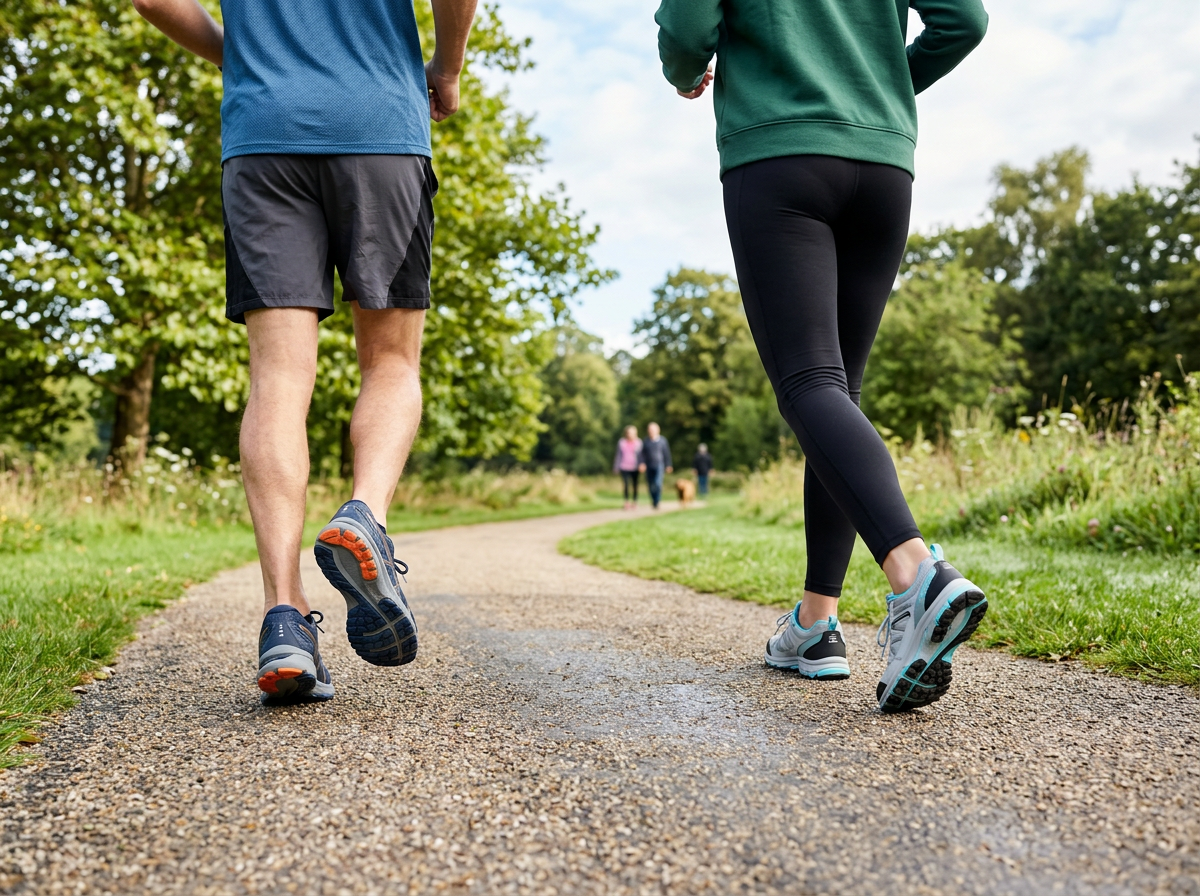
Dedicated Motion-Control and Daily Walking Models
For severe overpronation, posterior tibial tendon dysfunction (PTTD), or extended shifts on unforgiving surfaces, daily walkers often require maximum control:
- Brooks Addiction Walker 2: Designed specifically for walkers, this shoe features an Extended Progressive Diagonal Rollbar (PDRB) that locks the medial side of the shoe, preventing severe inward rotation.
- New Balance 928v3: A leather walking shoe equipped with ROLLBAR posting technology that eliminates rearfoot movement and accommodates thick custom orthotics easily.
- New Balance 1540v3: A heavy-duty motion-control running shoe with a straight last, providing full ground contact and stabilizing severe flat-foot biomechanics.
If you spend long hours on hard flooring, review The Ultimate Guide to Best Walking Shoes for Long Distance on Concrete to find a model that balances durable outsoles with impact dispersion.
Managing Secondary Conditions: Plantar Fasciitis, Knee, and Back Pain
Flat feet rarely cause isolated foot discomfort; when the foundation collapses, the structural shockwaves radiate upward. Roughly 30% of patients presenting with knee pain have flat feet as a contributing cause due to compensatory tibial rotation. Furthermore, clinical observations indicate that roughly 60% of plantar fasciitis patients also present with flat feet.
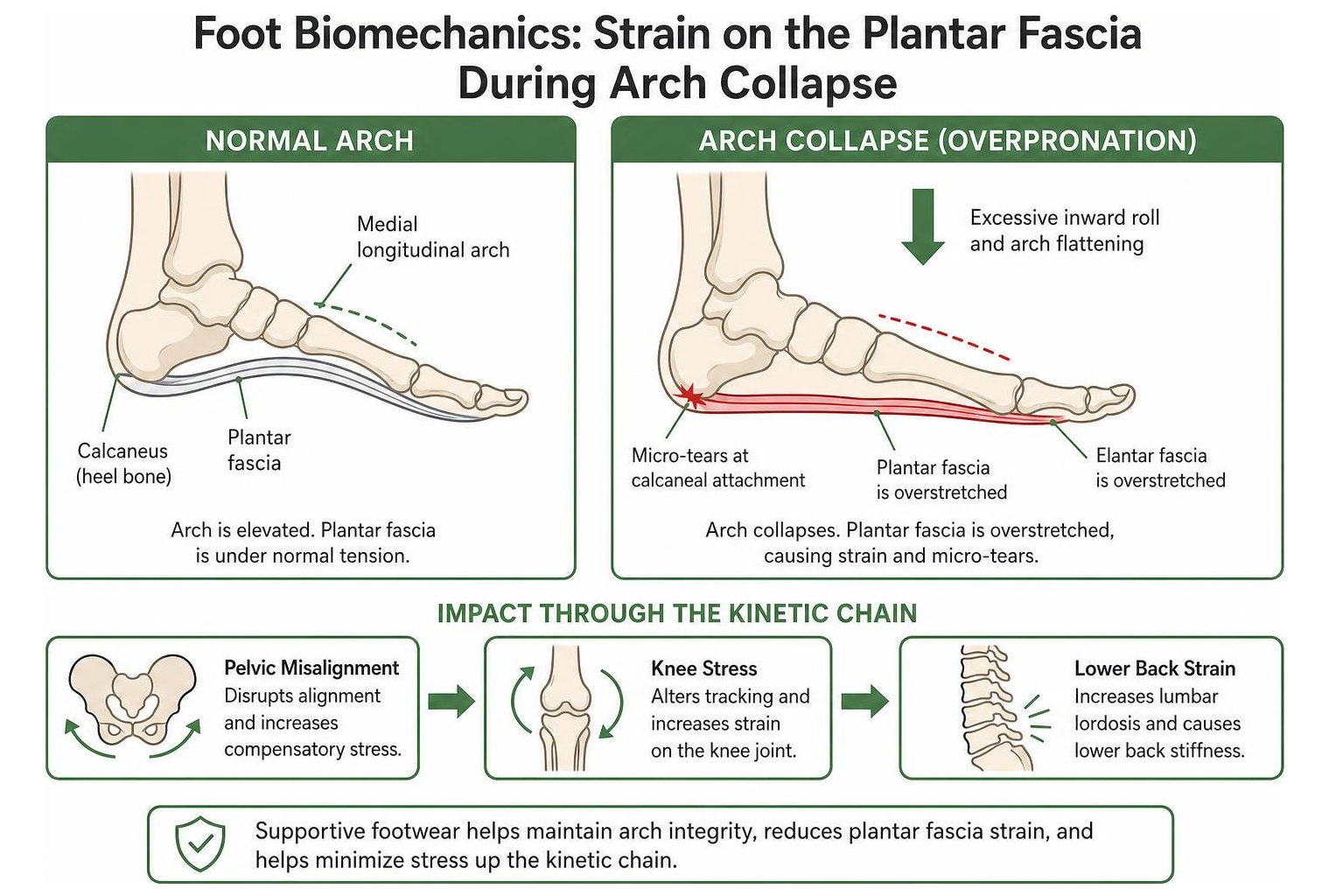
When the arch flattens, the plantar fascia band is stretched beyond its elastic capacity, creating micro-tears at the calcaneal attachment. This instability also disrupts pelvic alignment, increasing lumbar lordosis and causing lower back stiffness. Investing in supportive footwear offloads these ascending stresses; see The Definitive Guide to Best Shoes for Back Pain and review the latest Clinical insights on plantar fasciitis and flat feet to address pain across the kinetic chain.
Custom Orthotics vs. Over-the-Counter Insoles
Even the best stability shoe provides about 40% of the arch support that a properly fitted orthotic insole delivers. Standard factory insoles are primarily thin foam liners intended for step-in comfort, not biomechanical correction.
Adding a rigid or semi-rigid orthotic shell (such as polypropylene) reduces the mechanical load on the plantar fascia by 30–40% with every step. For patients who still experience discomfort after switching to a stability shoe, adding an over-the-counter insert like a PowerStep Pinnacle orthotic typically provides another 40–50% pain reduction within 10 days. In fact, clinical data shows that patients report 60–70% pain reduction within 2–3 weeks of switching to a Brooks Adrenaline GTS shoe paired with a PowerStep orthotic.
Custom orthotics and stability shoes together achieve better outcomes than either alone for symptomatic flat foot. To select the best insert for your footwear, consult The Ultimate Guide to Buying Orthotic Insoles for Flat Feet.
Proper Sizing, Fitting, and Replacement Guidelines
A supportive shoe cannot function correctly if it does not fit your foot shape. Wearing a stability shoe that is too narrow will cause your collapsing medial arch to push against the upper material, creating friction, blisters, and premature upper blowout.

How to Size and Fit the Best Walking and Running Shoes for Flat Feet
Follow these essential fitting principles:
- Fit in the Afternoon: Feet naturally swell by up to half a shoe size after hours of weight-bearing activity.
- The Thumb-Width Rule: Ensure a full thumb’s width (about 1/2 inch) of space between your longest toe and the end of the shoe box when standing.
- Account for Flat Foot Spread: Because flat feet spread wider under weight, many individuals need a Wide (2E) or Extra-Wide (4E) width to keep the base of the foot resting entirely over the midsole platform.
- Bring Your Insoles: Always remove the factory liner and try on shoes with your OTC or custom orthotic in place to ensure your heel remains seated in the heel counter.
For a comprehensive fitting checklist, see Your Step-by-Step Flat Feet Running Shoe Guide for Success.
Replacement Lifespan: Mileage and Degradation
Most athletic shoes should be replaced every 300–500 miles or every 6–12 months with regular use. Even if the rubber outsole shows little wear, the EVA or TPU foam inside the midsole compresses and loses its elastic resilience over time, drastically reducing its shock-absorption and pronation-control capabilities. To explore options built for high-mileage durability, see Best Supportive Running Shoes for Comfort and Protection.
Frequently Asked Questions about Flat Feet Footwear
Can shoes fix flat feet or do they only manage symptoms?
Shoes and orthotics manage symptoms rather than structurally altering adult bone anatomy. Symptom control without structural correction is the goal for most people—custom orthotics, motion-control shoes, and targeted physical therapy manage flat foot symptoms effectively in 85–90% of cases. They support collapsed structures, minimize tissue strain, and allow you to walk and run pain-free.
How do I know when my stability shoes have worn out?
Check your shoes placed on a flat tabletop. If they tilt medially (inward) when viewed from behind, the medial support posting has compressed and is no longer stabilizing your foot. Increased morning heel pain, shin splints, or knee tenderness are also strong indicators that the midsole cushioning has degraded.
Are expensive flat foot shoes worth the extra investment?
Yes, up to the point of functional engineering. Premium stability and motion-control shoes ($130–$180) feature dual-density midsoles, rigid TPU shanks, and advanced cushioning compounds designed to withstand high biomechanical loads. Beyond this price tier, however, costs usually reflect fashion branding rather than superior foot support.
Conclusion
Living with flat feet does not mean you have to accept chronic discomfort or give up running and walking. By understanding your foot biomechanics and investing in footwear with firm medial stability, torsional rigidity, and deep heel seating, you can protect your entire kinetic chain. Pair your shoes with a supportive orthotic when necessary, keep your footwear within its 300–500 mile lifespan, and enjoy every stride. Ready to upgrade your daily rotation? We invite you to explore our full collection of flat feet running shoes for in-depth comparisons and reviews.