
Podiatrist-Recommended HOKA Shoes for Plantar Fasciitis Relief
Best HOKA Sneakers for Plantar Fasciitis: Where to Start
If you want max cushioning for walking or long days on your feet, start with the HOKA Bondi 8. For something lighter for everyday wear, go with the Clifton 9. And if your feet roll inward and you need more stability? The Arahi 7. Need more structure? The Gaviota 5. For work, check out the slip-resistant Bondi SR.
Plantar fasciitis usually hits hardest with those first steps in the morning. A cushioned shoe can make those steps easier. But you also need a secure heel and support that fits your foot. And honestly? No sneaker is a guaranteed fix for ongoing pain.
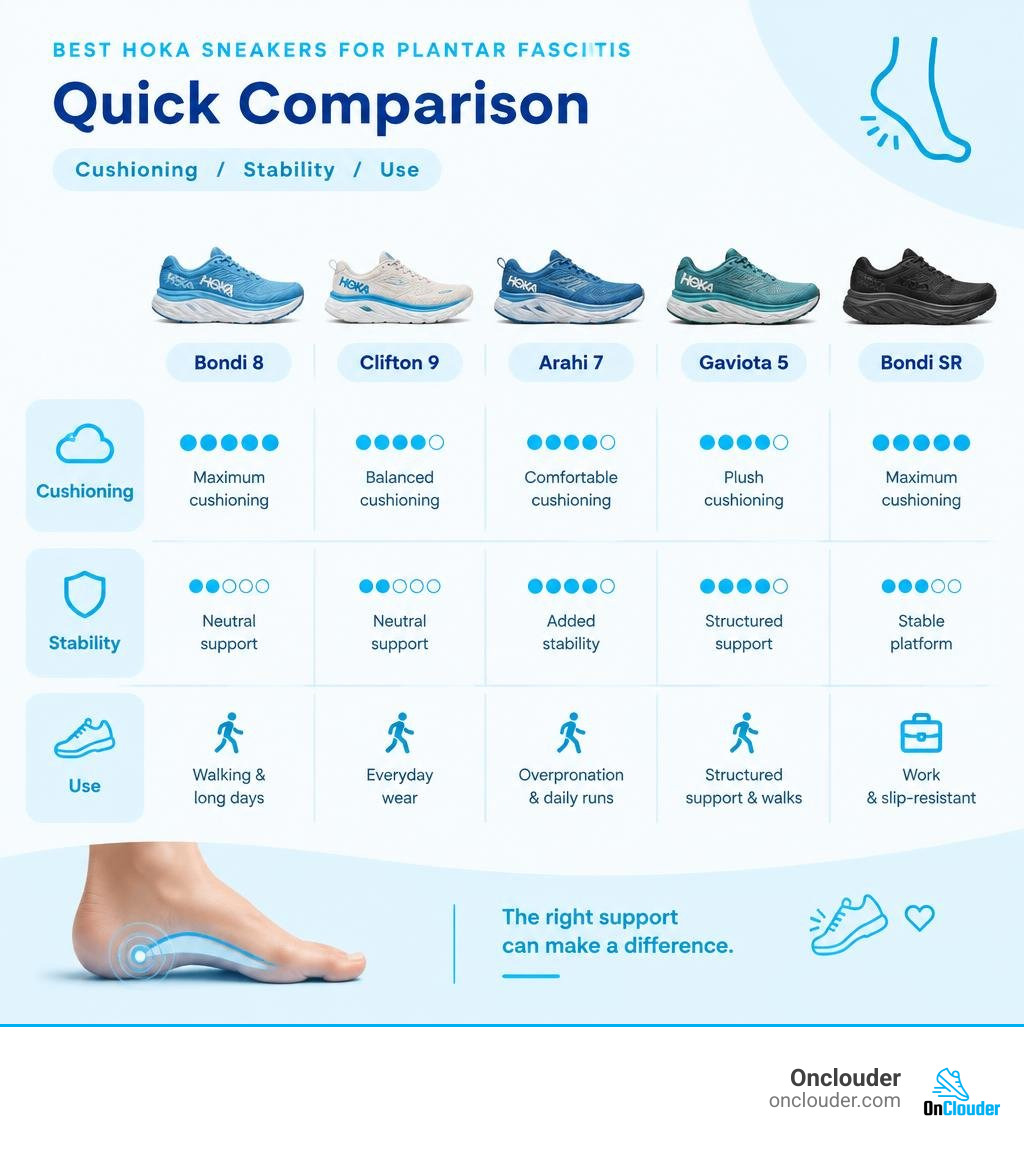
Handy best hoka sneakers for plantar fasciitis terms:
For a broader medical perspective on heel pain and arch strain, see the plantar fasciitis overview.
How HOKA Shoes Help with Plantar Fasciitis
So what is plantar fasciitis, really? It’s when the thick band of tissue along the bottom of your foot gets irritated. Or inflamed. Or develops tiny tears from too much tension. That band runs from your heel bone to your toes. And here’s what happens with every step. Your foot flattens. That stretches the fascia. Now, if your shoes don’t have proper arch support or shock absorption? Every single stride puts strain right on that tender spot at your heel.
HOKA tackles this problem with real design work. Not just soft foam under your feet.
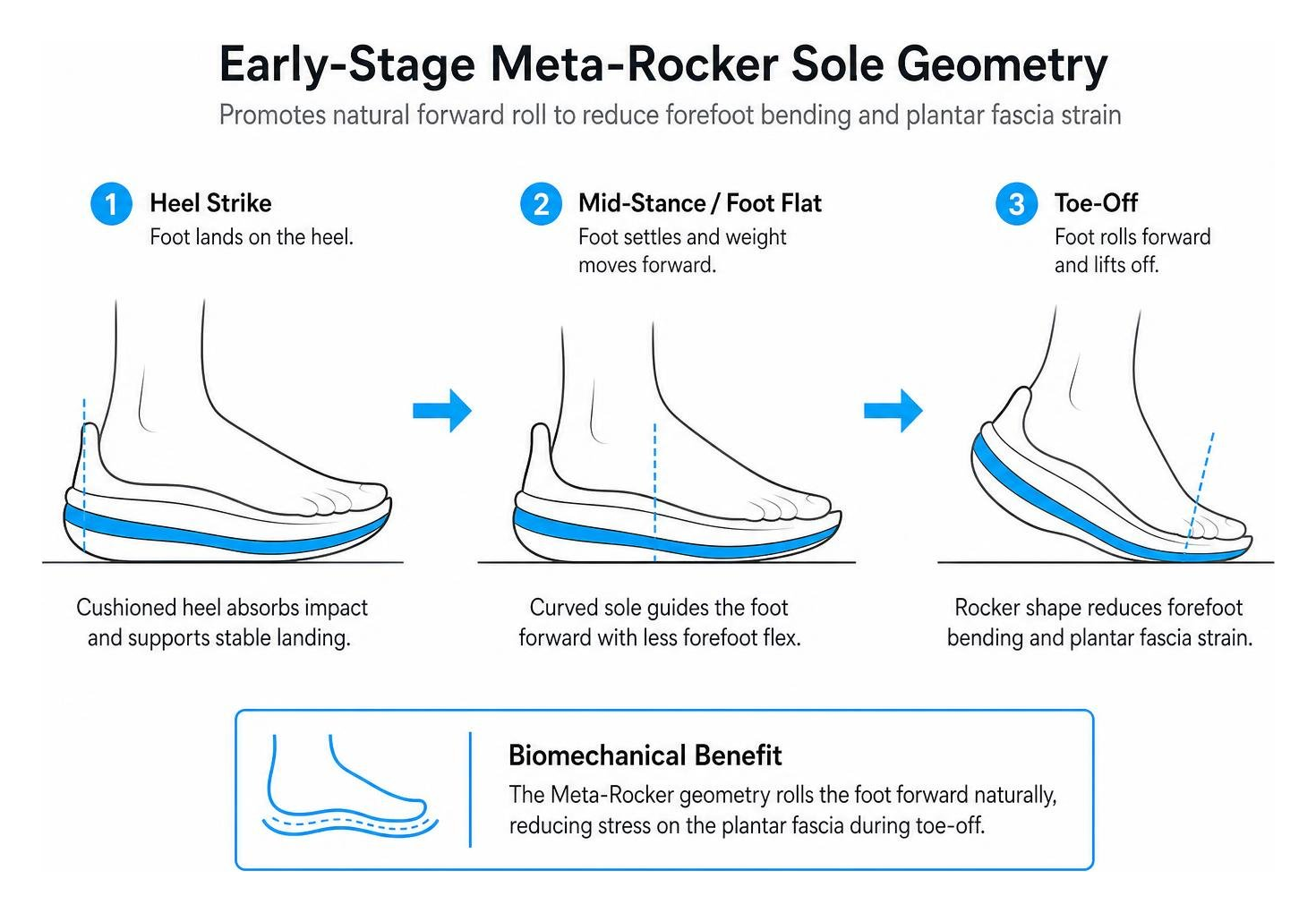
Three primary mechanical features work together to offload stress from the plantar fascia:
- Meta-Rocker Geometry: Most traditional shoes require your foot to bend at the metatarsophalangeal joints (the ball of the foot) during toe-off. This flex engages the “windlass mechanism,” which pulls the plantar fascia tight across the bottom of your foot. HOKA’s curved rocker profile rolls your foot forward naturally, reducing the degree of forefoot bending and significantly lowering peak strain on the tissue.
- Oversized EVA Midsoles: By packing high volumes of tuned EVA foam beneath the foot, HOKA midsoles absorb ground reaction forces before those impacts travel up through the calcaneus (heel bone). This high level of impact attenuation prevents the sharp heel strikes that often aggravate inflamed tissue.
- Balanced Heel-to-Toe Drop: Most HOKA models feature a moderate 4 mm to 5 mm heel drop. Unlike flat zero-drop shoes that place sudden eccentric load on the Achilles tendon and plantar fascia, or steep 12 mm drops that shift excessive pressure forward onto the forefoot, a moderate drop keeps your ankle and calf complex in a neutral, relaxed position.
So why does shoe shape matter so much for recovery? Understanding these mechanics explains it. Want to dig deeper into how different designs stack up for lower-body issues? Check out our complete guide to footwear for foot pain . Or see how maximalist shoes compare in our On Cloud vs Hoka for knee and joint support. analysis.
5 Best HOKA Sneakers for Plantar Fasciitis in 2026
Choosing the right shoe depends on whether your foot requires pure impact absorption, guidance for overpronation, or dedicated workplace durability. Here is how the top supportive models stack up:
| Model | Category | Heel Drop | Cushion Level | Stability Tech | Best Use Case |
|---|---|---|---|---|---|
| Bondi 8 | Neutral / Max Cushion | 4 mm | Plush | Wide Active Foot Frame | Walking, recovery, long standing |
| Clifton 9 | Neutral / Balanced | 5 mm | Balanced / Medium | Moderate Base Width | Daily walking, mixed running |
| Arahi 7 | Dynamic Stability | 5 mm | Balanced | J-Frame Medial Support | Overpronation, arch strain |
| Gaviota 5 | Max Stability | 6 mm | Plush | H-Frame Dual Density | Flat feet, severe heel pain |
| Bondi SR | Occupational / Max | 4 mm | Plush | Water-resistant leather upper | Service industry, medical work |
HOKA Bondi 8: The Best HOKA for Plantar Fasciitis If You Want Max Cushioning
Think of the HOKA Bondi 8 as the max cushioning king. If you get sharp, pinpoint heel pain every time you step on hard floors, this shoe has the thickest layer of shock-absorbing foam in HOKA’s road lineup.

Here’s what’s going on with the design. The shoe has an extended heel shape. Plus an engineered, billowed crash pad at the rearfoot. What does that do? It spreads the force of your heel strike across a wide area. That means less concentrated pressure right on your heel spur. Inside, a padded memory foam collar hugs your Achilles tendon. And it locks your heel into the heel cup. No slipping around in there.
Is it good for speed workouts? No. Too bulky for that. But for walking? It’s excellent — especially if you deal with chronic morning stiffness. Work a job where you’re on your feet 8 to 12 hours at a time? Check out our detailed guide on HOKA models for standing all day. And if you want to see how it stacks up against other max-cushion shoes, read our On Cloudmonster vs Hoka Bondi 8 breakdown.
- Pros: Deepest underfoot cushioning; wide stabilizing platform; plush memory foam ankle collar.
- Cons: Substantial weight; bulky silhouette can feel cumbersome for fast paces.
HOKA Clifton 9: The Best Balanced Daily Trainer for Arch Pain
For walkers and runners who find the Bondi too heavy or squishy, the HOKA Clifton 9 delivers balanced comfort in a streamlined, lightweight package. It strikes a practical middle ground: protective enough to soothe an aching heel, yet responsive enough for daily fitness routines.
The Clifton 9 has an updated compression-molded EVA midsole. That foam is lighter and more energetic than older versions. And it’s paired with an early-stage Meta-Rocker. Together, they guide your stride forward smoothly. That means less strain on your calf muscles and plantar fascia. Whether you’re running errands or hitting the road.
The engineered knit upper wraps your midfoot comfortably. It doesn’t push down hard on high arches. Want to see how this daily trainer compares to other max-cushion shoes? Check out our head-to-head comparison of the On Cloudmonster vs Hoka Clifton 9.
- Pros: Versatile weight-to-cushion ratio; smooth toe-off transition; breathable upper.
- Cons: Less stability guidance for severe overpronators.
HOKA Arahi 7: Best Stability Sneaker for Overpronation
Plantar fasciitis often goes hand in hand with overpronation. That’s when your ankle rolls too far inward and your arch collapses with every step. And that inward collapse? It twists and strains your plantar fascia. The HOKA Arahi 7 was built to fight exactly that.
Most stability shoes use stiff plastic posts under the arch. But those can irritate sensitive fascia. So HOKA did something different. The Arahi 7 uses their J-Frame technology. That’s a firmer foam that wraps around the inside of your heel. Then it runs along the edge of the shoe in a J shape.
So what does that give you? Structured guidance that gently stops inward roll. No rigid pressure under your arch. Plus a secure midfoot lockdown and an early-stage Meta-Rocker. Together, they keep your arch from collapsing. And that’s key, because arch collapse slows down plantar fasciitis recovery.
- Pros: Structured stability without rigid medial posts; lightweight for a support shoe; excellent heel hold.
- Cons: Upper fits slightly narrower in the midfoot than neutral models.
HOKA Gaviota 5: Heavy-Duty Support for Severe Heel Pain
Got very flat feet? Flexible arches? Or carry more body weight? Then standard stability shoes might not cut it. They just don’t give enough support to take pressure off your plantar fascia. The HOKA Gaviota 5? It packs maximum stability and plush cushioning into one shoe.
So how does it work? The Gaviota 5 uses an H-Frame system. That’s a base layer of firmer foam that locks together. It stabilizes both the inner and outer edges of the shoe. And that wide, stable base? It cradles your foot. Keeps it from rolling too far in or out.
Now, the base is rigid. But the top layer? It’s soft, high-stack EVA foam. So your heel gets a forgiving landing. While the base underneath holds firm alignment. No give there.
- Pros: High torsional stability; accommodating, wider footbed; top-tier pronation control.
- Cons: Premium price point; heavier overall footprint.
HOKA Bondi SR: The Best Slip-Resistant Work Shoe for All-Day Standing
A lot of people dealing with plantar fasciitis work in healthcare, service, education, or retail. They’re on their feet for long shifts on hard concrete or tile. And regular mesh running shoes? They just don’t hold up. No spill protection. Not enough durability. And the traction? Not there for those kinds of floors.
The HOKA Bondi SR takes that ultra-cushioned midsole from the Bondi line and tweaks it for work. You get a water-resistant leather upper. Plus a slip-resistant rubber outsole. And it’s been tested against oily and wet surfaces.
That thick EVA cushion soaks up constant shock through long shifts. And the early-stage Meta-Rocker keeps you moving forward smoothly. Whether you’re walking hospital halls or kitchen floors. Want a broader look at work shoe options? Check out our supportive work shoes guide.
- Pros: Certified slip-resistant outsole; easy-to-clean leather upper; maximum standing relief.
- Cons: Heavier and less breathable than mesh models due to the full-grain leather construction.
How to Choose the Right Plantar Fasciitis Footwear
Finding relief requires matching a shoe’s engineering to your specific foot structure, daily routine, and gait characteristics.
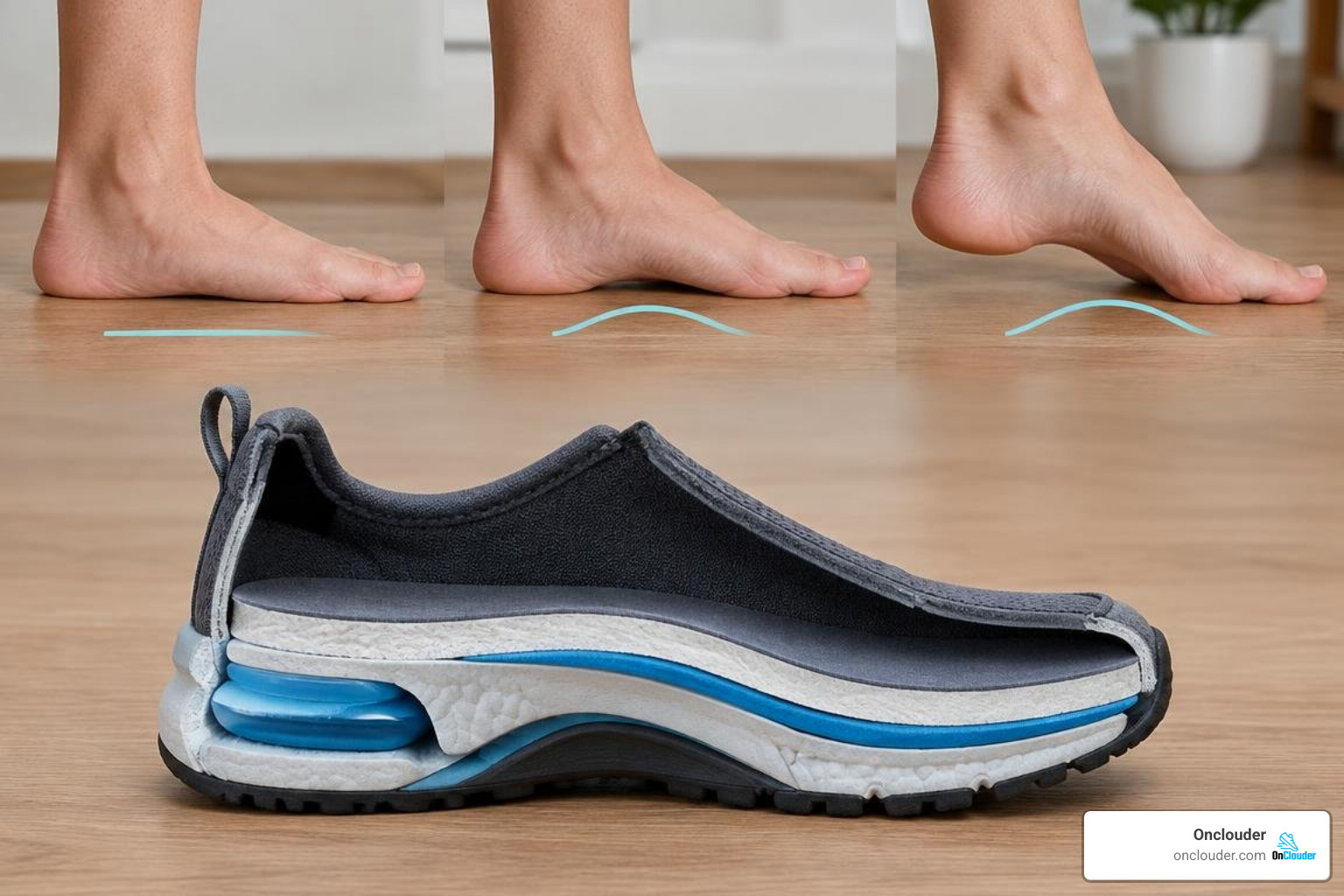
Key Design Elements of the Best HOKA Sneakers for Plantar Fasciitis
When evaluating shoes for heel and arch relief, look for these foundational structural qualities:
- Torsional Rigidity: A shoe that you can easily twist like a dishtowel will not adequately protect an inflamed plantar fascia. Look for a firm midfoot shank or a wide platform that resists twisting.
- Deep, Rigid Heel Counter: Squeeze the back of the shoe around the heel cup. It should feel firm, not flimsy. A supportive heel counter locks your calcaneus in place, minimizing lateral shifting that tugs on the fascia.
- Supportive Insole Integration: The factory sockliner should be removable so you can swap in podiatric orthotics if your treatment plan calls for them. You can read our guide on choosing between orthotic inserts and custom supports to determine what your feet need.
- Accommodating Toe Box: A tapered, tight toe box forces your big toe inward, which can pull the abductor hallucis muscle and tighten the plantar fascia. Choose models with sufficient width for natural toe splay.
Sizing, Sourcing, and Local Availability
Fit is just as crucial as footwear geometry. When shopping for supportive footwear:
- Size for Volume and Swelling: Feet naturally expand over the course of the day. Shop in the afternoon and allow roughly a thumb’s width (about half an inch) between your longest toe and the end of the shoe.
- Consider Wide (2E/4E) Widths: If you have a broader forefoot or need extra space for a rigid orthotic insert, select wide variations (offered across the Bondi, Clifton, Arahi, and Gaviota lines).
- Local Fittings: While ordering online is convenient, trying shoes on in person allows you to test the rocker geometry on a hard floor. If you are shopping locally in suburban areas such as Palatine, IL, visit dedicated specialty running stores or authorized athletic retailers to have your gait analyzed on a treadmill.
Frequently Asked Questions About HOKA Shoes for Plantar Fasciitis
Do HOKA sneakers require a break-in period for heel pain relief?
Yes, most people need a brief adaptation period. While HOKA’s EVA midsoles feel soft immediately out of the box, the early-stage Meta-Rocker sole changes how your ankle and foot muscles engage during your gait cycle.
If you are accustomed to traditional flat, high-drop footwear, start by wearing your new shoes for 1 to 2 hours per day around the house. Gradually increase your wear time over 5 to 7 days to allow your Achilles tendon, calves, and foot intrinsics to adapt smoothly.
Can I use custom orthotics inside HOKA running shoes?
Yes. All major HOKA road models—including the Bondi, Clifton, Arahi, and Gaviota—come equipped with removable molded EVA insoles. You can slip out the stock insole and replace it with an over-the-counter arch support or custom-molded podiatric orthotic.
Because HOKA shoes feature deep footbeds and an Active Foot Frame, they accommodate structured orthotic inserts without causing your heel to slip out of the rear collar.
Where can I find HOKA sneakers locally in Palatine, IL?
Shoppers in the Palatine, Illinois area can find authorized HOKA retailers at several nearby locations. Specialty running and walking stores provide professional gait analysis and direct fittings.
Additionally, regional sporting goods locations and authorized footwear retailers carry deep inventories of current HOKA running, walking, and occupational models.
Conclusion
Managing plantar fasciitis requires an intentional balance of shock absorption, arch stability, and gait mechanics. By combining thick EVA cushioning with curved Meta-Rocker geometries and firm heel counters, HOKA sneakers help offload mechanical strain from the plantar fascia band, giving irritated tissue the environment it needs to rest and recover.
Whether you choose the ultra-plush Bondi 8 for daily walking, the structured Arahi 7 to correct overpronation, or the durable Bondi SR for long workplace shifts, selecting the right model is a critical step toward pain-free mobility. For our complete curated collection of therapeutic footwear options, explore our comprehensive guide to podiatrist-approved footwear for plantar fasciitis.