
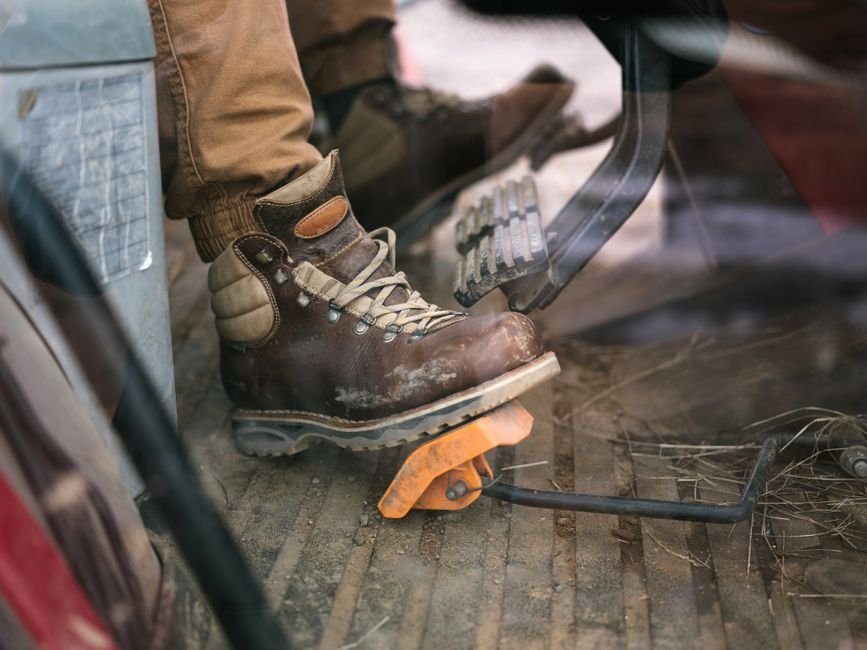
Why Heavy Duty Insoles Matter at 220+ lbs
Heavy duty insoles are made for one job: holding up your feet when the pressure never lets up. Weigh 220 lbs or more? On your feet all shift? Then you need three things. A firm arch. A stable heel cup. And cushioning that won’t flatten out after a week. Fit matters too. The right pair should sit in your shoes without squishing your toes or lifting your heel.
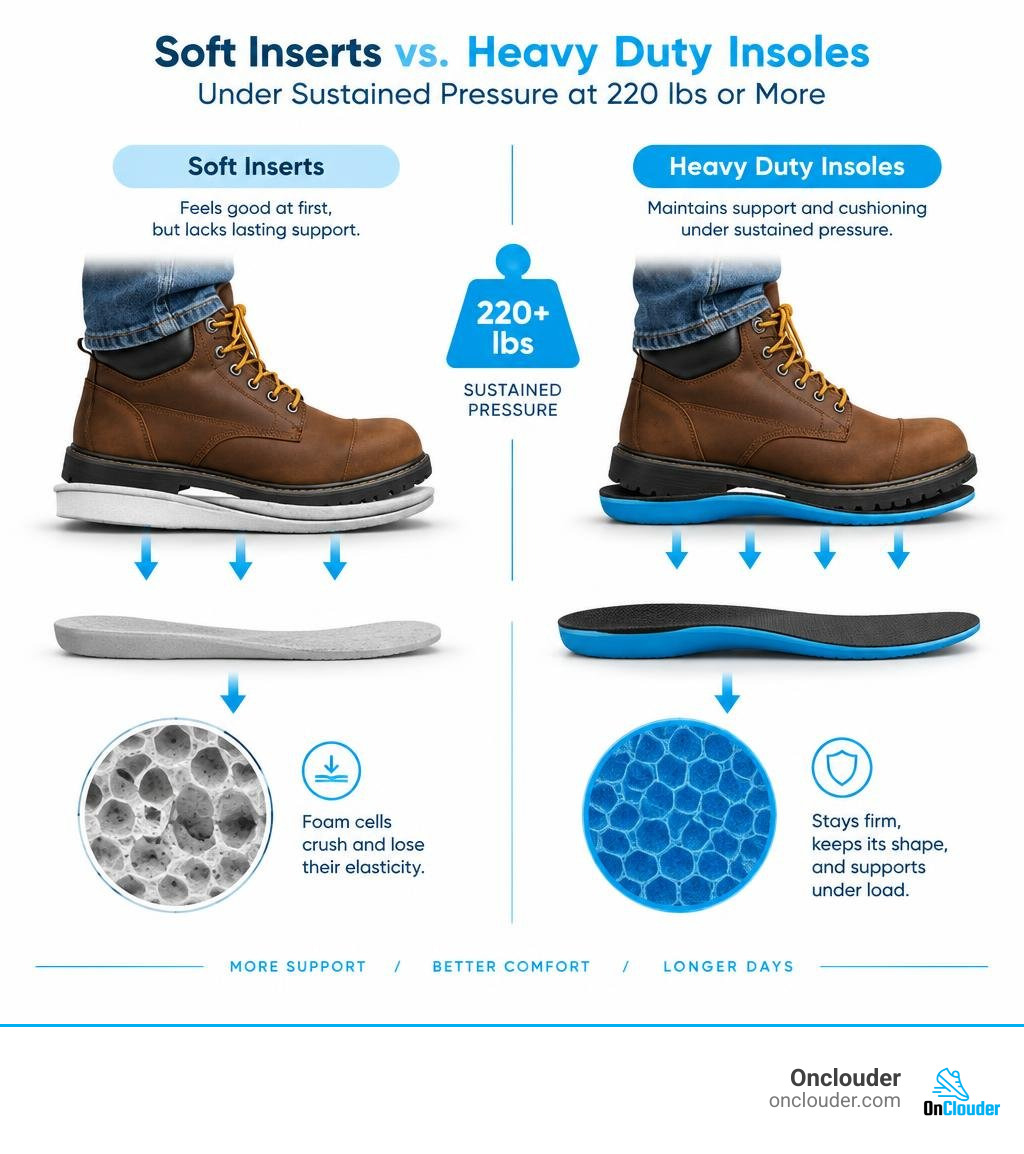
Soft inserts feel great for the first hour. Then they give out. No structure left. Heavy duty insoles do the opposite. They spread pressure across your whole foot instead of letting it pile up in one spot. Now, will they cure your foot or back pain? No. Nothing does that overnight. But a pair that fits right? It can make a 10-hour shift on concrete a whole lot easier to get through.
The Biomechanics: Why Standard Cushions Collapse Under Heavy Loads
When you weigh 200, 220, or 250+ lbs, every step you take generates dynamic ground reaction forces that multiply your body weight by up to three times. Over an 8- to 12-hour shift on unyielding concrete or industrial tile, standard off-the-shelf inserts face an overwhelming mechanical challenge.
Most standard inserts use EVA foam. Or some squishy open-cell foam. They feel plush for the 30 seconds you’re trying them on in the store. Then you actually walk on them. That’s when ‘foam bottoming’ kicks in. All those tiny cell walls inside the foam crush together. The insole loses its bounce. And it stays flat. Permanently. What’s left is basically a dense, dead wafer.

So what happens when an insert bottoms out? Your foot has to absorb all that impact on its own. And without a firm structure underneath, your arch just keeps dropping. That stretches your plantar fascia tight. Think of an over-tightened bowstring. Now you’ve got pressure spikes hitting your heel bone and the balls of your feet. Here’s the thing about how to choose the best insoles for foot pain — plush comfort alone won’t stop structural collapse. Not when real weight is on the line.
Structural Differences in Heavy Duty Insoles vs Standard Inserts
Heavy-duty footbeds aren’t built for pillow softness. They’re built for structure. And for spreading impact around. That’s the whole point. To handle all that extra force, they mix dense polymers with composite shells that actually hold their shape.
| Feature | Standard Replacement Inserts | Heavy Duty Footbeds (220+ lbs) |
|---|---|---|
| Primary Arch Support | Soft compressed EVA or thin foam ridge | Reinforced rigid/semi-rigid polyamide or composite shell |
| Arch Heights | Generic 15–20 mm low-profile curve | Targeted 30–32 mm structured biomechanical contour |
| Heel Cup Depth | Shallow (5–12 mm), easily flaring outward | Deep, structured cradle (20–30 mm) for motion control |
| Core Cushioning | Low-density open-cell foam or liquid gel | High-density Polyurethane (PU), Poron, or sugarcane bagasse |
| Compression Resistance | Collapses within 4–8 weeks under >200 lbs | Retains structural geometry for 6–12 months |
| Motion Stability | Minimal lateral or torsional resistance | Controls ankle eversion and excessive pronation |
Here’s where heavy-duty insoles really pull ahead: the arch cradle and the deep heel cup. With standard insoles, your heel pad spreads out sideways every time you step down. That kills your natural fat cushion. Heavy-duty designs do the opposite. They use deep heel cradles — usually 25 to 30 mm deep — to cup that fat pad and keep it right under your heel bone. That’s how you get real shock absorption. And **** overpronation insoles to stop excessive rolling ? They steady your ankle joint too. Which stops your arch from collapsing inward before that strain travels up to your knees and hips.
Key Engineering Features of Top-Rated Heavy Duty Insoles
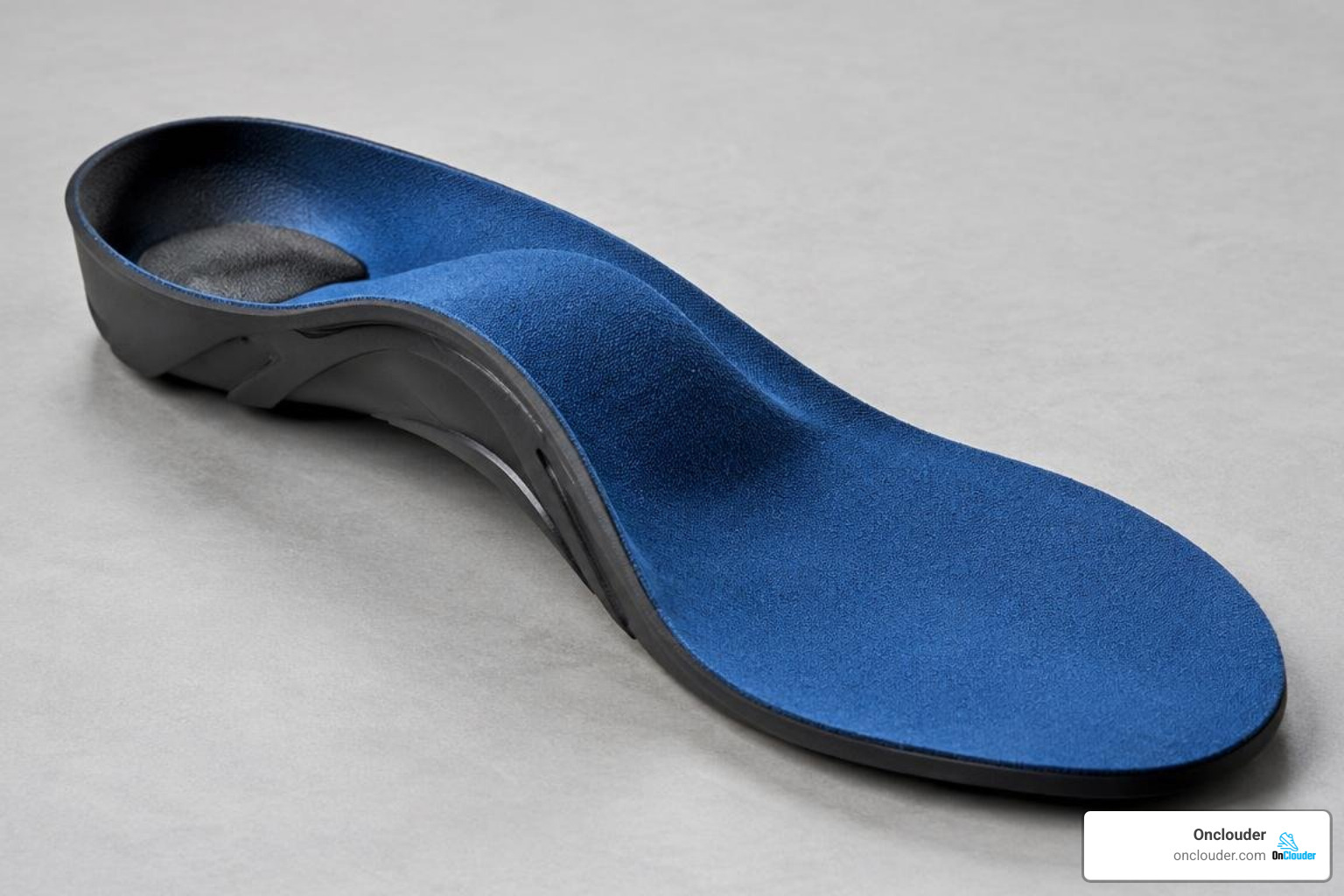
Engineering a footbed capable of supporting 220 to 260+ lbs without buckling requires specialized design:
- Substantial Arch Profiles (30–32 mm): Heavy-duty models incorporate elevated, rigid arch bridges that actively resist foot collapse.
- Deep Heel Cradling: Firm sidewalls wrap the rearfoot to stabilize movement during walking and stance phases.
- Multi-Density Layering: Rather than using a single foam slab, premium inserts combine high-rebound top sheets with rigid structural bottom plates.
- Targeted Dispersion Zones: Specially formulated heel pads and forefoot drop zones absorb the initial shock of heel strike and provide smooth toe-off transitions.
Selecting insoles for standing all day that actually work requires matching these rigid structural elements to your footwear’s volume.
Cushioning Materials That Withstand 220+ lbs Without Flattening
The materials used in high-capacity insoles differ significantly from the generic foams found in bargain inserts:
- High-Density Polyurethane (PU): Unlike standard EVA, high-density PU is an elastomer with high tensile strength and compression resistance. It absorbs heavy cyclic loading without packing out quickly.
- Sugarcane Bagasse & Plant-Based Polymers: Modern eco-friendly heavy-duty inserts repurpose sugarcane bagasse fibers into composite bases that can support over 240 lbs without structural collapse.
- Reinforced Polyamides and Carbon Fiber: Rigid, moldable bases with 32 mm arch profiles handle loads of 225 lbs and up. High-end athletic and industrial variants also use carbon composites for lightweight, torsion-resistant support.
- Premium Impact-Dispersing Foams: High-quality occupational options incorporate specialized cushioning layers designed to disperse shock waves across the footbed, meeting recognized standards for occupational footwear support.
- Moisture-Regulating Top Fabrics: Heavy-duty applications require durable, friction-reducing top covers. Reviewing our moisture wicking shoe insoles guide highlights how silver-ion treatments (like Silvadur™) and technical weaves reduce heat, blisters, and moisture buildup.
Puncture Protection and Safety Ratings for Demanding Jobsites
For industrial workers, warehouse teams, and tradespeople operating on harsh terrain, underfoot safety extends beyond cushion support. Standard work boot plates can feel stiff, leading many workers to look for drop-in protective solutions.
Advanced occupational inserts integrate flexible composite barrier layers that meet strict jobsite safety standards, including recognized ASTM puncture-resistant hazard protection specifications and EN ISO 22568-4:2021 Type PS standards. These flexible composite barrier layers protect against sharp screws, scrap metal, and nails on job sites while providing stable arch support and heel cushioning.
Relieving Plantar Fasciitis, Overpronation, and Back Pain at Higher Weights
Carrying 220+ lbs changes your standing and walking biomechanics. When foot arch structures flatten under load, the lower leg rotates internally. This internal rotation shifts knee alignment, tilts the pelvis anteriorly, and increases stress on the lower lumbar spine.
When assessing shoe inserts vs custom orthotics for plantar fasciitis, the core mechanical goal remains the same: stabilizing the rearfoot and supporting the medial arch. By preventing the arch from bottoming out, a supportive insole reduces micro-tears in the plantar fascia and evenly distributes body weight across the entire footbed. Exploring options like arch support insoles for total foot relief shows how proper alignment can ease discomfort in your heels, knees, and lower back.
How Heavy Duty Insoles Realign Stride Mechanics for Heavy Walkers
Under heavier loads, gait instability often appears as overpronation—where the ankle rolls inward during the stance phase. Heavy-duty insoles address this with a firmer platform that guides the foot through a neutral stride:
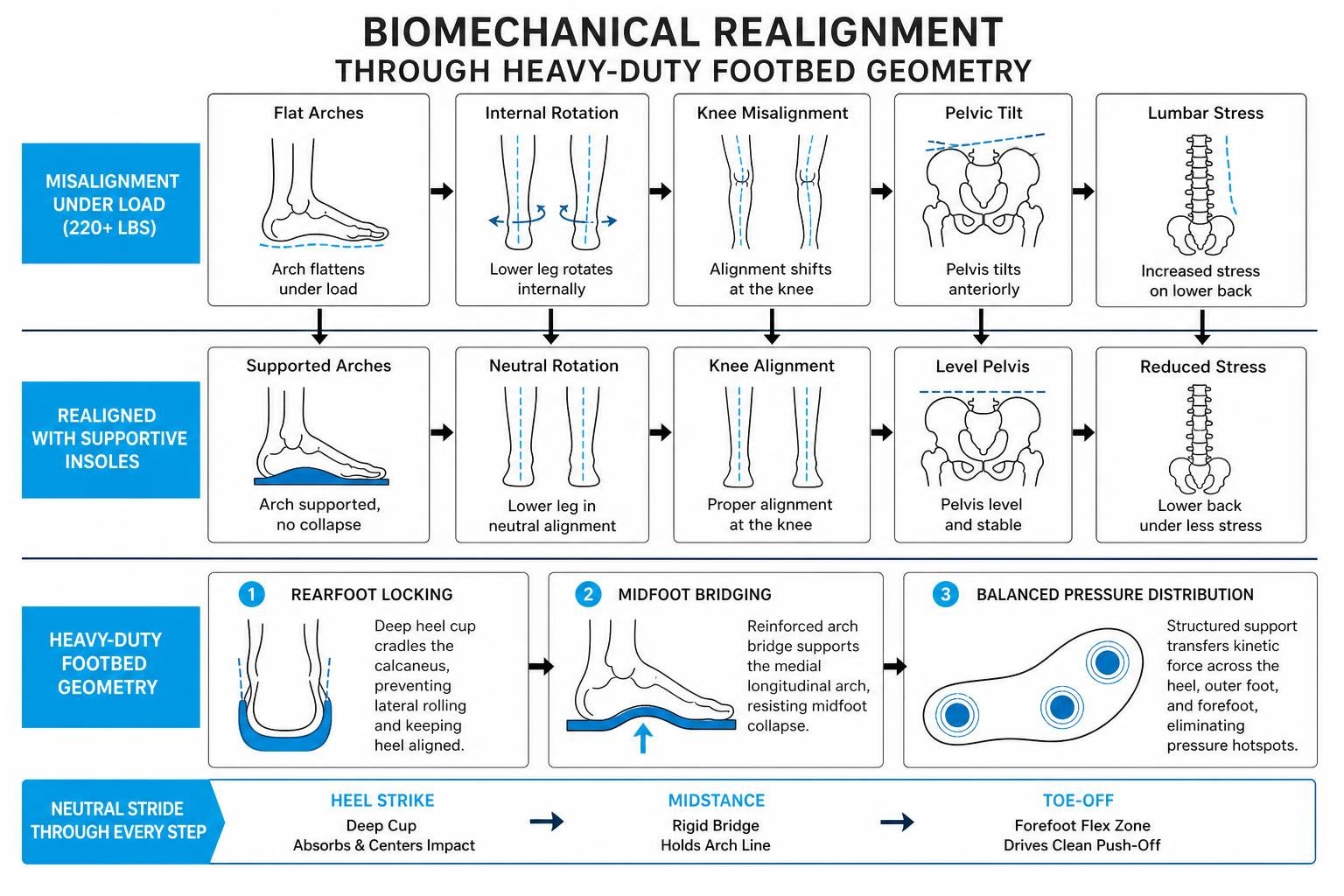
- Rearfoot Locking: The deep heel cup cradles the calcaneus, preventing lateral rolling and keeping your heel aligned.
- Midfoot Bridging: The reinforced arch bridge supports the medial longitudinal arch, resisting midfoot collapse.
- Balanced Pressure Distribution: Structured support transfers kinetic force across the heel, outer foot, and forefoot, eliminating pressure hotspots under the ball of the foot.
Equipping your daily footwear with robust work shoe inserts for demanding jobs helps reduce lower-body fatigue during long shifts on hard surfaces.
Fit, Trimming, and Care Guide for Maximum Insole Lifespan
“Even a great insole won’t do much if it doesn’t sit right in your shoe. And heavy-duty ones? They’ve got thick heel platforms and solid arch bridges. So getting them in properly matters even more.
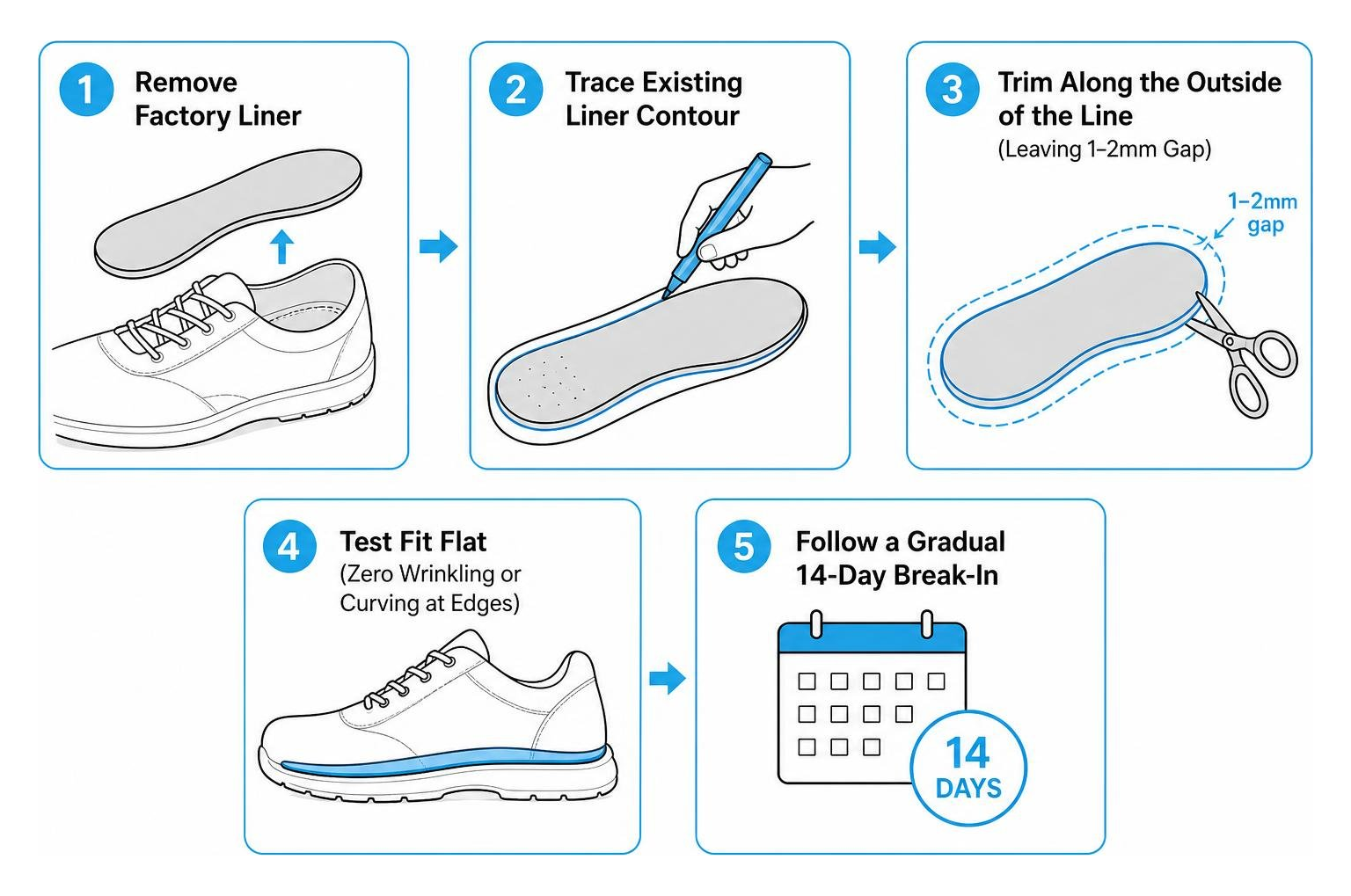
- Step 1: Always Remove the Factory Footbed: Never stack a heavy-duty insole on top of an existing factory insert. Stacking cramps the toe box, raises your heel out of the shoe’s heel counter, and causes blister-causing slippage.
- Step 2: Trace and Match: Place the original factory liner directly over your new heavy-duty footbed, aligning both at the heel. Trace the toe profile using a pen.
- Step 3: Trim Conservatively: Use sharp household scissors to cut along the traced line. Leave an extra 1–2 mm border initially—you can always trim more away, but you cannot add material back.
- Step 4: Check for Flat Placement: Slide the trimmed insert into your footwear. Run your fingers along the edges to verify the footbed lies completely flat against the midsole, with no curling along the sidewalls or toe cap.
- Step 5: Follow a Gradual 14-Day Break-In: Because firm orthotic shells realign your foot posture, ease into wearing them. Start with 1–2 hours on Day 1, 2–3 hours on Day 2, and increase wear time gradually over two weeks as your foot muscles adjust.
- Step 6: Maintain with Hand Washing Only: Never put heavy-duty insoles in a washing machine or dryer. Clean them by wiping with a cloth dipped in warm water and mild soap, scrub lightly with a soft brush if needed, and let them air dry completely away from direct heat.
Extending Durability: Replacement Timelines and Warranty Considerations
If you’re over 220 lbs and wearing them daily, heavy-duty footbeds usually hold up for 6 to 12 months. Standard factory insoles? Those give out in 4 to 8 weeks. Same feet. Same conditions. Big difference.
To keep track of wear, monitor your footbeds for signs of structural breakdown:
- Compression lines or visible cracks in the supportive arch shell.
- Permanent thinning under the ball of the foot or the center of the heel.
- Returning foot fatigue, shin splints, or lower back stiffness at the end of a shift.
Many reputable manufacturers offer a 30- to 60-day satisfaction guarantee or a 12-month structural warranty. This gives you time to complete the break-in period and verify that the support profile suits your daily routine.
Frequently Asked Questions About Heavy Duty Footbeds
How do I know if heavy duty insoles will fit my work boots or shoes?
Heavy-duty footbeds are thicker than standard inserts, with forefoot profiles often measuring 4.5 mm to 5.5 mm and heel platforms exceeding 10 mm. They fit best in roomy footwear with removable factory liners, such as work boots, hiking shoes, and wide-fit athletic sneakers (such as 2E or 4E widths). If your shoes have non-removable insoles or a low-volume toe box, look for low-profile supportive insoles instead.
Can people over 220 lbs use soft gel insoles instead of structured orthotics?
Soft gel insoles generally lack the stiffness required to support users over 220 lbs. Gel materials deform easily under pressure, bottoming out during prolonged standing and walking. This allows the arch to collapse and can lead to overpronation, plantar fascia strain, and foot fatigue. Users above 220 lbs typically benefit more from high-density polyurethane bases supported by rigid composite or polyamide arch shells.
How long do heavy duty insoles last under daily high-impact use?
When used for 8 to 12 hours a day on hard surfaces by individuals weighing 220+ lbs, high-quality heavy-duty insoles usually last 6 to 12 months. Their high-density polyurethane and reinforced thermoplastic arches resist compression far longer than standard EVA foams. If you notice persistent arch collapse or feel old aches returning, it is time to replace them.
Conclusion
When you’re carrying 220+ lbs, you need real structural support. Not just softness on the surface. Standard foam insoles crush flat fast under that kind of load. And once they do? Your feet, ankles, and lower back take the hit. Every day. On hard floors.
Switch to heavy duty insoles made with high-density polyurethane. Look for deep heel stabilization and rigid arch reinforcement. That combo spreads impact evenly across your whole foot. Want more detail on picking the right support profile and materials? Check out our comprehensive high arch support insole reviews. You’ll find the right foundation for every step.
explore our comprehensive high arch support insole reviews to find the ideal foundation for every step.
