Is Adidas Boost Supportive Enough for Overpronation?
Boost cushioning does not, by itself, control pronation. A standard Ultraboost may feel comfortable if your feet roll inward, but its soft foam may not feel steady enough if you need more support. Adidas adds guidance in some other Boost shoes: Solar Boost uses side rails, while the Boston 6 pairs Boost with firmer EVA foam.
If you overpronate, judge the whole shoe, not the foam name. Try it on and check whether your foot feels secure through the heel and midfoot. If you have marked inward rolling or pain, compare it with a dedicated stability shoe rather than assuming cushioning will fix the problem. For a deeper look at how adidas boost pronation support works, see our guide to stability running shoes for overpronation.
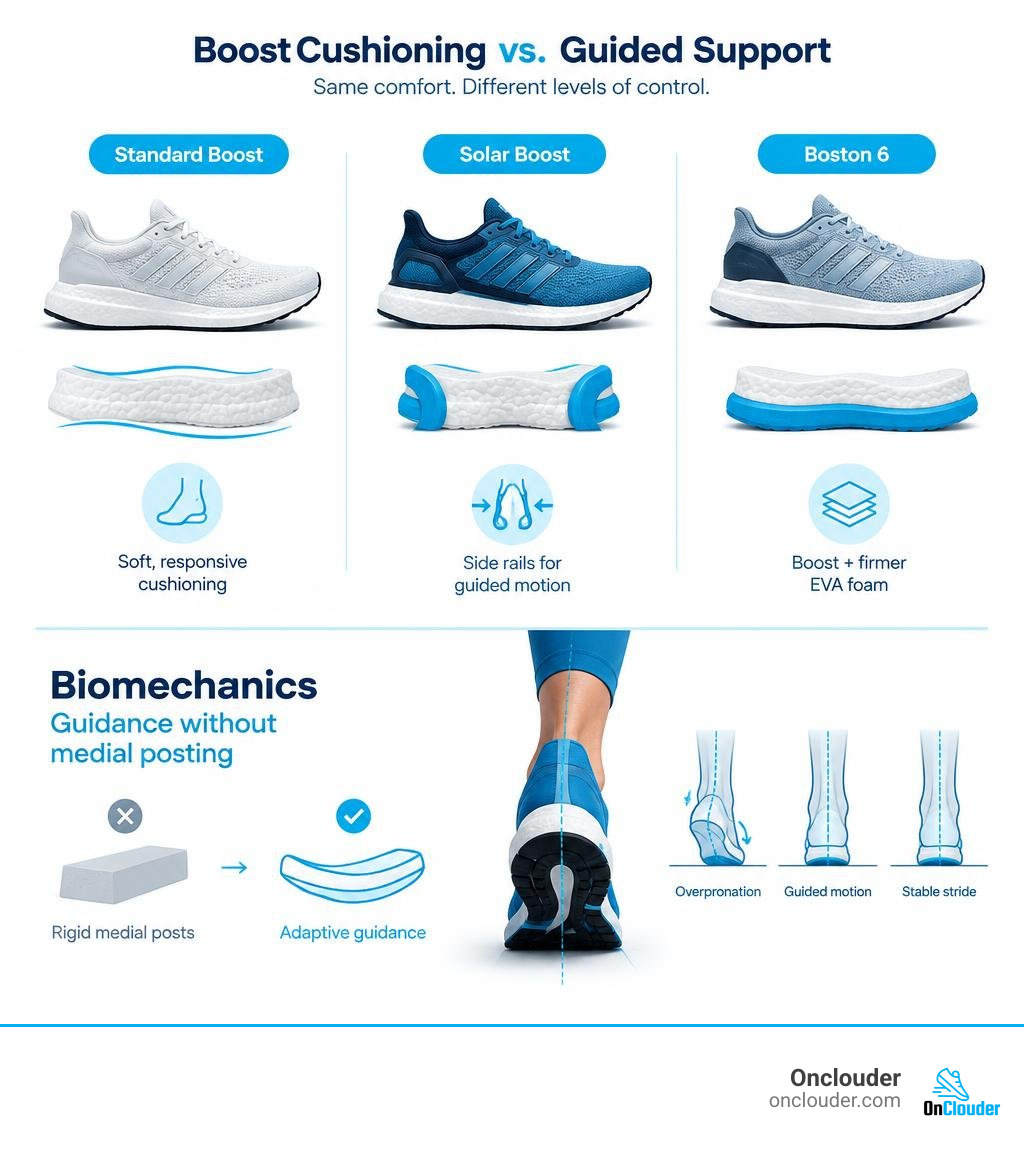
Biomechanics: How Adidas Boost Pronation Mechanics Work Without Medial Posting
Many runners trying to understand adidas boost pronation control wonder why modern performance trainers have moved away from traditional stability methods. For decades, the footwear industry relied heavily on dense medial posts—rigid blocks of hard foam placed beneath the inside of the arch—to physically block excessive inward roll. While effective at halting movement, rigid posting often created jarring transitions, added dead weight, and led to localized pressure points under the foot.
To provide support without these drawbacks, modern engineering focuses on non-posted guidance geometry. Rather than trying to immobilize your foot like a plaster cast, contemporary stability engineering works with your natural movement path. As we detail in the ultimate guide to running with overpronation, managing inward roll successfully requires controlling the rate and velocity of foot eversion rather than stopping all joint articulation entirely.
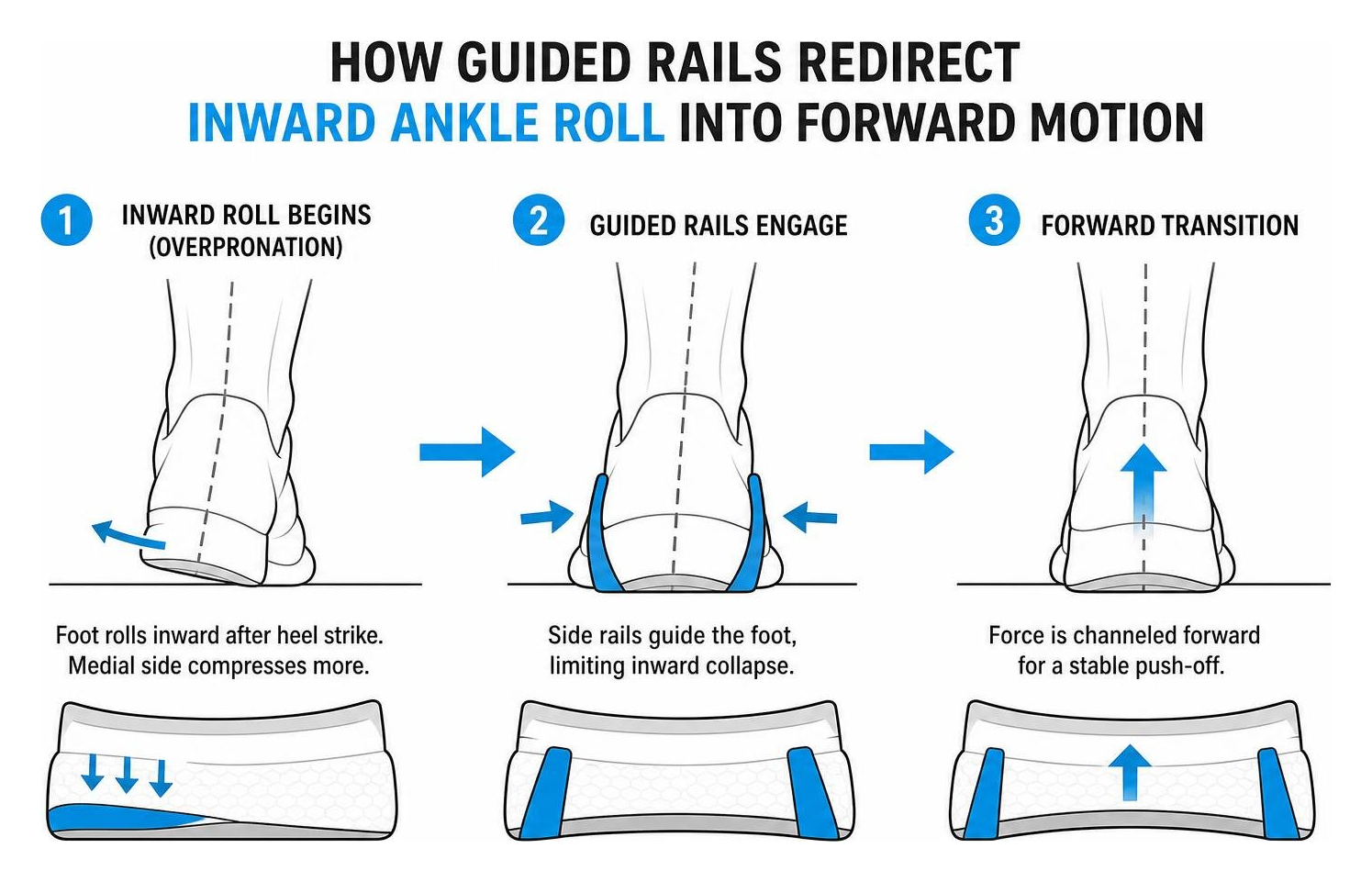
Standard expanded thermoplastic polyurethane (eTPU) pellets provide high energy return, but because the material compresses uniformly under load, an overpronating runner will quickly compress the medial side deeper than the lateral side. To counterbalance this, non-posted trainers utilize wide perimeter bases, strategically firm top layers, and structural guidance rails. These features guide transitions from heel strike to toe-off, gently channeling force along the center of the shoe rather than letting your arch collapse inward unchecked.
Understanding Adidas Boost Pronation Control Through Dual-Density EVA Layers
One of the most effective ways to stabilize high-rebound eTPU foam is dual-density layering. Pure Boost delivers pillowy energy return, but layering a firmer, compression-molded EVA layer directly over or around it transforms the entire ride.
By designing a firm EVA rim or top layer across the rearfoot and midfoot, the softer material is kept from squishing excessively under the medial side of your foot during stance phase. In models built for performance, this EVA layer often runs almost the full length of the shoe, opening into a small forefoot window where the bouncy material can flex freely for an energetic toe-off.
This approach provides essential advantages for runners managing gait instability:
- Torsional Stiffness: The firmer upper layer prevents the shoe from twisting mid-stride, keeping your foot level as force shifts forward.
- Speed Responsiveness: At easy paces, the shoe feels firm and controlled; as your pace increases and impact forces rise, your foot engages the underlying high-energy foam without losing alignment.
- Even Load Distribution: Rather than concentrating stability directly under the navicular bone (as old-school medial posts did), dual-density layering distributes ground impact across the entire sole.
If you require structured guidance to keep your ankles and knees properly aligned, exploring stability running shoes for overpronation will help you find the right level of underfoot resistance.
Guiding Foot Strike: Solar Propulsion Rails and Extended Torsion Systems
Guidance rails and rigid midfoot plates represent another major leap forward in non-invasive stability. Instead of shoving your arch upward from below, Solar Propulsion Rails sit like bumpers along the top edge of the midsole on both sides of the foot.
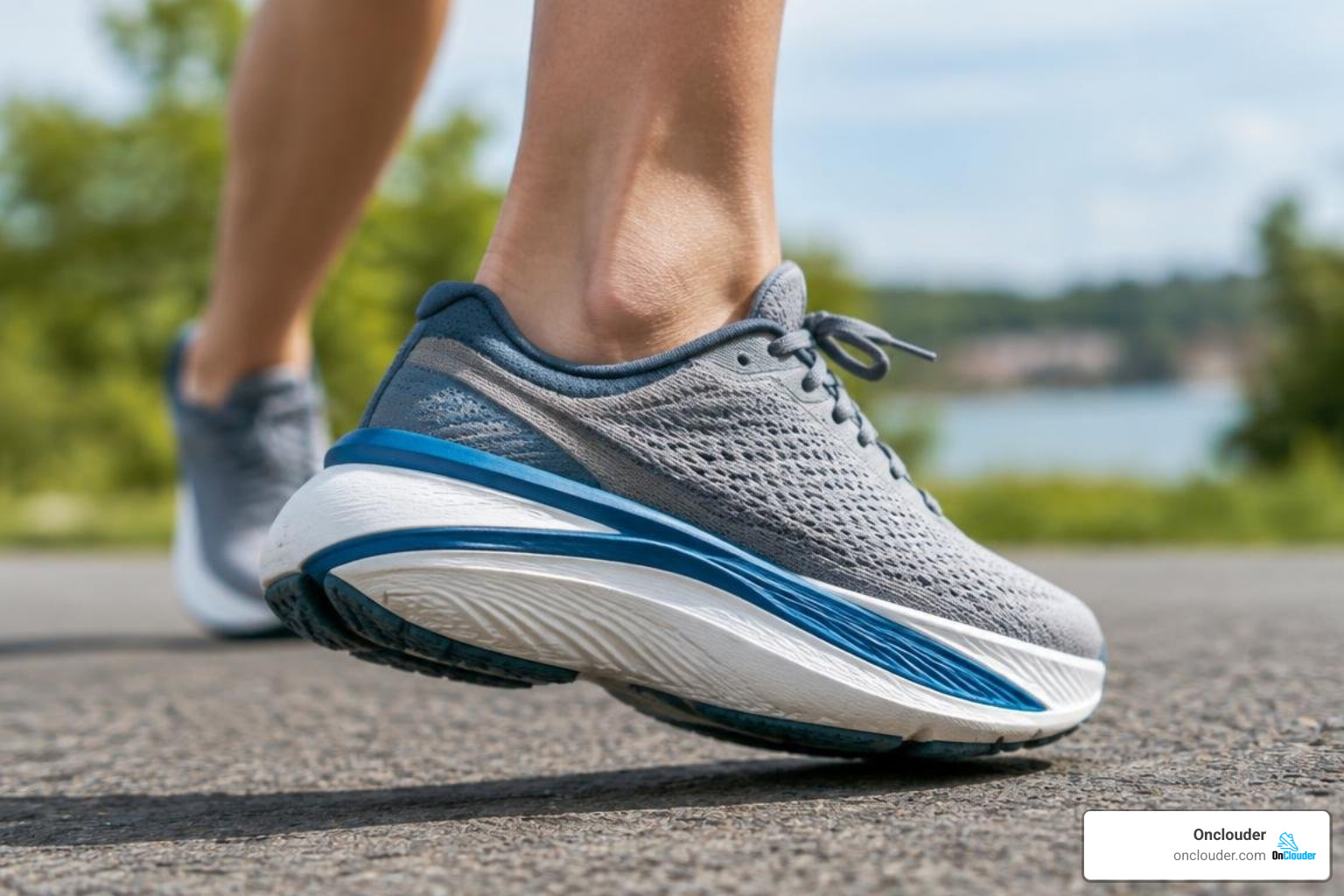
These dual-density rails keep your heel and midfoot centered during ground contact. When your ankle begins to roll inward prematurely, the medial rail provides gentle lateral resistance, nudging your foot back toward a neutral trajectory.
Working in tandem with these rails is the extended thermoplastic polyurethane (TPU) Torsion System. As explained in our overview of stability shoes for runners, a decoupled heel and midfoot shank are critical for preventing early torsional collapse. In race-tuned and fast-training trainers, this TPU plate extends along the bottom of the midsole, featuring vertical medial extensions that stabilize the foot during early pronation. The result is a smooth, snappy transition that guides foot strike directly toward the big toe for maximum push-off efficiency.
Comparing Key Models: Which Boost Shoes Suit Overpronators vs Neutral Runners?
Finding the right balance between plush cushioning and firm guidance depends entirely on your biomechanics, body weight, and weekly mileage goals. A shoe that feels perfectly supportive for a neutral runner on a 5K tempo run might leave a severe overpronator dealing with sore arches halfway through a marathon training block.
Before settling on a specific model, it is helpful to consult top podiatrist-approved shoes for overpronation to understand where your gait falls along the stability spectrum.
Analyzing Adidas Boost Pronation Support Across Solar Boost, Boston, and Adios
To see how these stability technologies perform in the real world, we evaluated three iconic trainers across daily miles, fast workouts, and race conditions:
1. Solar Boost
The Solar Boost is engineered as a reliable, highly cushioned daily road trainer. It blends a plush eTPU midsole with Solar Propulsion Rails and midfoot reinforcement. Because the propulsion rails cradle the foot on both sides, it delivers broad-spectrum stability without feeling stiff or intrusive under the arch. While its weight makes it less suitable for high-intensity track intervals, it provides excellent structural security for neutral runners and mild overpronators tackling high-mileage training blocks. Furthermore, runners managing common overuse injuries can look at our Ultraboost plantar fasciitis analysis to see how midsole cushioning affects bottom-of-foot strain.
2. Adizero Boston 6 Boost
The Boston 6 strikes an ideal balance between lightweight tempo racer and structured mileage trainer. It utilizes a firm EVA layer positioned directly over the eTPU foam throughout the rearfoot and midfoot, paired with a small forefoot Boost window. This setup provides noticeable torsional rigidity and prevents excessive medial sinking at higher speeds. Independent laboratory tests note how its EVA layer effectively dampens low-speed squish while delivering stability and snap during faster paces.
3. Adizero Adios Boost 3
Weighing in as a featherweight road racer, the Adios Boost 3 is designed for speed. However, racing flats often introduce instability because of their thin, flexible profiles. Adidas counteracts this by integrating an extended TPU Torsion System with a vertical piece along the medial heel to check early pronation. This reinforced shank delivers surprising mid-stance stability and smooth forward alignment, making the shoe viable for race distances up to 30 kilometers for neutral runners and light overpronators.
Model Comparison: Specs, Stack Heights, and Pronation Suitability
To help you decide which trainer matches your weekly rotation, we have compiled the core specifications across these models below:
| Feature / Metric | Solar Boost | Adizero Boston 6 Boost | Adizero Adios Boost 3 |
|---|---|---|---|
| Category | Daily Mileage Trainer | Fast Daily / Tempo Trainer | Road Racing Flat |
| Shoe Weight (Men’s US 9) | 10.6 oz (300 g) | 8.6 oz (244 g) | 7.9 oz (224 g) |
| Stack Height (Heel / Forefoot) | 28 mm / 18 mm | ~27 mm / 17 mm | 23 mm / 13 mm |
| Heel-to-Toe Drop | 10 mm (feels lower under load) | 10 mm | 10 mm |
| Stability Mechanism | Solar Propulsion Rails & TFP | Firm EVA Top Layer & Torsion | Medial-Extended TPU Torsion Plate |
| Pronation Suitability | Neutral to Mild Overpronation | Mild Overpronation & Fast Paces | Neutral (Stable Race Ride) |
| Outsole Rubber & Lifespan | Continental (~300–500 miles) | Continental (~450 miles) | Continental Pods (~300–400 miles) |
For female runners looking for tailored upper fits and narrower heel cups to maintain alignment, our guide to women’s overpronation trainers offers further practical insights.
Upper Support and Heel Geometry: Protecting the Achilles and Midfoot
Midsole foam is only half of the stability equation. If a shoe’s upper is too loose or its heel structure causes pinching, your foot will slide over the footbed, triggering compensatory inward rolling regardless of what is happening underfoot.
Fit Counter Design, Heel Bevels, and Haglund Deformity Relief
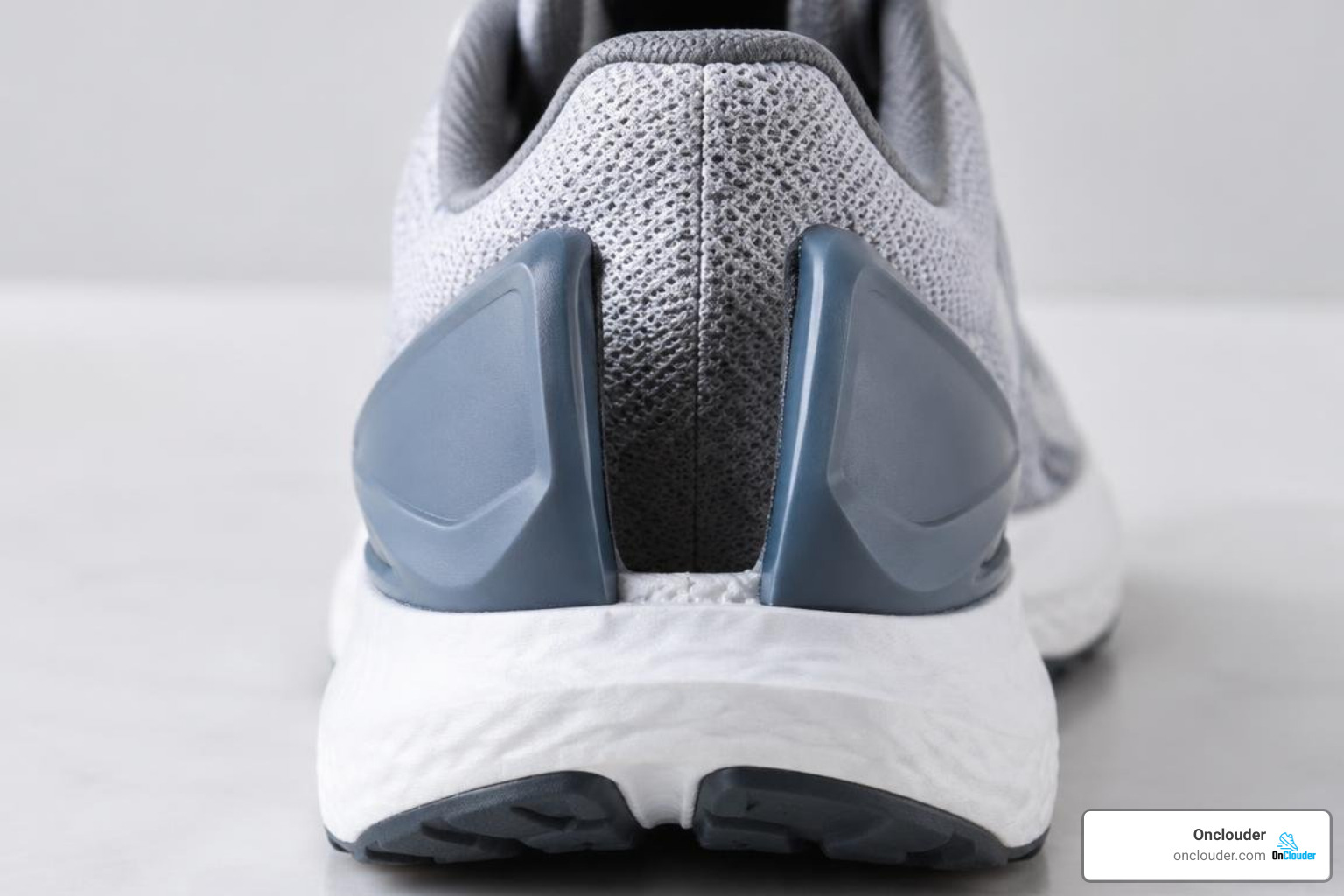
Traditional running shoes often rely on stiff, cardboard-like plastic cups that wrap completely around the back of the heel bone (calcaneus). For many runners, this rigid construction rubs against the Achilles tendon, aggravating bursitis or prominent heel bumps known as Haglund deformities.
In modern designs like the Solar Boost, Adidas replaced the one-piece cup with a split Fit Counter design. Two independent plastic frame pieces cradle the medial and lateral sides of the heel, leaving the central canal completely open. Clinical physical therapy evaluations emphasize how this decoupled configuration locks the heel bone down without placing direct compression on the Achilles tendon insertion.
Key geometry features that prevent irritation and instability include:
- Split Heel Counters: Stabilize calcaneal tilt while freeing the Achilles tendon from direct pressure.
- Heel Beveling: Curving the rear bottom edge of the midsole reduces the lever arm upon impact, softening ground collision forces and slowing early pronation.
- Posterior Flare: A broad base under the rearfoot provides a stable platform upon landing, preventing inward tipping.
- Decoupled Crash Pads: Isolate initial heel impact so shock forces do not immediately roll into the arch.
Midfoot Lock via Tailored Fiber Placement and Engineered Mesh
Once the heel is secure, midfoot lockdown becomes essential. If your arch collapses inward, your foot naturally wants to expand and spill over the medial sidewall of the shoe.
To solve this, advanced models incorporate Tailored Fiber Placement (TFP). Instead of using thick plastic cages or heavy synthetic leather overlays, TFP uses thousands of stitched structural threads sewn directly into the midfoot fabric. These micro-targeted fibers provide high tensile strength across the arch while maintaining flexibility and breathability. Paired with lightweight engineered mesh across the toe box, your foot stays firmly centered directly over the midsole cushions through every turn and stride.
Frequently Asked Questions About Adidas Boost and Foot Pronation
Can runners with severe overpronation wear standard Ultraboost shoes?
Standard, unguided Ultraboost models are generally not recommended for runners with severe or symptomatic overpronation. Because standard eTPU foam is soft and responsive, high medial loads will cause the inner edge of the foam to bottom out faster than the outer edge. Without firm medial posting, dynamic guidance rails, or a wide base, this deep compression can increase rotational torque across the ankle, Achilles tendon, and knee joint. Severe overpronators should look toward purpose-built stability shoes with structured guide rails or firm dual-density midsoles.
How does dynamic stack compression in Boost affect perceived heel drop?
While many Boost trainers feature a static heel-to-toe drop of 10 mm when measured on a lab bench, the dynamic drop during real-world running often feels closer to 6 mm to 7 mm. Because Boost foam is highly compliant, runners who land with significant heel force compress the rearfoot cushion deeper than the firmer forefoot platform. This dynamic compression lowers the effective drop mid-stance, placing slightly more load onto the Achilles tendon and calf complex than a standard firm 10 mm drop shoe would.
What is the lifespan and stability retention of Boost cushioning?
One of the key strengths of eTPU Boost foam is its outstanding durability and temperature resistance. Unlike standard EVA foam—which can pack out and lose its structural resilience after 250 to 300 miles—Boost foam retains its rebound and geometric shape for upwards of 450 to 500 miles. Because eTPU does not harden significantly in winter freezing conditions or turn overly soft in summer heat, its stability and guidance characteristics remain exceptionally consistent throughout the shoe’s entire lifespan.
Finding the Right Support for Your Stride
Evaluating modern running shoes means looking past marketing buzzwords and understanding how foams, guidance rails, and upper materials work together as an integrated system. Pure, unguided eTPU cushioning delivers plush comfort and high energy rebound, but it cannot solve overpronation on its own.
For runners who need dependable gait guidance without the stiff, unnatural feel of traditional medial posts, models built with Solar Propulsion Rails, firm dual-density EVA top layers, and split Fit Counter heels offer an excellent balance of comfort and control.
To explore more shoe choices and find the perfect match for your biomechanical needs, check out our essential guide to the best overpronation shoes to keep your training comfortable, supportive, and injury-free.