Why Altra Shoes Give Your Toes More Room
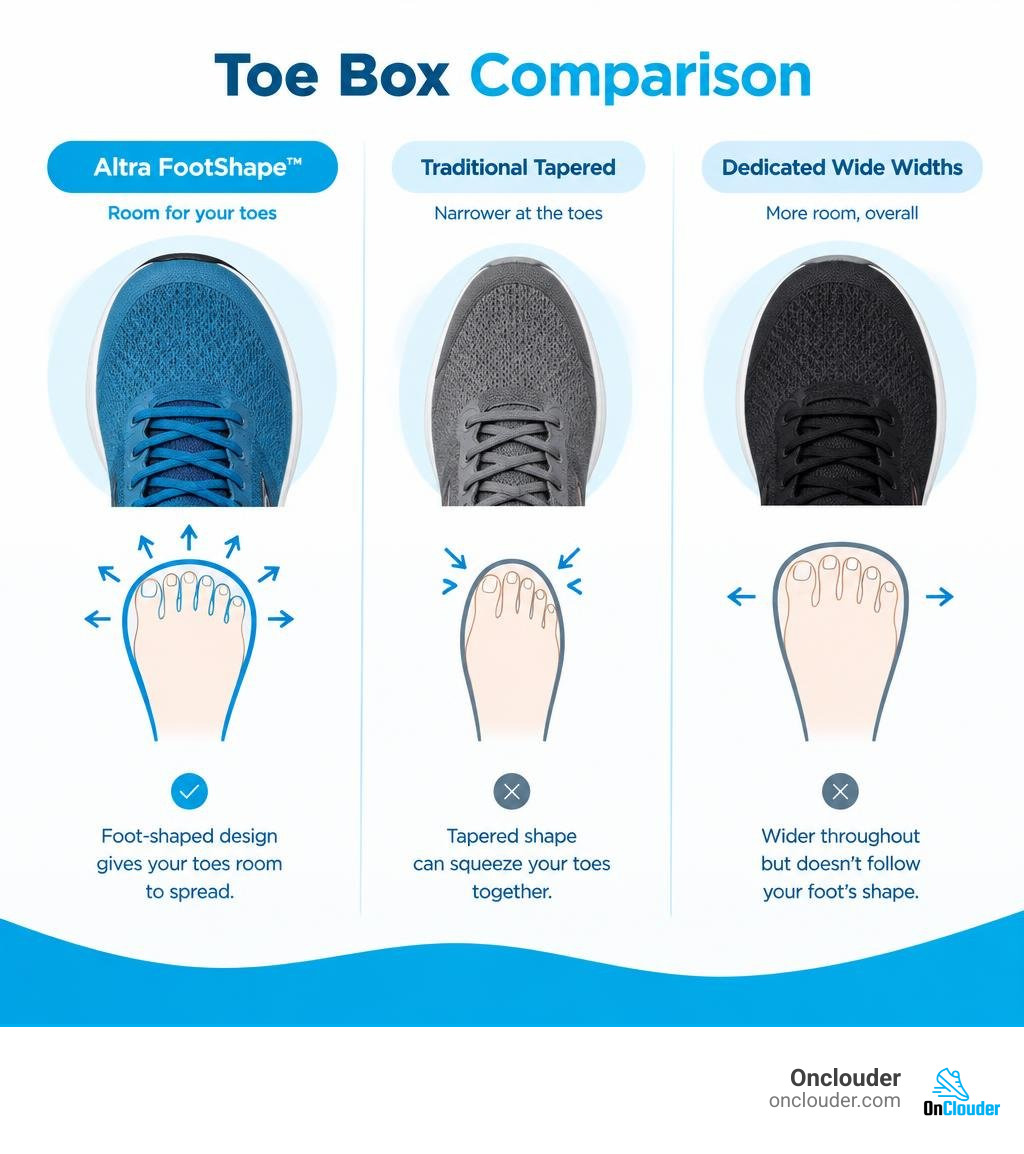
Altra shoes use a foot-shaped toe box so your toes have room to spread instead of being squeezed together. Altra calls this FootShape™. It is different from a standard wide shoe: the extra space is shaped around the toes, while the midfoot can still fit securely. An Altra shoes wide toe box gives you that extra forefoot room without the midfoot slop of a generic wide width, so if you need more room throughout the shoe, look for a model specifically sold in a wide width.
That difference matters when you walk or run. Toes need space to move as your foot lands and pushes off. Altra offers three FootShape™ fits, from roomier Original to snugger Racing, so you can choose toe room without guessing from a “wide” label alone.
Related guides on foot-shaped footwear:
- room to splay in wide toe box shoes
- natural forefoot splay in running shoes
- switching to broad toe shoes
Understanding the Altra Shoes Wide Toe Box and FootShape™ Fit
Most conventional athletic shoes are built around a traditional shoe last that tapers sharply inward at the ball of the foot. While this creates a sleek, arrow-like silhouette on store shelves, human feet simply are not shaped like pointed arrows. When you pack five metatarsals and their corresponding phalanges into a restrictive, tapered toe box, you force your big toe (the hallux) inward and compress your smaller digits together.
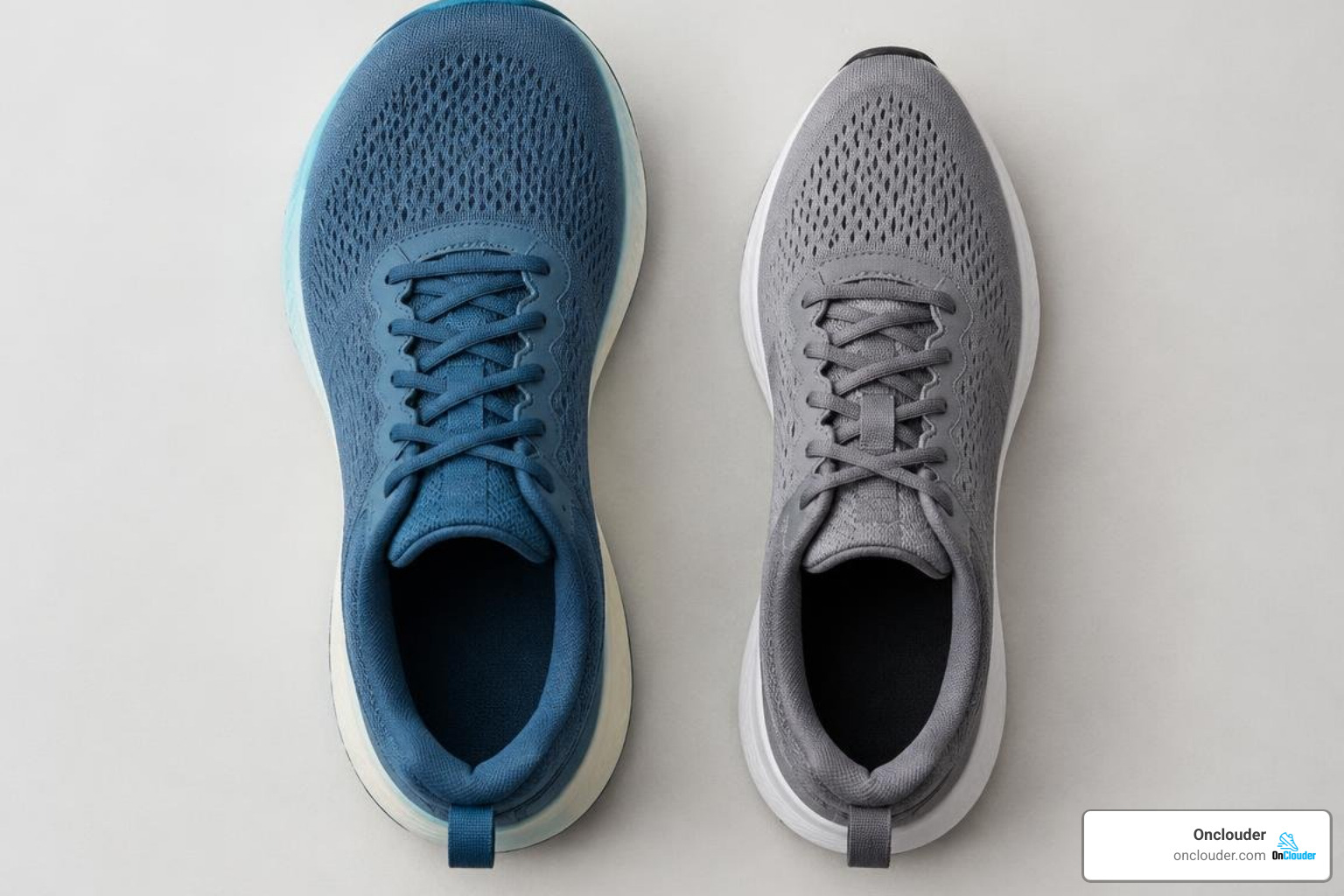
Altra’s core design philosophy addresses this fundamental anatomical mismatch. In Altra shoes, wide toe box engineering does not just add random excess fabric; it mirrors the natural, fan-like outline of a healthy human foot. By respecting natural biological differences in men’s and women’s feet, this anatomical design allows your metatarsal bones to sit flat and expand outward during weight-bearing phases.
If you have ever felt your feet going numb after several miles, reading an essential guide to wide toe box shoes reveals just how much unnecessary strain conventional lasts place on forefoot nerves and circulation.
Original, Standard, and Racing: The Three FootShape™ Profiles
Not every runner wants the exact same volume inside their footwear. A trail runner conquering rocky ascents demands locked-in precision, while an ultramarathoner logging fifty miles on paved roads needs abundant room for natural swelling. To serve varying foot shapes and running styles, Altra organizes its lineup into three distinct FootShape™ fit categories:
| FootShape™ Fit Profile | Forefoot Room | Midfoot & Heel Volume | Best Suited For | Key Model Examples |
|---|---|---|---|---|
| Original Fit | Maximum / Roomiest | Relaxed midfoot, natural heel pocket | Maximum splay, ultra-distances, wider feet | Lone Peak, Escalante |
| Standard Fit | Balanced / Moderate | Secure midfoot, standard heel hold | Daily road miles, versatility, average feet | Torin 9, Paradigm 8, Voyager |
| Racing Fit | Streamlined / Snug | Performance lockdown, precision heel | Fast workouts, race day, technical trails | Experience Wild 3, FWD VIA 2 |
- Original Fit: This is the classic profile that built the brand. It features the roomiest toe box alongside generous volume through the midfoot and arch, offering total freedom for your digits to spread out completely.
- Standard Fit: Serving as the balanced middle ground, Standard Fit maintains plenty of anatomical room for your toes to splay while tightening the midfoot and instep for a more supportive, locked-down feel.
- Racing Fit: Designed for speed and agility, this cut provides targeted room for your big toe to engage while hugging the waist of your foot tightly to prevent internal sliding during hard corners and fast paces.
How FootShape™ Differs from Traditional 2E Wide Shoes
A common point of confusion for footwear shoppers is assuming that a wide toe box is identical to a standard 2E wide shoe. Traditional sizing classifications (like D for standard men’s, B for standard women’s, and 2E/4E for wide) generally increase the total circumference across the entire shoe last. This means a standard 2E shoe gets wider at the forefoot, but it also becomes looser through the midfoot, arch, and heel collar.
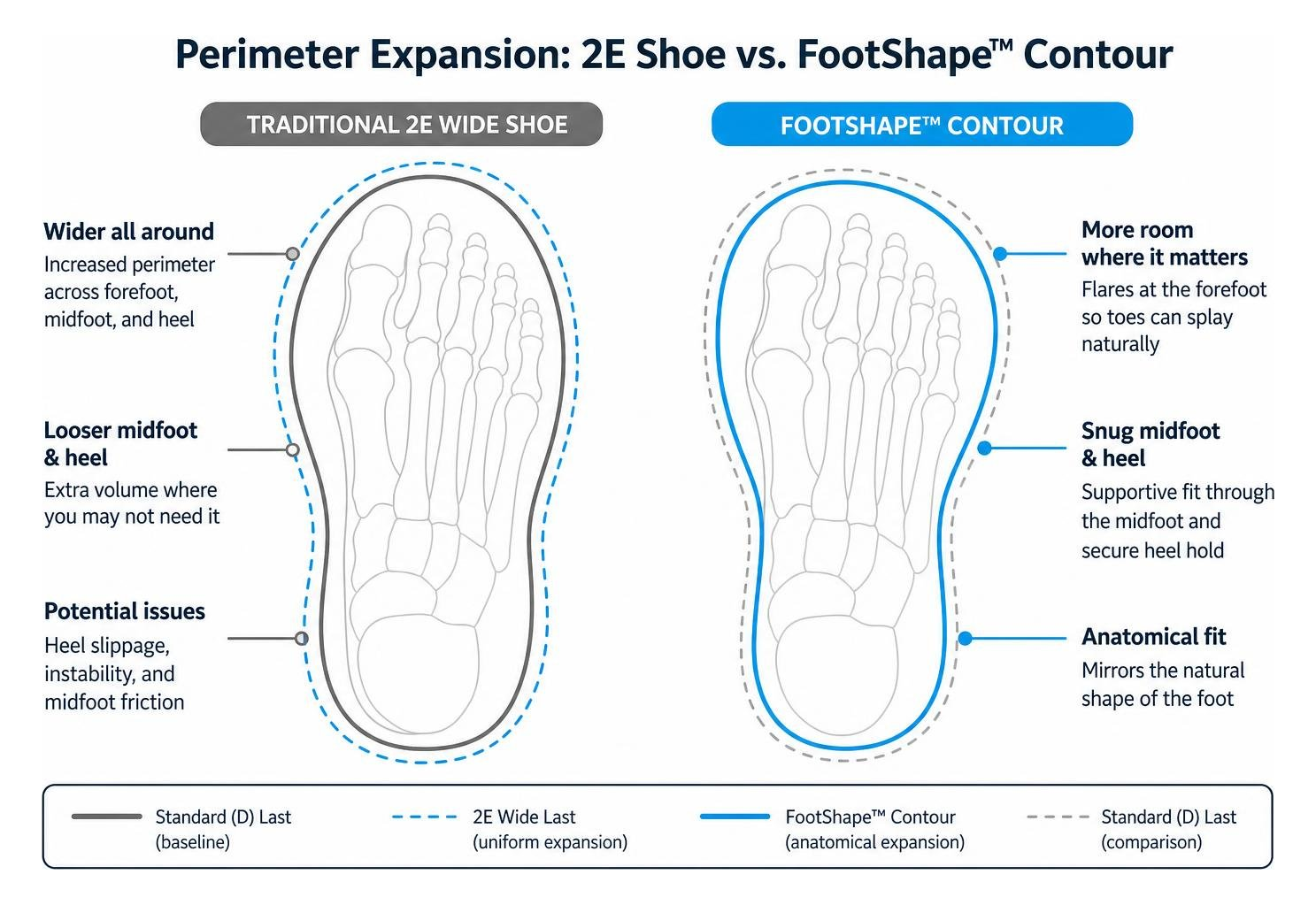
When runners with standard-width heels buy a traditional 2E shoe just to give their bunions or toes room, they often suffer from heel slippage, ankle instability, and midfoot friction blisters. FootShape™ solves this by keeping the heel cup snug and the midfoot supportive while flaring open only where your toes need room.
However, for runners who genuinely have high-volume feet across both the forefoot and midfoot, Altra also manufactures dedicated Wide (2E) options for several key models:
- Torin Wide: Maximum neutral daily trainer room with zero drop.
- Paradigm Wide: High-cushion stability support with ample volume.
- Lone Peak Wide: Legendary trail grip built with extra circumference throughout.
Biomechanics and Foot Health: Why Toe Splay Matters
When you step onto the ground, your foot naturally pronates slightly, your arches flex to absorb shock, and your toes spread wide to stabilize your center of mass. This toe splay creates a wide tripod of balance between your calcaneus (heel), the first metatarsal head, and the fifth metatarsal head.
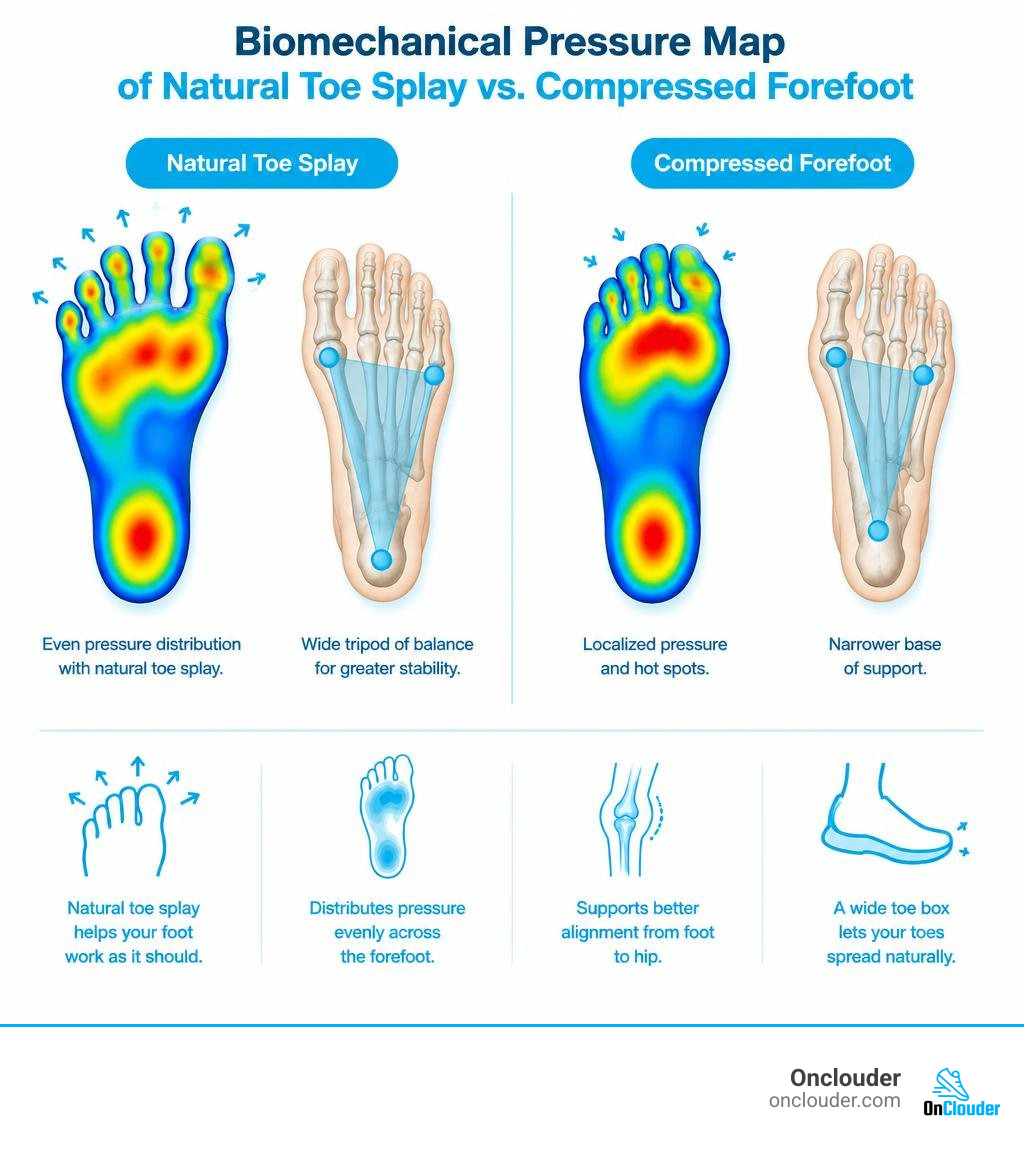
When conventional footwear clamps the big toe inward, it compromises your hallux’s ability to anchor into the ground. That lack of base stability forces your ankle, knee, and hip joints to overcompensate. Letting your toes splay naturally distributes plantar pressure evenly across the ball of the foot, offloading localized hot spots.
If you struggle with friction, checking out our guide to big toe box running shoes for blister-free miles explains how proper forefoot clearance stops repetitive friction between neighboring toes.
How Zero-to-Low Drop Complements an Altra Shoes Wide Toe Box
Altra pairs its roomy toe boxes with a balanced zero-to-low drop platform (consistently measuring either 0mm or 4mm from heel to forefoot). In traditional running shoes featuring 8mm to 12mm heel elevations, your foot sits on a downward slope. This heel lift continuously shoves your body weight forward into the toe bumper, jamming your toes directly into the tapered front of the shoe.
By keeping the heel and forefoot level (0mm) or nearly level (4mm), your body weight stays balanced over your midfoot and heel. This balanced geometry encourages an efficient midfoot strike, unloads repetitive impact forces, and promotes natural spinal posture. For runners transitioning away from high-heeled trainers, our practical guide to zero drop running shoes provides actionable calf-strengthening routines to make the switch seamless.
Podiatric Considerations and Long-Term Foot Health
A cramped forefoot is a primary contributor to several painful foot ailments:
- Bunions (Hallux Valgus): Chronic inward pressure on the big toe angles the joint outward, creating painful bone friction.
- Morton’s Neuroma: Squeezing the metatarsal heads together pinches the interdigital nerves, resulting in sharp, burning forefoot pain.
- Plantar Fasciitis: When the big toe cannot fully extend and splay, the windlass mechanism of the plantar fascia cannot engage efficiently, increasing arch strain.
Because of their anatomical design and foot-friendly geometry, several athletic shoe models have earned the APMA Seal of Acceptance, a prestigious certification from the American Podiatric Medical Association awarded to footwear that actively promotes long-term foot health and normal biomechanical function.
Cushioning, Foams, and Stability Technologies Across Altra Models
Modern footwear design proves that choosing natural foot health does not mean sacrificing luxurious impact protection. Altra integrates sophisticated midsole compounds and dynamic support frameworks to keep long road and trail miles comfortable.
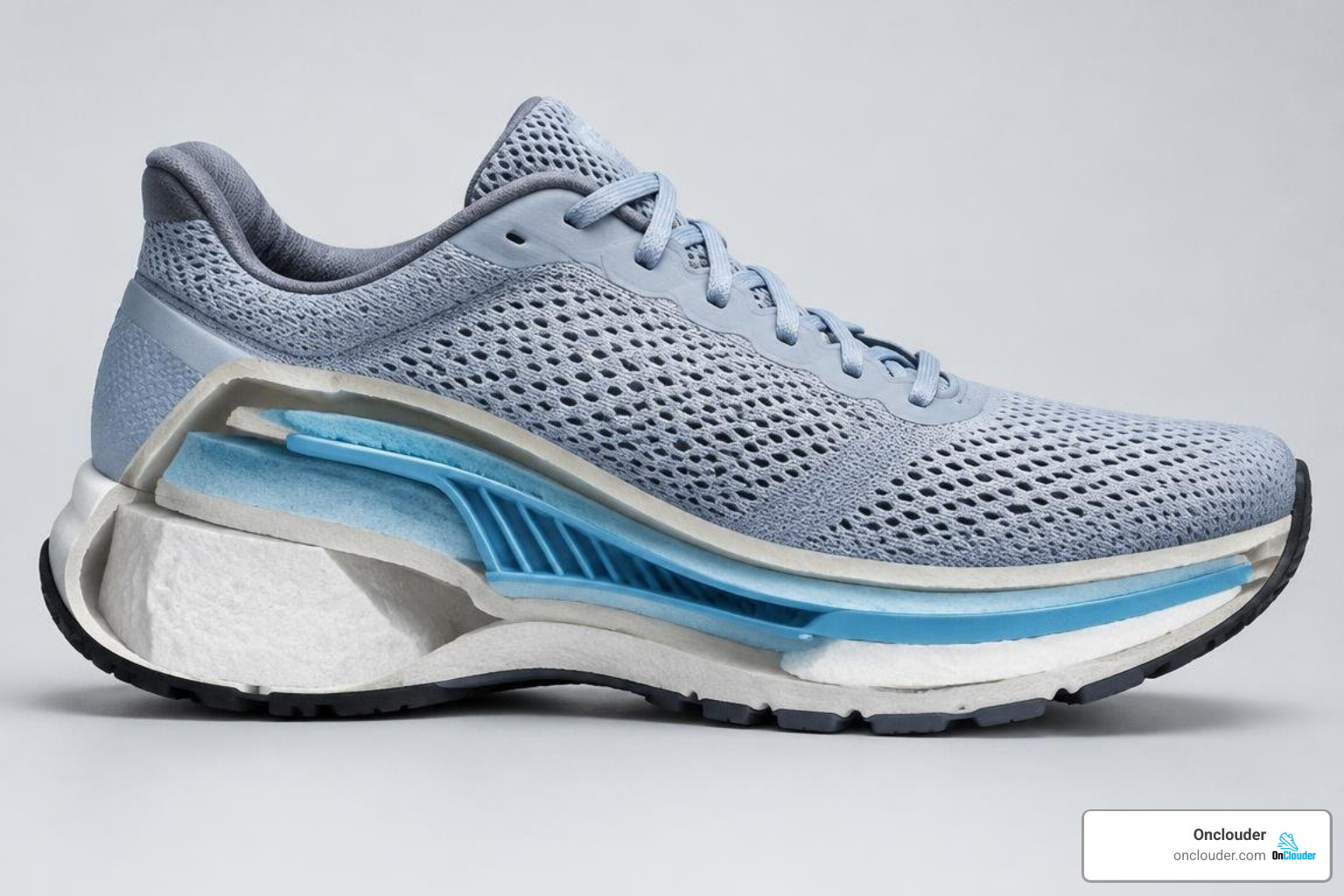
For runners who overpronate or experience late-run fatigue when their arches collapse, models like the Paradigm 8 integrate GuideRail™ technology. Unlike old-school stiff medial posts that forcefully jam your foot outward, GuideRail™ functions like a highway rumble strip—it sits quietly beneath your foot and only provides gentle guidance when your stride deviates from its natural path.
Midsole Innovations: EGO™ P35 and P35X™ Dual-Density Foams
Altra’s midsole engineering balances plush comfort with energy return:
- Altra EGO™ P35: A state-of-the-art foam formulation engineered to be 19% softer than previous generations. Found in max-cushioned road models like the FWD VIA 2 (which features a generous 33mm/37mm stack height and a 4mm drop), this foam delivers an ultra-smooth, lightweight ride that absorbs heavy pavement impact effortlessly.
- P35X™ Dual-Density Foam: Utilizing a dual-layer build that pairs a plush internal core with a firmer, more stable outer rim, P35X™ gives runners the best of both worlds: pillowy step-in softness backed by structural integrity.
Outsole Traction: High-Traction Rubber and MaxTrac™ Technology
To ensure every bit of your toe-off energy translates into forward motion, Altra collaborates with top rubber specialists and builds specialized compounds:
- Vibram® XS DURA & XS Trek Evo: Road-focused models like the Torin 9 utilize an all-new high-durability rubber compound that provides an 8.5% increase in grip over previous versions, ensuring confident traction on slick morning pavement.
- MaxTrac™ Trail Lugs: Multi-directional, angled lugs bite into loose scree, wet mud, and steep dirt paths. Paired with the integrated GaiterTrap™ hook-and-loop heel tab, these outsoles allow trail runners to secure strapless protective gaiters and keep debris out of their shoes.
Choosing the Right Altra Model for Running, Walking, and Trail
Selecting the right model depends on your primary terrain, your cushion preference, and how much stability support you require.
To explore how these shoes compare to other roomy brands on the market, consult our best wide toe box running shoes guide for 2026 for comprehensive, lab-tested breakdowns.
Road Running and Walking: Torin 9, Paradigm 8, and FWD VIA 2
- Torin 9 (Zero Drop, 28mm Stack): The quintessential neutral daily workhorse. Featuring a Standard FootShape™ fit and available in dedicated Wide (2E), the Torin 9 delivers balanced cushioning that excels for daily training, tempo runs, and long road miles.
- Paradigm 8 (Zero Drop, 30mm Stack): The top pick for runners needing max cushion paired with active guidance. Its GuideRail™ support makes it a favorite for recovery runs and healthcare workers who spend 12-hour shifts standing on hard hospital floors.
- FWD VIA 2 (4mm Drop, 33mm/37mm Stack): Built for runners who crave maximum underfoot plushness and a slight heel lift. Its EGO™ P35 foam creates a rocker-like, forward-rolling ride that makes long training runs feel effortless.
Trail and Lifestyle Performance: Lone Peak, Experience Wild 3, and Voyager
- Lone Peak Series (Zero Drop, Original Fit): The undisputed king of thru-hiking and rugged trail running. Its wide footprint and stoneguard protection keep your feet comfortable over hundred-mile mountain traverses.
- Experience Wild 3 (4mm Drop, Racing Fit): For technical trail runners who want responsive ground feel and nimble handling, the Experience Wild 3 pairs a lightweight 11.1 oz chassis with MaxTrac™ grip.
- Voyager Lifestyle (4mm Drop, Standard Fit): Bringing performance running tech into everyday casual wear, the Voyager combines a durable ripstop mesh upper, inner heel collar pillows, and speed lacing for all-day urban comfort.
How to Measure and Size Altra Footwear Accurately
Getting the correct size in an anatomically shaped shoe requires understanding how much forward clearance your toes need when flexing.
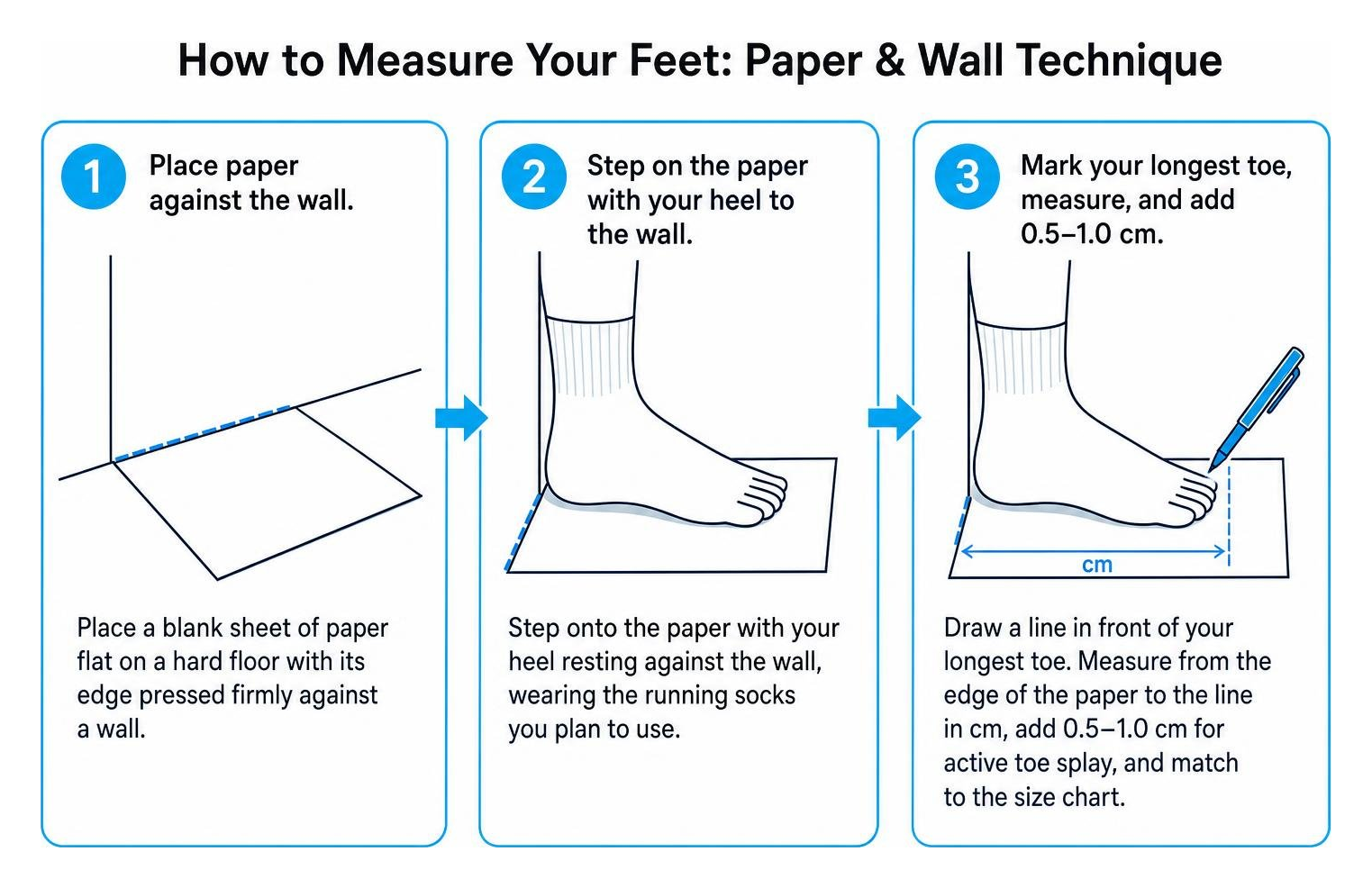
Follow this simple, three-step paper measurement method at home:
- Place a blank sheet of paper flat on a hard floor with its edge pressed firmly against a wall.
- Step onto the paper with your heel resting against the wall, wearing the running socks you plan to use.
- Draw a line directly in front of your longest toe. Measure the distance from the edge of the paper to the line in centimeters, add 0.5 cm to 1.0 cm for active toe splay, and match that number to the brand size chart.
For direct model-by-model sizing evaluations, our hands-on best Altra wide toe box shoes comparison highlights how individual uppers stretch over time.
Finding the Right Altra Shoes Wide Toe Box Size and Profile
As a general rule of thumb, we recommend ordering your Altra running shoes ½ size larger than your standard dress shoe size. Dress shoes are designed to fit closely without accounting for the dynamic elongation and blood-flow expansion that happens during a 10-mile run.
When you lace up your shoes, you should have approximately a full thumb’s width of empty space between your longest toe and the front of the shoe bumper. Your heel should feel securely cupped with zero vertical slipping, and your midfoot should feel comfortably wrapped without any pinching across the top eyelets.
Frequently Asked Questions about Altra FootShape™ Footwear
What is the difference between FootShape™ fit and a wide 2E shoe?
FootShape™ fit alters the anatomical geometry of the toe box, providing a wide, squared-off front to accommodate natural toe splay while maintaining standard width through the midfoot and heel. A traditional 2E shoe increases volume across the entire last, which can cause unwanted heel slippage if you only have a wide forefoot.
Should I size up when buying Altra running shoes?
Yes, most runners benefit from ordering a half-size larger than their dress shoes or casual footwear. This extra length ensures your toes have sufficient clearance to expand forward during foot strike without hammering into the front of the shoe on downhill descents.
Which Altra models are best for walking and standing all day?
The Paradigm 8 and FWD VIA 2 are standout choices for all-day standing and walking. The Paradigm 8 offers plush EGO™ MAX foam and GuideRail™ stability to combat arch fatigue, while the FWD VIA 2 provides ultra-soft EGO™ P35 foam that absorbs constant hard floor impact.
Conclusion
Your feet are masterpieces of biological engineering, containing 26 bones, 33 joints, and over a hundred muscles, tendons, and ligaments designed to stabilize and propel you. Giving your toes the physical space to spread out naturally restores proper biomechanical balance, relieves joint stress, and keeps your runs comfortable mile after mile.
Whether you are hitting the pavement for your first 5K or tackling technical mountain trails, pairing the right FootShape™ profile with your ideal level of cushioning unlocks a whole new standard of running comfort.
Ready to step away from cramped, narrow footwear? Discover our comprehensive field tests and find the perfect barefoot and wide toe box shoes to give your feet the freedom they deserve.