Best ASICS Trainers for Overpronation in 2026
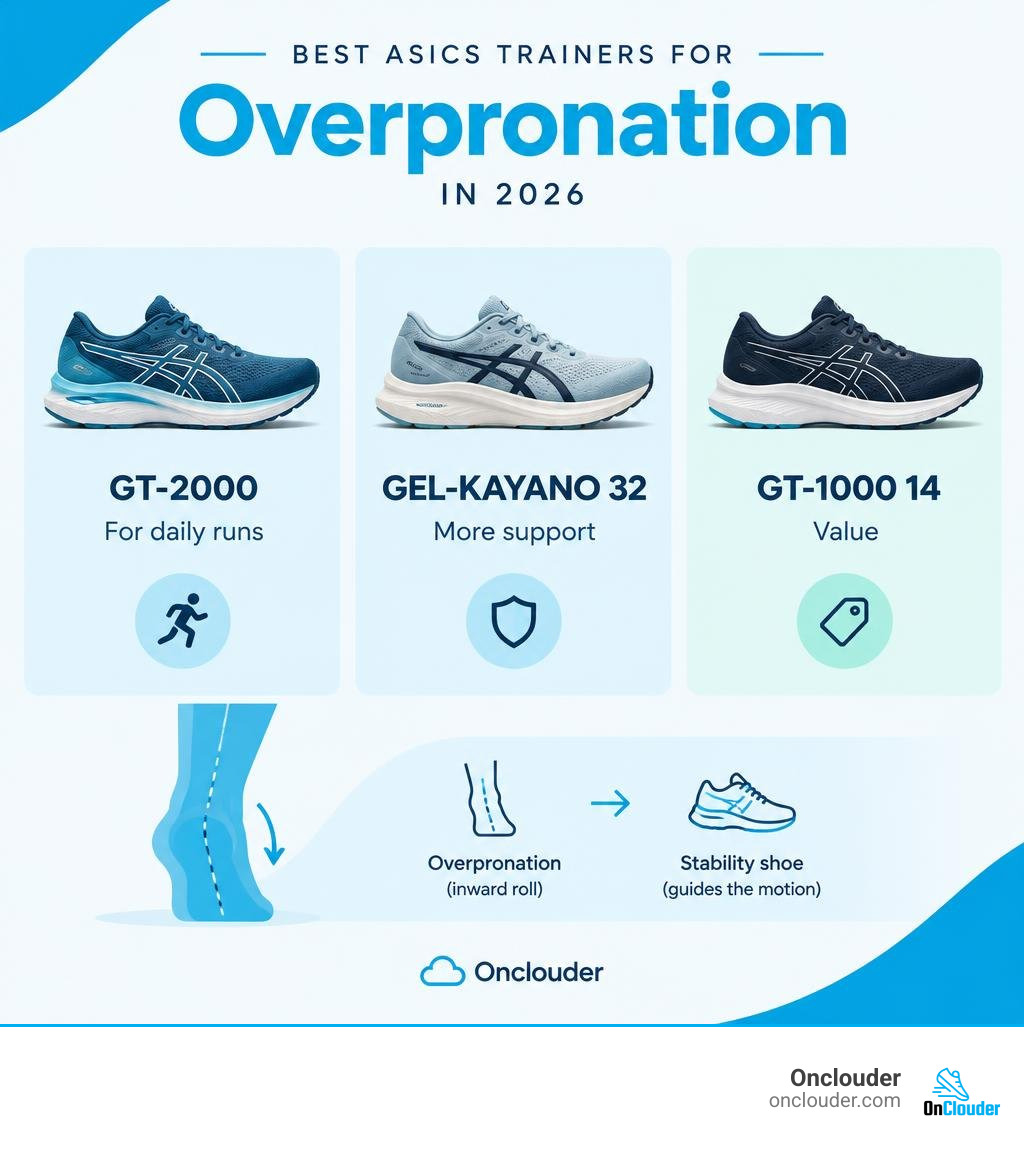
Start with the GT-2000 for mild to moderate overpronation. Choose the GEL-KAYANO 32 if you want more support and cushioning for long runs. The GT-1000 14 is the budget pick for shorter runs and daily wear.
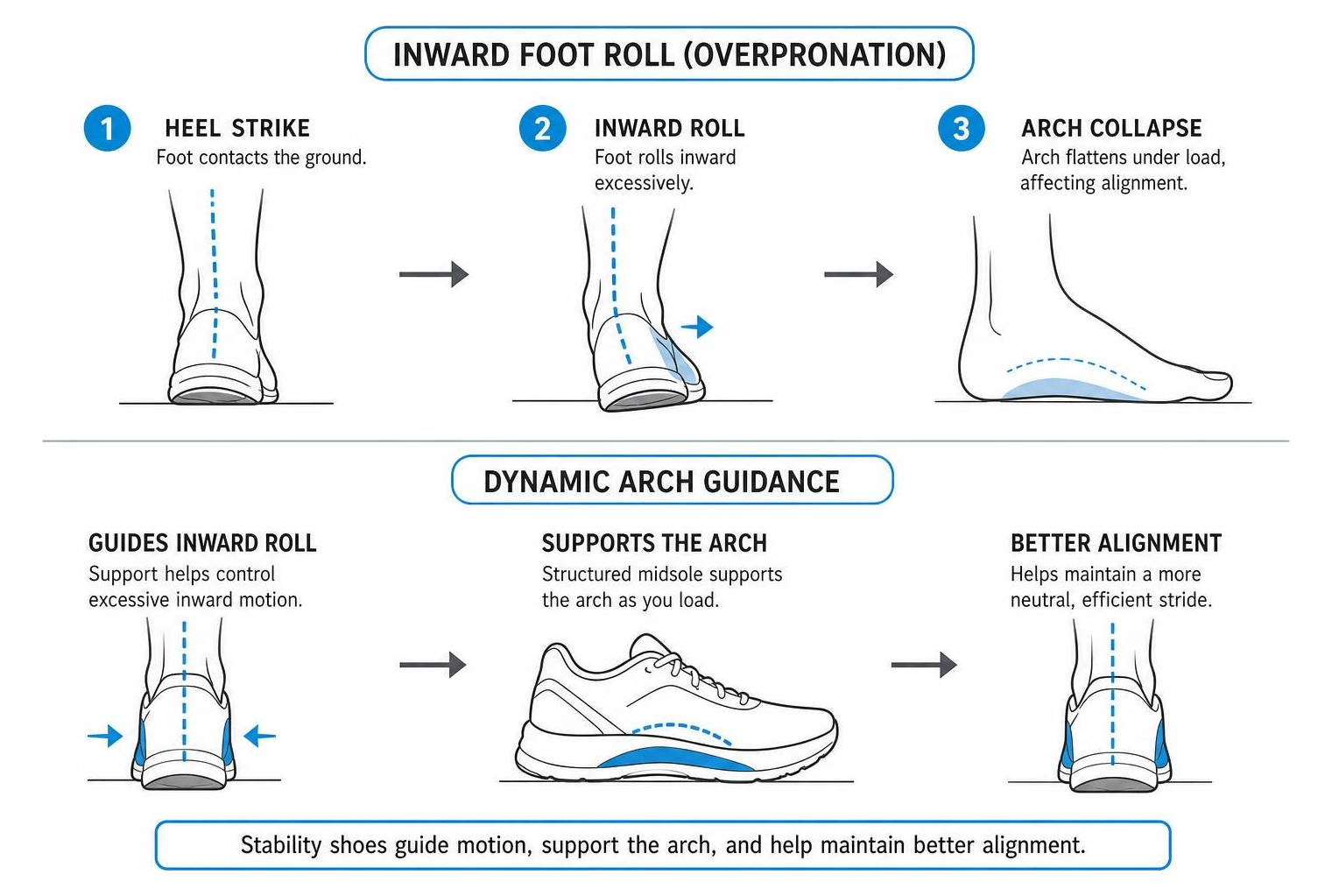
Overpronation means your foot rolls inward more than you want as you move. A stability shoe can help guide that motion, but the best choice is one that also feels comfortable: look for room around your toes and a secure fit at your heel. If arch pain persists, get advice from a clinician rather than relying on shoes alone.
Key terms for best asics trainers for overpronation:
- adidas boost pronation
- stability running shoes overpronation
- best dress shoes for overpronation
Overpronation is an excessively deep inward roll of the foot following heel strike. When your arch collapses under load, it creates an alignment chain reaction affecting your ankles, shins, knees, and hips. In 2026, finding the right pair among the best asics trainers for overpronation means choosing modern biomechanical guidance over stiff, uncomfortable medial posts.
Top Picks: The Best Trainers for Overpronation in 2026
To help you find the right fit for your training regimen, we have field-tested and evaluated the leading ASICS stability footwear options across key categories. Understanding the technical specs helps clarify which pair aligns with your weekly mileage and stability requirements.
| Model | Primary Category | Support Mechanism | Midsole Cushioning | Weight (Men’s 9 / Women’s 7.5) | Best For |
|---|---|---|---|---|---|
| Gel-Kayano 32 | Maximum Support | 4D GUIDANCE SYSTEM™ | FF BLAST™ PLUS ECO + PureGEL™ | ~10.7 oz / 9.2 oz | Long runs, severe overpronation, marathon training |
| GT-2000 13 | Daily Mileage Workhorse | 3D GUIDANCE SYSTEM™ | FF BLAST™ PLUS + PureGEL™ | ~9.7 oz / 8.3 oz | Everyday training, mild to moderate pronation |
| GT-1000 14 | Budget Stability | 3D GUIDANCE SYSTEM™ | FLYTEFOAM™ + Rearfoot GEL™ | ~9.5 oz / 8.1 oz | 3–8 mile runs, gym workouts, walkers |
| Gel-Contend 9 | Entry-Level Comfort | Internal Heel Counter | AMPLIFOAM™+ Rearfoot GEL™ | ~10.4 oz / 8.8 oz | Casual walking, low mileage, tight budgets |
| Gel-Venture 10 | Off-Road / Trail | Broad Trail Base | AMPLIFOAM™ + Rearfoot GEL™ | ~10.9 oz / 9.4 oz | Mixed terrain, dirt paths, trail jogging |
Choosing dedicated stability running shoes for overpronation protects your joints and maintains optimal energy return mile after mile.
Maximum-Support Trainer: Cushioning for Long Runs

The ASICS Gel-Kayano 32 remains the standard for maximum-support daily running. For runners dealing with moderate to severe overpronation, this shoe provides extensive stability without feeling like a rigid cast.
At the heart of the Kayano 32 is the 4D GUIDANCE SYSTEM™. Instead of forcing your foot into an artificial position with hard plastic posts, this technology uses a soft, responsive foam pod placed directly under the medial arch. The moment your foot rolls inward excessively, the pod compresses and bounces back, guiding your foot back onto an even path.
Under the heel, the Kayano 32 incorporates PureGEL™ technology, which is 65% softer than standard legacy GEL units. When combined with the high-stack FF BLAST™ PLUS ECO midsole foam, the shoe absorbs harsh heel strikes during long-distance marathon blocks.
- Weight: 10.7 oz (Men’s 9) / 9.2 oz (Women’s 7.5)
- Best use: High-mileage recovery runs, marathon training, severe overpronators
- Podiatry profile: Excellent match for runners seeking podiatrist-approved shoes for overpronation
Advantages:
- Adaptive 4D stability customizes support during fatigue
- PureGEL™ delivers exceptional heel shock attenuation
- Spacious toe box accommodating natural foot splay
Limitations:
- Not built for fast intervals or short-distance speedwork
- Premium price tier
Daily Trainer: Best for Everyday Mileage
The ASICS GT-2000 13 is the most versatile daily trainer in the lineup. It delivers approximately 90% of the stability seen in the Gel-Kayano 32 while shaving off noticeable weight, making it an ideal choice for mild to moderate overpronators.

The GT-2000 13 uses the 3D GUIDANCE SYSTEM™, relying on a wider base flare, an increased heel bevel, and targeted midsole geometry to keep your stride centered. Its upper is made with at least 50% recycled materials, maintaining solid breathability and midfoot lockdown.
In our long-term testing, the GT-2000 13 showed minimal midsole compaction even after 400+ miles of road use. For runners seeking a reliable everyday mileage shoe, it ranks high among the best stability shoes for every type of overpronator.
Advantages:
- Lightweight build suitable for both tempo runs and long daily miles
- Durable midsole that resists early foam compression
- Eco-conscious upper construction
Limitations:
- Less plush heel cushioning than the Kayano series
- May lack sufficient motion control for severe overpronators
Budget Stability Trainer: Lightweight Support
If you want structured pronation control under $110, the ASICS GT-1000 14 delivers strong value. Designed as an accessible stability trainer, it utilizes the 3D GUIDANCE SYSTEM™ to provide consistent arch protection across 3- to 8-mile runs and daily cross-training sessions.
The midsole pairs lightweight FLYTEFOAM™ cushioning with a traditional Rearfoot GEL™ unit embedded under the calcaneus. The platform is tuned slightly firmer than the GT-2000, which offers inherent stability without unnecessary bulk. It serves as a dependable option for beginner runners, light daily joggers, and walkers needing arch support.
Advantages:
- Budget-friendly price point
- Lightweight, balanced platform
- Capable transition from road running to gym workouts
Limitations:
- Cushioning bottoms out faster under heavy runners on high-mileage runs (10+ miles)
- Firmer underfoot feel compared to FF BLAST™ PLUS
Entry-Level Trainer: Everyday Comfort
The ASICS Gel-Contend 9 is an entry-level athletic shoe built for casual runners, daily walking, and commuting on paved surfaces. While it lacks the active guidance systems of the GT and Kayano series, it uses a rigid internal heel counter and targeted midsole sidewalls to keep the rearfoot stable.
The Gel-Contend 9 pairs AMPLIFOAM™+ cushioning with Rearfoot GEL™ shock absorption. Fit note: User testing shows the Gel-Contend 9 runs small; many runners find going up a half size provides a better fit in the toe box.
Advantages:
- Affordable entry-level price
- Solid rearfoot lockdown from the structured heel cup
- Reliable OrthoLite™ sockliner comfort
Limitations:
- Runs small across standard sizing
- Lacks dynamic medial support for moderate or severe overpronation
Trail Trainer: Off-Road Stability and Grip
Running on trails requires a shoe that stabilizes the ankle against lateral twists, rocky roots, and mud. The ASICS Gel-Venture 10 translates stability to uneven terrain.
The Gel-Venture 10 features a wider base that prevents unwanted ankle rollover on rocky singletracks, supported by rugged, multi-directional outsole lugs that grip loose dirt and wet inclines. Built with durable AMPLIFOAM™ and a protective toe bumper, this shoe provides reliable support for off-road trails and park loops.
Advantages:
- Aggressive lugged outsole for wet and loose terrain
- Reinforced upper shields against rocks and debris
- Broad, stable platform
Limitations:
- Firmer ride on paved roads
- Heavier overall profile
Stability Shoe Technologies: Guidance Systems vs. Cushioning
Modern ASICS engineering uses structural geometry and advanced materials to control excessive pronation:
3D vs. 4D GUIDANCE SYSTEM™
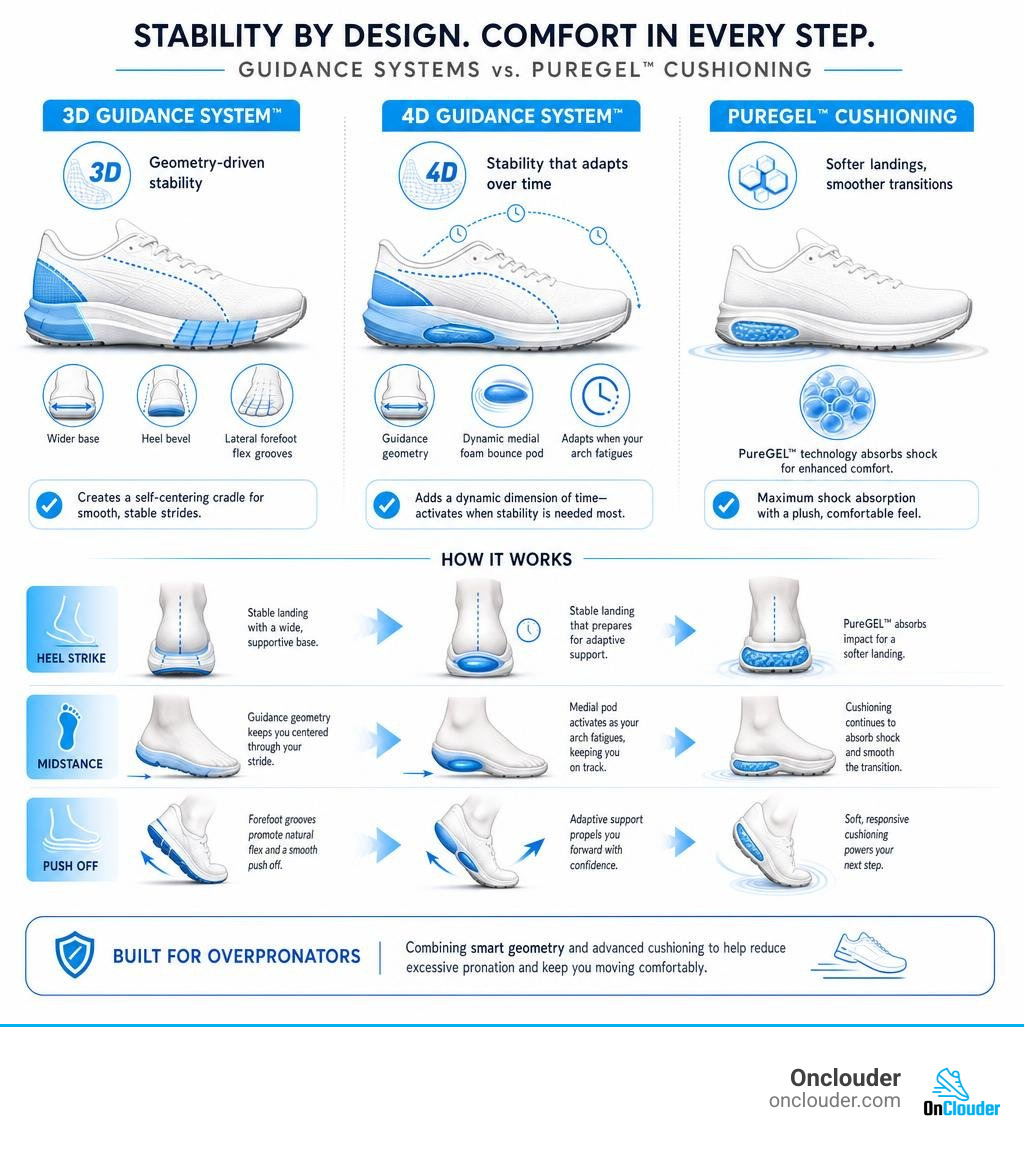
- 3D GUIDANCE SYSTEM™ (Found in GT-2000 13 & GT-1000 14): Focuses on geometry. By adjusting the base width, heel bevel, and lateral forefoot flex grooves, it creates a self-centering cradle that keeps mild overpronators moving smoothly forward.
- 4D GUIDANCE SYSTEM™ (Found in Gel-Kayano 32): Adds a dynamic dimension of time. When your arch fatigues over long miles, the medial foam bounce pod activates dynamically, adapting to your stride when stability is needed most.
PureGEL™ vs. Traditional GEL™
- PureGEL™: Positioned internally within the rearfoot, PureGEL™ is 65% softer than heritage silicone units. It dissipates impact forces without adding excess weight.
- Rearfoot GEL™: The exposed silicone compound used in entry-level and trail shoes like the Gel-Contend and Gel-Venture. It delivers proven durability, though at a slightly firmer, heavier profile.
To learn more about how modern geometry has replaced rigid medial posting across the industry, read our guide covering everything you need to know about stability shoes.
How to Choose the Right Shoes for Your Pronation Level and Arch Type
Finding the right stability trainer requires matching shoe mechanics to your anatomical profile and training goals:
- Assess Pronation Severity:
- Mild Overpronation: Look for neutral-to-stable shoes or the GT-2000 13.
- Moderate Overpronation: The GT-2000 13 and Gel-Kayano 32 provide ideal support.
- Severe Overpronation / Rigid Flat Feet: The Gel-Kayano 32 provides the structured guidance needed to manage significant arch collapse.
- Account for Arch Height: Runners with flat feet or flexible low arches often need a wide platform with medial support. You can review our roundup of the top running shoes for flat feet and overpronation for targeted recommendations.
- Upper Lockdown and Fit: Stability starts at the heel counter. Ensure your heel stays locked in without slipping, leaving a thumbnail’s width of space in the toe box to accommodate natural foot swelling.
- Eco-Friendly Materials: Many models, including the GT-2000 13, use engineered mesh uppers made from at least 50% recycled content, helping reduce waste without sacrificing structural integrity.
Frequently Asked Questions About Overpronation Shoes
How long do stability shoes last before needing replacement?
Most road stability shoes, such as the GT-2000 13 and Gel-Kayano 32, last between 400 and 500 miles. While the high-abrasion AHARPLUS™ rubber outsole often looks intact past 500 miles, the internal stability foams and guidance pods gradually compress. If you notice recurring arch tenderness, knee soreness, or uneven medial tread wear, it is time to replace your shoes.
What is the best shoe for overpronation and plantar fasciitis?
The ASICS Gel-Kayano 32 is widely regarded as the top option for runners suffering from overpronation alongside plantar fasciitis. Its combination of a 10mm drop, an adaptive medial 4D arch pod, and rearfoot PureGEL™ reduces tension across the plantar fascia during the transition from heel to toe. For additional relief, consult our guide on shoes for foot pain.
Do overpronation shoes run true to size?
Most premium models—like the GT-2000 13, GT-1000 14, and Gel-Kayano 32—run true to standard running shoe sizing with accommodating toe boxes. However, entry-level models like the Gel-Contend 9 tend to run small, making it best to go up a half size for adequate forefoot clearance.
Conclusion
Overpronation does not have to result in arch pain or joint fatigue. Modern stability footwear from ASICS blends structured gait guidance with plush cushioning to help you run comfortably.
- Pick the Gel-Kayano 32 for maximum support, long-mileage training, and soft underfoot protection.
- Choose the GT-2000 13 for a lightweight, durable daily trainer that handles mild to moderate overpronation with ease.
- Select the GT-1000 14 if you want dependable stability at a lower price point.
For more in-depth reviews and step-by-step guidance on selecting footwear for your gait, visit our essential guide to best overpronation shoes.