

Why Your Feet Are Suffering at Work (And What to Do About It)
If you’ve been searching for breathable safety toe shoes, here are the top picks to consider in July 2026:
| Shoe | Best For | Toe Type | Key Feature |
|---|---|---|---|
| KEEN Atlanta Cool | Hot outdoor construction | Steel | Mesh upper, asymmetrical toe |
| Reebok Sublite Cushion | Warehouse/concrete floors | Composite | Ultra-lightweight, ~350g |
| Bellota Flex Air S1P | Delivery drivers, shop floors | Fiberglass composite | ESD rated, very high breathability |
| Albatros AER55 Breeze | Warehouses, logistics | Composite | 55% energy return midsole |
| SafeStep Lite | General work, shop floors | Steel | Kevlar midsole, mesh upper |
Breathable safety toe shoes sound simple. But finding a pair that actually vents heat — rather than just claiming to — is harder than it looks.
Over 70% of construction and warehouse workers say heat and sweat are their biggest complaints about traditional safety boots. And it makes sense. A standard leather boot with a steel toe cap traps heat from two directions: the hot ground below and your working body above.
The result? Sweat. Blisters. Fatigue. And by hour eight of a twelve-hour shift, feet that feel like they’ve been slow-cooked.
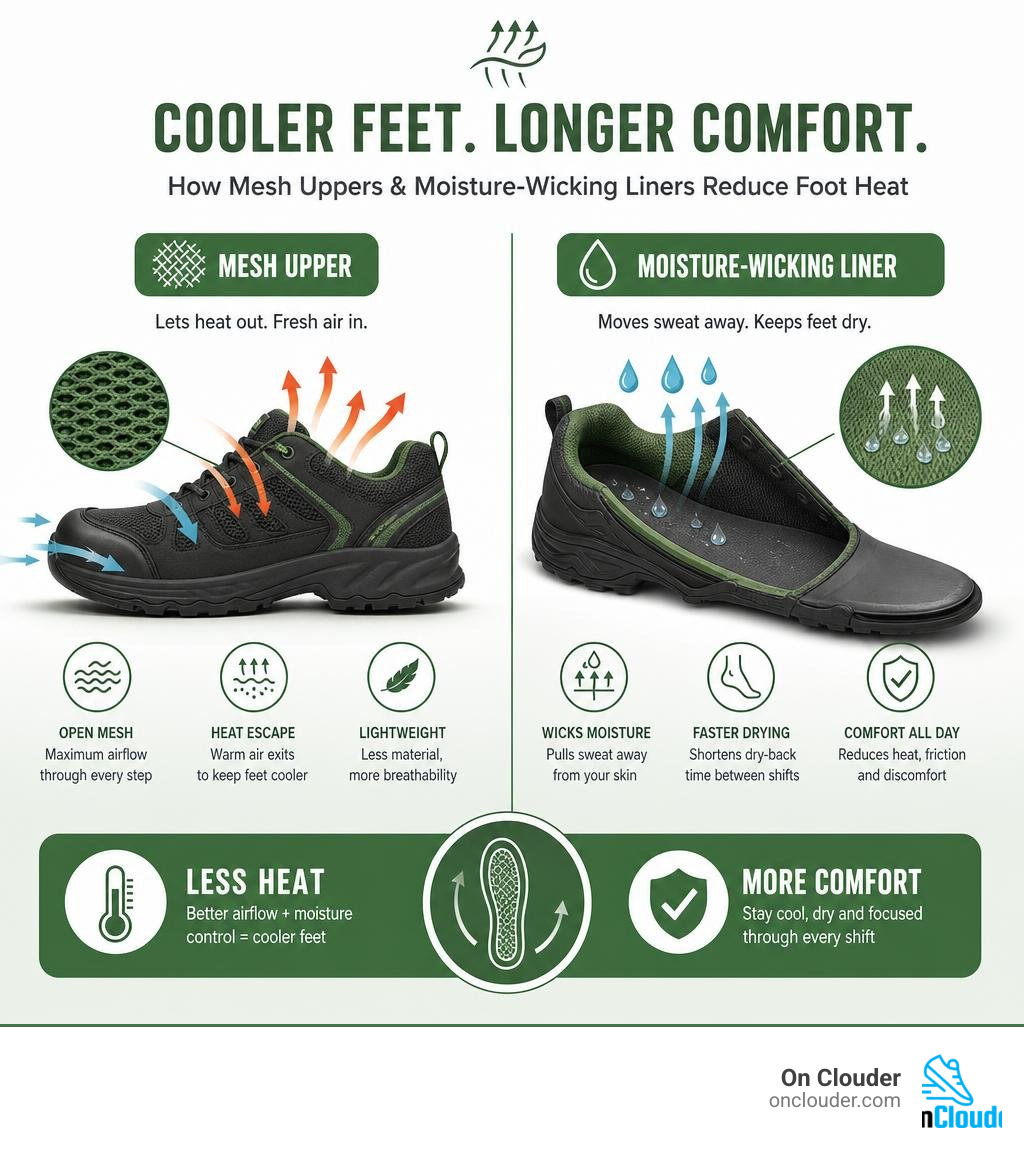
The good news is that modern breathable safety footwear has come a long way. Mesh uppers can reduce foot temperature by up to 15°F compared to traditional leather. Composite toes run cooler than steel because they don’t conduct heat. And moisture-wicking liners can cut overnight dry-back time in half when you pull the insoles out between shifts.
But not every “breathable” label means the same thing. Some boots use perforated leather — which moves far less air than open mesh. Others add a Gore-Tex membrane that breathes slower than it should in extreme heat. And a few just use the word breathable as a marketing hook with nothing behind it.
This guide cuts through that noise.
I’m Faisal S. Chughtai, a footwear expert who has spent years evaluating breathable safety toe shoes for comfort, protection, and real-world performance across demanding work environments. In the sections below, I’ll walk you through exactly what to look for — and which models are worth your money.
Breathable safety toe shoes word guide:
- breathable safety toe boots
- waterproof and breathable work boots
- women’s steel toe shoes
The Science of Airflow: What Makes Breathable Safety Toe Shoes Actually Work?
To understand how breathable safety toe shoes manage heat, we have to look past the marketing buzzwords. True breathability isn’t just about punching a few tiny holes in a sheet of leather. It requires a coordinated system of ventilation, moisture transport, and smart material choices.
At the core of any highly ventilated shoe is its upper material. Traditional heavy-duty work boots rely on thick, oil-tanned leather. While exceptionally durable, leather acts as an insulator, trapping the ambient heat generated by your muscles. Modern breathable footwear replaces or supplements leather with high-tensile engineered mesh or safety knit fabrics.
According to laboratory testing, mesh upper work boots can reduce internal foot temperature by up to 15°F compared to traditional leather boots during hot summer shifts. This open-weave structure allows ambient air to actively circulate through the shoe with every step you take, pushing hot, humid air out while drawing cooler air in.
However, a mesh upper is only half the equation. If the interior lining is a cheap, non-breathable synthetic, your sweat will still pool. This is where advanced moisture-wicking liners come into play. High-performance linings use hydrophobic and hydrophilic fibers woven together to pull sweat away from your skin and spread it across a larger surface area on the shoe’s exterior, accelerating evaporation.
For a complete breakdown of how these systems function together, check out our Beginners guide to breathable work boots for men.
When evaluating options, we must also consider the role of waterproof membranes. Many workers assume they need a fully waterproof boot, but as we explain in The science of dry waterproof and breathable steel toe boots explained, waterproof barriers like Gore-Tex restrict airflow. In high-heat, dry environments, a non-waterproof shoe with an open-mesh construction—such as those featured in the Breathable Work Shoes | Work Sneakers – KEEN Footwear line—will always keep your feet significantly cooler and drier than a waterproof equivalent.
Steel vs. Composite: Choosing the Right Toe Cap for Hot Weather
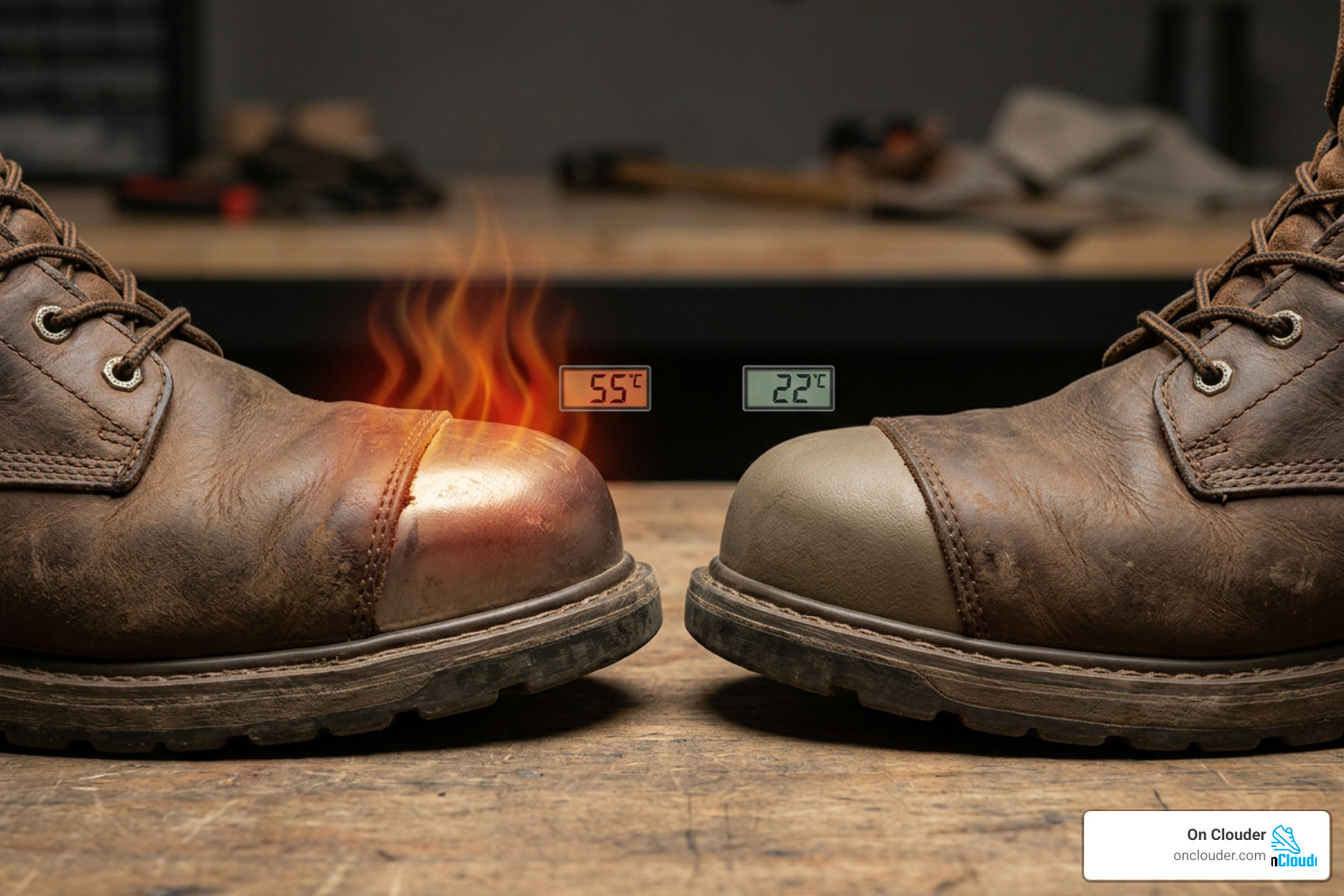
When selecting breathable safety toe shoes, the material protecting your toes has a massive impact on how hot your feet get. The debate usually comes down to traditional steel versus modern composite materials.
Steel is a highly efficient thermal conductor. If you are working outdoors under the baking July sun, a steel toe cap will absorb that external radiant heat and transfer it directly into your toe box, essentially creating a mini-oven around your forefoot. Conversely, in cold weather, steel conducts the cold inward.
Composite toe caps—made from carbon fiber, fiberglass, or heavy-duty plastics—are thermal insulators. They do not conduct heat or cold, meaning your toes remain shielded from extreme external temperatures. Furthermore, because composite materials are significantly less dense than steel, they offer massive weight savings. Lightweight composite toe work shoes average 20% to 30% less weight than steel toe versions, which reduces the metabolic heat your body generates during long shifts.
To learn more about the orthopedic advantages of making this switch, read our guide on Tough as nails why you need orthopedic composite toe shoes and find out how to lighten your daily load with these Stop dragging your feet with these featherweight composite toe boots.
Here is how the three primary toe cap materials stack up when the heat is on:
| Feature | Steel Toe | Composite Toe | Alloy (Aluminum) Toe |
|---|---|---|---|
| Heat Conduction | High (Gets hot quickly) | Extremely Low (Insulates) | Medium-High |
| Weight | Heavy (Standard baseline) | Light (20-30% lighter than steel) | Very Light |
| Profile Thickness | Thin | Thick | Thin |
| Electrical Hazard | Conductive (Unless insulated) | Non-conductive (Best for EH) | Conductive |
| ASTM F2413 Certified | Yes | Yes | Yes |
While composite toes are a favorite for hot concrete and electrical environments due to their non-conductive nature, alloy (aluminum) toes offer a compelling middle ground, providing the slim profile of steel at a fraction of the weight.
Top-Rated Breathable Safety Toe Shoes for Every Work Environment
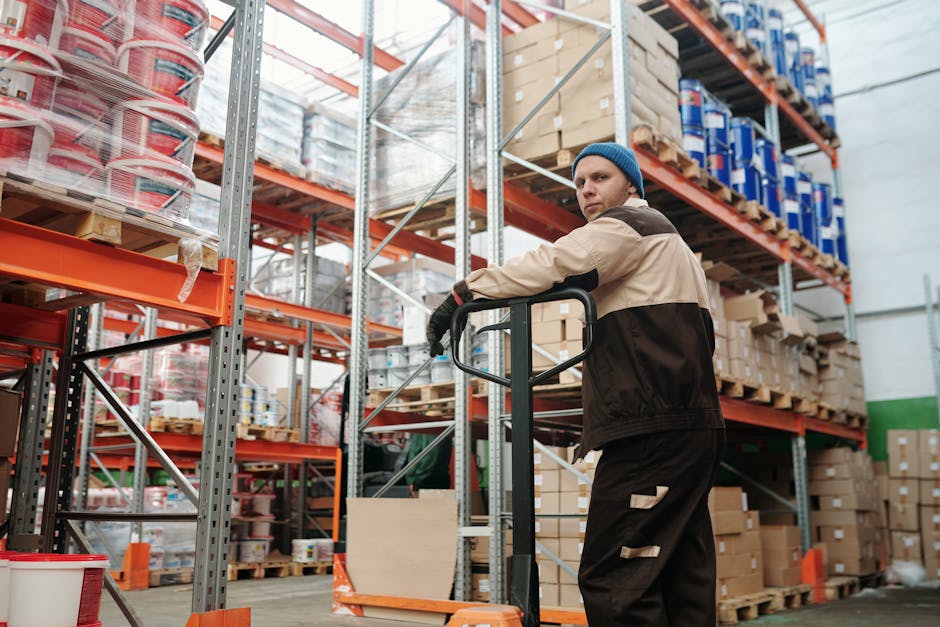
Finding the perfect pair of breathable safety toe shoes requires matching the footwear to your specific daily work environment. A shoe that excels on a polished, climate-controlled warehouse floor will quickly fall apart on a dusty, gravel-filled outdoor construction site. Below, we break down the top performers by category.
Best Overall Breathable Safety Toe Shoes for Hot Outdoor Construction
For rugged outdoor jobs where the sun is relentless but the terrain demands heavy-duty protection, the KEEN Utility Atlanta Cool stands out as the gold standard.
Unlike standard symmetrical safety toes that can pinch your feet as they naturally swell in the heat, KEEN’s asymmetrical steel toe design is anatomically shaped to fit your left and right feet perfectly. This provides a roomier toe box, which directly translates to better air circulation around your forefoot.
The Atlanta Cool utilizes large, open-mesh panels along the sides of the upper to maximize cross-ventilation. To survive the abrasiveness of a construction site, these mesh zones are framed by durable, water-resistant leather overlays. While dust management is always a challenge with mesh shoes on dry dirt sites, the Atlanta Cool’s mesh is tight enough to filter out larger debris while still letting heat escape.
To explore more heavy-duty ventilated options, take a look at The 5 most breathable steel toe work boots for 2026 – The Foot Facts.
Best Lightweight Breathable Safety Toe Shoes for Warehouses and Concrete Floors
If you spend 10 to 12 hours a day walking on hard, unyielding concrete, your primary enemies are heat buildup and impact fatigue. For these conditions, we highly recommend the Reebok Sublite Cushion and the Albatros AER55 Breeze.
The Reebok Sublite Cushion is one of the lightest ASTM F2413-rated options on the market, weighing in at approximately 350 grams per shoe. It features a deep-grooved mesh upper that allows your foot to flex naturally while dumping heat.
If you want to feel like you are walking on air, the Albatros AER55 Breeze is a revelation. It features a dual-density IMPULSE.FOAM midsole that delivers an impressive 55% energy return with every step, dramatically reducing leg fatigue. Its upper is constructed from breathable SAFETY KNIT textile, which behaves like a high-performance athletic sock while maintaining S1P-certified safety protection.
For more options that prioritize a weightless feel, see our list of Safety shoes so light you might forget you are wearing them and read the full specs for the Albatros AER55 Breeze Impulse Low Safety Shoes S1P – Unishore Workwear.
Best Athletic-Style Safety Sneakers for Delivery Drivers and Shop Floors
Delivery drivers and light industrial shop workers need the agility of a running shoe combined with dependable slip resistance and toe protection.
The Bellota Flex Air S1P and the SafeStep Lite are built specifically for this high-speed, high-mobility lifestyle. The Bellota Flex Air utilizes an ultra-breathable mesh upper paired with a lightweight fiberglass toe cap, making it completely metal-free and highly flexible. It also boasts ESD (electrostatic discharge) certification, making it safe for electronics assembly and sensitive shop floors. Check out the details on this model at Flex Air S1P safety sneakers / FTW04GS1P | Bellota.
The SafeStep Lite offers a sporty aesthetic with a robust puncture-resistant Kevlar midsole and an ASTM-rated steel toe cap, providing heavy-duty defense in a sneaker profile. You can find this model at Lightweight Steel Toe Shoes | Breathable Work Sneakers – SafeStep Gear.
Other fantastic athletic-style safety sneakers worth checking out include:
- Lightweight Breathable Work Shoes for Men – larnmern
- Men’s Breathable Steel-Toe Safety Shoes Non-Slip Lightweight Work Sneakers (also available via Ortorex)
- Safety JB Work Boots | Puncture-Resistant | 9KSAFETYJB
To dive deeper into the engineering behind these ultra-light athletic designs, read Technology stop dragging your feet with these ultra light safety shoes.
Balancing Protection and Airflow: Trade-offs and Real-World Durability
While breathable safety toe shoes are a lifesaver in hot weather, they are not a magic bullet for every single job site. Choosing highly ventilated footwear requires accepting certain trade-offs in protection and long-term durability.
First and foremost is the issue of moisture. By design, open-mesh uppers let air in, which means they also let water, mud, and chemicals in just as easily. If you work in an environment with frequent liquid spills or heavy morning dew, a mesh shoe will leave you with soaked socks within minutes. For wet environments, you will need to look at specialized Waterproof safety shoes 101 that utilize breathable membranes rather than open mesh.
Another critical safety consideration is exposure to hot work. If your job involves welding, grinding, or heavy demolition, mesh uppers are a safety hazard. Sparks and hot slag can easily burn through synthetic mesh fabrics, causing severe burns to your feet. In these environments, heavy-duty leather is non-negotiable for safety, regardless of the temperature.
Real-world feedback from online communities like Reddit’s r/Construction and r/electricians highlights the long-term durability trade-offs of these shoes. While traditional leather boots can last years with proper care and resoling, lightweight mesh safety sneakers typically have a service life of 6 to 12 months under daily, heavy use. Synthetic mesh is more prone to tearing when scraped against sharp metal or concrete edges, and lightweight foam midsoles tend to compress and lose their cushioning support over time.
For female workers navigating these trade-offs, our Womens steel toe shoes survival guide offers practical advice on finding the right balance of protection, fit, and ventilation.
Frequently Asked Questions About Breathable Safety Footwear
How do I clean and maintain mesh safety shoes to preserve breathability?
To keep your mesh safety shoes venting air efficiently, you must keep the mesh free of dust and grime. We recommend brushing off dry dirt and dust weekly with a soft-bristled brush. For deeper cleans, hand-wash the uppers using warm water and a mild soap—never put them in a washing machine or dryer, as extreme heat can degrade the adhesives and warp the safety toe caps.
Always let them air-dry naturally. To speed up drying and prevent odor, remove the insoles overnight; breathable work boots with moisture-wicking liners can reduce overnight dry-back time by up to 50% when the insoles are pulled out between shifts.
Do breathable safety shoes meet OSHA and ASTM F2413 standards?
Yes, high-quality breathable safety shoes from reputable manufacturers meet or exceed the exact same ASTM F2413 standards for impact and compression resistance as traditional leather boots. Whether the safety toe is made of steel, alloy, or composite, it must withstand a 200-joule impact and 15 kN of compression to comply with OSHA requirements. Always check the safety label under the tongue of the shoe to verify its specific ASTM and EH (Electrical Hazard) ratings before wearing them on a regulated job site.
Should I size up when buying breathable work shoes for hot weather?
Yes, we generally recommend sizing up by a half-size or choosing a “wide” width variant when buying safety shoes for hot weather. During a long, active shift in high temperatures, your feet will naturally swell. If your shoes fit too tightly, it constricts blood flow and eliminates the small pocket of air inside the toe box that is crucial for active ventilation. A slightly roomier fit ensures your feet have space to breathe and swell without rubbing against the rigid safety toe cap.
Conclusion
At On Clouder, we believe that staying safe on the job shouldn’t mean sacrificing your comfort or enduring the misery of hot, sweaty feet. By choosing breathable safety toe shoes with engineered mesh uppers, moisture-wicking liners, and advanced composite or alloy toe caps, you can dramatically improve your daily comfort and reduce fatigue.
Whether you are navigating a bustling summer warehouse or a dusty outdoor construction site, matching the right ventilation technology to your specific job requirements is key.
Ready to upgrade your work gear and take the next step toward ultimate comfort? Explore our comprehensive breakdown of modern footwear technology in The Evolution of the Modern Step: Men’s Breathable Non-Slip Work Shoes and find the perfect pair to keep you cool, dry, and protected all day long.