Why Running Shoe Arch Support Makes or Breaks Your Run
Running shoe arch support is one of the most important factors in choosing the right insole or shoe for pain-free, high-performance running. Here’s a quick breakdown of what you need to know:
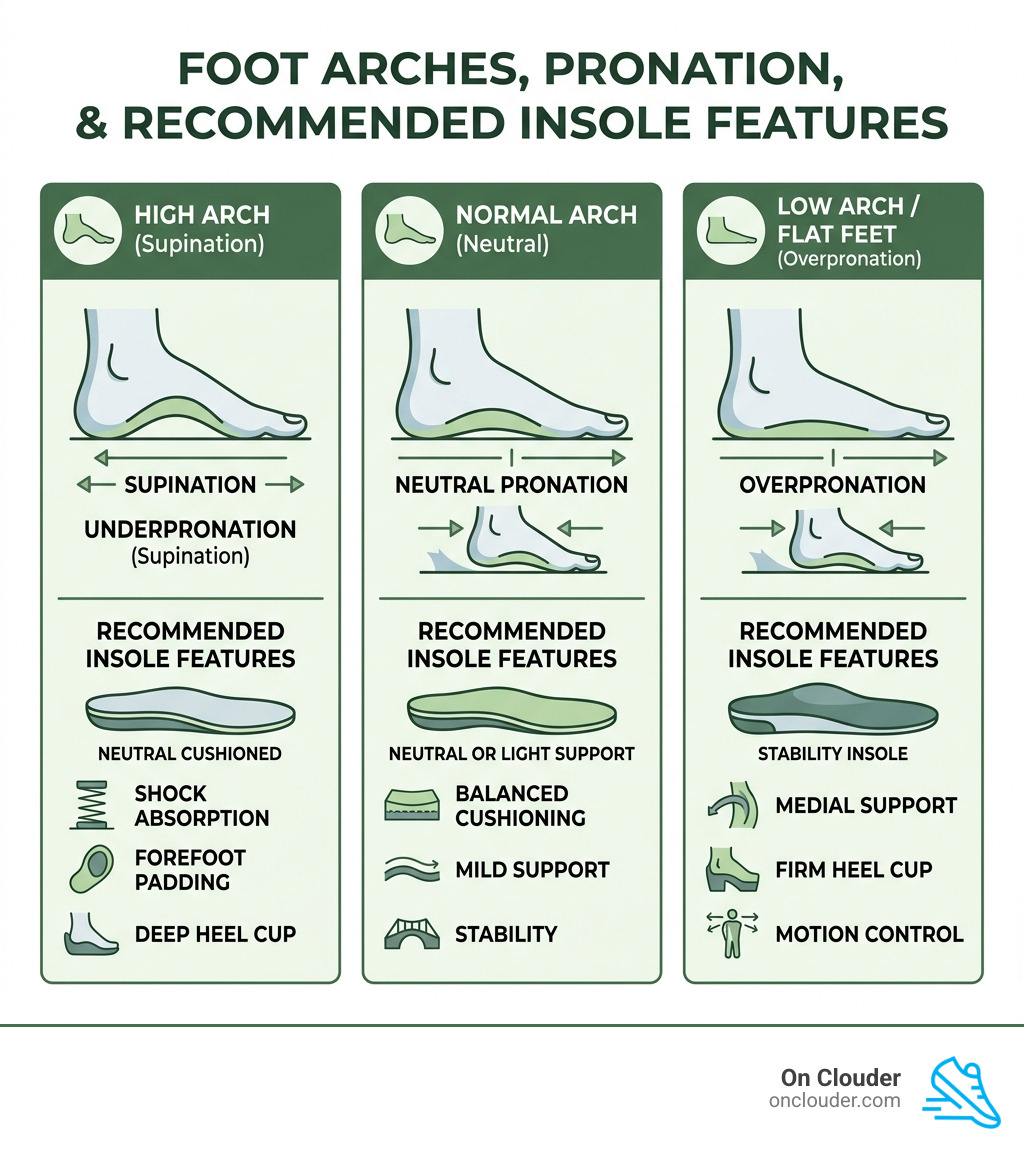
Best insole type by arch profile:
| Arch Type | Recommended Insole | Key Feature |
|---|---|---|
| High arch | Neutral cushioned insole | Shock absorption, forefoot padding |
| Normal arch | Neutral or light support insole | Balanced cushioning |
| Low arch / flat feet | Stability insole | Medial support, firm heel cup |
Your foot has three arches that work together to absorb impact, distribute weight, and power each stride. When your insole doesn’t match your arch profile, the result is often pain, fatigue, or injury — especially over long distances or extended time on your feet.
The problem is real. Overpronation (common with flat feet) increases the risk of plantar fasciitis, shin splints, and knee pain. High arches, on the other hand, don’t absorb shock efficiently, pushing stress onto the heel and forefoot.
The right insole doesn’t just add comfort — it can correct your gait, reduce impact, and improve energy return mile after mile.
At On Clouder, our footwear experts have dedicated their careers to helping runners and active professionals find the perfect fit — including the right running shoe arch support for their unique foot profile. In this guide, we’ll walk you through exactly which high-performance insoles and energy return inserts deliver real results.
Understanding Foot Biomechanics and Running Shoe Arch Support
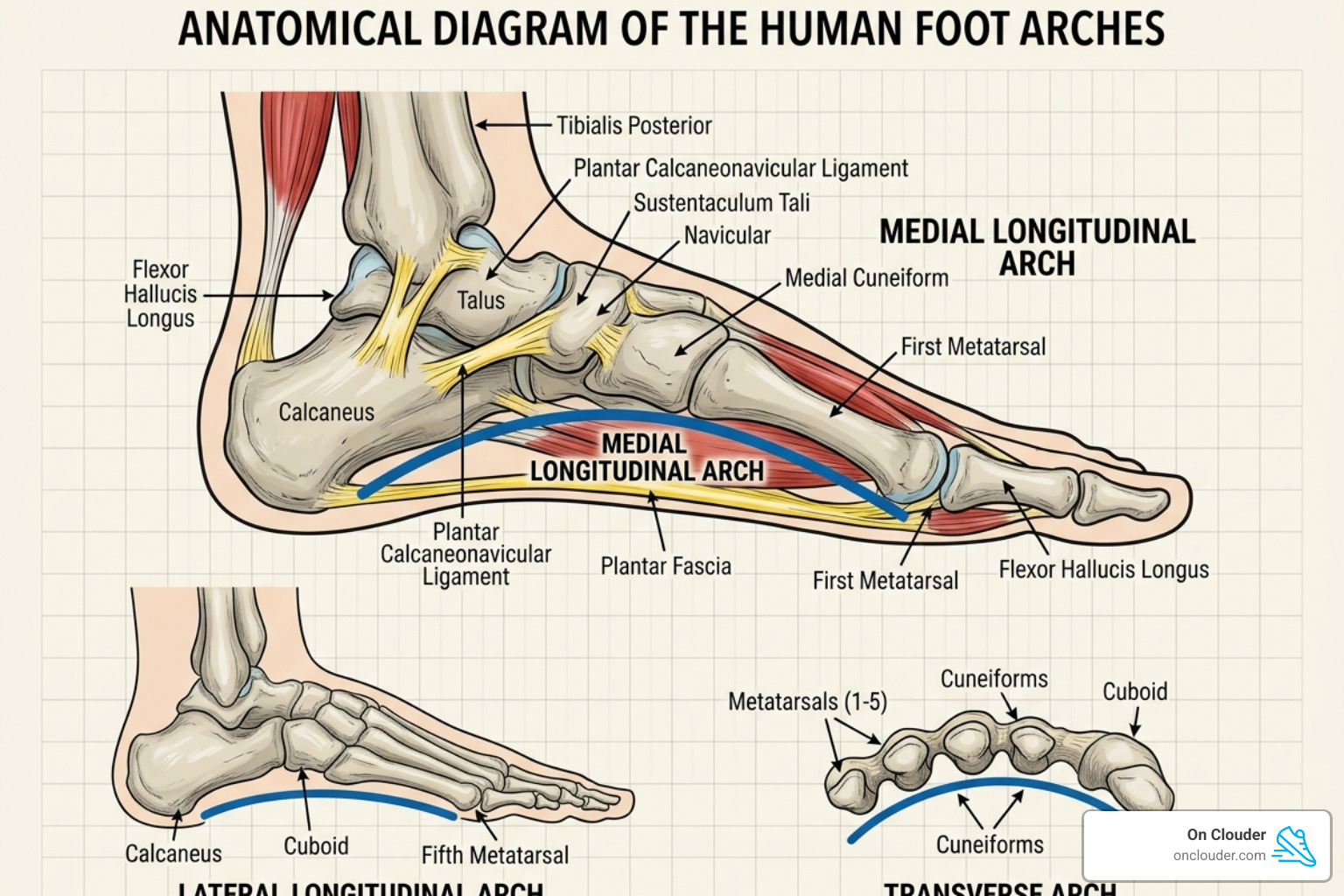
To understand why running shoe arch support is so vital, we first have to look at the biomechanics of the human foot. It is a masterpiece of biological architecture, consisting of 26 bones, 33 joints, and over 100 muscles, tendons, and ligaments.
The foot doesn’t just have one arch; it actually has three distinct structures that work in harmony:
- Medial Longitudinal Arch: This is the most prominent arch on the inside of your foot. It’s the primary shock absorber.
- Lateral Longitudinal Arch: Located on the outer edge of the foot, this arch provides stability during the weight-bearing phase of your stride.
- Anterior Transverse Arch: This runs across the midfoot from side to side, helping with weight distribution and flexibility.
When we run, these arches flatten slightly to dissipate the force of impact (which can be up to three times your body weight) and then “recoil” to help propel us forward. If your arches are too high or too flat, this natural spring system doesn’t function optimally, leading to a chain reaction of stress that can reach your knees, hips, and lower back.
Determining Your Arch Type: The Wet Footprint Test
Before you can choose the right running shoe arch support, you need to know what you’re working with. While high-tech solutions exist—advanced research has used over 50 million foot scans to design products—you can get a very accurate reading at home using the “Wet Footprint Test.”
- Dip the sole of your foot in a shallow pan of water.
- Step firmly onto a piece of dark construction paper or a piece of cardboard.
- Step away and look at the mark you left behind.
- High Arches (Pes Cavus): You’ll see your heel and the ball of your foot, but the middle section (the arch) will be very thin or entirely missing.
- Normal Arches: You’ll see about half of your arch filled in. This is the most common foot type and generally handles shock well.
- Flat Feet (Pes Planus): The entire footprint is visible. There is little to no inward curve, meaning your arch collapses completely when you stand.
For a deeper dive into how these shapes affect your gear choices, check out our Arch Support Inserts 101 guide.
How Pronation Influences Running Shoe Arch Support
Arch height is closely tied to “pronation”—the way your foot rolls inward as it hits the ground.
- Overpronation: Usually associated with flat feet, the foot rolls too far inward. This places excessive strain on the big toe and inner ankle. This is where stability insoles with a firm medial post come into play.
- Supination (Underpronation): Common in high-arched runners, the foot doesn’t roll inward enough. Instead, the impact is concentrated on the outer edge of the foot. These runners need maximum cushioning to make up for the lack of natural shock absorption.
Understanding this “roll” is key to preventing injuries like shin splints and plantar fasciitis. If you struggle with excessive rolling, you might find relief by looking at the best overpronation insoles to stabilize your gait.
Choosing the Right Insole Support for Your Foot Profile
The running shoe market is surprisingly skewed. Statistics show that roughly 85% of running shoes on the market are “neutral,” designed for runners with normal to high arches. Only about 15% are dedicated “stability” or “motion control” shoes for those with flat feet.
This is why aftermarket insoles are a game-changer. They allow you to take a high-quality neutral shoe and customize the internal geometry to fit your specific needs.
| Foot Profile | Insole Goal | Shoe Pairing |
|---|---|---|
| High Arch | Cushioning & Pressure Redistribution | Neutral Cushioned Shoe |
| Normal Arch | Comfort & Fatigue Reduction | Neutral Shoe |
| Flat Feet | Realignment & Arch Support | Stability or Neutral Shoe |
High Arches: How Insoles Provide Neutral Cushioning and Shock Dissipation
If you have “Pes Cavus” (high arches), your feet are often rigid. Because the arch doesn’t flatten much, the shock of each step isn’t dissipated; it’s sent straight into your bones and joints.
For these runners, the best running shoe arch support isn’t necessarily a hard plastic wedge. Instead, you need a flexible insole base with high-rebound foam. The goal is to fill the “gap” under your arch so the entire foot shares the load, rather than just the heel and forefoot. This prevents “ball-of-foot” pain and keeps you moving comfortably. You can learn more about finding that “walking on clouds” feeling in our article on high arch comfort.
Low Arches and Flat Feet: The Role of Insole Stability
Flat feet, or “Pes Planus,” require the opposite approach. Because the foot is too flexible and collapses inward, the insole needs to act as a structural foundation.
Effective stability insoles use dual-density materials—softer foam where you want comfort, and firmer, reinforced materials under the arch and heel. A firm heel cup is essential here; it keeps the fatty pad under your heel bone centered, maximizing your body’s natural cushioning. If you’re tired of the “collapsed” feeling during long runs, our guide on flat feet support offers specific recommendations for firming up your foundation.
Key Features of High-Performance Adjustable Arch Insoles
Not all insoles are created equal. When we look at high-performance options for serious runners, we look for “adjustable” or “adaptive” features. Your feet change throughout a run—they swell, the muscles fatigue, and your form might shift. An insole that can adapt to these changes is worth its weight in gold.
Core Structural Elements for Insole Arch Support
When shopping for the best running shoe arch support, look for these five structural hallmarks:
- Deep Heel Cup: This stabilizes the rearfoot and prevents the side-to-side “sloshing” that leads to blisters and instability.
- Customizable Arch Inserts: Some premium insoles come with interchangeable “plugs” or “pads” of different heights, allowing you to fine-tune the support level.
- Adaptive Cushioning: Materials that respond to the heat and pressure of your foot to create a personalized map.
- Integrated Support Zones: Look for “pods” on the outsole of the insole that help guide the foot through a neutral gait cycle.
- Anti-Slip Features: A high-friction top cover ensures your foot doesn’t slide forward during steep descents or fast sprints.
Lab-Tested Metrics: Insole Shock Absorption and Energy Return
We love the data. When we analyze insoles, we look at lab-tested metrics like Shock Absorption (SA) and energy return.
- SA Ratings: High-quality insoles often aim for an SA rating of 110 or higher. This measures how well the material dampens the “thud” of impact.
- Durometer: This measures the hardness of the foam. For runners, a “Goldilocks” durometer is key—too soft and it bottoms out; too hard and it feels like running on concrete.
- Advanced Compounds: Modern insoles use PU (Polyurethane) blends or specialized EVA foams that are 13% to 17% more responsive than standard shoe inserts.
- Energy Return: This is the “bounce” factor. Carbon fiber-infused arches are particularly popular now because they act like a spring, returning energy to your stride rather than just absorbing it.
Enhancing Performance with Adjustable Insoles and Orthotics
While many runners start with over-the-counter (OTC) inserts, some eventually move toward custom orthotics. However, the gap between the two is closing. Modern adjustable insoles offer many of the benefits of medical-grade orthotics at a fraction of the cost.
For those with high arches, the focus is often on moisture-wicking covers and carbon fiber supports that provide rigid strength without adding weight. If you’re looking for that premium feel, check out high arch inserts for walking on sunshine.
Trimming and Breaking In Your Inserts
Once you’ve purchased your high-performance running shoe arch support, the work isn’t quite done. Proper fit is everything.
- The Trim: Most insoles are “trim-to-fit.” Use your shoe’s original factory liner as a template. Trace it onto the new insole and cut with sharp household scissors. Pro tip: leave a 1-2mm gap at the toe to allow the insole to “float” slightly as the shoe flexes.
- The Break-In: Do not go for a 10-mile run the day you get your insoles! Your feet need time to adjust to the new alignment.
- Day 1-2: Wear them for 1-2 hours around the house.
- Day 3-5: Wear them for short walks or easy 20-minute runs.
- Week 2: Gradually increase mileage until they feel like a natural part of your foot.
For more tips on making the right selection, see our guide on choosing the best insoles for foot pain.
Frequently Asked Questions about Running Shoe Arch Support
Do arch supports weaken your foot muscles over time?
This is a common myth, but there is no scientific evidence that using arch support “atrophies” the muscles of the foot. In fact, by aligning the foot properly, arch supports can allow the muscles to function more efficiently and with less pain, which often leads to more consistent training and stronger feet overall.
How do I know when to consult a podiatrist for arch pain?
If you experience sharp, stabbing pain (especially in the morning), swelling that doesn’t go down with rest, or numbness/tingling, it’s time to consult a professional, such as a member of the American Podiatric Medical Association. While high-quality insoles can solve many issues, they aren’t a replacement for medical intervention if you have a structural injury or chronic condition.
Does foot strike influence which arch support I should choose?
Absolutely.
- Heel Strikers: Need maximum cushioning in the rearfoot and a very stable heel cup.
- Midfoot/Forefoot Strikers: Should look for insoles with enhanced padding in the “metatarsal” (ball of foot) area and a lower “drop” (the height difference between the heel and toe).
Conclusion
At On Clouder, we know that the right running shoe arch support is the difference between a personal best and a physical therapy appointment. Whether you have high arches that need the plush shock absorption of a neutral cushioned insole, or flat feet that require the rigid structural integrity of a stability insert, the goal is the same: a personalized fit that optimizes your performance.
Don’t settle for the thin, flimsy foam that comes in your shoes from the factory. By investing in high-performance, adjustable insoles, you’re taking control of your biomechanics and protecting your long-term running health.
Ready to see how different shoes stack up when it comes to built-in support? Dive into our high-performance shoe comparisons to find your next favorite pair. Happy running!