Why Finding the Best Shoes for Long Distance Walks Can Make or Break Your Day
The best shoes for long distance walks can mean the difference between finishing your day feeling strong or limping home with sore, tired feet.
Here are the top picks at a glance:
| Shoe | Best For | Drop | Cushion Level |
|---|---|---|---|
| Hoka Bondi 9 | Maximum cushioning | 5mm | Maximum |
| On Cloudsurfer 2 | All-day comfort | 9mm | Maximum |
| ASICS Gel-Kayano 32 | Stability & support | 8mm | High |
| Brooks Adrenaline GTS | Overpronation | 8mm | High |
| Hoka Clifton 10 | Active recovery | 8mm | Maximum |
| New Balance Fresh Foam | Neutral support | 4mm | High |
Whether you’re logging 20,000+ steps on vacation, standing all day at work, or powering through daily fitness walks, your footwear carries the full load. Poor shoes lead to foot fatigue, joint pain, and over time, real injuries like plantar fasciitis.
The good news? The right pair solves most of these problems before they start.
Most people reach for whatever shoes they already own. But walking — especially long-distance walking — puts very specific demands on a shoe. You need cushioning that absorbs repeated heel strikes, enough arch support to stay comfortable after mile five, and breathability that keeps your feet from overheating.
This guide cuts through the noise to show you exactly what works.
I’m Faisal S. Chughtai, a footwear expert who has spent years testing and reviewing shoes — especially On Cloud models — to help people find the best shoes for long distance walks for their specific needs. Let’s break down everything you need to make a smart, confident choice.
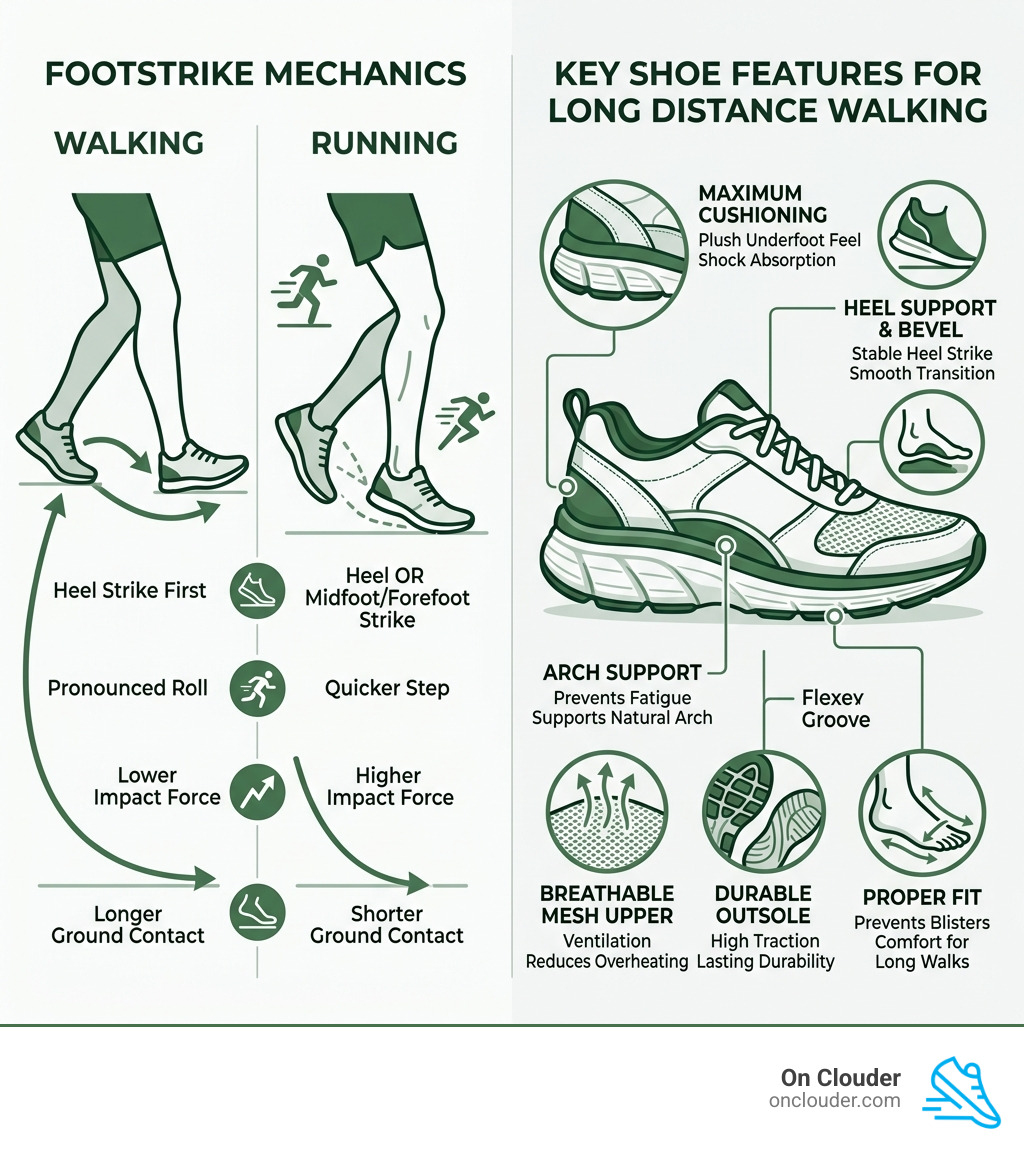
Key Features of the Best Shoes for Long Distance Walks
When we talk about the best shoes for long distance walks, we aren’t just looking at what looks good on a shelf. We are looking for engineering that protects your musculoskeletal system over thousands of repetitions. Unlike running, where you might have a midfoot or forefoot strike, walking is almost exclusively a heel-strike activity. This means the impact goes straight up your leg if the shoe isn’t prepared for it.
Cushioning and Shock Absorption
The most critical feature for high-mileage walking is shock absorption. According to biomechanical research, walking shoes should ideally have a high Shock Absorption (SA) score for all-day wear. High-stack midsoles, like those found in the Hoka Bondi 9 (which features a 10mm thicker stack height than its predecessor), are designed to act as a buffer between your joints and the pavement. This is especially vital if you are following The Ultimate Guide To Best Walking Shoes For Long Distance On Concrete, where the surface provides zero “give.”
Heel-to-Toe Drop
The “drop” is the difference in height between the heel and the forefoot. For long-distance walking, a range of 6mm to 10mm is generally considered the “sweet spot.” This elevation cushions the initial heel strike and reduces the strain on your Achilles tendon and calf muscles. While zero-drop shoes exist, they often require a significant transition period to avoid injury.
Breathability and Upper Construction
Long walks generate heat. If that heat and moisture stay trapped, you get blisters. Look for engineered mesh or “roller mesh” uppers. These materials provide a balance of breathability and structure. Some high-performance models even use TPU mudguards or reinforced lacing systems to ensure the foot stays secure without being suffocated.
Traction and Stability
Even if you aren’t hiking technical trails, traction matters. A durable rubber outsole ensures you don’t slip on wet sidewalks or loose gravel. Furthermore, torsional rigidity—the shoe’s resistance to twisting—helps maintain a stable platform, preventing your foot from fatiguing as you navigate uneven city streets or park paths.

Top-Rated Footwear for All-Day Comfort and High Mileage
Finding the perfect balance between weight and support is the “Holy Grail” of footwear design. We want a shoe that feels light enough to lift for 30,000 steps but substantial enough to keep our arches from collapsing. Our Best Walking Shoes Long Distance Guide highlights that modern foams, particularly nitrogen-infused varieties, offer incredible energy return without the heavy bulk of traditional rubber.
Best Shoes for Long Distance Walks with Maximum Cushioning
If your primary goal is to feel like you are walking on clouds (pun intended), maximum cushioning is the way to go.
- Hoka Bondi 9: This is the “king of cushion.” With its massive stack height and wide base, it provides a stable, plush ride that is perfect for those dealing with joint sensitivity.
- On Cloudsurfer: Utilizing CloudTec Phase technology, the Cloudsurfer offers a seamless heel-to-toe transition. Testers have worn these for over 30,000 steps on vacation and reported significantly less foot fatigue than with standard sneakers. For more details, check out The Best On Cloud Shoes For Walking And Travel 2025 Update.
- Hoka Clifton 10: This model added 3mm of extra cushioning in the heel specifically to improve impact absorption for prolonged walks. It hits the “sweet spot” of being firm enough for support but soft enough for comfort.
For those who occasionally mix in a light jog, understanding the crossover is key. You can find more in Everything You Need To Know About Best Long Distance Running Shoes.
Best Shoes for Long Distance Walks for Stability and Support
Not everyone has a “neutral” stride. If your ankles roll inward (overpronation), you need a shoe that fights back.
- ASICS Gel-Kayano 32: This shoe is a legend in the stability world. Its 4D Guidance System provides adaptive stability, meaning it supports you more as your form starts to break down toward the end of a long walk.
- Brooks Adrenaline GTS: Known for its “GuideRails” technology, this shoe acts like bowling alley bumpers for your feet, keeping your stride in a natural path without being overly intrusive.
- On Cloudrunner: A fantastic option for those who want the On aesthetic but need more structural support than the lifestyle models offer. You can see how these stack up in our On Cloud Vs Brooks For Walking comparison.
For a broader look at the market, see our Top 10 Sneakers For Walking Comfort 2026 Guide.
Addressing Specific Foot Conditions and Needs
We all have unique feet. Some of us have “duck feet” (wide), some have “pancake feet” (flat), and some deal with the dreaded “morning heel pain” (plantar fasciitis).
Wide Feet and Bunions
If you have wide feet, look for brands that offer specific width sizing (2E or 4E). A wide toebox is essential to allow for natural toe splay, which prevents the formation of bunions and hot spots. The Hoka Vs Brooks For Walking debate often comes down to width; Brooks is famous for its consistent wide sizing, while Hoka has expanded its wide offerings in recent years.
Plantar Fasciitis
For those suffering from plantar fasciitis, a shoe with a stiff heel counter and excellent arch support is non-negotiable. The New Balance Fresh Foam X 880 is a favorite for this condition because of its supportive heel structure and balanced cushioning. In the sneaker world, several models have earned the American Podiatric Medical Association (APMA) Seal of Acceptance for their supportive design, including the Hoka Bondi SR.
Flat Feet
Flat feet require a shoe with a straight or semi-curved last and a firm midsole to prevent the arch from collapsing. Stability shoes with medial posts or guidance systems are usually the best bet. Check our latest updates at Tag/Walking Shoes 2026 for the newest tech in arch support.
Durability and Maintenance: When to Replace Your Gear
One of the biggest mistakes walkers make is wearing their shoes until they literally fall apart. However, the support of a shoe usually dies long before the look of the shoe does.
The 350-500 Mile Rule
Most high-quality walking shoes last between 350 and 500 miles. If you walk 3 miles a day, that is roughly 4 to 6 months. Even if the tread looks fine, the internal foam (EVA or nitrogen-infused) eventually loses its “rebound” through a process called midsole compression. Once the foam is dead, your joints take the hit.
Signs You Need a Replacement:
- New Aches: If your knees or hips start hurting after a walk that used to be easy, the cushioning is likely shot.
- The Table Test: Put your shoes on a flat table. If they tilt to one side or look “squashed,” the structural integrity is gone.
- Visible Wear: If the outsole tread is worn smooth in certain areas, your traction and gait are compromised.
Maintenance Tips
To extend the life of your Comfortable Walking Shoes, we recommend a few simple steps:
- Rotate Your Shoes: Having two pairs of Long Run Shoes and alternating them allows the foam to fully decompress between uses.
- Keep Them Cool: Never put your shoes in the dryer. High heat destroys the adhesives and the foam structure. Air dry them with the insoles removed.
- Cleaning: Use a soft brush and mild soap. Keeping the mesh clear of dirt ensures the breathability remains at 100%.
Frequently Asked Questions About Long Distance Walking
Can I use running shoes for long-distance walking?
Yes, but with caveats. Running shoes are designed for forward motion and are generally excellent for walking. However, “performance racers” or “carbon-plated” shoes are often too unstable for the slower, heel-heavy gait of walking. Stick to “daily trainers” which offer the durability and heel support needed for Walking Sneakers.
How do I choose the right size for 20k+ steps?
Your feet will swell. It is a biological fact. When walking long distances, your feet can expand by half a size or more.
- Afternoon Fitting: Always shop for shoes in the afternoon when your feet are at their largest.
- The Thumb Rule: You should have a thumb’s width of space between your longest toe and the end of the shoe.
- Check the Width: If you feel pressure on the sides of your pinky toe, you likely need a wider width. Check out our Tag/Walking Shoes section for more sizing guides.
What is the ideal heel-to-toe drop for walking?
As mentioned, the 6mm to 10mm range is ideal for most people. A higher drop helps propel you forward and protects the heel. If you have a history of Achilles issues, a higher drop (10mm-12mm) can reduce the stretch and strain on that tendon. If you prefer a more “natural” feel, you can go lower, but do so gradually. Explore more on our Tag/Best Walking Shoes page.
Conclusion
At On Clouder, we believe that the best shoes for long distance walks are an investment in your long-term health. Whether you choose the plush comfort of a Hoka, the technical precision of an On shoe, or the tried-and-true stability of an ASICS, the goal is the same: to keep you moving without pain.
Remember to replace your gear every 500 miles, choose a size that accounts for swelling, and always prioritize support over style. For those specifically navigating urban environments, don’t miss The Ultimate Guide To Best Walking Shoes For Long Distance On Concrete for our top surface-specific recommendations.
Happy walking, and we’ll see you out on the path!