Why the Lightest Safety Shoes in the World Are Changing How We Work
The lightest safety shoes in the world weigh as little as 300 grams per shoe — roughly the same as a running sneaker — while still meeting full safety certifications.
Here’s a quick look at the top lightweight contenders:
| Shoe | Weight (per shoe) | Key Certification |
|---|---|---|
| Ninja UltraLight™ | ~300g (0.66 lb) | ASTM F2413-18, CE EN-12568 |
| Diadora Utility Fly Litebase | ~350g | EN ISO 20345, S1P, SRC |
| Safety Jogger ABSOLUTE S1P | ~425g | EN ISO 20345, S1P, SRC, ESD |
| Safety Jogger LIGERO2 S1P | ~465g | EN ISO 20345, S1P, SRC, ESD |
| CAT Invader Sport | ~500g (1.1 lb) | ASTM composite toe standard |
The average safety shoe weighs around 500 grams. That doesn’t sound like much — until you’ve been on your feet for 10 hours.
Every extra gram adds up. Studies on occupational fatigue consistently show that heavier footwear increases energy expenditure and leg fatigue over a full shift. For warehouse workers, assembly line staff, and anyone logging serious steps at work, shoe weight is a real performance factor.
The good news? Advances in materials like nano carbon toe caps, Vibram Litebase soles, and Kevlar midsoles have made it possible to build shoes that protect your feet without weighing them down. You no longer have to choose between safety and comfort.
I’m Faisal S. Chughtai, a footwear expert with years of hands-on experience testing and analyzing performance-focused shoes — including the lightest safety shoes in the world — to help you find the best fit for long shifts and demanding environments. Let’s break down exactly what’s available and what’s worth your money.
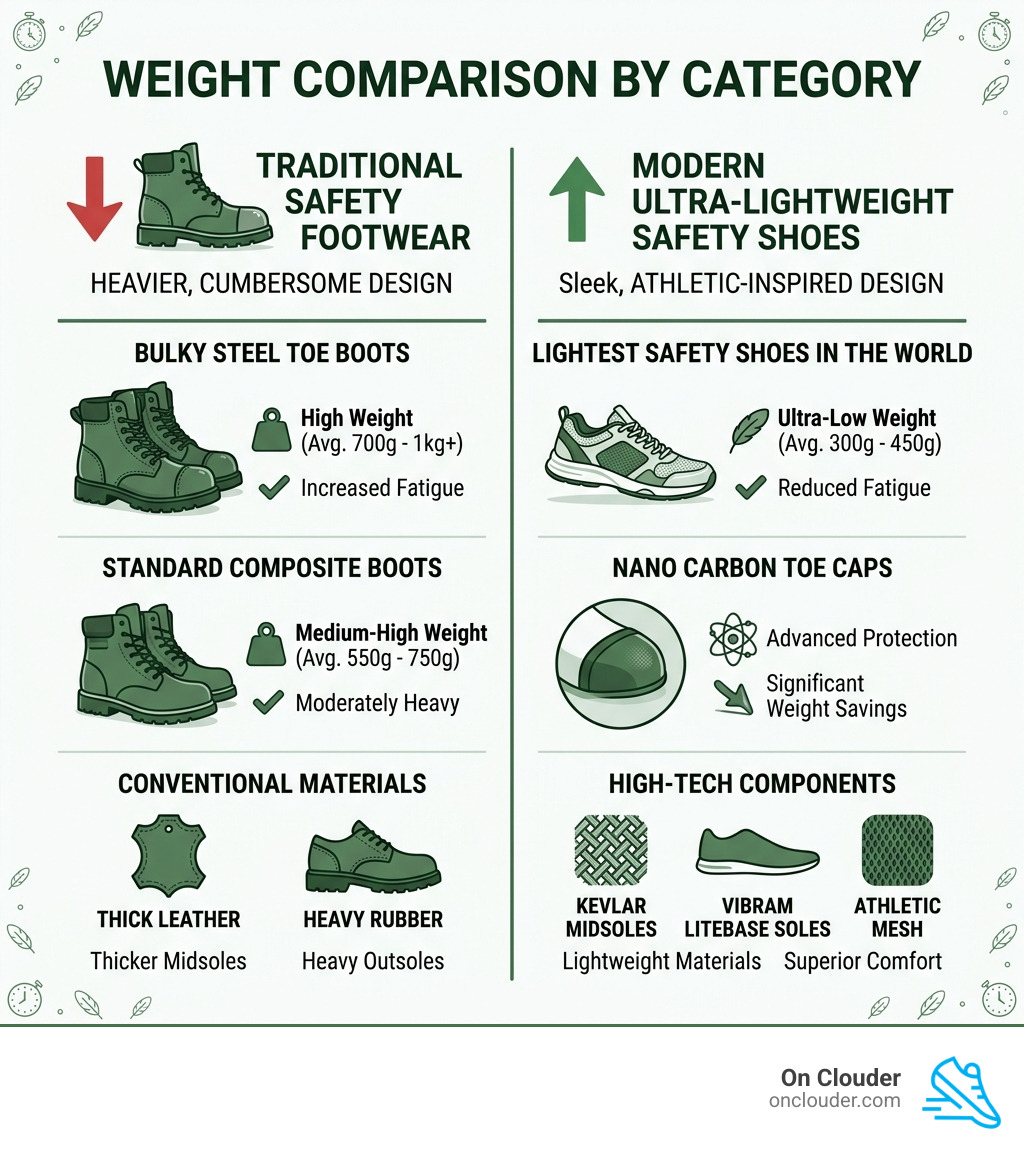
Lightest safety shoes in the world word list:
The Engineering Behind the Lightest Safety Shoes in the World
How do manufacturers manage to shave off hundreds of grams without leaving your toes vulnerable to a falling pallet? It isn’t magic; it’s a masterclass in material science. We’ve moved far beyond the days of heavy leather and thick iron plates. Today, the lightest safety shoes in the world utilize aerospace-grade components.
One of the biggest breakthroughs is the Nano Carbon toe cap. Traditionally, steel was the only way to ensure 200 Joules of impact resistance. Then came standard composite toes, which were lighter but often bulkier. Nano carbon changes the game entirely—it is roughly 50% lighter than steel and 40% lighter than standard composite, all while maintaining a slim profile that doesn’t look like a clown shoe.
The weight savings don’t stop at the toes. Brands are now looking at the “engine room” of the shoe: the sole. Technologies like Vibram Litebase allow for an outsole that is 50% thinner and up to 30% lighter than regular rubber soles, without sacrificing a bit of traction or durability. When you pair this with an EVA midsole—the same bouncy foam found in high-end running shoes—you get a platform that absorbs shock while weighing next to nothing.
For puncture protection, the heavy steel mid-plates of the past have been replaced by Kevlar midsoles or non-woven fabrics like FAP® LITE. These materials are flexible, breathable, and significantly lighter. If you’re tired of heavy footwear, you should Stop Dragging Your Feet With These Featherweight Composite Toe Boots and look into these modern alternatives.
Upper materials have also evolved. Instead of thick, heavy leather, we now see Matryx 2.0 fabric and SAFETY KNIT® CR. These technical textiles provide high abrasion resistance and even cut resistance while allowing air to flow freely. Some manufacturers even use XPR.FOAM technology, which creates a sole that is over 100g lighter than conventional polyurethane soles. By utilizing the minimum thicknesses allowed under strict quality standards, these brands are pushing the limits of what a safety shoe can be.
Exploring Leading Examples of Ultra-Lightweight Safety Shoes
When we look at the market today, the variety of designs is staggering. You can find everything from high-top “industrial athlete” sneakers to low-profile mesh runners. The common thread is a relentless focus on the weight-to-protection ratio.
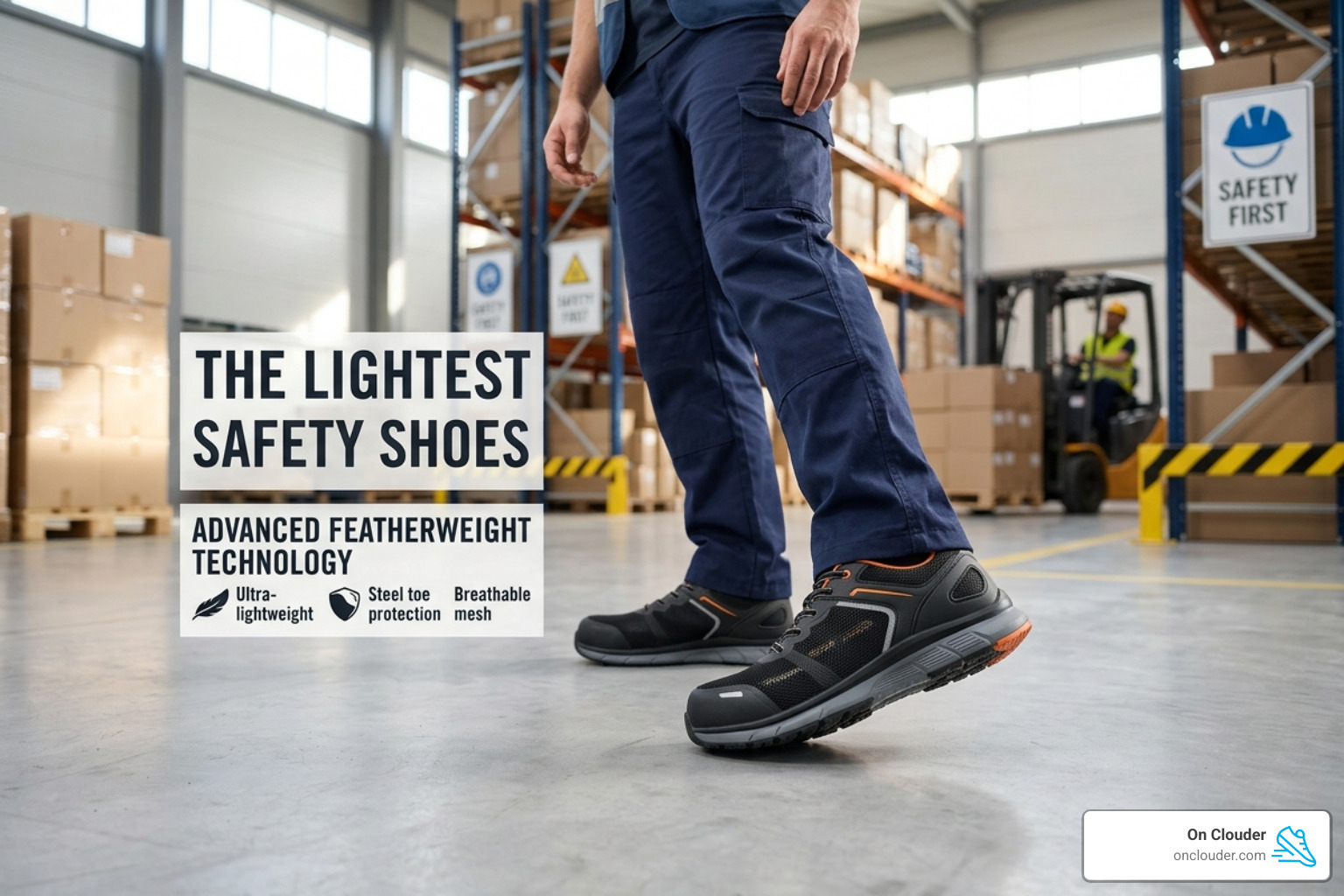
To help you navigate the options, we’ve categorized these shoes by their weight benchmarks. While the “average” safety shoe sits around 500g, the elite models we are discussing here are significantly below that mark.
| Category | Weight Range (per shoe) | Best For |
|---|---|---|
| Featherweight Champions | 300g – 330g | Maximum agility, logistics, indoor light duty |
| Performance Lightweights | 340g – 400g | High-step counts, automotive, assembly |
| Robust Ultra-Lights | 410g – 480g | General industry, maintenance, light construction |
The Featherweight Champions (Around 300g)
In ultra-lightweight footwear, the Ninja UltraLight™ is often cited as a top contender, claiming a weight of just 300g (0.66 lbs) per shoe. To put that in perspective, that is roughly the weight of two medium-sized apples.
Despite being incredibly light, these shoes don’t skimp on the essentials. They often feature steel toe caps that meet international standards and offer impressive electrical hazard protection—sometimes up to 6000V. The construction usually relies on a breathable mesh that mimics the feel of a high-performance track shoe. These are the go-to choices for “industrial athletes” who need to move quickly across a warehouse floor without feeling like they have anchors tied to their ankles.
The Performance-Oriented Lightweights (Around 350g)
A step up in weight often brings a step up in specialized technology. The Diadora Utility Fly Litebase is a prime example here, weighing in at approximately 350g. This shoe is designed to feel exactly like a running shoe, making it a favorite for those in the logistics sector.
What makes these special is the integration of Matryx 2.0 fabric for the upper and the Vibram Litebase sole. By reducing the thickness of the sole by half, Diadora provides a shoe that sits closer to the ground, offering better stability and a more natural gait. These models typically carry an S1P certification, meaning they provide toe protection, antistatic properties, and puncture resistance.
The Robust Ultra-Lights (Around 425g-465g)
If you need a bit more “substance” or a higher-cut design for ankle stability, the 425g to 465g range is where you’ll find models like the Safety Jogger ABSOLUTE and LIGERO2.
These shoes often utilize Nano Carbon toe caps to keep the weight down while offering a more traditional work shoe silhouette. One of the standout features in this category is the ergonomic fit systems, such as the SJ-3FIT technology, which allows for adjustable widths to accommodate different foot shapes. These are often metal-free designs, making them perfect for workers who have to pass through metal detectors frequently, such as those in airport logistics or high-security manufacturing plants.
Safety Standards and Certifications for Lightweight Footwear
We often hear the question: “If they are so light, are they actually safe?” The answer lies in the certifications. A shoe cannot be marketed as a “safety shoe” in major markets unless it passes rigorous testing.
The two primary standards you will see are ASTM F2413 (common in the USA) and EN ISO 20345 (the European standard). These certifications ensure the shoe can handle a specific amount of impact and compression. For example, a 200 Joules rating means the toe cap can withstand a 20kg weight dropped from a height of one meter.
Key ratings to look for include:
- S1P: This indicates the shoe has a protective toe cap, antistatic properties, energy absorption in the heel, and a puncture-resistant midsole.
- SRC: This is the highest rating for slip resistance, meaning the shoe has been tested on both ceramic tile (with detergent) and steel floors (with glycerin).
- ESD: Electrostatic Discharge protection is crucial for those working with sensitive electronics, as it safely dissipates static electricity from the body to the ground.
While some of these shoes look like sneakers, they are built to a much higher standard than your gym shoes. For those working in wet environments, you might also want to check out our guide on waterproof safety shoes to see how lightweight tech handles H2O. If you’re specifically looking for metal-free options, searching by Tag/Steel Toe or composite alternatives is a great place to start.
Pros and Cons of Ultra-Lightweight Safety Shoes
Choosing the lightest safety shoes in the world is a brilliant move for many, but it is important to understand the trade-offs.
The Pros:
- Reduced Fatigue: This is the big one. Lowering the weight on your feet reduces the strain on your hip flexors and calves, meaning you have more energy at the end of a shift.
- Agility: If your job requires climbing ladders, pivoting quickly, or driving vehicles, the reduced bulk of these shoes makes a world of difference.
- Breathability: Most ultra-light shoes use advanced meshes and textiles, which keep your feet much cooler than traditional leather boots.
The Cons:
- Ankle Support: Most of the lightest models are low-cut sneakers. If you are working on uneven ground or heavy construction sites, you might miss the support of a traditional boot. You can find more rugged options under our Tag/Work Boots section.
- Durability in Harsh Conditions: While these shoes are tough, they aren’t meant for wading through caustic chemicals or heavy demolition. They are “light-duty” champions.
- Price: High-tech materials like carbon fiber and Kevlar often come with a higher price tag than basic steel and leather.
If you’re interested in exploring the heavier, more traditional side of the spectrum for comparison, check out our Tag/Lightweight Work Boots page.
Frequently Asked Questions about the Lightest Safety Shoes in the World
Are the lightest safety shoes in the world as safe as heavy boots?
Yes, provided they carry the same certifications (like ASTM F2413 or EN ISO 20345). A carbon fiber toe cap that passes the 200 Joules test offers the same level of impact protection as a steel toe cap that passes the same test. The difference is in the weight of the material used to achieve that safety, not the safety level itself.
Which toe cap material is the lightest for safety footwear?
Currently, Nano Carbon and Carbon Fiber are the lightest materials available. They are significantly lighter than steel and even outperform standard composite toes in terms of weight-to-strength ratio. These materials are also non-conductive and don’t get cold in the winter, which is a nice bonus.
Who should wear ultra-lightweight safety shoes?
These shoes are ideal for anyone in “light” industrial roles. This includes logistics, warehouse fulfillment, automotive assembly, indoor maintenance, and light manufacturing. If you are a delivery driver or a courier who is constantly in and out of a vehicle, these are a lifesaver. For a deeper dive into specific models designed for these environments, you might enjoy The Modern Sentinel A Comprehensive Review Of The Mjythf Rotating Button Safety Shoes.
Conclusion
At On Clouder, our mission is to help you find the perfect balance between comfort and performance. The era of the “clunky work boot” is officially over for many industries. By choosing the lightest safety shoes in the world, you are investing in your long-term health by reducing the daily toll that heavy footwear takes on your body.
Whether you opt for the extreme lightness of a 300g sneaker or the robust features of a 450g nano-carbon model, the key is to ensure the shoe matches the specific hazards of your workplace. Don’t forget that comfort doesn’t stop at the shoes—if your job keeps you on hard surfaces all day, you might also find our Ultimate Dress Shoes Guide for Standing on Concrete helpful for those days when you need to look a bit sharper without sacrificing your arches.
Stay light on your feet, stay safe, and keep moving!