

Why Your Feet Are Losing the Match Before You Even Step on Court
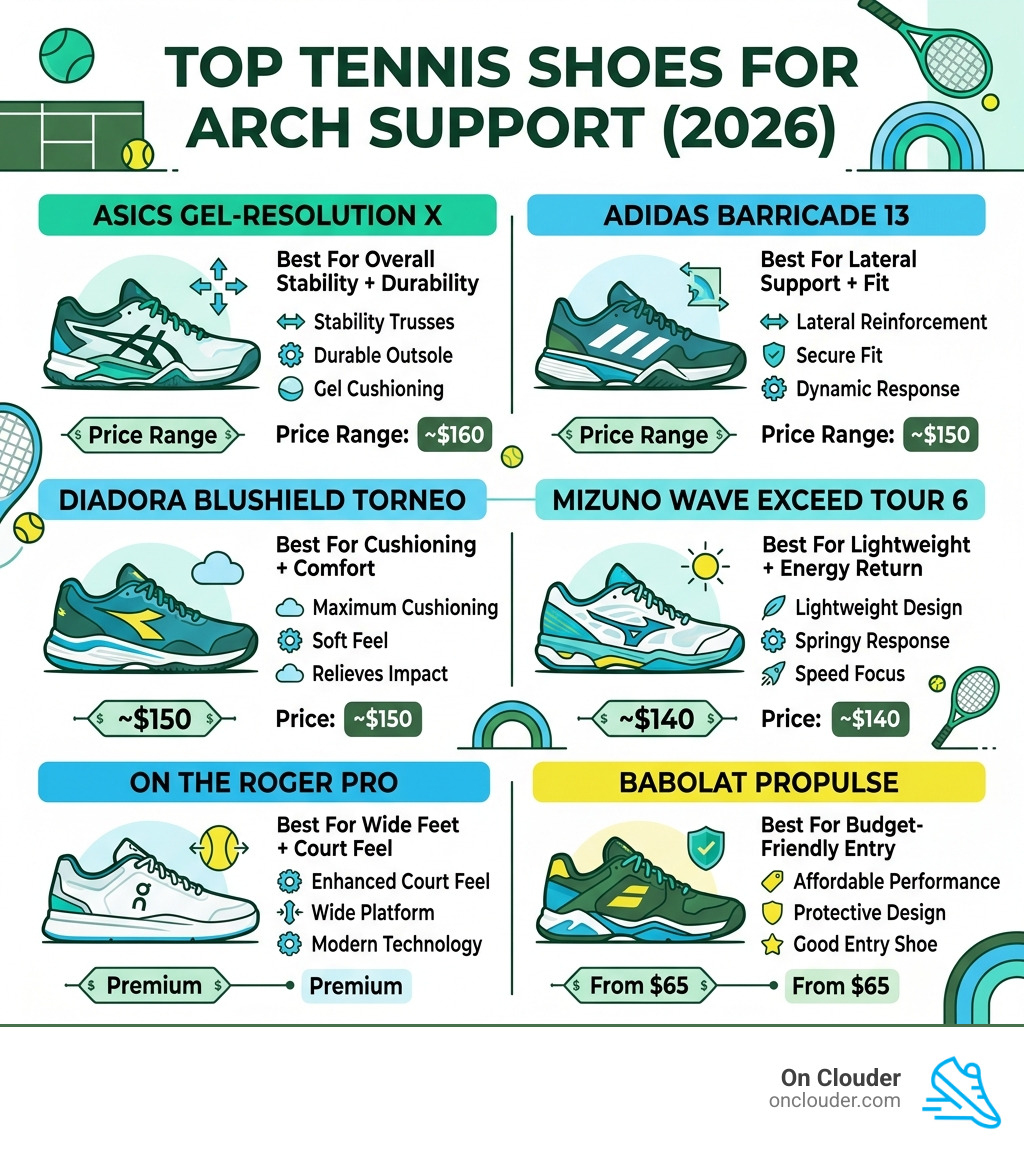
The best tennis shoes for arch support can be the difference between playing through a full set and limping off after the first game. If you want the quick answer, here are the top picks:
| Shoe | Best For | Price |
|---|---|---|
| Asics Gel-Resolution X | Overall stability + durability | $159.95 |
| Adidas Barricade 13 | Lateral support + fit | ~$150 |
| Diadora Blushield Torneo | Cushioning + comfort | $150.00 |
| Mizuno Wave Exceed Tour 6 | Lightweight + energy return | $140.00 |
| ON The Roger Pro | Wide feet + court feel | Premium |
| Babolat Propulse | Budget-friendly entry | From $64.95 |
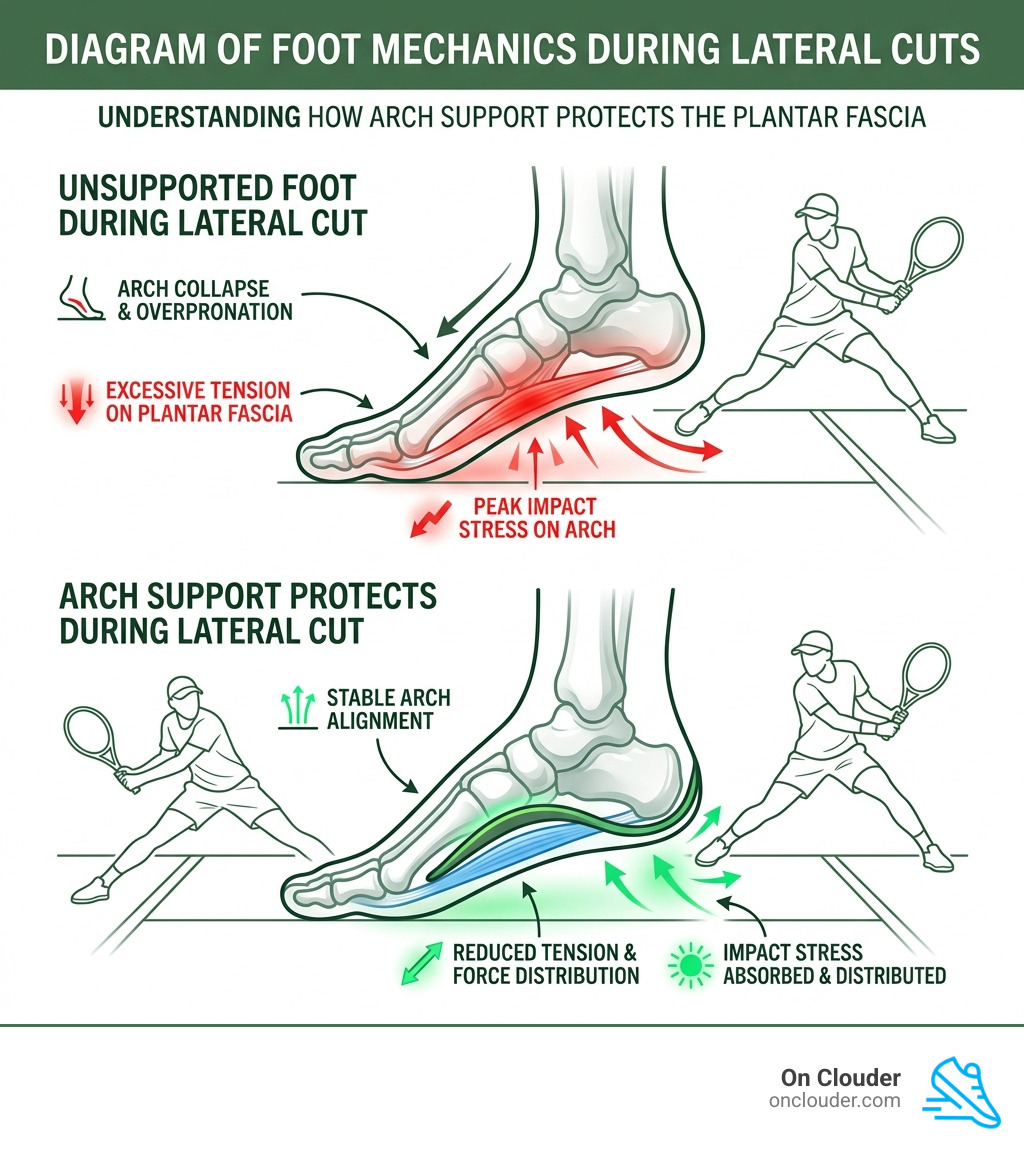
Tennis puts your feet through something most sports don’t. Every rally means explosive lateral cuts, hard stops, and sudden direction changes — all on unforgiving court surfaces. Without proper arch support, that repeated stress travels straight up through your plantar fascia, ankles, knees, and lower back.
The arch acts as your foot’s natural shock absorber. When your shoes don’t support it, things go wrong fast — plantar fasciitis, overpronation, and chronic foot fatigue are all common results.
I’m Faisal S. Chughtai, a footwear comfort and performance specialist who has spent years testing and reviewing court shoes to help athletes find the right fit for their foot type and playing style — including finding the best tennis shoes for arch support for every budget and court surface. Let’s break down exactly which shoes deserve a spot in your bag this season.
Simple guide to best tennis shoes for arch support terms:
- best arch support inserts
- best shoes for arch support
- best arch support shoes reddit
Why Arch Support is Critical for Tennis Performance
In tennis, your feet are your foundation. Unlike walking or running, where the movement is primarily forward, tennis is a game of 360-degree chaos. You are constantly sliding, pivoting, and leaping. This is why understanding everything you need to know about arch fit footwear is essential for any player hitting the court in May 2026.
Lateral Stability and the Kinetic Chain
When you make a sharp lateral cut to reach a wide forehand, your arch takes the brunt of that force. If the arch collapses (overpronation), it creates a “domino effect” up your kinetic chain. Your ankle rolls inward, your knee follows, and your hip tilts. Proper arch support keeps your foot in a neutral alignment, providing the lateral stability needed to push off with power and precision.
Preventing Common Injuries
The most dreaded word in a tennis player’s vocabulary is often “Plantar Fasciitis.” This condition involves inflammation of the thick band of tissue running across the bottom of your foot. Without the best tennis shoes for arch support, this tissue is overstretched during every sprint. Research shows that roughly 83% of people with foot pain are wearing inappropriate footwear. By choosing shoes with a structured midfoot, you distribute pressure evenly, reducing the risk of chronic injury and foot fatigue.
Balance and Fatigue Reduction
Ever feel like your legs are “heavy” in the third set? It might not just be your cardio. When your arches aren’t supported, the small muscles in your feet have to work overtime just to keep you balanced. This leads to premature fatigue. Supportive footwear acts as a mechanical assist, allowing you to maintain your balance and stay light on your toes even as the match drags on.
Top-Rated Models: Best Tennis Shoes for Arch Support Reviews
Finding the right shoe is a personal journey, but some models consistently rise to the top for their engineering and support. Here are our deep-dive reviews for 2026.
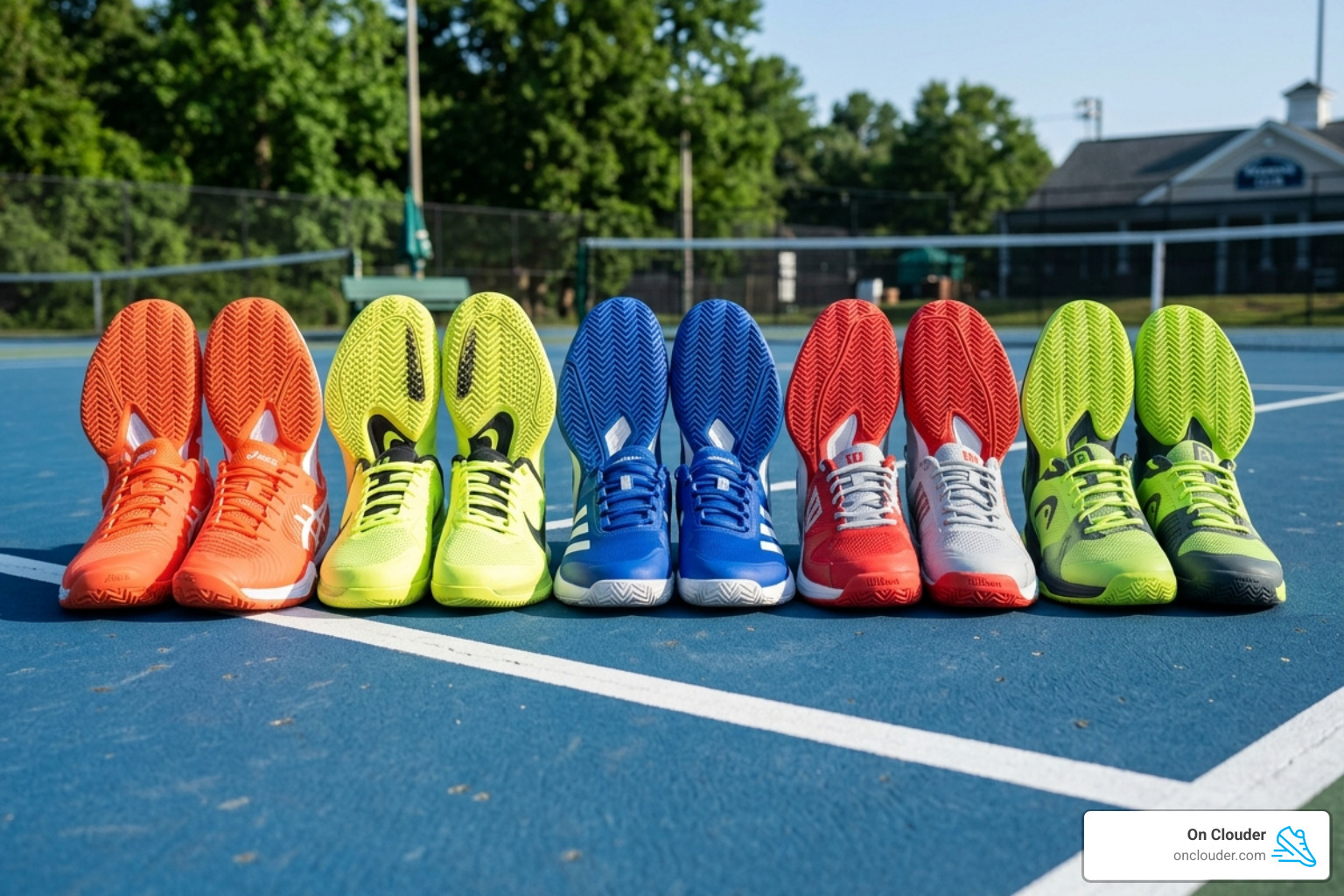
Asics Gel-Resolution X
The GEL-RESOLUTION X WIDE is widely considered the gold standard for stability. Asics offers 12 different models in the arch-support category, the most of any brand. The “X” (the 10th generation) features a re-engineered DYNAWALL technology that extends further into the heel. This provides a “locked-in” feel that is unmatched for baseline players who move side-to-side aggressively.
- Pros: Incredible outsole durability, 6-month warranty, and a plush FlyteFoam Blast+ midsole.
- Cons: Can feel slightly stiff during the first few hours of play; requires a break-in period.
- Price: $159.95
Adidas Barricade 13
The Barricade has a legendary reputation for support. The 13th iteration uses a TPU midfoot shank that acts like a bridge for your arch, preventing the shoe from twisting. It’s designed for the player who wants to feel completely secure during high-speed transitions.
Diadora Blushield Torneo
Diadora offers 6 models of the Blushield Torneo, all priced around $150.00. The Blushield technology is unique because it’s designed to “cradle” the foot rather than just provide a rigid block of foam. It’s an excellent choice for players who need a mix of high-end cushioning and arch structure.
Mizuno Wave Exceed Tour 6
If you find stability shoes too heavy, the Wave Exceed Tour 6 AC Men’s Tennis Shoe is your answer. Weighing in at only 11.6 oz, it uses the MIZUNO WAVE plate to disperse impact energy. It’s one of the fastest shoes on the market that still offers legitimate arch protection.
- Pros: Extremely lightweight, includes a 6-month outsole guarantee, and features the responsive MIZUNO ENERZY NXT foam.
- Cons: The fit is quite athletic and snug; may not suit those with very wide feet.
ON The Roger Pro
Co-created with Roger Federer, ON The Roger Pro White/Blue Men’s Shoes features a 100% carbon fiber Speedboard. While the arch is described as “slightly low,” the midfoot cage provides excellent lateral lock-in.
- Pros: Stylish, great court feel, and highly responsive.
- Cons: Durability is a common concern among high-frequency players; the sole can wear faster than Asics models.
Babolat Propulse
For those looking for budget-friendly options, the Propulse line often starts around $64.95. While it lacks some of the high-tech carbon plates of the $160 models, it provides solid lateral support and a reliable fit for club players.
Key Features of the Best Tennis Shoes for Arch Support
When shopping, don’t just look at the colors. Look for these technical specs:
- TPU Shanks: A hard plastic piece in the midfoot that prevents the shoe from bending in the middle.
- Deep Heel Cups: These help align the rearfoot, which in turn supports the arch.
- Torsional Rigidity: The shoe’s resistance to twisting. You can test this by trying to wring the shoe like a towel; it shouldn’t budge much.
- Midsole Materials: Look for specialized foams like Asics’ FlyteFoam or Mizuno’s POWNCE, which offer resilience without bottoming out. If the built-in support isn’t enough, you can always step up your game with the best arch support inserts.
How to Choose and Maintain Your Best Tennis Shoes for Arch Support
Choosing the right shoe is only half the battle. You also need to ensure a proper fit and maintain the support over time. Check out our best arch support shoes insoles guide for a deeper look at custom options.
Sizing and Fit
Tennis shoes often run differently than running shoes. For example, the Asics Gel-Resolution X can run slightly long, while the ON The Roger Pro has a snugger, more “pro” fit. We recommend trying shoes on in the afternoon when your feet are at their largest. Ensure there is about a thumbnail’s width of space at the toe, but the arch should feel “hugged” by the shoe’s contour.
The 300-500 Mile Rule
Just because the outsole still has tread doesn’t mean the arch support is still there. Most midsole foams lose their structural integrity after 300 to 500 miles of use (or about 60-80 hours of intense tennis). If you start feeling “stabbing” pains in your heel or increased fatigue, it’s time for a replacement.
| Feature | Hard Court Needs | Clay Court Needs |
|---|---|---|
| Outsole | Highly durable AHAR+ rubber | Herringbone pattern for sliding |
| Arch Support | Maximum shock absorption | High lateral stability for slides |
| Stability | Rigid midfoot shank | Flexible forefoot for movement |
Specialized Support for Different Foot Types
Not all arches are created equal. Whether you have “flat feet” or “high arches,” your requirements will change.
Flat Feet and Overpronation
If you have low arches, your feet tend to roll inward. You need “stability” or “motion control” tennis shoes. These shoes often feature a firmer foam on the medial (inner) side of the shoe to prevent that collapse. The Asics Gel-Resolution X Wide is a fantastic choice here, as it provides the extra real estate needed for a flatter foot to spread out comfortably.
High Arches (Supination)
Players with high arches don’t absorb shock well because their feet are too rigid. You should look for “neutral cushioned” shoes that offer plenty of midsole padding to take the pressure off the heel and ball of the foot. You might also want to explore the best arch fit shoes for running and walking to see how different brands handle high-volume feet.
Orthotic Compatibility
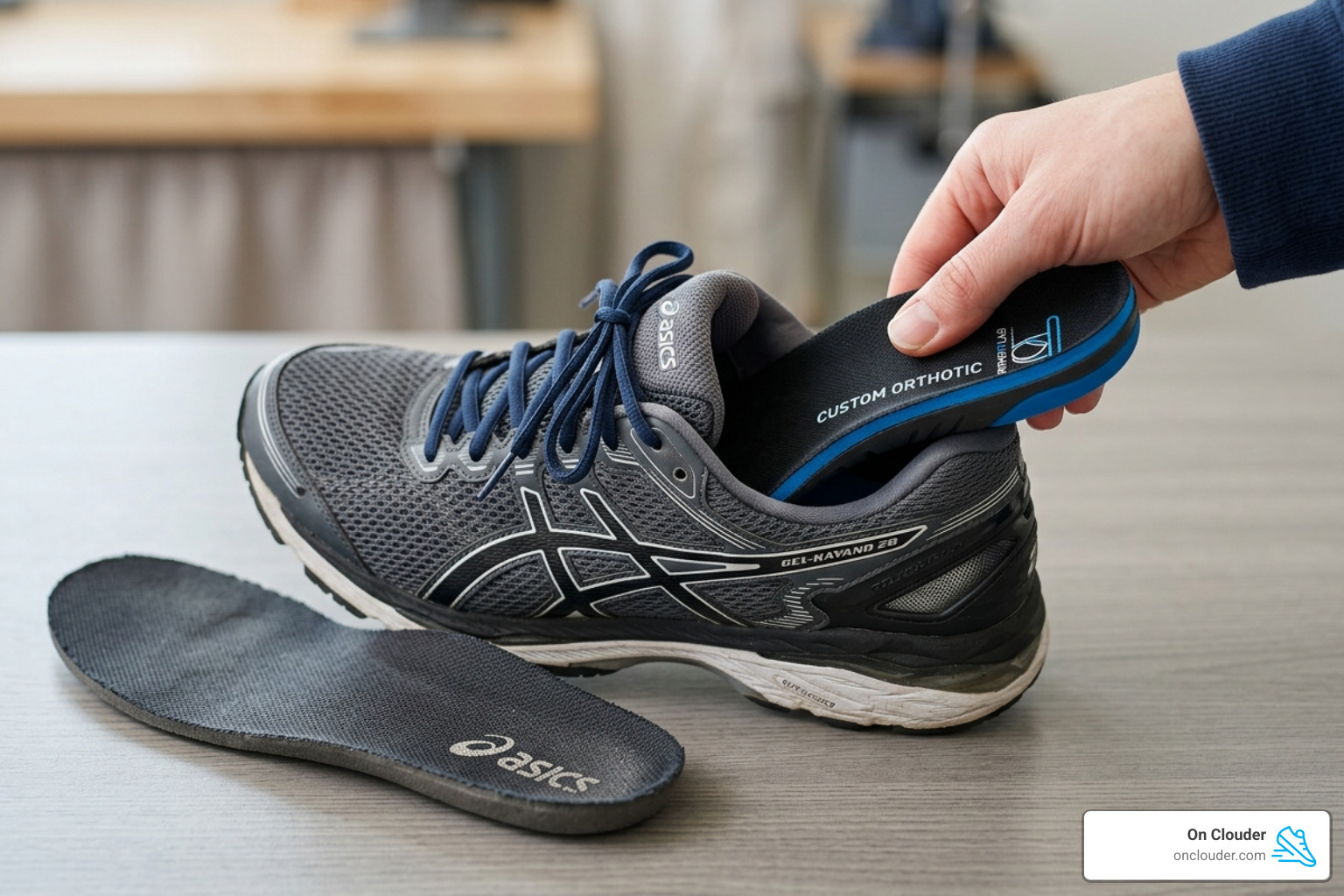
Many of the best tennis shoes for arch support come with removable insoles. This is a game-changer if you use custom orthotics prescribed by a podiatrist. When testing a shoe, always bring your orthotics with you to ensure the heel doesn’t slip out once the custom insert is added.
Frequently Asked Questions about Tennis Footwear
Can I use running shoes for tennis if I need arch support?
We strongly advise against this. Running shoes are designed for linear (forward) movement. They have high “stack heights” and soft sidewalls. If you try to make a sudden lateral stop in running shoes, the lack of lateral support can lead to a nasty ankle sprain. Tennis shoes are built lower to the ground with reinforced sidewalls specifically to handle these forces.
How do I know if my tennis shoes have lost their support?
Look for “compression lines” in the foam of the midsole. If the foam looks wrinkled or stays compressed after you take the shoe off, the cellular structure has broken down. Another test is the “Heel Squeeze”: if the back of the shoe (the heel counter) feels soft and flimsy, it’s no longer providing the rearfoot stability your arch needs.
Are there budget-friendly tennis shoes with good arch support?
Yes! While flagship models hit the $150+ range, you can often find previous-generation models (like the Gel-Resolution 8 or 9) on sale for under $100. Brands like Babolat and Wilson also offer entry-level “team” shoes that provide basic TPU shanks and decent arch structure for casual club play.
Conclusion
At On Clouder, we know that the right gear is the secret to longevity in any sport. Choosing the best tennis shoes for arch support isn’t just about comfort; it’s about protecting your body so you can keep playing the game you love for decades to come.
Whether you opt for the tank-like stability of the Asics Gel-Resolution X or the lightning-fast feel of the Mizuno Wave Exceed, prioritize the needs of your specific arch type. Don’t forget to rotate your shoes regularly and consider adding a high-quality insert if you need that extra level of customization.
Ready to take your foot health to the next level? Step up your game with the best arch support for runners and see how the right support can transform your performance on and off the court. See you at the baseline!