
Why High Arch Work Boot Insoles Matter Before Your Next Shift
High arch work boot insoles are specially designed inserts that fill the gap between a raised arch and the boot’s footbed — giving your foot the contact, support, and shock absorption it can’t create on its own.
Here’s a quick summary of what you need to know:
- Who needs them: Workers with high arches (also called pes cavus) whose feet are rigid and don’t absorb shock well
- Top picks for 2026: Superfeet All-Purpose High Arch, BRUNT High Arch CUSH’N®, Currex WorkPro High Profile, PowerStep Pinnacle Work
- Key features to look for: High arch profile, deep heel cup, firm cushioning, moisture-wicking top cover
- How long they last: 6–12 months depending on usage and activity level
- Best for: Plantar fasciitis, heel pain, back strain, and fatigue from long shifts on hard surfaces
High arches might sound like a minor quirk, but on a 10-hour shift in steel-toe boots, they become a real problem. A high-arched foot is naturally rigid. It struggles to flex and absorb the impact of every step. Over time, that rigidity puts extra stress on your heels, joints, and lower back.
The standard insole that ships inside most work boots? It’s usually flat and designed for a neutral foot. For someone with high arches, that’s like putting a flat board under a curved bridge — the support lands in the wrong place, or not at all.
That’s where the right insole changes everything.
I’m Faisal S. Chughtai, a footwear comfort expert who has spent years helping people find the right insoles and shoes for demanding, on-your-feet lifestyles — including evaluating high arch work boot insoles across brands, profiles, and job types. In the sections below, I’ll walk you through exactly what to look for and which options are worth your money.
Explore more about high arch work boot insoles:
Why High Arch Work Boot Insoles are Essential for Long Shifts

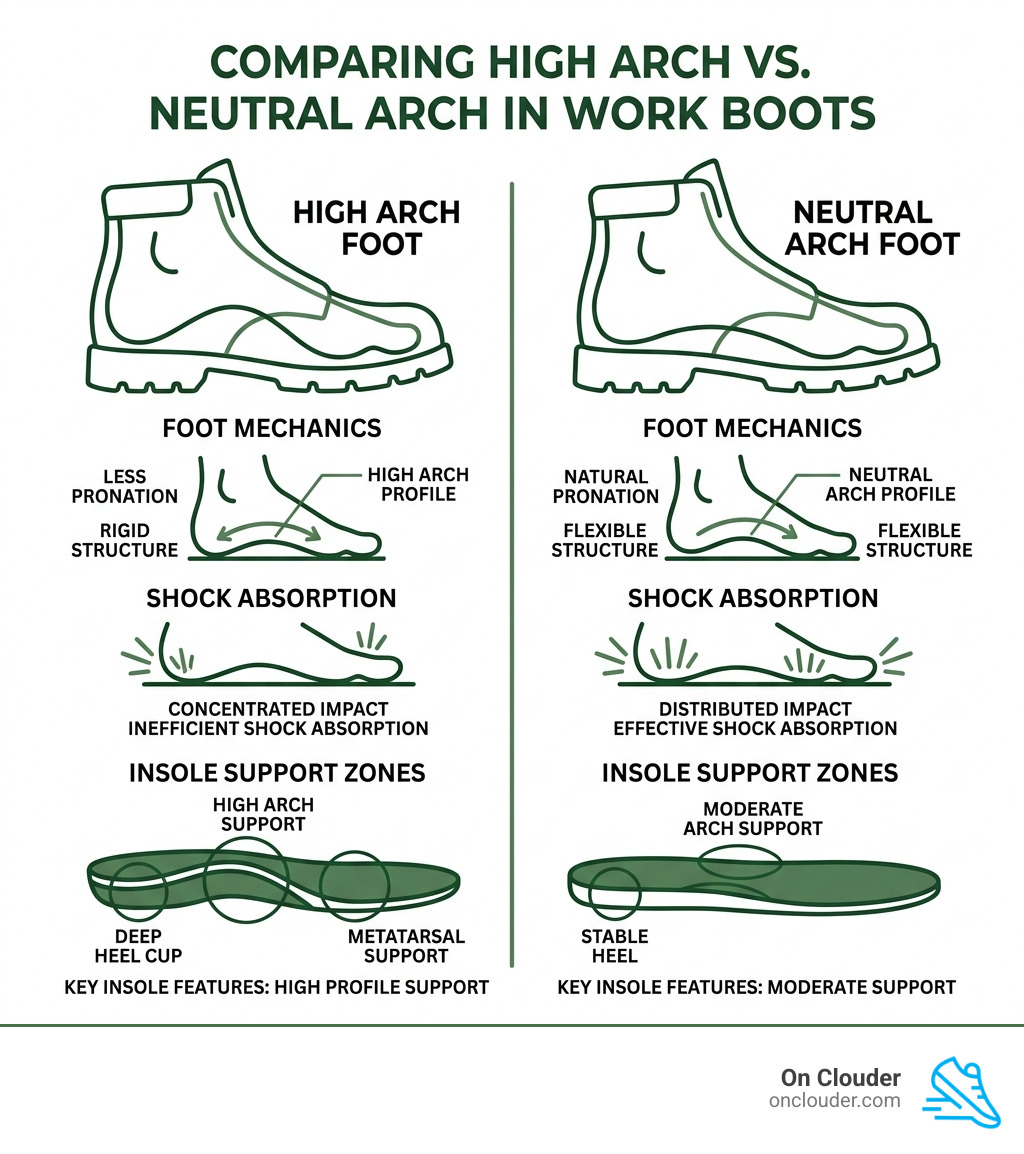
If you have high arches, your feet are essentially high-performance bridges that are a bit too stiff. While a flat foot collapses too much, a high arch (pes cavus) doesn’t collapse enough. This rigidity means that when your boot hits the concrete, the shock doesn’t get distributed; it travels straight up your leg.
When we talk about the necessity of high arch work boot insoles, we are looking at three main physiological challenges:
- Over-Supination: Because the arch is high and rigid, the foot tends to roll outward. This places immense pressure on the outer edge of the foot, leading to ankle instability and potential sprains.
- Lack of Surface Contact: In a standard boot, only your heel and the ball of your foot touch the footbed. The middle of your foot is literally “hanging in the air.” This concentrated pressure leads to rapid fatigue and localized pain.
- The Kinetic Chain Effect: Foot pain rarely stays in the feet. When your foundation is unaligned, your knees, hips, and lower back have to compensate. This is why many workers find that the best arch support insoles for total foot relief actually fix their chronic backaches.
By filling that empty space under your arch, a specialized insole provides “total contact.” This redistributes your body weight across the entire surface of the foot, significantly reducing the risk of conditions like plantar fasciitis and heel spurs. To understand the basics of how these inserts function, check out our Arch Support Inserts 101 guide.
Key Features to Look for in High-Quality Support
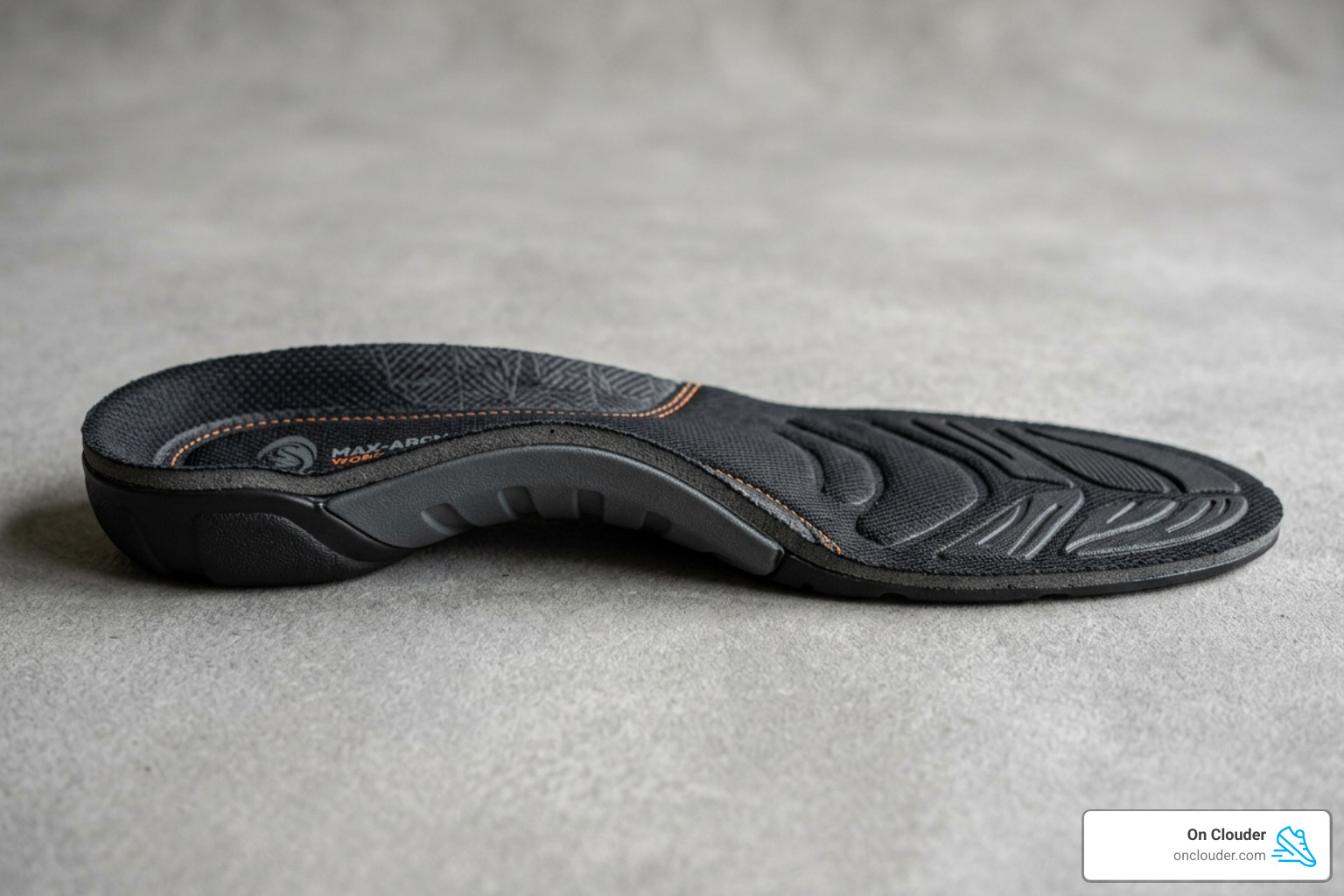
Not all insoles are created equal, especially when you’re dealing with the heavy-duty environment of a construction site or warehouse. Here is what we recommend looking for in high arch work boot insoles:
Arch Height and Profile
This is the most critical factor. You need a “High Profile” or “Maximum Support” insole. If the arch support is too low, it won’t reach your foot, and you’ll still feel that “hollow” sensation. Look for brands like the Currex WorkPro High Arch Work Insoles which offer specific “High Profile” models tailored for pes cavus feet.
Deep Heel Cup
A deep, sculpted heel cup is essential for stabilization. It “anchors” the rear of your foot, preventing the side-to-side shifting that causes blisters. This is especially important in roomy steel-toe boots where your foot has more space to slide around.
Firm Cushioning vs. Soft Foam
While memory foam feels great for the first five minutes, it often bottoms out under the weight of a worker carrying tools. We look for “responsive” cushioning—materials like polyurethane or specialized EVA foams that provide bounce-back. For example, the PowerStep Work Insoles use a dual-layer cushion that maintains its shape over a long shift.
Safety and Durability Features
In industrial settings, your insoles need to do more than just feel soft. Look for:
- Antistatic Properties: Vital for hazardous environments where static discharge could be a risk.
- Carbonised Materials: These increase the durability of the insole without making it heavy.
- Odor Control: Look for moisture-wicking top covers (like Superfeet’s Moisturewick™) to manage sweat and prevent the “boot funk” that develops during 12-hour days.
Top-Rated High Arch Work Boot Insoles for 2026
Choosing the right brand can be overwhelming. Based on our research and user feedback from April 2026, here is how the top contenders stack up for workers with high arches.
| Brand/Model | Best For | Key Stat | Unique Feature |
|---|---|---|---|
| Superfeet All-Purpose High Arch | Durability & Alignment | Lasts up to 12 months | Firm stabilizer cap for maximum support |
| BRUNT High Arch CUSH’N® | Heavy Labor & Comfort | 4.2/5 Star Rating | 3/4” contoured support plate |
| Currex WorkPro High Profile | Safety & Industrial Use | Antistatic & Carbonised | Decoupled heel for movement |
| PowerStep Pinnacle Work | Pain Relief (Plantar Fasciitis) | #1 Podiatrist Recommended | Patented shell for motion control |
Superfeet All-Purpose Support High Arch
Formerly known as the “Green” insole, the All-Purpose Support High Arch is the gold standard for high-profile support. It features a high-density foam layer and a firm stabilizer cap. It’s designed for roomy footwear, making it a perfect match for most work boots. With 661 reviews on some platforms, its reputation for reducing foot fatigue is well-documented.
BRUNT High Arch CUSH’N® Insole
The BRUNT High Arch CUSH’N® Insole was designed specifically with the blue-collar worker in mind. It features a specialized orthotic arch stabilizer and a grippy toe coating to prevent your foot from sliding forward during heavy lifting. It’s a great value option, especially if you opt for their subscription model. You can read more in the top high arch support insoles reviewed on our blog.
Currex WorkPro High Profile
The Currex WorkPro High Arch Work Insoles stand out because they are technically “dynamic.” Instead of being a stiff piece of plastic, they move with your foot while still providing that high-profile bridge support. They are also antistatic, which is a non-negotiable for many electricians and factory workers.
How to Choose and Fit Your High Arch Support
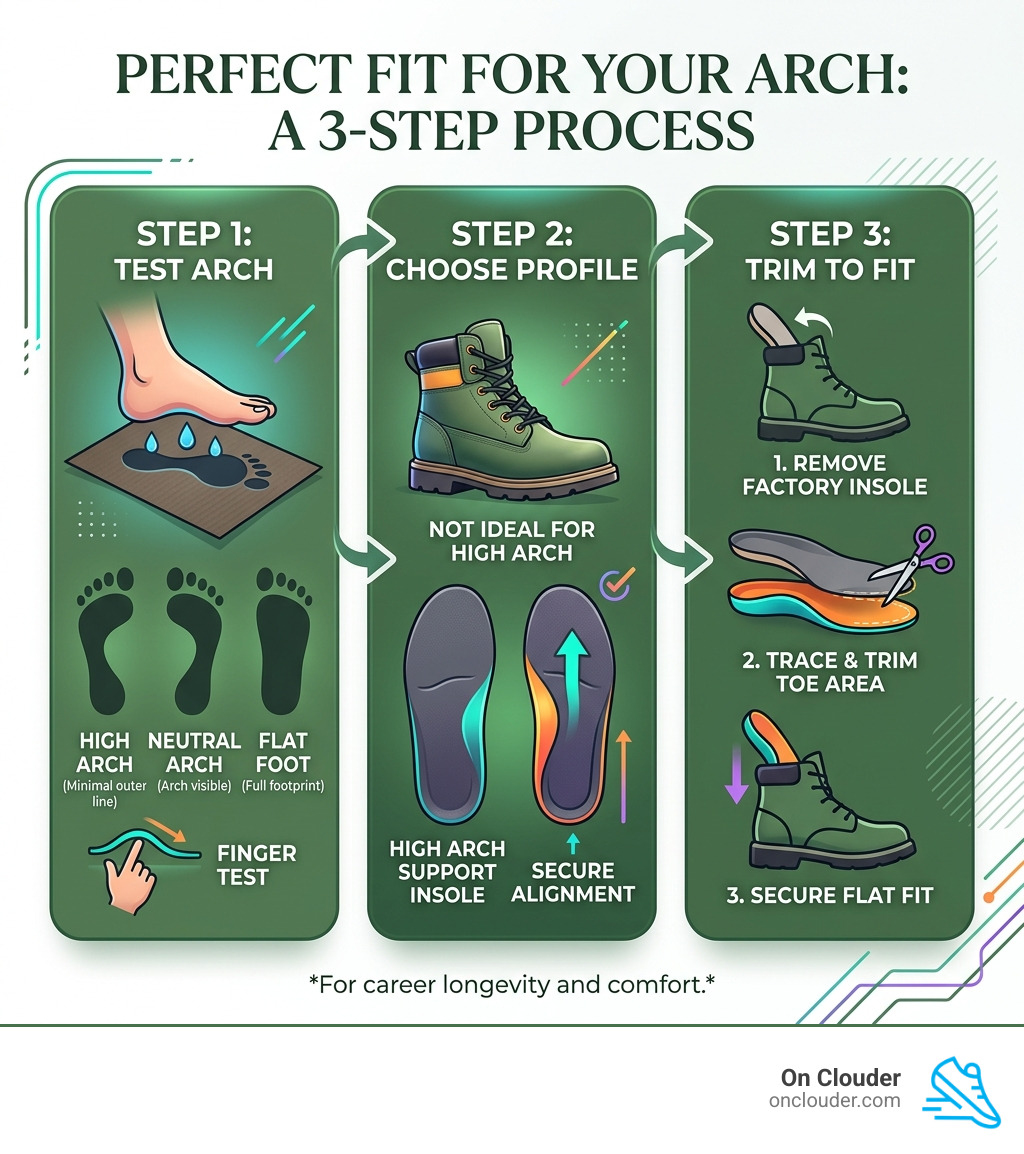
Before you click “buy,” you need to confirm that you actually have high arches. Many people mistake a “neutral” arch for a “high” one.
The Wet Foot Test
This is the easiest DIY method. Wet the bottom of your foot and step onto a piece of cardboard or dark paper.
- Flat Foot: You see the entire footprint.
- Neutral: You see about half of the arch area.
- High Arch: You see the heel and the ball of the foot, but only a very thin line (or nothing at all) connecting them along the outer edge.
The Finger Test
While standing, try to slide your index finger under your arch. If your finger slides in easily with plenty of room to spare, you have a high arch profile.
Fitting and Trimming
Most high arch work boot insoles are “trim-to-fit.” Here is our pro-tip for a perfect fit:
- Remove the factory insole: Never put a high-profile insole on top of the old one. It will make the boot too tight and likely cause pain.
- Trace and Cut: Use the old insole as a template. Place it over the new one, trace the toe area, and trim with sharp scissors.
- The Break-In: Don’t wear them for a 12-hour shift on day one. Start with 2–3 hours and increase the time by an hour each day. It takes about two weeks for your tissues to adjust to the new support. For more tips, see our guide on Insoles For Standing All Day That Actually Work.
Frequently Asked Questions about High Arch Support
How long do high arch work boot insoles last?
In a demanding work environment, most high-quality insoles like PowerStep or BRUNT will last between 6 to 12 months. Superfeet specifically rates theirs for 500 miles or 12 months. If you notice the foam looking compressed or you start feeling that familiar heel pain again, it’s time for a replacement.
Do high arch work boot insoles help with back pain?
Yes, absolutely. By correcting over-supination and providing shock absorption, these insoles prevent the “shockwave” from traveling up to your lumbar spine. Proper alignment starts at the foundation; when your feet are supported, your pelvis sits more neutrally, reducing strain on the lower back muscles.
Do I need to trim my high arch work boot insoles?
Most premium insoles come in size brackets (e.g., Men’s 10-11). Because work boot shapes vary wildly between brands, you will likely need to trim the toe area for a secure fit. Always ensure the insole lies flat without bunching, as any ripples can cause severe blisters during a long shift. If you’re unsure about the process, check out our How To Choose The Best Insoles For Foot Pain And Arch Support article.
Conclusion
At On Clouder, we know that your gear is just as important as your skills on the job. Investing in a pair of high arch work boot insoles isn’t just about comfort—it’s about career longevity. Whether you choose the rugged durability of Superfeet, the worker-centric design of BRUNT, or the technical safety of Currex, your feet will thank you at the end of every shift.
While over-the-counter insoles solve 90% of issues, if you have severe foot deformities or chronic pain that doesn’t subside with high-profile inserts, a visit to a podiatrist for custom orthotics may be necessary. For more deep dives into how different brands compare, visit our footwear comparisons page.