Why Your Feet Are Suffering at Work (And What to Do About It)
Breathable safety toe boots are work boots that combine protective toe caps — steel, composite, or alloy — with ventilation features like mesh panels, moisture-wicking linings, and breathable membranes to keep your feet cool and dry during long shifts.
Here’s a quick look at what makes them different:
| Feature | Standard Work Boots | Breathable Safety Toe Boots |
|---|---|---|
| Toe protection | Yes | Yes |
| Airflow | Limited | Mesh panels, vented uppers |
| Moisture control | Minimal | Moisture-wicking linings |
| Weight | Often heavy | Often lighter (composite/alloy toe) |
| Hot weather comfort | Poor | Significantly better |
If you work on your feet for 8, 10, or 12 hours a day, non-breathable boots aren’t just uncomfortable — they’re a real health risk. Trapped heat and sweat create the perfect conditions for blisters, chafing, and athlete’s foot.
Real workers describe it well: “I work 12-hour shifts at a warehouse and these are great for that environment” — and “I wore these boots straight out of the box for an 8-hour work day, not a single blister.” That’s the difference breathability makes.
I’m Faisal S. Chughtai, a footwear expert with years of hands-on experience testing and reviewing performance footwear — including breathable safety toe boots built for demanding work environments. Let me walk you through everything you need to know to find the right pair.
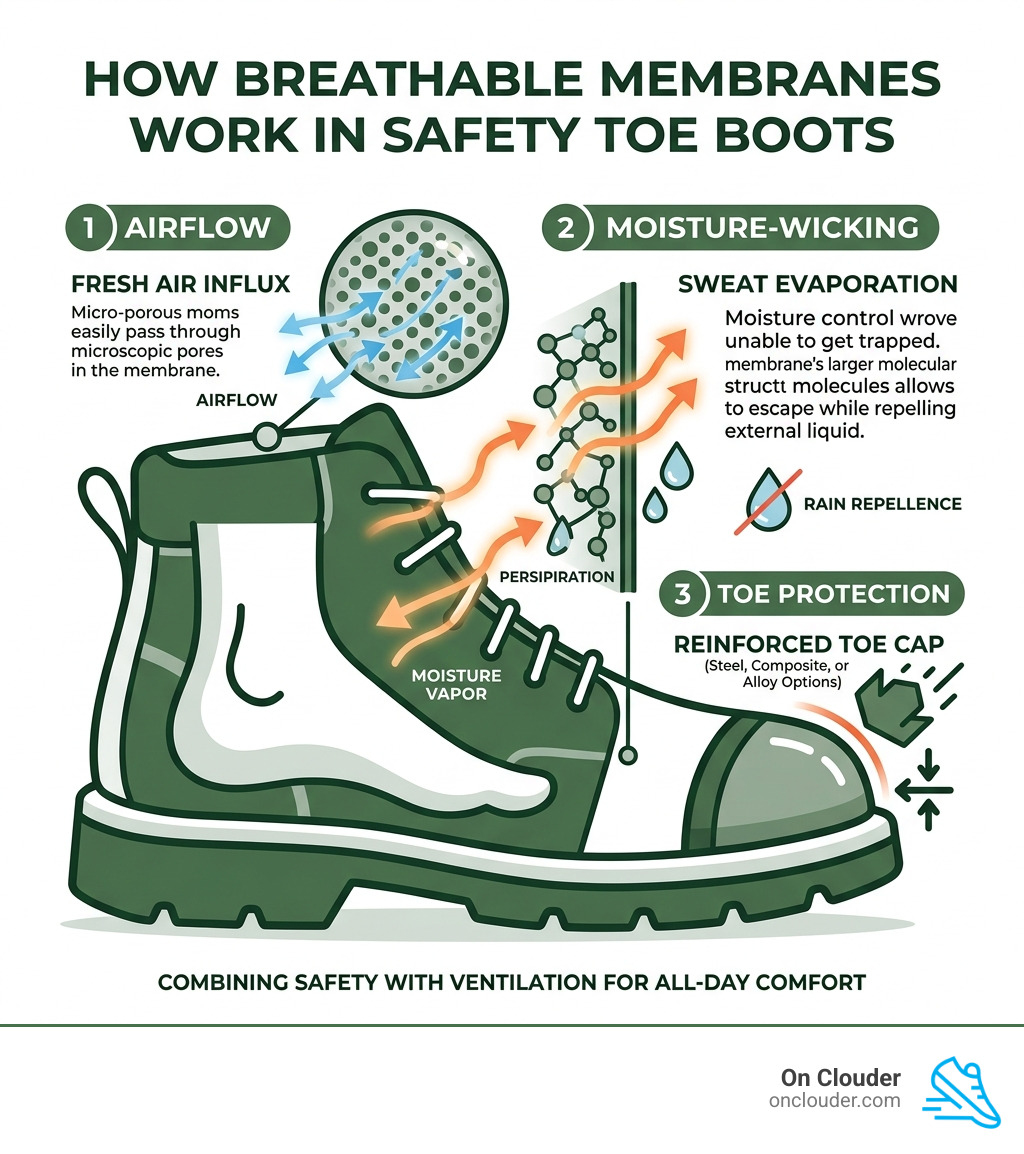
Easy breathable safety toe boots glossary:
Why Workers Need Breathable Safety Toe Boots
When we think about safety on the job, we usually think about heavy objects falling on our toes or stepping on sharp nails. But there is a silent enemy lurking inside your boots: moisture. For those of us working 12-hour shifts in warehouses or under the summer sun on a construction site, sweaty feet aren’t just a nuisance—they are a productivity killer.
The primary reason to switch to breathable boots is temperature regulation. Standard leather work boots act like ovens, trapping heat against your skin. This leads to excessive sweating, which softens the skin and makes it incredibly prone to friction. The result? Painful blisters and chafing that can turn a standard Wednesday into a marathon of misery.
Beyond the immediate pain of blisters, chronic dampness in your work footwear is the leading cause of athlete’s foot and other fungal infections. Without proper airflow, your boots become a petri dish. By choosing breathable safety toe boots, you allow moisture to escape and fresh air to circulate, keeping your skin tough and your boots smelling (relatively) fresh.
Top-Rated Breathable Safety Toe Boots for Industrial Use
Finding the right balance between “tough as nails” and “cool as a breeze” is an art form. Several industry leaders have mastered this, offering boots that breathe without compromising on the ruggedness required for industrial sites.
One of the standout performers in our research is the BRUNT Marin. This model, particularly the unlined version, is a favorite for those who need a traditional boot look but want modern ventilation. Its composite toe option keeps the weight down, which is a blessing when you’re clocking 10 miles a day on concrete.
For those who prefer an athletic silhouette, the CAT Invader series is a top contender. CAT offers a massive range of breathable work boots, with dozens of models specifically designed to vent heat. Their “Invader Mid Vent” is a prime example of how you can integrate mesh panels directly into a safety-rated boot.
Another heavy hitter is KEEN Utility. They’ve revolutionized comfort with their KEEN.ReGEN midsole technology, which returns 50% more energy than standard foam. Models like the Atlanta II Cooler are essentially the “sandals” of the safety world—featuring massive mesh windows that provide maximum breathability while keeping a steel toe cap between you and danger.
Choosing Breathable Safety Toe Boots for Women and Wide Feet
For a long time, the safety footwear industry followed a “shrink it and pink it” philosophy for women. Thankfully, those days are over. Women now have access to high-performance, gender-specific fits that account for narrower heels and different arch shapes. If you’re looking for a detailed breakdown, our Women’s Steel Toe Shoes Survival Guide is an essential resource.
Breathability is especially important in women’s steel toe sneakers, which often use lightweight mesh and synthetic overlays to provide an athletic feel. Brands like Reebok and CAT have expanded their lines to include dozens of women-specific breathable models, ensuring that protection doesn’t come at the cost of a swampy fit.
Wide-width options are equally critical. If a boot is too narrow, it compresses the foot, reducing blood flow and making your feet feel even hotter. Many breathable models from Wolverine and KEEN are available in “EE” or “Wide” widths, allowing your toes to splay naturally. This extra room actually aids in airflow, as there is more space for air to move around the foot within the boot.
Comparing Safety Toe Materials: Steel vs. Composite
When you’re shopping for breathable safety toe boots, the material of the “toe” itself plays a massive role in how cool your feet stay. It’s not just about weight; it’s about thermal conductivity.
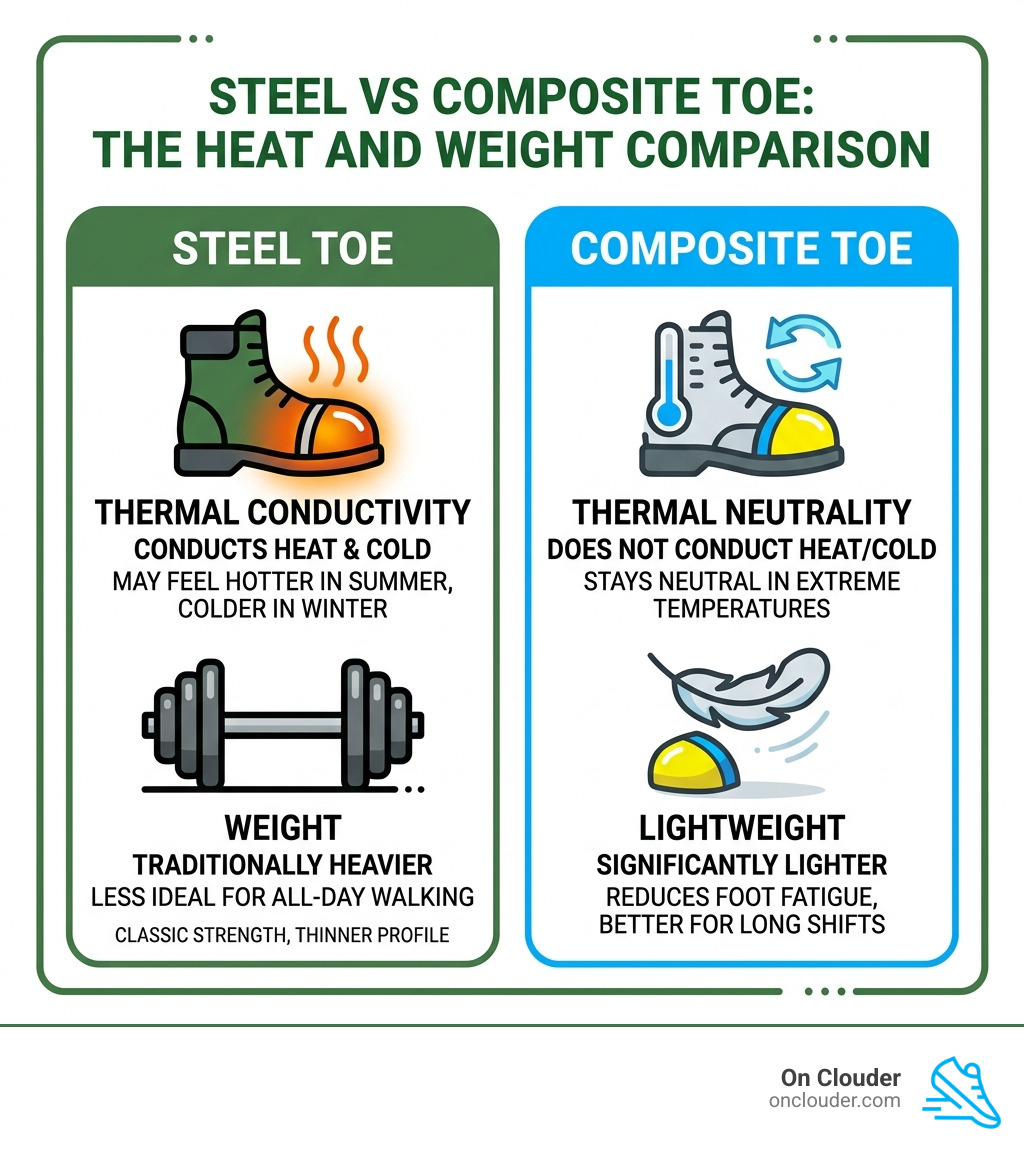
Steel Toes are the classic choice. They are incredibly strong and allow for a thinner profile. However, steel is a conductor. In the summer, it can soak up the heat from the sun and hold it right over your toes. In the winter, it does the opposite, acting like a heat sink that pulls warmth away from your body.
Composite Toes are the heroes of the breathable world. Made from materials like carbon fiber, plastic, or Kevlar, they are featherweight options that don’t conduct heat. This means they stay neutral in temperature, making them much more comfortable for all-day wear in extreme heat. Plus, they are 100% non-metallic, which is a huge plus if you work in an environment with metal detectors.
Alloy Toes are the middle ground. Made from lightweight metals like aluminum or titanium, they offer the strength of steel toes but with significantly less weight. They are thinner than composite toes, which can sometimes allow for better airflow in the toe box area.
| Feature | Steel Toe | Composite Toe | Alloy Toe |
|---|---|---|---|
| Weight | Heaviest | Lightest | Lightweight |
| Heat Conductivity | High (Gets hot/cold) | Low (Stays neutral) | Moderate |
| Bulkiness | Low Profile | Bulky | Low Profile |
| Breathability Potential | Moderate | High | High |
Key Features That Drive Ventilation and Comfort
What actually makes a boot “breathable”? It’s more than just poking a few holes in the side. True breathable safety toe boots utilize a combination of advanced materials and smart engineering.
- Mesh Panels and Vents: This is the most obvious feature. By replacing solid leather with high-abrasion mesh, manufacturers allow air to flow directly into the boot. The CAT Invader Mid Vent is a masterclass in this, using strategically placed vents to keep air moving.
- Moisture-Wicking Linings: Even if air can’t get in, moisture needs to get out. Linings made of materials like polyester or proprietary blends pull sweat away from your skin and move it to the outer layer of the boot where it can evaporate.
- Unlined Construction: Sometimes, less is more. Many workers find that soft toe work boots or unlined safety boots are the coolest options. By removing the extra layers of padding and insulation, you create a direct path for heat to escape.
- Advanced Midsoles: Comfort isn’t just about air; it’s about the “ride.” The TruGuard Lite series utilizes ultralight materials to reduce the energy you expend with every step. Similarly, the KEEN.ReGEN midsole provides a springy feel that prevents your feet from feeling “heavy” and hot at the end of a long day.
Balancing Safety Standards with Maximum Airflow
A common myth is that a boot can’t be “safe” if it’s “breathable.” That couldn’t be further from the truth. Modern breathable safety toe boots are engineered to meet or exceed the exact same standards as their heavy, leather counterparts.
The gold standard is ASTM F2413. This certification ensures the boot can withstand specific levels of impact and compression. Whether it’s a mesh-heavy sneaker or a 9-inch leather boot, if it has this tag, your toes are protected. Many breathable models also carry an EH (Electrical Hazard) rating, meaning the soles are designed to reduce the risk of electric shock.
Take a look at the 8600FLX by ROYER. This boot features their proprietary “AIRFLOW” membrane. It’s a clever bit of tech that is waterproof (keeping external liquid out) but highly breathable (allowing internal vapor to escape). It meets safety shoe standards for puncture resistance and impact while feeling significantly lighter and cooler than a traditional rigger boot.
Slip resistance is another non-negotiable. Breathable boots often feature “siped” outsoles—small channels cut into the rubber—that help move water away from the bottom of the boot, much like a high-performance car tire. This ensures that while your feet are staying cool, you’re staying upright on oily or wet surfaces.
Maintenance Tips to Preserve Boot Breathability
You’ve spent the money on a high-quality pair of breathable safety toe boots—now you need to make sure they keep working. Dirt is the enemy of breathability. When mud and dust clog the pores of a mesh panel or a breathable membrane, the airflow stops, and you’re back to square one.
- Clean Regularly: Use a soft brush to remove dry dirt and debris from the mesh panels after every shift. If they are really caked in mud, use a damp cloth and mild soap. Never use harsh detergents, as these can break down the moisture-wicking chemicals in the lining.
- Air Dry Only: This is the most important rule. Never put your breathable boots in a dryer or in front of a heater. High heat can damage the adhesives and shrink the breathable membranes. Pull the insoles out and let them air dry naturally in a well-ventilated area.
- Rotate Your Pairs: If possible, have two pairs of work boots and rotate them every other day. This gives the materials a full 24-48 hours to completely dry out, which significantly extends the life of the boot and prevents odors from taking root.
- Condition Sparingly: If your boots have leather accents, use a leather conditioner, but keep it away from the mesh or fabric areas. You don’t want to accidentally “seal” the parts of the boot that are supposed to let air through.
Frequently Asked Questions
How long do breathable safety toe boots typically last?
On average, a high-quality pair of breathable work boots will last between 6 to 12 months with regular use. This can vary based on your environment—an indoor warehouse worker will get more life out of their boots than someone working in abrasive road construction. Because these boots often use lighter materials like mesh and synthetics, they may show surface wear faster than heavy leather, but the safety and comfort features remain intact.
Can a work boot be both waterproof and breathable?
Yes! Thanks to technologies like Gore-Tex or proprietary membranes like ROYER’s AIRFLOW, boots can be “waterproof-breathable.” These membranes have pores that are large enough for a molecule of sweat vapor to escape but too small for a drop of water to enter. However, keep in mind that a fully waterproof boot will always be slightly warmer than a non-waterproof, unlined mesh boot.
Do breathable safety toe boots meet OSHA requirements?
Absolutely. OSHA requires that employees wear protective footwear when working in areas where there is a danger of foot injuries. As long as the breathable safety toe boots you choose meet the ASTM F2413 standard for impact and compression, they are fully OSHA compliant. Most major brands like CAT, KEEN, and Reebok clearly label their boots with these certifications.
Conclusion
At the end of the day, your feet are the foundation of your hard work. Choosing breathable safety toe boots isn’t just a luxury; it’s a smart investment in your health, comfort, and daily performance. Whether you’re a delivery driver walking 10 miles a day or a factory worker standing on hot concrete, there is a ventilated solution designed for your specific needs.
At On Clouder, we take pride in our in-depth comfort and performance rankings. We know that the right pair of shoes can be the difference between a productive shift and a painful one. From breathable non-slip work shoes to the latest in carbon-toe technology, we are here to help you find the perfect fit.
Don’t let “swamp foot” slow you down. Explore the latest breathable options, take care of your gear, and keep your toes on ice—even when the job gets hot.