
Why the Right Shoes Matter for Arthritic Knees
The best shoes for arthritic knees can make a real difference in how much pain you feel with every step. Roughly 1 in 4 adults over 45 has arthritic knees — and footwear is one of the simplest, most affordable tools to manage daily discomfort.
Here are the top shoe picks for arthritic knees:
| Shoe Type | Best For | Key Feature |
|---|---|---|
| Hoka Bondi | Maximum cushioning | 60% more impact absorption than standard foam |
| ASICS Gel-Nimbus | Running & walking | GEL cushioning + stability |
| Brooks Ghost Max | Long walks, uneven terrain | Wide base, rocker sole, APMA Seal |
| New Balance Fresh Foam | Daily comfort | Plush midsole, motion control |
| Skechers Go Walk | Casual everyday use | Lightweight, responsive foam |
| OrthoFeet (wide fit) | Swollen or deformed feet | Adjustable straps, arch support |
Here’s the core idea: your shoes affect how force travels through your feet, up your knees, and into your hips and spine. Worn-out or unsupportive shoes can turn a manageable condition into a daily struggle. As one orthopedic expert put it, wearing the wrong shoe when you already have inflamed joints is “like poking an angry bear.”
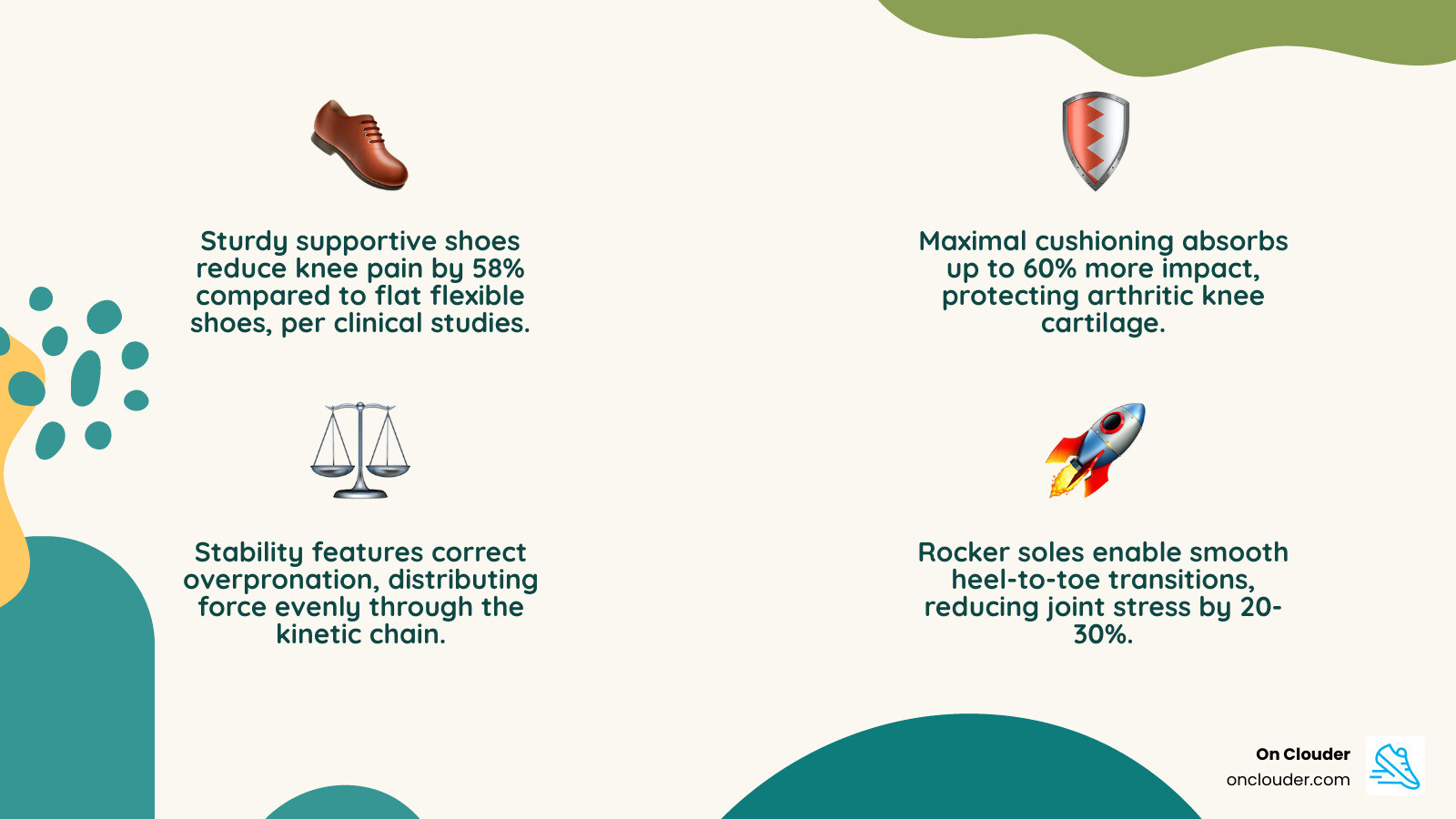
A rigorous clinical study found that 58% of people wearing sturdy, supportive shoes experienced meaningful knee pain reduction while walking — compared to only 40% of those wearing flat, flexible shoes. That’s a significant gap, and it’s backed by real evidence.
The good news? You don’t need to sacrifice style for function. The right pair is out there.
I’m Faisal S. Chughtai, a footwear expert at On Clouder, with years of hands-on experience helping people find the best shoes for arthritic knees and other joint conditions. In the sections below, I’ll break down exactly what to look for — and which specific models deliver real relief.
Best shoes for arthritic knees terms simplified:
The Science of Footwear and Knee Osteoarthritis
When we talk about knee osteoarthritis (OA), we are talking about the “wear-and-tear” of the protective cartilage that cushions the ends of your bones. Without that cushion, your bones can rub together, causing inflammation, swelling, and that all-too-familiar sharp pain. But how do shoes fit into this biological puzzle?
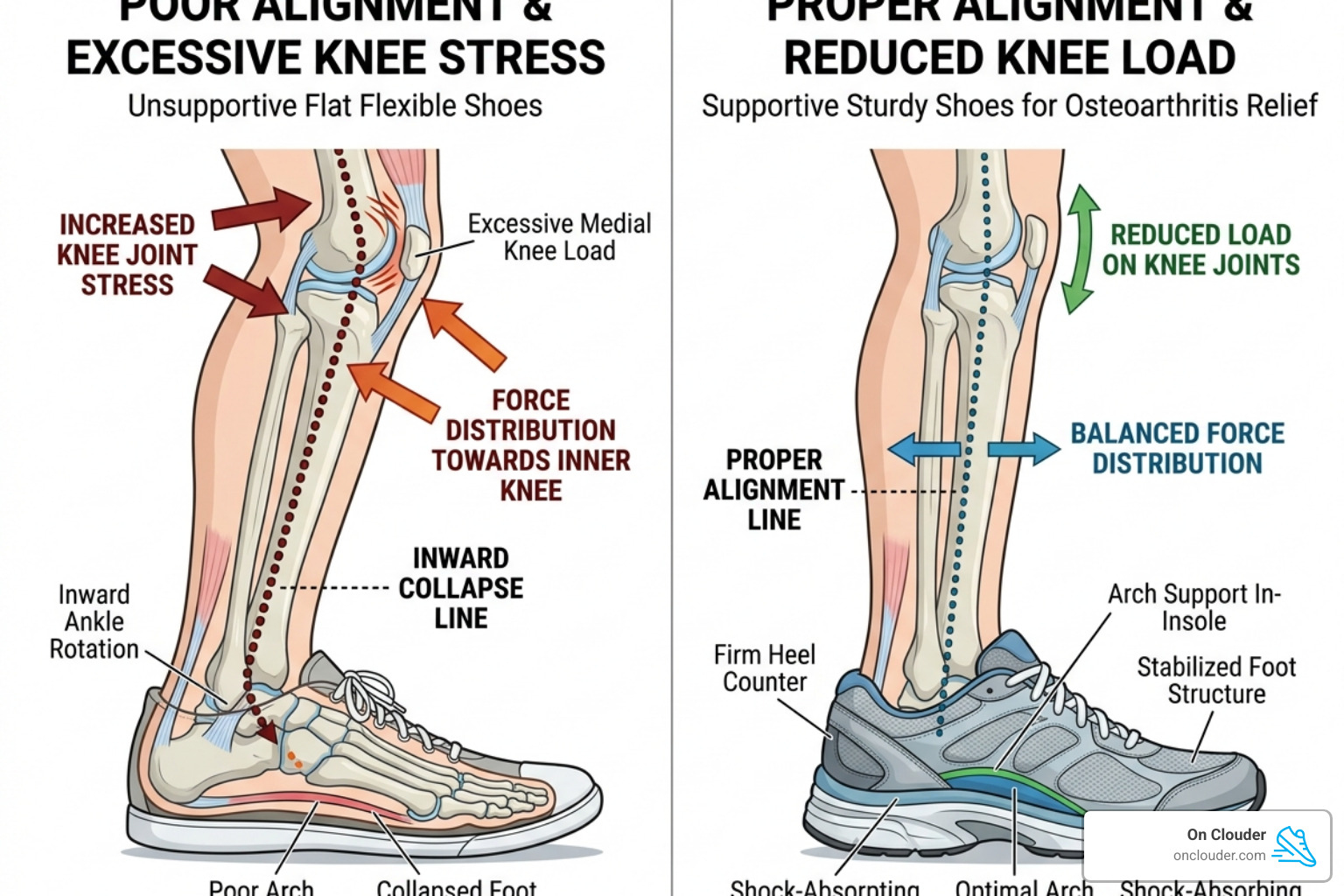
Think of your body as a kinetic chain. Your feet are the foundation. If the foundation is shaky, the stress travels upward. Every time your heel hits the pavement, a shockwave travels through your ankle and directly into your knee. Scientific research on shoe support for knee OA suggests that the right footwear acts as an external shock absorber, taking the “hit” so your cartilage doesn’t have to.
Sturdy Supportive vs. Flat Flexible Shoes
For years, there was a debate in the medical community: should we go “natural” with flexible, barefoot-style shoes, or stick to heavy-duty support? We finally have some clear answers.
A major study involving 164 patients aged 50 and older compared these two types of footwear. The results were telling:
- Sturdy Supportive Shoes: These shoes feature motion control, arch support, and a rigid sole that doesn’t bend easily. 58% of participants in this group saw a meaningful reduction in pain.
- Flat Flexible Shoes: These are lightweight with minimal cushioning and no arch support. Only 40% of participants saw improvement, and this group reported twice as many adverse effects, like increased foot pain or knee swelling.
The takeaway? While flexible shoes rely on your body having perfect mechanics, arthritic knees usually don’t. A sturdy shoe is like a luxury car going over potholes—it absorbs the bumps so the passenger (your knee) stays comfortable.
Essential Features of the Best Shoes for Arthritic Knees
Finding the best shoes for arthritic knees isn’t just about picking a brand name; it’s about the technology inside the shoe. Here are the “must-haves” we look for when ranking footwear for joint health:
- Maximal Cushioning: Look for midsoles made of advanced foams. Some modern foams can absorb up to 60% more impact than traditional materials.
- Stability: A wide base helps prevent the foot from wobbling, which in turn prevents the knee from twisting.
- Arch Support: This helps distribute your weight evenly across the foot, preventing pressure points that can aggravate the knee pain cycle.
Neutral vs. Stability Shoes: Which Do You Need?
| Feature | Neutral Shoes | Stability Shoes |
|---|---|---|
| Best For | Normal arches / Supinators | Flat feet / Overpronators |
| Midsole | Uniform softness | Firmer foam on the inner side |
| Flexibility | More flexible | More rigid to control motion |
| Orthotics | Easily accommodates inserts | May be too bulky for extra inserts |
Understanding Pronation and Foot Type
Before you buy, you need to know your “gait.” This is simply the way your foot moves when you walk.
- Overpronation: Your foot rolls inward excessively. This can cause the lower leg to rotate, putting extra torque on the knee.
- Neutral: Your foot rolls inward just enough to absorb shock.
- Supination: Your foot doesn’t roll inward enough, meaning your knees take more of the impact.
We always recommend a professional fitting. Many specialty stores now offer digital foot scans or will look at the wear patterns on your old shoes. If the inside of your soles is worn down, you’re likely an overpronator. If the outside is worn, you’re a supinator.
The Role of Rocker Soles and Orthotics
One of the coolest innovations in the best shoes for arthritic knees is the rocker sole. Brands like Hoka use “Meta-Rocker” technology, which is essentially a curved sole. Instead of your foot having to bend and push off, the shoe “rolls” you forward. This reduces the amount of bending your knee has to do with every step.
If your shoes are almost perfect but need a boost, over-the-counter orthotics like Dr. Scholl’s Knee Pain Relief inserts can help. They are specifically designed to shift your alignment and reduce the load on the inner part of your knee, where arthritis often hits hardest.
Top-Rated Footwear Categories for Joint Pain
Top Athletic Brands for the Best Shoes for Arthritic Knees
When it comes to the best shoes for arthritic knees, athletic sneakers often lead the pack because they invest millions into foam research.
- Hoka Bondi: This is often the gold standard. Its midsole foam is incredibly plush, and the rocker sole makes walking feel almost effortless.
- ASICS Gel-Nimbus: Known for its “GEL” technology, this shoe provides excellent shock absorption in the heel and forefoot. It’s a favorite among podiatrists for its consistent comfort.
- Brooks Ghost Max: This model features a high-stack height of “DNA LOFT” foam, which is nitrogen-infused to stay soft but responsive. It also carries the APMA (American Podiatric Medical Association) Seal of Acceptance.
- New Balance Fresh Foam: These offer a wide base and a very soft landing, making them great for those who spend all day on their feet.
Casual and Dress Options: The Best Shoes for Arthritic Knees for Daily Wear
You can’t wear sneakers to every event, but you shouldn’t have to suffer in “church shoes” either. For daily wear, look for:
- Wide Toe Boxes: Arthritis can cause feet to swell or develop bunions. A roomy toe box prevents painful pinching.
- Adjustable Straps: Monk straps or Velcro closures are a godsend if your hands also have arthritis, making them much easier to put on than laces.
- Low Heels: Keep heels between 1.5 and 2 inches. Anything higher puts immense pressure on the forefoot and shifts your center of gravity, which wreaks havoc on arthritic knees.
Maintenance and Fitting Tips for Long-Term Relief
Even the best shoes for arthritic knees won’t last forever. Most experts recommend replacing your walking or running shoes every 300 to 500 miles. For a daily walker, that’s about every six months. Even if the tread looks fine, the internal foam “sets” and loses its ability to absorb shock.
Pro Fitting Tips:
- Shop in the Afternoon: Your feet are at their largest late in the day due to natural swelling.
- The Thumb Rule: There should be about a thumb’s-width of space between your longest toe and the end of the shoe.
- Wear Your Socks: Bring the socks you plan to wear regularly to ensure the fit is accurate.
When deciding between top brands, you might wonder about specific differences. Check out our deep dive on On Cloud Vs Hoka Which Brand Is Better For Your Knees/ to see how these two heavyweights stack up.
Frequently Asked Questions about Best Shoes for Arthritic Knees
Are flip-flops or barefoot walking safe for knee arthritis?
This is a “yes and no” answer. Interestingly, research from Rush University found that flip-flops can reduce the load on the knee joint by about the same percentage as walking barefoot—which is actually less load than some stability sneakers. However, flip-flops offer zero ankle support and are a major trip hazard. If you have balance issues, stick to a supportive sandal with an ankle strap.
How often should I replace my walking shoes?
As mentioned, the 300–500 mile rule is standard. However, listen to your body. If you start feeling “new” twinges of pain in your knees or lower back after a walk, it’s a sign the midsole has broken down.
Are there different shoe recommendations for men and women?
Yes. Women generally have a wider “Q-angle” (the angle at which the femur meets the tibia) due to wider hips. This can put different stresses on the knee. Some brands, like Ryka, design shoes specifically for female biomechanics. Men typically need more volume in the midfoot and a wider heel base.
Conclusion
Living with knee osteoarthritis doesn’t mean you have to stop moving. In fact, staying active is one of the best ways to keep your joints lubricated and your muscles strong. Choosing the best shoes for arthritic knees is an investment in your independence and your quality of life.
Whether you opt for the maximal cushion of a Hoka, the stability of an ASICS, or the specialized fit of an orthopedic shoe, the goal is the same: reduce the impact, align the joints, and keep the “angry bear” of inflammation at bay.
Ready to find your next pair? We’ve tested the top models so you don’t have to. Find your perfect fit at On Clouder and take your first pain-free step today!
