Why Finding the Right Running Shoes That Are Good for Flat Feet Changes Everything
Running shoes that are good for flat feet are not just a comfort upgrade — they can be the difference between running pain-free and sitting on the sidelines with shin splints or plantar fasciitis.
Here are the top picks at a glance:
| Shoe | Best For | Key Feature |
|---|---|---|
| Adidas Supernova Solution 3 | Best Overall | Guide Your Ride subtle stability |
| Saucony Hurricane 25 | Best Cushioning | 40.2mm stack, CenterPath tech |
| HOKA Arahi 8 | Best Lightweight | High shock absorption, low weight |
| Brooks Glycerin GTS 22 | Best Durability | GuideRails, 54.5% sturdier outsole |
| ASICS Gel Kayano 32 | Best Wet Traction | 4D Guidance System, 0.84 wet grip |
| New Balance Fresh Foam X 860v14 | Best Pronation Control | Dual-layer cushioning, stability plane |
Flat feet — also called fallen or low arches — affect 20% to 30% of people. When you run, that lack of arch structure causes your foot to roll inward more than it should. That motion, called overpronation, puts extra stress on your ankles, knees, and hips over time.
The good news? The right shoe can absorb that stress and keep you running strong.
I’m Faisal S. Chughtai, a footwear expert who has spent years helping runners and active professionals find the right fit — including a deep focus on running shoes that are good for flat feet. Let’s break down exactly what to look for and which models stand out in 2026.
Understanding Flat Feet and Their Impact on Running
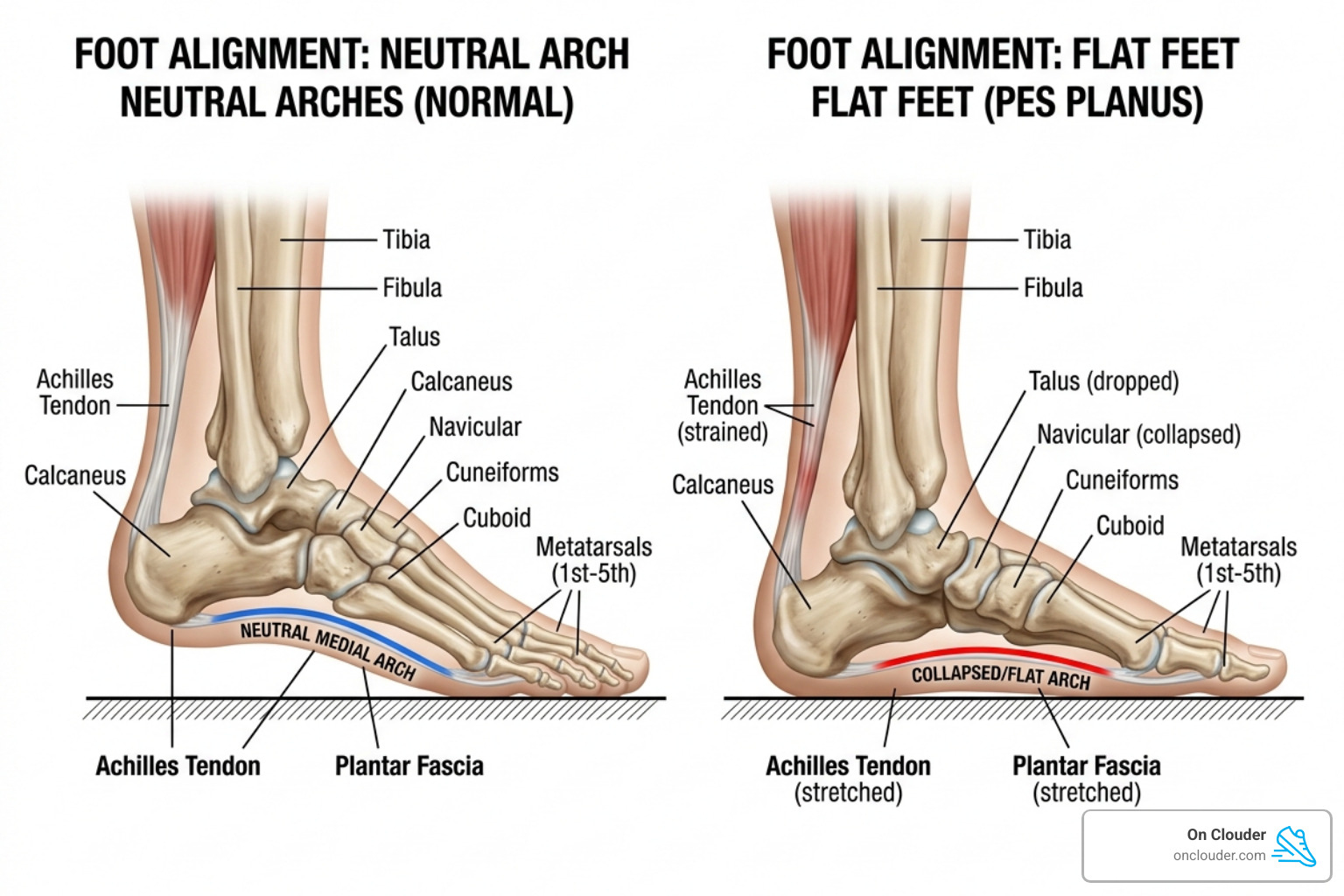
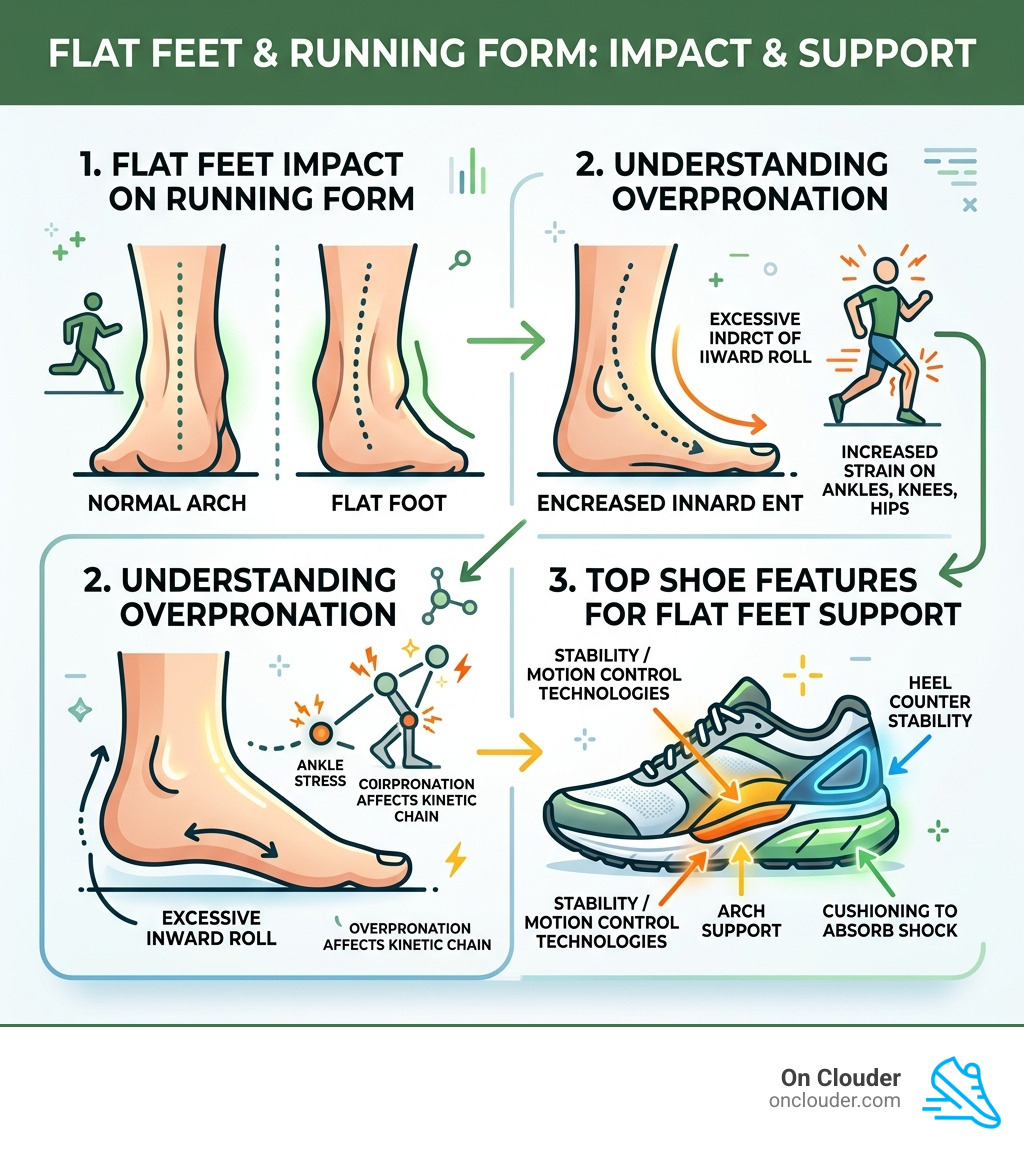
When we talk about flat feet, we are describing a foot shape where the longitudinal arch—the curve running along the inside of your foot—is either very low or non-existent. Statistics show that this condition affects roughly 20% to 30% of the general population. While many people are born with this foot structure, others experience “fallen arches” later in life. This is particularly common among women over the age of 40 and individuals managing obesity, as increased weight and time can strain the posterior tibial tendon that supports the arch.
For runners, flat feet aren’t just an aesthetic trait; they dictate your biomechanics. The most common issue we see is overpronation. This occurs when the foot rolls excessively inward after landing, transferring the weight to the inner edge instead of the ball of the foot. Without a functional arch to absorb the shock, the impact travels up the kinetic chain.
If you don’t wear the best flat foot shoes to keep you on your toes, you may find yourself dealing with a “greatest hits” list of running injuries. Overpronation is a primary driver for:
- Shin Splints: Excessive rotation of the lower leg bones.
- Plantar Fasciitis: Strain on the connective tissue under the foot.
- Bunions and Heel Spurs: Pressure on the big toe joint and heel bone.
According to Brooks Running, the goal isn’t to “fix” the foot, but to provide a stable platform that mimics the support a natural arch would provide.
Flexible vs. Rigid Flat Feet
Not all flat feet are created equal. We generally categorize them into two types: Flexible and Rigid.
- Flexible Flat Feet: This is the most common type. If you sit down and dangle your feet, you might actually see an arch appear. However, as soon as you stand up and apply weight, the arch collapses. These runners often benefit from “stable neutral” shoes or mild stability features that help the foot muscles engage.
- Rigid Flat Feet: In this case, the foot is flat whether you are standing, sitting, or on your tiptoes. This is often an anatomical bone structure issue. Runners with rigid flat feet usually require more significant support and a no arch no problem approach with maximum stability and cushioning to prevent joint pain.
How to Determine Your Foot Type and Pronation
Before you buy running shoes that are good for flat feet, you need to know what you’re working with. You don’t necessarily need a lab; you can perform these simple tests at home:
- The Tiptoe Test: Stand on your tiptoes in front of a mirror. If an arch forms while you are elevated, you likely have flexible flat feet. If it stays flat, you have rigid flat feet.
- Jack’s Test: While sitting, have someone manually pull your big toe upward (dorsiflexion). If an arch appears on the bottom of your foot, your “windlass mechanism” is functional, indicating a flexible structure.
- The Wet Foot Test: Wet the sole of your foot and step onto a piece of cardboard or a dark tile. A neutral foot leaves a print with a distinct curve inward. A flat foot leaves a nearly complete print of the entire sole.
- Gait Analysis: If you can, visit a specialist for a video gait analysis. Watching how your ankle collapses inward during a stride is the gold standard for identifying overpronation.
Essential Features of Running Shoes That Are Good for Flat Feet
When we evaluate running shoes that are good for flat feet, we look for specific engineering designed to counteract the inward roll of overpronation. Modern footwear has moved away from just “blocking” the foot and toward “guiding” it.
Key features to look for include:
- Medial Posts: A firmer piece of foam located on the inside (medial side) of the midsole to prevent the shoe from compressing too much under the arch.
- GuideRails Technology: Popularized by brands like Brooks, these act like bumpers on a bowling alley, keeping your foot in its natural path of motion without forcing it.
- 4D Guidance System: Found in the ASICS GT-4000 4 WIDE, this uses adaptive stability to provide support only when your form starts to break down.
- CenterPath Technology: A wider platform with higher sidewalls that “cradles” the foot, providing stability through geometry rather than hard plastic posts.
- H-Frame Support: A frame built into the midsole that ensures the foot stays centered over the cushioning.
Understanding these features is vital, especially if you are following our 5 best running shoes for flat feet overpronation 2026 guide.
Why Lab Metrics Matter for Running Shoes That Are Good for Flat Feet
At On Clouder, we don’t just look at the colors; we look at the data. Stability shoes are inherently different from neutral shoes. On average, a stability shoe weighs about 10 oz (285g), whereas a neutral shoe averages 9.3 oz (263g). That extra mass usually goes into the support structures.
Other metrics we track include:
- Torsional Rigidity: How much the shoe resists twisting. Flat-footed runners need a shoe that is harder to twist to maintain a stable platform.
- Shock Absorption (SA): Measured in SA units. Since flat feet lack a natural “spring,” the shoe must do the heavy lifting in absorbing impact.
- Stack Height: The amount of foam between your foot and the ground. High stack heights (35mm+) provide the plushness needed for long-distance comfort.
- Heel-to-Toe Drop: Most stability shoes feature an 8mm to 12mm drop, which helps shift your weight forward and reduces the strain on the Achilles tendon.
Choosing the Right Size in Running Shoes That Are Good for Flat Feet
One of the most common mistakes flat-footed runners make is buying shoes that are too narrow. Because a flat foot “spreads” out when it hits the ground, you often need more real estate than someone with high arches.
Look for wide platforms and a roomy toe box. Many of the best models come in dedicated D width (wide) or 4E width (extra wide) options. A shoe that is too narrow will cause the foot to spill over the edge of the midsole, leading to blisters and a complete loss of the shoe’s stability benefits. Ensuring midfoot integrity means the shoe shouldn’t “pinch” the arch area, but rather support it comfortably.
Top-Rated Models for Support and Comfort in 2026
To help you navigate the crowded market, we’ve compiled the latest lab data and wear-test results for the top performers of the year.
| Shoe | Stack Height (Heel/Toe) | Weight | Stability Tech |
|---|---|---|---|
| Adidas Supernova Solution 3 | 36mm / 26mm | 10.1 oz | Guide Your Ride |
| Saucony Hurricane 25 | 40.2mm / 33.1mm | 10.6 oz | CenterPath |
| Brooks Glycerin GTS 22 | 38mm / 28mm | 10.7 oz | GuideRails |
| ASICS Gel Kayano 32 | 40mm / 32mm | 10.8 oz | 4D Guidance |
| NB Fresh Foam X 860v14 | 29mm / 21mm | 10.8 oz | Stability Plane |
Best Overall: Adidas Supernova Solution 3
The Adidas Supernova Solution 3 has taken the top spot this year because it strikes a perfect balance. It doesn’t feel like a “clunky” stability shoe. Its Guide Your Ride system provides subtle support that works for both mild overpronators and neutral runners who experience fatigue on long runs.
In our lab tests, it scored a 0.72 traction score, making it roughly 24% grippier than the average trainer—perfect for wet sidewalks. It also features a 15.2N flexibility rating, meaning it moves with your foot rather than fighting against it. It’s the ultimate daily trainer for the flat-footed runner who wants a natural feel.
Best Cushioning: Saucony Hurricane 25
If you want to feel like you’re running on clouds, the Saucony Hurricane 25 is the answer. It boasts a massive 40.2 mm stack height. But height without stability is a recipe for a rolled ankle. Saucony solves this with CenterPath technology, which uses a broad footprint and high sidewalls to keep you centered.
The lab numbers are impressive: 151 SA heel absorption and 140 SA forefoot absorption. It also offers a 74% energy return, which is incredibly high for a stability shoe, ensuring you don’t feel “sunk” into the foam.
Best Support: Brooks Glycerin GTS 22
The “GTS” stands for Go-To Support, and Brooks delivers. This shoe is built like a tank. In our Dremel durability test, the outsole showed only a 0.5 mm dent, making it 54.5% sturdier than the average running shoe.
The GuideRails support system is the star here. It focuses on the most injury-prone part of a runner’s body: the knees. By controlling excess shin and heel rotation, it keeps your stride in a safe zone. If the built-in support isn’t enough, this shoe has plenty of depth to accommodate arch support inserts for flat feet.
Frequently Asked Questions about Flat Feet Running
Can I wear neutral shoes if I have flat feet?
The short answer is: sometimes. If you have flexible flat feet and your overpronation is very mild, you might get away with a stable neutral shoe. These are neutral shoes that feature a full-contact midsole (no gap under the arch) and side walls that provide a bit of a cradle. However, most flat-footed runners will eventually find that neutral shoes lack the medial support needed to prevent long-term fatigue and injury. If you’re unsure, check our best shoes for flat feet high arches 2026 guide to see how the two types compare.
Do I need orthotics or custom insoles?
Not everyone with flat feet needs custom orthotics. Many modern stability shoes are designed to provide all the arch support you need. However, if you still experience pain in your arches or shins even with stability shoes, seeing a physical therapist or podiatrist is a smart move. They can help you determine if you need a custom insert or if you simply need to perform strengthening exercises to build the small muscles in your feet.
How often should I replace stability shoes?
Stability shoes are the “workhorses” of the running world. However, the support structures (like medial posts or GuideRails) can lose their effectiveness before the outsole even looks worn. We recommend replacing your shoes every 300 to 500 miles. If you notice the foam feels “dead” or you start feeling old aches and pains returning, it’s time for a new pair. Our lab’s Dremel test proves that while outsoles like those on the Brooks Glycerin are durable, the midsole compression is what usually dictates the shoe’s lifespan.
Conclusion
Running with flat feet doesn’t have to be a struggle. By understanding your specific foot type—whether flexible or rigid—and choosing running shoes that are good for flat feet, you can turn a potential obstacle into just another part of your training routine.
At On Clouder, we believe that the right gear empowers you to go further. Remember to consult a specialist if you have persistent pain, and don’t forget that foot strengthening is just as important as the shoes you wear. For more tips on staying comfortable, check out our guide on the best flat foot shoes to keep you on your toes. Happy running!