

Why Running Shoe Sizes Don’t Match Across Brands (And What to Do About It)
Running shoe size comparison between brands is one of the most confusing parts of buying running shoes — especially online. Here’s a quick reference to get you started:
| Brand | General Sizing Tendency | Width Notes |
|---|---|---|
| Nike | Runs narrow/small | Limited wide options |
| Adidas | True to size | Standard widths |
| ASICS | True to size or slightly roomier | 2E and 4E wide options |
| HOKA | True to size | Some wide models available |
| Brooks | Slightly roomy | Wide options available |
| New Balance | True to size | B, D, 2E, 4E widths |
| PUMA | Runs slightly small (go half size up) | Standard widths |
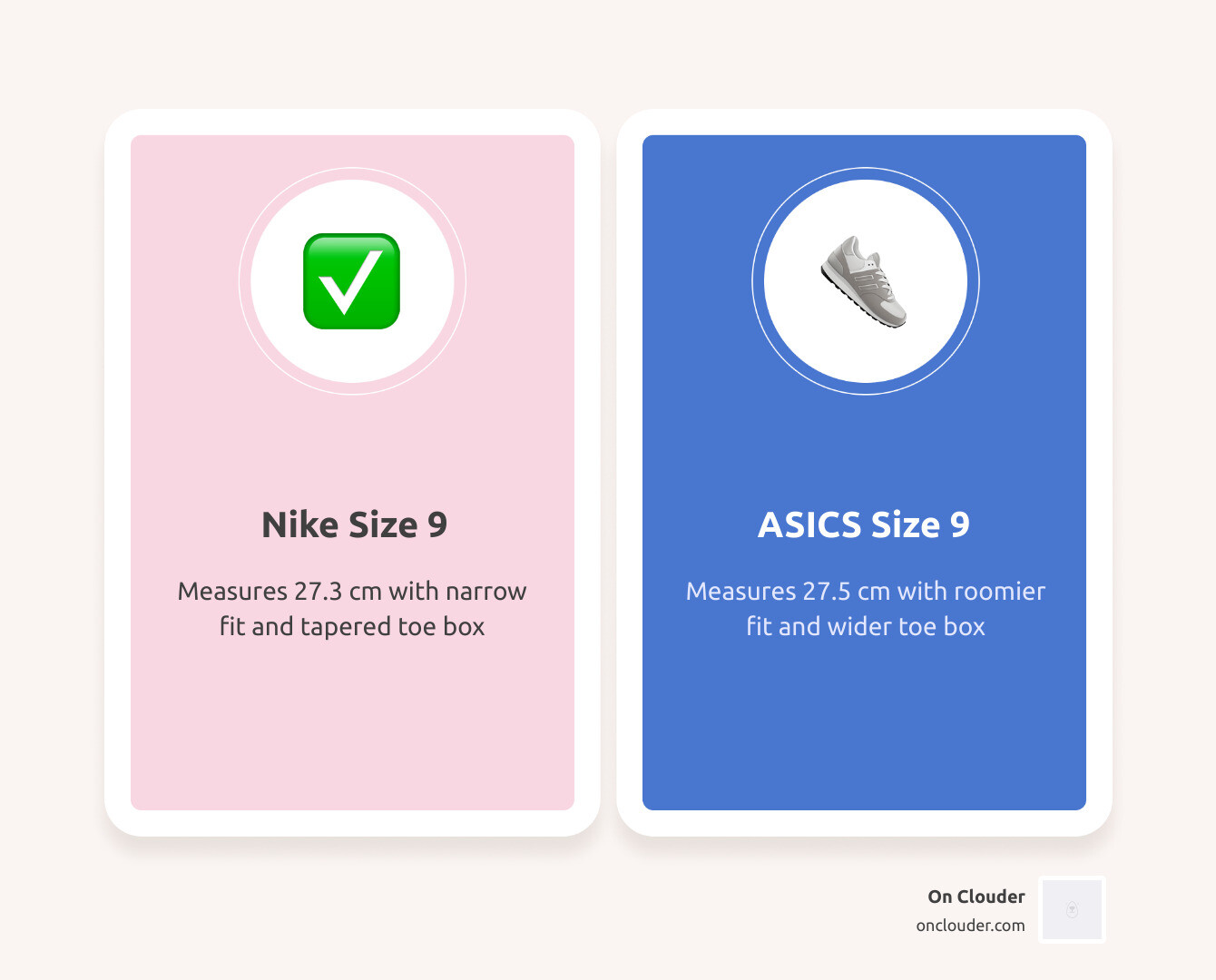
The short answer: The same number on the box does not mean the same fit across brands. A Nike size 9 measures about 27.3 cm, while an ASICS size 9 measures about 27.5 cm. That small difference — combined with very different toe box shapes, heel tapers, and upper materials — means 68% of runners switching from ASICS to Nike need to go up half a size.
So before you buy, measure your foot in centimeters. It’s the most reliable baseline across all brands.
You’ve probably opened a box expecting a perfect fit and found something that felt completely off. That’s not a fluke — it’s how the industry works. Brands build shoes on different lasts (the molds shoes are shaped around), use different upper materials, and design for different foot shapes. A size 10 in Nike can feel noticeably tighter than a size 10 in New Balance or Brooks — even if both technically measure out to the same length.
This guide walks you through exactly why that happens, how to measure correctly, and how to compare sizes across the brands that matter most to runners in 2026.
I’m Faisal S. Chughtai, a footwear expert who has spent years helping runners and active professionals navigate running shoe size comparison between brands to find their perfect fit across leading labels like On Cloud, HOKA, ASICS, and Nike. With hands-on experience testing and comparing shoe fits across dozens of models, I’ll help you stop guessing and start running in shoes that actually fit.
Important running shoe size comparison between brands terms:
Running Shoe Size Comparison Between Brands: Why the Same Number Fits Differently
A shoe size is not a law of physics. It is more like a suggestion with branding.
That is why a US 9 in one brand can feel comfortably snug, while a US 9 in another feels like your toes are filing a complaint. In a proper running shoe size comparison between brands, length is only one piece of the puzzle. Fit also changes because of:
- Last shape
- Internal volume
- Toe-box shape
- Heel taper
- Midfoot wrap
- Foam thickness and sidewalls
- Upper stretch
- Manufacturing tolerances
- Differences in US, UK, and EU labeling
Even EU sizing, which many shoppers assume is more consistent, is not perfectly standardized across brands. That is why we always prefer centimeter-based sizing as the starting point, then confirm with the brand chart and model feedback.
Why Nike, Adidas, ASICS, HOKA, Brooks, and New Balance all size differently
Each brand has its own fit philosophy.
- Nike often feels narrower and more performance-shaped, especially through the forefoot and midfoot.
- Adidas is usually one of the easier transitions for runners because it tends to fit closer to true to size.
- ASICS often feels a bit roomier than Nike and usually offers more width options.
- HOKA can fit true to size in length, but its rocker geometry and upper design can change how secure or roomy the shoe feels.
- Brooks often feels slightly roomier and is a frequent safe pick for runners who hate cramped forefeet.
- New Balance is one of the most width-friendly brands, with options like B, D, 2E, and 4E.
There is also a difference between performance lasts and casual lasts. Racing shoes are often built to feel more locked in and lower volume. Daily trainers usually allow more comfort and swelling room. So even within the same company, a relaxed everyday shoe and a race-day rocket can fit like distant cousins.
How foot width, volume, and toe-box shape change the feel of the same size
Two runners can wear the exact same measured foot length and still need different shoes.
Why? Because length is only part of fit. The rest comes from shape:
- Forefoot width: Wide forefeet often feel squeezed in tapered shoes even when length is correct.
- Midfoot wrap: Some runners need a secure hug through the arch; others feel strangled by it.
- Instep volume: High-volume feet need more upper space, especially under the laces.
- Toe shape: Long second toes, bunions, and splayed toes all change how a shoe feels up front.
- Heel shape: Narrow heels can slip in shoes that otherwise fit well.
- Swelling: Feet often expand during longer runs, which makes a “perfect” try-on fit feel too short later.
If that sounds familiar, our guide to wide toe box shoes can help you narrow down what kind of shape works best for your foot.
How to Measure Your Feet Correctly Before Using Any Brand Chart

Before you look at any size converter, chart, or product page, measure your feet properly. This step matters more than brand loyalty, flashy colorways, or your insistence that “I’m always a 10.” Your feet do not care what size you used in college.
The most reliable method for running shoe size comparison between brands
The most reliable method is to measure in centimeters, standing up, at the end of the day, while wearing the socks you actually run in.
Here is the simplest method:
- Put a sheet of paper against a wall on a hard floor.
- Stand with your heel lightly touching the wall.
- Wear your usual running socks.
- Mark the end of your longest toe.
- Measure from the wall to the mark in centimeters.
- Repeat for both feet.
- Use the longer foot measurement.
- Add your preferred running allowance, usually around 1.0 to 1.5 cm of toe space.
That toe allowance matters. Many fit guides recommend roughly 1.0 to 1.5 cm in front of the longest toe for running, which helps account for foot expansion and downhill toe movement. A good quick check is the classic thumb-width rule.
If you have access to a Brannock device in a specialty store, great. It can help with both length and width. But even a careful paper measurement works well if you do it correctly. We also recommend cross-checking your result with an official brand chart.
Common measuring mistakes that lead to the wrong size online
The biggest online sizing mistakes are surprisingly boring:
- Measuring in the morning when feet are smaller
- Measuring while sitting down instead of standing
- Using thin socks when you run in thicker socks
- Measuring only one foot
- Ignoring width and focusing only on length
- Assuming your old size still applies across all brands
- Forgetting orthotics or aftermarket insoles
- Rounding badly when between half sizes
If one foot is longer, fit the longer foot. If your shoe fits in length but crushes the sides of your foot, that is usually a width problem, not a cue to keep going longer and longer until you are basically wearing flippers.
Brand-by-Brand Running Shoe Size Comparison Between Brands
Here is a practical overview of how major brands usually compare.
| Brand | Length Tendency | Fit Shape | Width Availability | Notes |
|---|---|---|---|---|
| Nike | Often slightly short/snug | Narrow forefoot, secure heel | Limited | Common to size up half |
| Adidas | Usually true to size | Balanced fit | Standard | Often close to Nike in length |
| ASICS | True to size to slightly roomy | More forefoot room than Nike | 2E, 4E in many models | Good switch option for wider feet |
| HOKA | Usually true to size | Can feel different due to rocker and upper volume | Some wide models | Model variation matters |
| Brooks | Slightly roomy | Comfortable forefoot, secure platform | Wide options common | Popular for daily training comfort |
| New Balance | True to size | Varies, often more accommodating | B, D, 2E, 4E | Excellent for width-specific fitting |
Nike vs ASICS: should you go up half a size?
Usually, yes, at least as a starting point.
Research shows that when runners switched from ASICS to Nike:
- 68% needed to go up half a size
- 22% needed a full size up if they had wide feet
- Only 10% found the sizes identical
Why does that happen if the numbers look so close? Because ASICS US 9 is about 27.5 cm, while Nike US 9 is about 27.3 cm. Add Nike’s more tapered forefoot and performance-oriented fit, and many runners feel cramped even when the label says the “same” size.
This is especially common in runners who have:
- Wide forefeet
- Long toes
- Mild bunions
- Swelling on longer runs
- Thick running socks
- Orthotics
So if you wear ASICS and are switching to Nike, our default advice is:
- Start with half a size up
- Consider a full size up if you have wide feet and the model is known to run narrow
- Prioritize heel lockdown and toe room over the printed size.
Nike, Adidas, and PUMA: where sizes stay close and where they don’t
Nike and Adidas are often fairly close. A Nike US 9 is usually similar to an Adidas US 9.
PUMA is trickier. Research suggests Nike US 9 often lines up more closely with PUMA US 9.5. That means runners moving from Nike to PUMA may want to compare centimeters carefully rather than blindly buying the same size.
A few broader cross-brand examples from converter data show how messy this gets:
- Nike US 9 is very close to Adidas US 9
- Nike US 9 may equal PUMA US 9.5
- Skechers often feels roomier than Nike
- Converse commonly runs large compared with athletic shoes
The lesson is simple: use conversions as clues, not commandments. A tool like this multi-brand size converter can help you build a starting point, but your centimeter measurement still matters more than the box label.
Which brands usually suit wide feet better
If you have wide feet, some brands make life easier than others.
The most width-friendly major running brands are usually:
- New Balance
- Brooks
- ASICS
- Selected HOKA models
Nike can work for some runners, but it generally offers fewer truly accommodating wide fits and often still feels snug through the forefoot. New Balance stands out because of its multiple width options. Brooks is also consistently strong for runners who want comfort without a cramped toe box. ASICS gives many runners a better mix of structure plus extra width choices.
If wide-fit shopping is your reality, these guides can help:
- The AZ Guide to Running Shoes for Wide Feet
- The Best Big Toe Box Running Shoes for Blister-Free Miles
What Official Size Charts and Conversion Tools Really Tell You
Official size charts are useful, but they are not magic. They tell you how a brand maps foot length to labeled size. They do not fully tell you how the shoe will feel on your foot shape.
How US, UK, and EU sizes differ across major brands
Here is the quick breakdown:
- US sizes are common in product listings but vary by brand
- UK sizes are different from US sizes and should never be guessed
- EU sizes look standardized but still vary more than many shoppers expect
- JP or CM sizing is usually the cleanest reference because it is based on length
Men’s and women’s sizes add another layer. In the US system, there is usually about a 1.5 size difference between men’s and women’s shoes. For example, a women’s 8.5 often lands near a men’s 7.
The safest workflow is:
- Measure foot length in cm
- Check the official brand chart
- Confirm men’s or women’s conversion
- Read model-specific fit notes
Official brand size charts are often available on manufacturer websites and can be helpful for quick reference across brands.
Are brand-to-brand converters and fit tools actually reliable?
They are useful, but only as a first step.
Some tools compare hundreds of brands. Others use data from 400+ brands or datasets built from up to 1,000,000 shoes. More advanced running-specific tools also compare around 60 current models with calibration for fit differences between specific shoes.
That sounds impressive, and it is helpful. But no converter can fully know:
- Your foot width
- Your instep height
- Your toe shape
- Whether you like race-snug or comfort-roomy fit
- Whether you wear thick socks or orthotics
So yes, converters are reliable enough to narrow your choices. No, they are not reliable enough to guarantee a perfect fit by themselves.
Why one model can fit differently from another in the same brand
This is where many runners get surprised.
Even within one brand, models can fit very differently because of:
- Upper material stretch
- Heel padding thickness
- Racing vs training fit
- Carbon plate design
- Midsole sidewalls
- Tongue construction
- Overall internal volume
For example, a daily trainer like a Pegasus can fit differently from a race shoe like a Vaporfly. The same is true in ASICS, where a Novablast and a Metaspeed can feel meaningfully different. Some model comparison tools even show examples where a runner in one ASICS model would go down half a size in another because of heel padding and fit volume differences.
The takeaway: know the model, not just the brand.
Common Fit Problems When Switching Brands and How to Avoid Them
Switching brands often creates one of a few familiar problems. The good news is that each problem usually points to a specific fix.
Too tight, too loose, or heel slipping: what each problem usually means
If the shoe feels too tight:
- The brand may run short
- The forefoot may be too tapered
- You may need a wide version, not a longer size
- Your feet may be swelling during runs
If the shoe feels too loose:
- The model may have too much internal volume
- The upper may be stretching more than expected
- You may need a lower-volume shoe or better lacing
If your heel slips:
- The heel cup may be too wide for your foot
- The shoe may be too long
- Your midfoot may not be locked down properly
Common issues and what they often cause:
- Black toenails: shoe too short or too low in toe height
- Toe bang: not enough front space, especially on descents
- Hot spots and blisters: friction from movement
- Arch pressure: mismatch between your foot shape and the shoe platform
- Lace bite: too much pressure over the instep
Simple fixes include:
- Heel lock lacing
- Trying your running socks during fit checks
- Swapping to thinner or thicker socks strategically
- Moving to a wide size instead of sizing up in length
- Buying from retailers with solid return policies
Smart tips for buying running shoes online without trying them on
Buying online is totally manageable if you act like a detective instead of a gambler.
Use this checklist:
- Measure both feet in cm first
- Check the brand’s official chart
- Read model-specific fit comments
- Compare your old shoe’s insole length to the new pair
- Order two sizes if you are between sizes
- Look for width options before sizing up
- Try on indoors first
- Test with your normal socks and insoles
- Keep the box until you are sure
- Review the return policy before you click buy
A little prep now is much cheaper than building a museum of “almost right” shoes in your closet.
When to choose a wide version instead of sizing up
This is a big one.
Choose a wide version instead of simply sizing up when:
- Your toes feel squeezed from the sides
- You have bunions or forefoot pressure
- Your midfoot fits but the toe box does not
- You get numb toes
- Going longer creates heel slip
Size up when:
- Your longest toe is too close to the front
- You get toe bang on descents
- The shoe is truly short overall
If width is your main issue, extra length can create a sloppy heel and unstable ride. In other words, fixing width with length often solves one problem by creating two more.
For more help, see:
Frequently Asked Questions About Running Shoe Size Comparison Between Brands
Should runners go up half a size or more when moving from ASICS to Nike?
Often yes. Half a size up is the most common starting point, especially because Nike tends to fit narrower and slightly shorter in feel than ASICS. If you have wide feet, long toes, or plan to run long distances, a full size up may be worth testing too.
Can I trust the same size across Nike, Adidas, Brooks, HOKA, and New Balance?
No. Sometimes you will get lucky, especially between brands with similar length mapping. But the “same size in every brand” idea is one of the biggest fit myths in running shoes. Always check the model, width options, and official chart.
Is centimeters the best way to compare running shoe sizes across brands?
Yes. It is the best universal baseline because it removes much of the confusion caused by US, UK, and EU labels. Measure in cm first, then translate that measurement through each brand’s chart.
Conclusion: Use Measurements First, Labels Second
If there is one thing we want every runner to remember, it is this: measure first, label second.
The smartest way to handle running shoe size comparison between brands is to:
- Measure both feet in centimeters
- Use the longer foot
- Allow 1.0 to 1.5 cm of toe room
- Check the brand’s official chart
- Read model-specific fit feedback
- Consider width before simply sizing up
- Buy with a return strategy when shopping online
At OnClouder, we believe fit beats brand loyalty every time. A great shoe in the wrong size is still the wrong shoe. If you want more side-by-side brand and model guidance, explore our full running shoe comparison hub.