
ASICS Heel Support Shoes Ranked for Plantar Fasciitis Relief
Which ASICS Shoes Offer the Best Heel Support?
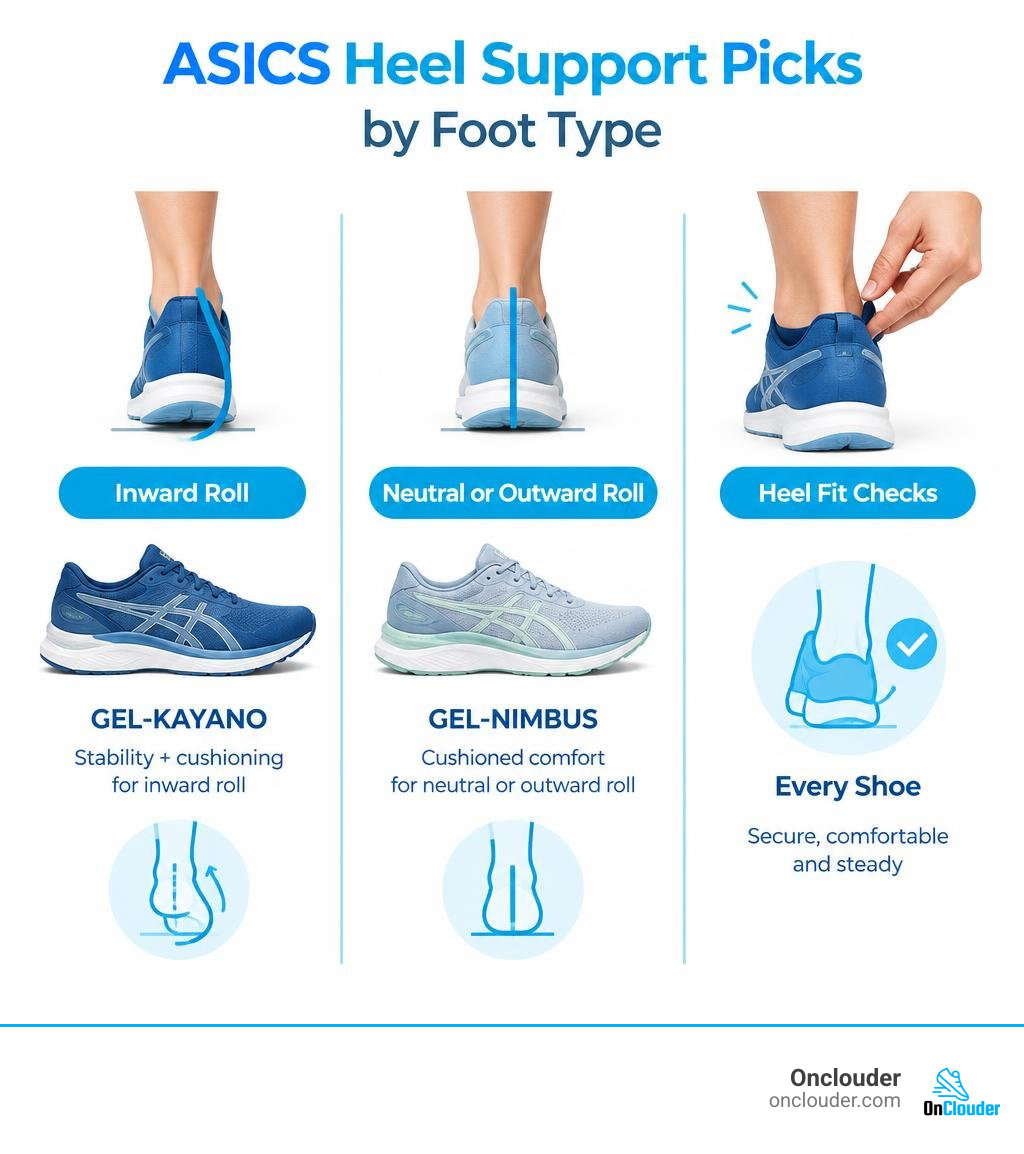
Start with your foot type. If your feet roll inward when you walk, look at the GEL-KAYANO 32. It pairs heel cushioning with a stability system. If your stride is neutral or your feet roll outward, try a cushioned neutral shoe like the GEL-NIMBUS. Want a walking-specific shoe? Check out the WALK RIDE FF. But test its heel fit first before you pick it over the running options.
With plantar fasciitis, a secure heel matters just as much as soft cushioning. Your heel shouldn’t slide around or rub. And the shoe should feel steady with every step. Good asics heel support comes from targeted rearfoot cushioning and structured stability. That’s what relieves tension across your foot. Now, no shoe can promise to fix your pain. If your heel pain sticks around, talk to a clinician.
How Heel Support Technology Helps with Plantar Fasciitis
You know that sharp, burning feeling on the bottom of your heel? The one that hits with those first steps in the morning? That’s your plantar fascia screaming for relief. Here’s what’s actually going on. Plantar fasciitis is inflammation or strain in the thick band of tissue along the bottom of your foot. It runs from your heel bone to your toes.
When your foot hits the ground, too much force and uncontrolled motion stretch that band past its limit. So how does ASICS tackle it? With a multi-layered design approach. It stabilizes your rearfoot. Spreads out the vertical forces hitting your foot. And controls how fast your heel deflects

Rearfoot Cushioning and Midsole Impact Absorption
Every time your heel hits asphalt or hard flooring, a shock wave shoots up through your heel bone. And if that impact doesn’t get absorbed? Your plantar fascia develops tiny tears right where it attaches.
ASICS handles this with special rearfoot cushioning. Older models used rearfoot GEL™. Newer ones use lightweight PureGEL™ inserts. Either way, it sits right under your heel bone. Pair that with a responsive midsole like FF BLAST™ PLUS or FlyteFoam™, and the whole platform absorbs those peak forces. Then it spreads them out sideways across the base of the shoe.
Instead of letting your heel bone slam into hard ground, the foam compresses smoothly. It’s a balance of softness and energy return. That keeps pressure off your heel bone. And it doesn’t feel like you’re walking through wet sand — which would just tire out your arch even more.
Guidance Features and Heel Bevel Design
Heel stability isn’t just about soft foam. It’s about controlling how your foot moves through each step. Here’s the problem. If your foot lands on its outer edge and then rolls inward fast? The torque on your plantar fascia goes through the roof.
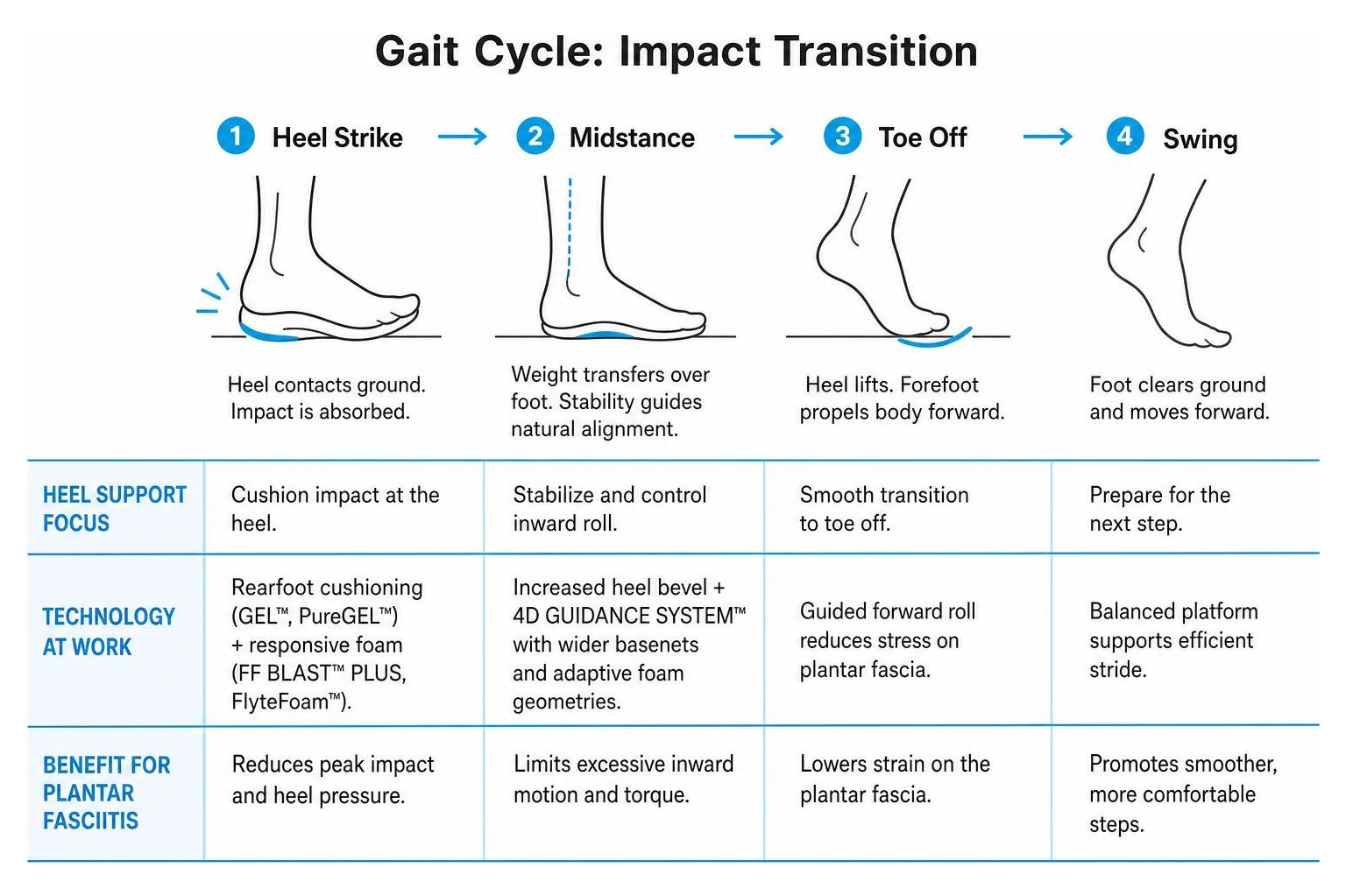
To smooth out that transition, ASICS adds an increased heel bevel. That’s the curved, rounded shape at the back of the sole. Think of it like a gentle landing ramp — not an abrupt brake. It guides your foot into its natural forward motion.
Then there’s the 4D GUIDANCE SYSTEM™. You’ll find it in models like the GEL-KAYANO series. It uses wider basenets and adaptive medial foam. So the midsole resists too much inward rolling on its own. No stiff plastic posts needed — the kind that can bruise sensitive arches.
nternal Heel Counter and Rearfoot Lockdow
Cushioning under your foot won’t help if your heel slides side to side inside the shoe. So ASICS uses a structured, rigid internal heel counter. It cups your rearfoot and stabilizes the joint underneath.
By locking your heel bone firmly in place, this counter stops unwanted rearfoot movement. That’s movement that stresses your Achilles tendon and plantar fascia. Newer versions also add a reinforced tongue wing and padded ankle collars. The result? No heel slippage at all. And your custom orthotics or footbeds stay put under your feet.
Top Shoes Ranked by Heel Support and Foot Type
To help you find the right match for your stride, we have broken down ASICS’ premier heel-support models based on pronation control, stack architecture, and target comfort levels.
| Model | Heel Drop | Pronation Profile | Midsole Foam | Price Range | Best For |
|---|---|---|---|---|---|
| GEL-KAYANO 32 | 8 mm | Overpronation | FF BLAST™ PLUS / PureGEL™ | $165 | Severe/Moderate Overpronation, Daily Stability |
| GEL-NIMBUS 23 / Modern | 10 mm (Men) / 13 mm (Women) | Neutral / Underpronation | FlyteFoam™ / Rearfoot GEL™ | $150 – $160 | Calcaneal Spurs, Maximum Cushioning |
| GT-2000 Series | 8 mm | Mild to Moderate Overpronation | FlyteFoam™ / PureGEL™ | $140 | Everyday Structured Support, Road Walking |
| GT-1000 Series | 8 mm | Mild Overpronation | FF BLAST™ / Rearfoot GEL™ | $100 – $110 | Budget-Friendly Walking & Standing |
| WALKRIDE FF | 8–10 mm | Neutral to Mild Support | FlyteFoam™ | $120 – $130 | Dedicated Walking, Dog Walking |
Premium Stability Shoe: Best Overall Heel Support for Overpronation
The premier choice in the stability category is the ASICS GEL-KAYANO 32. Built specifically for runners and walkers whose arches collapse inward, the Kayano has long served as a benchmark for structured comfort. The shoe utilizes a generous stack of FF BLAST™ PLUS foam paired with rearfoot PureGEL™ and an 8 mm heel drop.
The men’s and women’s models are tuned with gender-specific midsole densities and arch accommodations:
- Consider the GEL-KAYANO 32 Men’s for structured support across a wider platform.
- Consider the GEL-KAYANO 32 Women’s for tailored flex grooves and targeted arch wrap.
The combination of a reinforced arch wing, a flared heel bevel, and deep internal heel cup makes the Kayano 32 an elite solution for managing severe overpronation and reducing chronic plantar fascia tension.
Maximum-Cushioning Shoes for Neutral Walkers and Calcaneal Spurs
If you have a neutral gait or tend to underpronate (roll outward), you do not need aggressive medial stability blocks. Instead, you need cloud-like impact attenuation to offload calcaneal spurs, plantar bursitis, or metatarsalgia.
This is where neutral plush trainers like the ASICS GEL-NIMBUS series shine. Detailed in medical reviews of the GEL-NIMBUS 23 design, this lineup uses a deep rearfoot foam stack and an anatomical heel counter that cups the sub-talar joint.
By providing unrestrained forefoot flexion alongside heavy rearfoot shock absorption, the Nimbus redistributes heel-strike pressure evenly across the outsole. This prevents isolated hotspots directly under the calcaneus, offering significant relief for walkers dealing with heel spurs.
Everyday Stability Shoes: Value Options
If you need dependable heel support without the top-tier price tag, ASICS provides exceptional alternatives in its GT lineup:
- ASICS GT-2000 Series: Sitting right below the Kayano, the GT-2000 provides lightweight structured support. It features a responsive FlyteFoam™ or FF BLAST™ midsole, rearfoot PureGEL™, and subtle guidance lines that gently nudge the foot through a neutral path. It is nimble, highly durable, and excellent for daily 5-mile walks.
- ASICS GT-1000 Series: Serving as a fantastic value option, the GT-1000 provides entry-level stability. While it features a slightly firmer foam compound, its rigid internal heel counter and rearfoot GEL™ unit offer genuine support for mild overpronators on a budget.
Choosing the Right Model by Fit, Width, and Activity
A shoe’s supportive features are only as effective as its fit. When matching an ASICS shoe to your lifestyle, consider your walking surface, daily distance, and specific foot contours.
For paved surfaces and daily errands, stability road trainers excel. If you frequently find yourself walking on hard surfaces or require specialized footwear for your job, understanding the all-day standing shoe requirements is crucial. Concrete offers zero shock absorption, meaning your shoe’s rearfoot foam and bevel geometry have to shoulder 100% of the impact.
Width Options and Lacing Strategies for Custom Heel Support
Heel slippage is a primary trigger for plantar fascia flare-ups because it forces the toes and plantar muscles to claw the footbed for stability. ASICS offers a wide array of widths to prevent this:
- Narrow (2A): Ideal for slender feet that swim in standard heel cups.
- Standard (B for women, D for men): The standard baseline fitting.
- Wide (D for women, 2E for men): Broadens the toe box while retaining a structured rearfoot.
- Extra-Wide (2E/4E for women, 4E for men): Maximum volume throughout the shoe.
If you struggle with managing narrow heels and wide forefoot profiles, sizing up to a wide shoe can sometimes cause your heel to slide.
To solve this, use the runner’s loop (heel-lock lacing) technique:
- Thread each lace through the extra top eyelet toward the outside of the shoe, creating a small loop on each side.
- Cross the lace ends over the tongue and feed each end through the opposite loop.
- Pull downward and forward to cinch the collar firmly around your ankle bone, then tie a standard bow.
This simple adjustment locks your calcaneus into the heel counter without requiring you to overtighten the laces across the top of your foot.
Heel Support Differences Across Men, Women, and Kids Footwear
ASICS tailors its rearfoot architecture differently depending on the target wearer:
- Women’s Models: Women typically present a narrower heel-to-forefoot ratio and a wider Q-angle (pelvic width to knee). ASICS often integrates a slightly higher heel drop (up to 2–3 mm higher than men’s counterparts) and softer midsole densities in women’s shoes to ease Achilles tension and cushion lighter body weights.
- Men’s Models: Feature wider heel basenets and firmer internal counters to resist deformation under heavier loads.
- Kids’ Footwear: Growing feet have softer bones and developing arches. ASICS youth shoes prioritize flexible midsoles with reinforced external heel counters to guide natural bone alignment without artificially restricting motion.
Frequently Asked Questions About Heel Pain and Footwear
What makes heel support effective for plantar fasciitis and heel spurs?
Effective heel support combines impact cushioning with rigid structural control. A shoe must absorb the initial shock at heel strike using responsive foams or gel inserts while simultaneously cradling the calcaneus in a stiff counter.
Additionally, a moderate heel drop (between 8 mm and 10 mm) slightly elevates the rearfoot, reducing the resting tension on the Achilles tendon and the attached plantar fascia.
How does a rigid heel counter prevent heel slippage and Achilles strain?
An internal heel counter wraps around the posterior and lateral walls of your heel bone. By locking the sub-talar joint in place, it prevents lateral wobble and excessive internal rotation during foot strike.
This keeps your foot moving strictly within the sagittal plane, reducing friction, eliminating blisters, and preventing the Achilles tendon from twisting at its insertion point.
Which shoes offer extra-wide widths to prevent heel rubbing?
Models like the ASICS GEL-KAYANO and GT-2000 are readily available in 2E (Wide) and 4E (Extra-Wide) options for men, as well as D (Wide) options for women. These wide iterations increase forefoot volume and midfoot space while maintaining a contoured rearfoot pocket, ensuring your toes can splay without your heel slipping out of place.
Conclusion
Plantar fasciitis and chronic heel pain can derail your daily routine, but selecting the right footwear can transform your comfort with every step. Whether you need the adaptive, pronation-correcting architecture of the GEL-KAYANO 32 or the plush, shock-absorbing protection of the GEL-NIMBUS series, matching your shoe’s heel support to your individual gait is essential for long-term foot health.
Take the time to evaluate your foot type, use heel-lock lacing to eliminate friction, and choose widths that match your foot’s natural anatomy. For more clinical recommendations on managing heel conditions, explore podiatrist-approved footwear for plantar fasciitis relief to keep your feet supported on every walk.