

Why Running Overpronation Affects More Runners Than You Think
Running overpronation is one of the most common biomechanical patterns in runners — and one of the most misunderstood. Here’s what you need to know at a glance:
Quick answers:
- What it is: Your foot rolls too far inward when it lands, causing your arch to flatten more than it should
- How common: Around 50% of runners overpronate naturally
- Is it dangerous? Not always — research shows overpronators are not at higher injury risk than other runners
- How to check: Look at your shoe soles — wear on the inner edge suggests overpronation
- What helps: The right footwear, targeted strength work, and sometimes orthotics
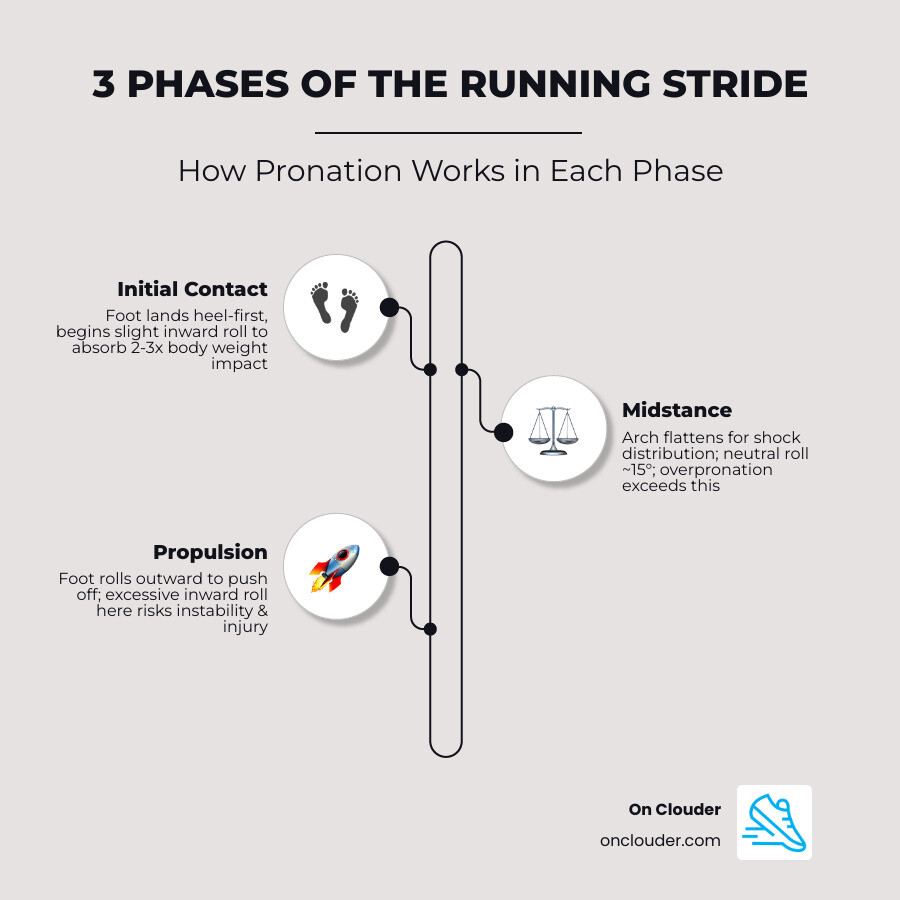
Pronation itself is completely normal. Every runner’s foot rolls inward slightly with each step — it’s how your body absorbs shock. The problem only starts when that inward roll goes too far or lasts too long through the stride cycle.
What surprises most runners? Despite stability shoes existing since the early 1980s, running injury rates have stayed stubbornly around 50% per year. That tells us footwear alone isn’t the full answer.
Whether you’re logging daily miles, pulling long shifts on your feet, or just starting out, understanding how your feet move is the first step toward running — and feeling — better.
At On Clouder, our team of footwear experts has spent years helping runners and active professionals navigate the complexities of running overpronation and find shoes that genuinely support their movement. In this guide, we’ll walk you through everything the research actually says — and what to do about it.
What is Running Overpronation?
To understand running overpronation, we first have to appreciate that our feet are marvels of engineering. As of April 2026, the consensus in sports medicine, supported by organizations like the American Podiatric Medical Association, remains that pronation is not a “defect” but a vital shock-absorption mechanism.
When your foot hits the ground, it naturally rolls inward. This motion allows the arch to flatten slightly, distributing the impact of the ground reaction forces. A “neutral” gait typically involves an inward roll of about 15 degrees. However, running overpronation occurs when the foot continues to roll inward past this point, or when the arch collapses excessively.
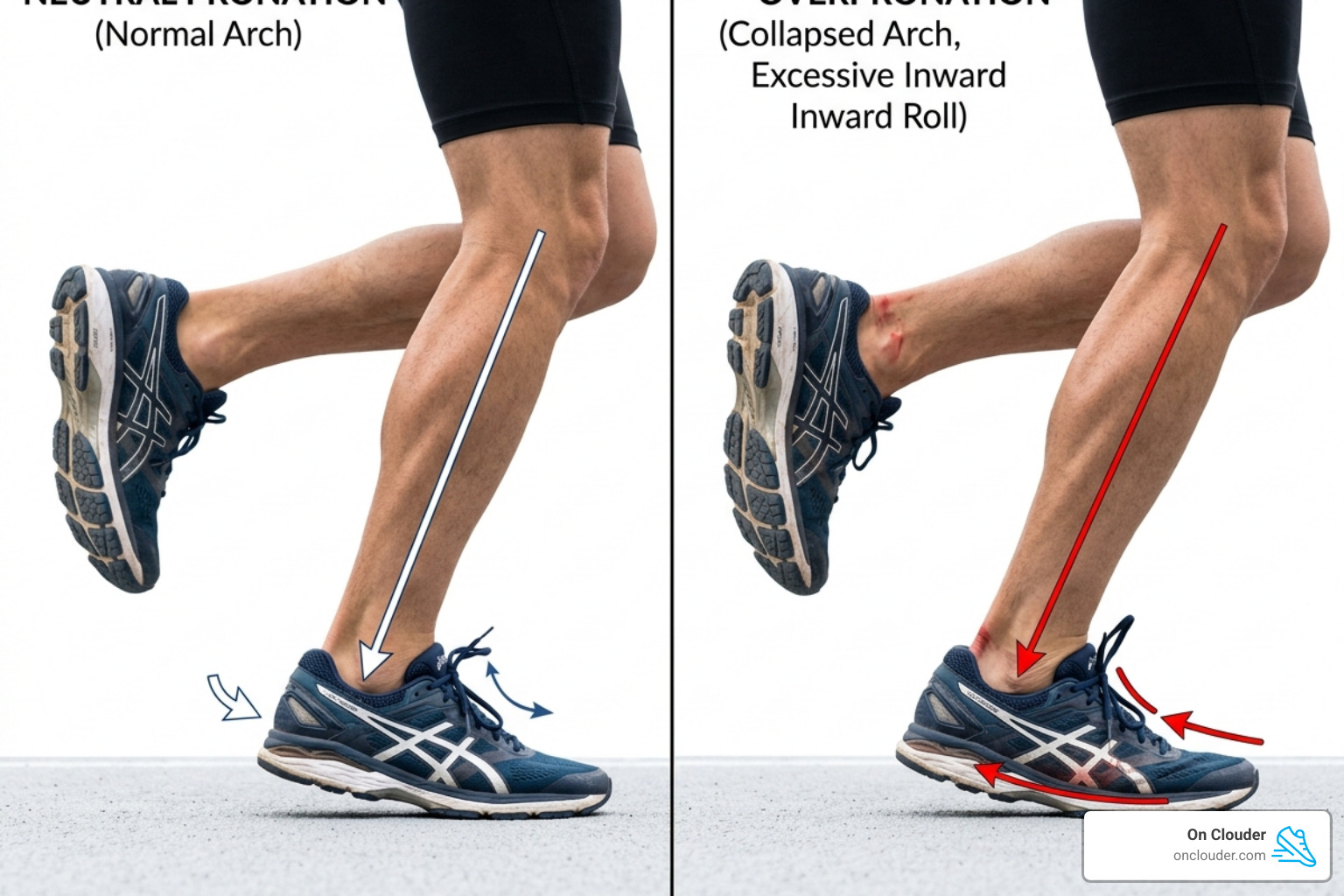
In an overpronated stride, the weight is not distributed evenly across the ball of the foot. Instead, it shifts heavily toward the medial (inner) edge. This forces the big toe and second toe to do more of the work during the “toe-off” phase, which can lead to instability further up the kinetic chain. For a deeper dive into the basics, check out our Understanding Pronation in Running: A Comprehensive Guide.
The Mechanics of Running Overpronation
Biomechanically, running overpronation is a tri-planar movement. It involves eversion (turning the sole outward), abduction (pointing the toes away from the midline), and dorsiflexion. When these happen in excess, the ankle rotates internally more than it should.
This internal rotation doesn’t stay at the ankle; it travels up the leg, affecting the shin bone (tibia) and even the femur (thigh bone). This is why many runners who struggle with overpronation don’t just feel it in their arches – they feel it in their knees and hips. If you’ve ever felt like your legs are “knocking” together while you run, you might be looking for Pronation Support to help stabilize that medial side.
Why Your Feet Roll Inward
Why do some of us roll more than others? It usually comes down to a mix of three factors:
- Genetics and Anatomy: Many runners are born with naturally flat feet or low arches. If the structural “bridge” of your foot is low, it is much easier for it to collapse under weight.
- Ligament Laxity: Some people have “looser” ligaments, meaning the soft tissues that hold the bones of the foot together are more flexible, allowing for more movement.
- Muscle Fatigue and Weakness: This is a big one. As you get tired during a long run, the muscles that support your arch – like the tibialis posterior – can stop firing effectively. This is why you might start with a neutral stride and end your run with significant running overpronation.
For more details on these triggers, see our guide on the Causes of Overpronation in Runners.
How to Identify Your Foot Type and Stride
You don’t necessarily need a PhD in biomechanics to figure out if you’re an overpronator. There are several low-tech ways to get a good idea of what’s happening beneath your ankles.
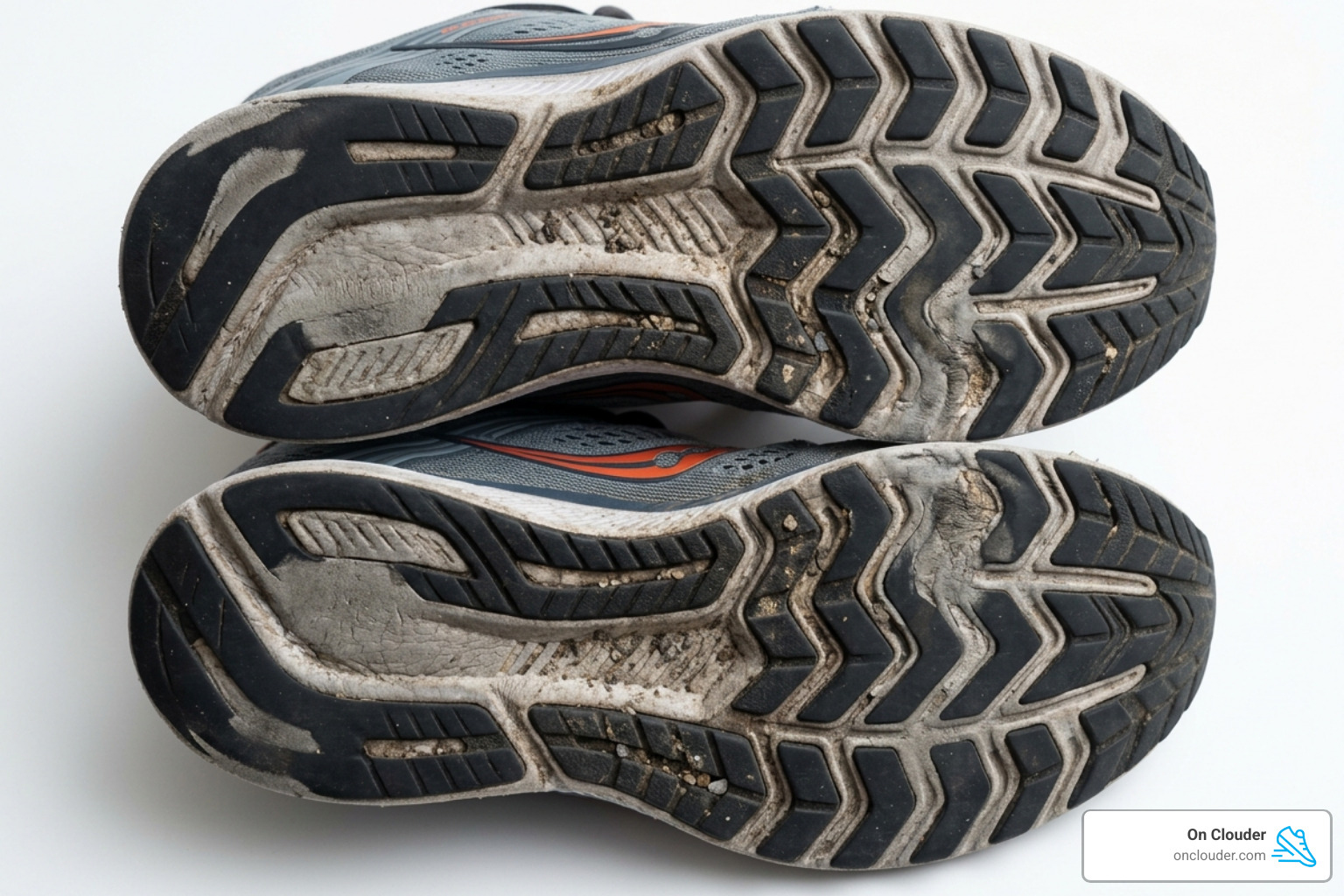
The most famous DIY method is the Wear Test. Take a pair of your old running shoes and look at the outsoles.
- Overpronation: You’ll see significant wear on the inside of the heel and under the ball of the foot (especially near the big toe).
- Neutral: The wear is centralized on the ball of the foot and the outer heel.
- Supination (Underpronation): The wear is concentrated on the outer edge of the shoe.
Another classic is the Wet Foot Test. Wet your sole and step onto a piece of cardboard. If you see a full footprint where the entire arch is visible, you likely have flat feet and a tendency toward overpronation. If you only see the heel and the ball with a thin line connecting them, you have high arches. You can find a step-by-step walkthrough in our article on How to Tell if You Overpronate or Underpronate.
Professional Gait Analysis
While DIY tests are great for a “vibe check,” a professional gait analysis is the gold standard. Many facilities now offer treadmill video analysis, filming you from behind while you run at your natural pace, then playing it back in slow motion to measure the exact angle of your ankle’s inward roll.
Some high-end clinics even use 3D mapping and pressure plates to see exactly where your weight is distributed. This is incredibly helpful because it moves beyond just “looking at the feet” and looks at how your knees and hips are behaving. If you’re serious about your training, exploring our resources on Stability Running can save you months of trial and error.
Common Injuries Linked to Running Overpronation
We want to be clear: running overpronation does not guarantee an injury. However, because it changes how force travels through your body, it is often associated with specific “overuse” issues:
- Shin Splints: The excess rotation pulls on the muscles attached to your shin bone.
- Plantar Fasciitis: The arch collapse overstretches the thick band of tissue under your foot.
- Runner’s Knee (Patellofemoral Pain): The inward rotation of the tibia can cause the kneecap to track incorrectly.
- Achilles Tendonitis: The tendon has to twist slightly to accommodate the heel’s inward tilt, leading to inflammation.
If you’re currently sidelined, our resource on Overpronation and Common Running Injuries can help you identify the culprit.
Effective Management and Correction Strategies
If you’ve identified that you overpronate, the next question is: What do I do about it? The modern approach is holistic. It’s not just about slapping on a heavy shoe; it’s about a “toolkit” of strategies.
| Feature | Stability Shoes | Neutral Shoes |
|---|---|---|
| Midsole | Multi-density foam (firmer on the inside) | Uniform, cushioned foam |
| Support | Integrated support systems | Minimal structural interference |
| Best For | Mild to moderate overpronation | Neutral runners or supinators |
| Weight | Typically slightly heavier | Typically lighter |
Modern stability shoes have come a long way since the clunky “orthopedic” looks of the past. Today, they use “support frames” and “adaptive support systems” that act like bumpers on a bowling alley—they only kick in when your foot starts to veer too far off course. For our top picks this year, see The 9 best stability shoes for every type of overpronator.
Strength Training for Foot Stability
Shoes are a great external tool, but your muscles are your internal “stability shoes.” Strengthening the kinetic chain is often more effective than any piece of foam.
- Short Foot Drills: Try to “shorten” your foot by pulling the ball of your foot toward your heel without curling your toes. This engages the intrinsic muscles of the arch.
- Calf Raises: Strong calves help control the descent of the heel and support the ankle.
- Clamshells: Most people don’t realize that running overpronation is often caused by weak hips. If your gluteus medius is weak, your knee dives inward, which forces your foot to collapse.
- Tibialis Posterior Strengthening: This is the primary muscle that holds up your arch. Weighted “inversion” exercises can help bulletproof this area.
Many runners find that by focusing on Stability Shoes in conjunction with these exercises, they can eventually move toward more flexible footwear.
Insoles and Orthotic Support
Sometimes, a shoe isn’t enough, or perhaps you have a favorite pair of neutral shoes you aren’t ready to give up. This is where insoles come in.
Over-the-counter (OTC) insoles provide a firm arch bridge that prevents the foot from collapsing. For runners with severe biomechanical issues, custom orthotics from a podiatrist might be necessary. However, a 2020 study suggested that for many, a combination of strengthening and a well-selected shoe is just as effective as expensive custom inserts. If you have particularly flat feet, check out The 5 best running shoes for flat feet overpronation 2026 guide for tailored advice.
Debunking Myths About Foot Rotation
It’s time for some “real talk.” For decades, the running industry treated overpronation like a disease that needed to be “cured.” But the data tells a different story.
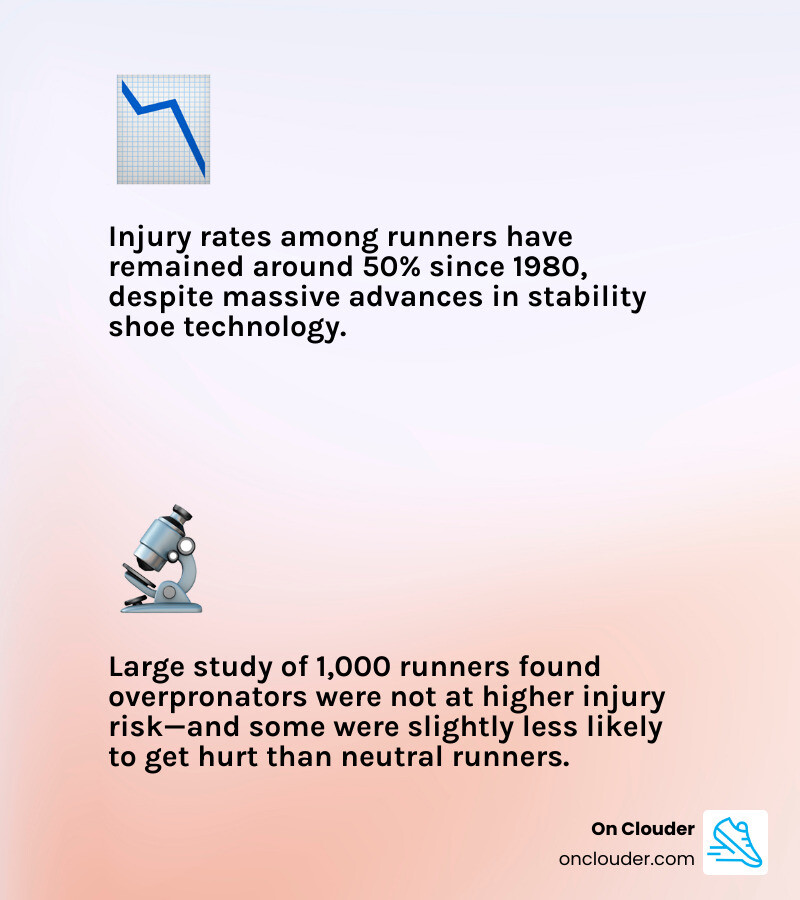
Myth 1: Overpronation causes all injuries. Actually, a massive study of 1,000 runners found that a more pronated foot was not associated with a higher injury risk. In fact, some overpronators were slightly less likely to get injured than neutral runners.
Myth 2: You MUST have stability shoes if you overpronate. Not necessarily. Comfort is the best predictor of injury prevention. If you overpronate but have run 500 miles in neutral shoes without a single ache, don’t change a thing. “If it ain’t broke, don’t fix it” is a golden rule in running.
Myth 3: Overpronation is “bad” form. Pronation is human. It is how we store energy and absorb impact. Without it, we would be incredibly inefficient runners. The goal isn’t to stop the roll; it’s to manage it so it doesn’t cause pain. To learn more about the shift in how we view gait, read Fixing Overpronation: Myths vs. Reality.
Frequently Asked Questions about Overpronation
Is overpronation a permanent condition?
If your overpronation is due to bone structure (flat feet), that won’t change. However, if it’s “functional” overpronation caused by weak muscles or tight tendons, you can significantly reduce it through physical therapy and strength training.
Can I run in neutral shoes if I overpronate?
Yes! Many overpronators prefer the feel of neutral shoes. If you have strong feet and hips, or if you use a supportive insole, a neutral shoe can work perfectly fine. The key is to monitor for any emerging “niggles” in your shins or knees.
When should I see a physical therapist for my gait?
If you have recurring injuries that always happen on the same side, or if you experience sharp pain that doesn’t go away after two days of rest, see a pro. A PT can tell you if your stability issues are coming from your feet or further up in your hips.
Conclusion
At On Clouder, we believe that every runner’s journey is unique. Whether you’re an “extreme” overpronator or just someone whose arches get a little tired after ten miles, understanding your biomechanics is empowering.
As we move through April 2026, the focus has shifted away from “correcting” runners and toward “supporting” them. Don’t let the term “overpronation” scare you. With the right mix of good running shoes for flat feet and a solid strength routine, you can run pain-free for years to come.
If you want to keep learning, start with our guide to good running shoes for flat feet and explore more On Clouder resources on support, fit, and comfort.
