

When Your Arches Work Against You: Finding the Right Insoles for High Arches
The best insoles for high arches provide firm arch support, deep heel cups, and shock-absorbing cushioning to distribute pressure evenly across your foot. Here are the top picks:
| Insole | Best For | Price | Rating |
|---|---|---|---|
| Superfeet All-Purpose Support High Arch | Everyday & work shoes | $59.99 | 4.7/5 (1,502 reviews) |
| PowerStep Pinnacle High | Supination control | ~$40-$50 | 4.6/5 (926 reviews) |
| Superfeet Run Cushion High Arch | Running & training | $59.99 | 4.75/5 (323 reviews) |
| Primal Soles Cortiças™ | Eco-conscious athletes | $42.00 | 4.8/5 (152 reviews) |
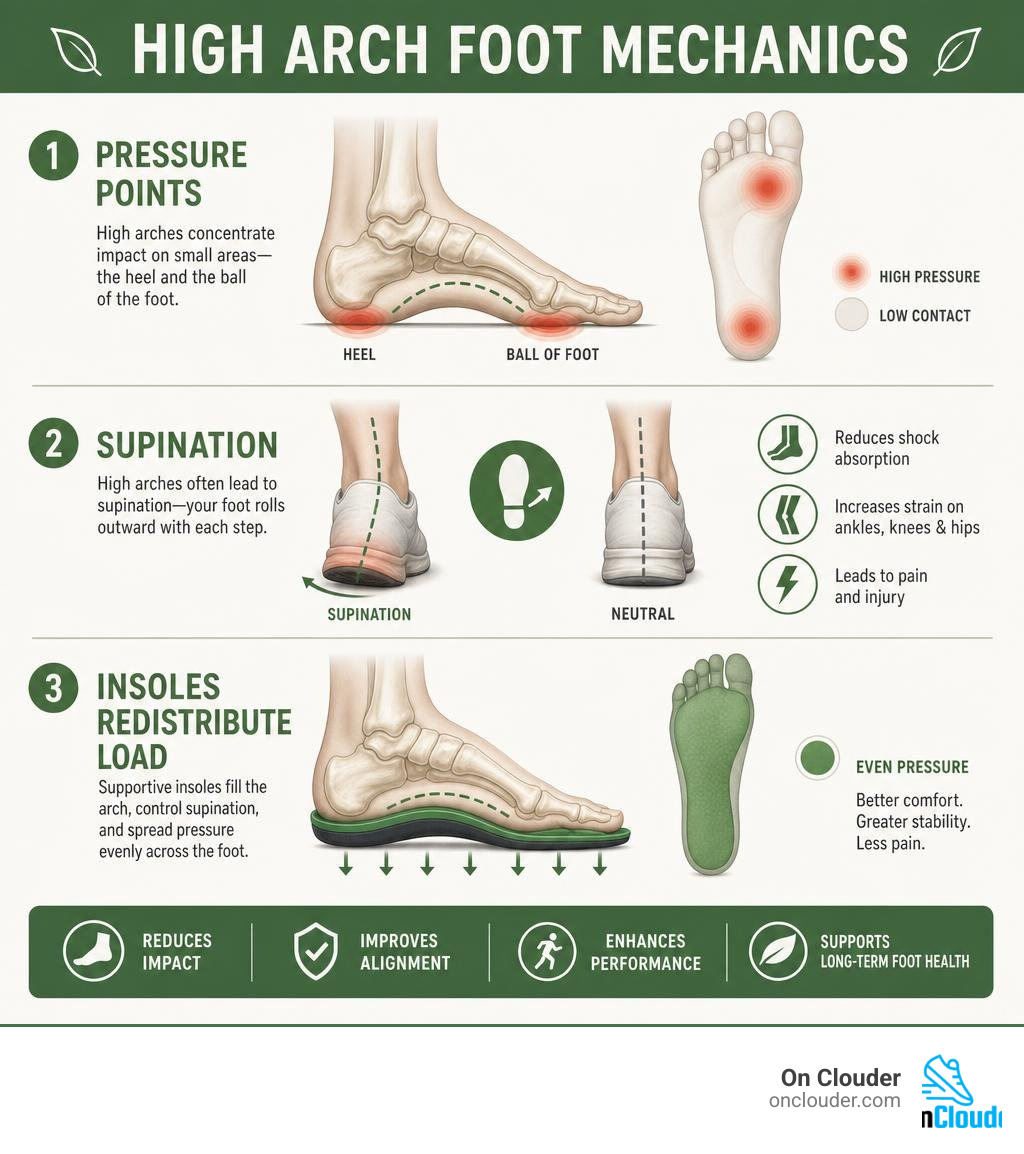
High arches affect roughly 20-30% of the population — and they’re not just a cosmetic quirk. A high arch is naturally rigid. Unlike a moderate arch, it doesn’t flex and spread on impact. Instead, shock slams straight into two small zones: your heel and the ball of your foot.
That concentrated pressure is why so many people with high arches end up dealing with plantar fasciitis, ankle sprains, and stress fractures. Add in supination — where your foot rolls outward with each step — and you’ve got a recipe for chronic pain that creeps up from your feet into your knees and hips.
The good news? The right insole can fill that hollow under your arch, spread the load, and bring real relief.
I’m Faisal S. Chughtai, a footwear specialist with a career dedicated to helping people find the right fit for their feet — and I’ve spent considerable time researching and evaluating insoles for high arches across dozens of brands and foot types. In the sections below, I’ll walk you through exactly what to look for and which options are worth your money.
Insoles for high arches word roundup:
- gel insoles high arches
- high arch boot inserts
- high arch work boot insoles
Understanding High Arches: Causes, Biomechanics, and Foot Pain
To understand why your feet hurt, we have to look closely at the structure of a high arch, medically known as a pes cavus or cavus foot. While flat feet are often discussed in footwear circles, high arches are the quiet instigators of an entirely different set of physical challenges.
Most high arches are inherited from birth. They are simply the structural blueprint your genetics handed you. However, there is an important clinical caveat: if you suddenly develop a high arch in only one foot later in life, it is crucial to consult a medical professional, as this can sometimes indicate an underlying neurological issue.
Biomechanically, a high arch means your foot lacks the natural shock-absorption system built into moderate arches. When a person with moderate arches walks or runs, their arch collapses slightly to absorb the ground impact. This is called pronation. In contrast, a high arch is structurally rigid and locked in place. Because the middle of your foot never touches the ground, your foot underpronates (also known as supination). Your foot rolls outward, and the force of every step is concentrated exclusively on the heel and the ball of the foot (metatarsal heads).
Over time, this biomechanical imbalance leads to a predictable lineup of painful conditions:
- Plantar Fasciitis: Because the arch is elevated, the thick band of tissue running along the bottom of your foot (the plantar fascia) is kept under constant, excessive tension. This causes painful micro-tears, especially noticeable during your first steps in the morning.
- Metatarsalgia: With no support in the middle of your foot, the ball of your foot bears the brunt of your body weight, leading to burning pain, inflammation, and calluses.
- Ankle Instability and Sprains: Supination causes you to walk on the outside edges of your feet. This shifts your center of gravity outward, making you highly susceptible to ankle wobble and repeated rolled ankles.
- Fat Pad Atrophy: The constant pounding on your heels and forefoot can prematurely wear down the natural protective fat pads on the bottom of your feet.
Understanding these mechanics is the first step toward relief. For a deeper dive into how different foot shapes interact with under-the-foot support, you can read about How to Find the Best Insoles For High Arches & Flat Feet.
High Arches vs. Flat Feet: The Biomechanical Difference
The difference between a high arch and a flat foot is essentially the difference between a rigid spring and a collapsed one.
Flat feet lack structural integrity, causing the foot to roll too far inward (overpronation). This places stress on the inside of the ankle, knee, and hip. To correct this, flat feet require structural control to prevent the arch from collapsing.
High arches, on the other hand, are already too rigid. They do not roll inward enough to absorb shock. Instead of trying to “correct” or flatten this shape, insoles for high arches must fill the empty space under the foot. By making physical contact with the entire arch, the insole acts as a bridge, distributing your body weight across the entire surface area of your foot rather than letting it slam down on just the heel and forefoot. For a detailed comparison of products addressing these distinct structures, check out The Top High Arch Support Insoles Reviewed.
How to Determine Your Arch Type at Home
If you aren’t entirely sure whether your arches qualify as high, you can perform a quick, reliable assessment at home using the classic wet footprint test:
- Pour a thin layer of water into a shallow pan.
- Step into the water to wet the bottom of your foot.
- Step firmly onto a blank piece of heavy paper or cardboard.
- Step off and look at the wet impression left behind.
If you see a very narrow wet band along the outer edge of your foot, or if the connection between your heel and the ball of your foot is completely invisible, you have high arches.
You can also perform a visual check: if your arch remains visibly raised and hollow even when you are standing and bearing your full weight, you have a high arch. Lastly, look at the soles of your favorite shoes. If the outer edges of the soles show significantly more wear and tear than the inside edges, your feet are supinating due to a high arch. For practical advice on managing these symptoms in daily life, take a look at Don’t Let High Arches Boot You Out of Comfort.
How Insoles for High Arches Prevent Injury and Relieve Pain
The primary goal of insoles for high arches is to distribute pressure evenly and absorb shock. When you place a high-profile, structured insole into your shoe, it fills the empty, hollow middle space. Suddenly, the surface area bearing your weight increases dramatically.
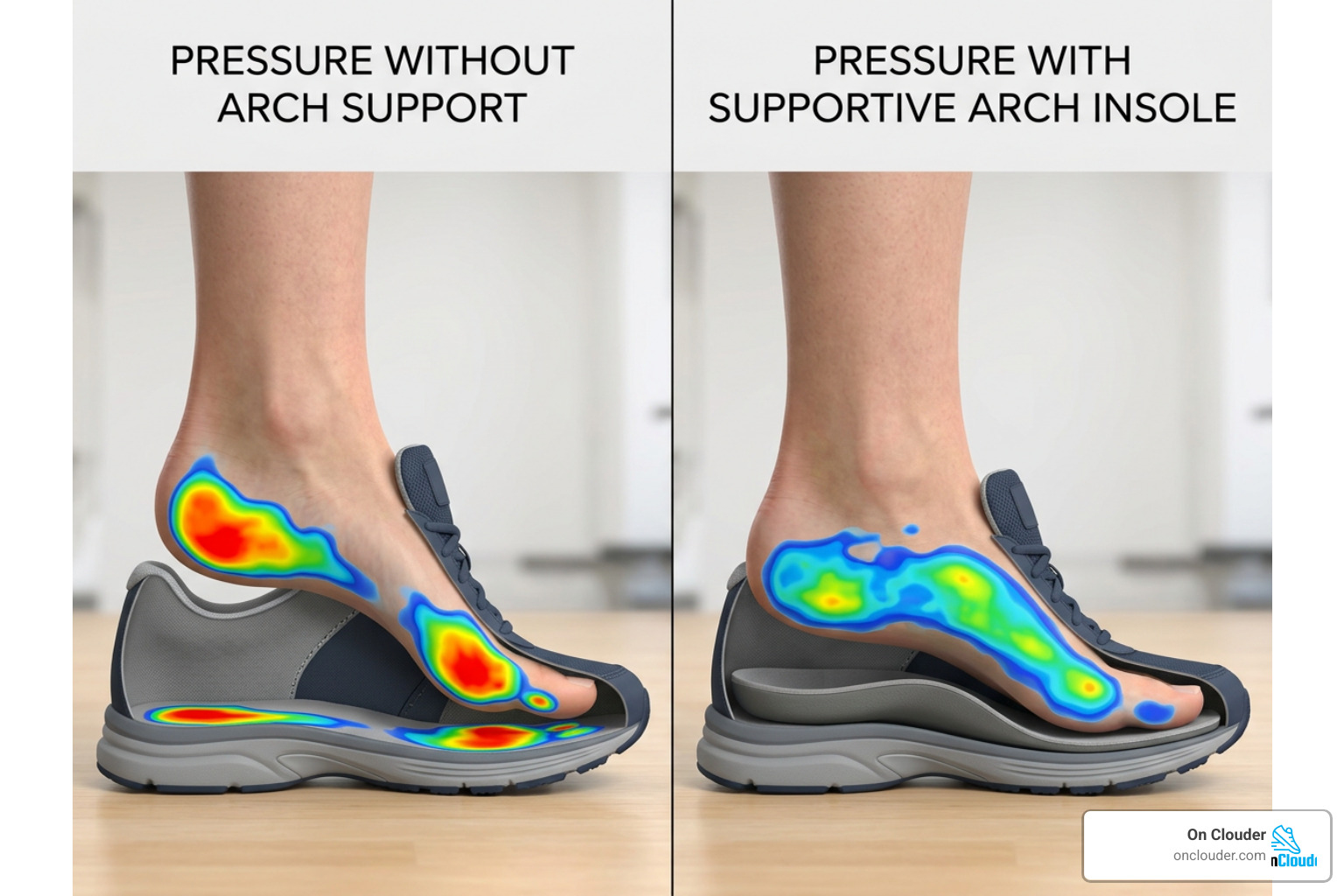
By spreading the load, these insoles take the extreme pressure off your metatarsal heads and heel bone. Furthermore, a deep heel cup stabilizes the rearfoot, keeping your heel locked in place and preventing the outward ankle roll that characterizes supination. This alignment radiates upward, keeping your ankles, knees, hips, and lower back in proper skeletal alignment. To learn more about how quality inserts achieve this pressure relief, read the guide on Shoe Inserts for High Arches.
Key Features of the Best Insoles for High Arches
When shopping for the best insoles for high arches, you should look for several non-negotiable features:
- Firm, Contoured Support: Many people make the mistake of buying soft, pillowy foam inserts. While they feel nice for the first five minutes, soft foam easily compresses under your weight, leaving your high arch floating without support. You need a firm, structured arch shell (often made of polypropylene, cork, or dense foam) that maintains its shape.
- Deep Heel Cup: A deep, sculpted heel cup cradles the heel fat pad and keeps the foot centered, preventing the outward roll of supination and providing natural shock absorption.
- Targeted Cushioning: Look for insoles that combine a firm support shell with responsive, shock-absorbing foam or gel pads in high-impact zones like the heel and forefoot.
- Footwear-Appropriate Materials: The materials should match your daily activity, balancing rigidity for work boots with flexibility for running shoes. For an in-depth look at what goes into these designs, explore The Most Comfortable Materials for High Arch Support.
Over-the-Counter Insoles vs. Custom Orthotics
One of the most common questions we encounter is whether you should buy over-the-counter (OTC) insoles or invest in custom orthotics from a podiatrist.
| Feature | Over-the-Counter (OTC) Insoles | Custom Orthotics |
|---|---|---|
| Cost | $30 – $80 | $300 – $600 |
| Accessibility | Available immediately online or in-store | Requires podiatrist visits and casting |
| Lifespan | 6 to 12 months | 2 to 5 years |
| Best For | Mild to moderate pain, general support, athletic use | Severe structural issues, clinical pain, unequal leg lengths |
For the vast majority of people with high arches, premium OTC insoles are highly effective. Modern high-end OTC brands offer medical-grade materials, firm arch shells, and deep heel cups that rival custom designs at a fraction of the cost. They serve as an excellent first line of defense. However, if you have tried high-quality OTC insoles for several weeks and still experience severe, debilitating pain, or if you have a history of complex structural injuries, a professional podiatric evaluation and custom orthotics are well worth the investment.
Top Recommended Insoles for High Arches and Supination
Finding the perfect fit can feel overwhelming with so many options on the market. To help you decide, we have selected and compared the top podiatrist-recommended insoles for high arches based on performance, durability, and support.
Superfeet All-Purpose Support High Arch
Formerly known to long-time fans as Superfeet Green, the Superfeet All-Purpose Support High Arch is a legendary product in the foot health industry. Approved by the American Podiatric Medical Association (APMA), this insole is built for those who require maximum, uncompromising support.
- Key Features: It features a heavy-duty stabilizer cap at the base, a deep, sculpted heel cup that maximizes natural shock absorption, and high-density closed-cell foam cushioning.
- Support Level & Feel: This is a very firm, rigid insole. It does not compress, providing a rock-solid foundation that keeps your foot aligned all day.
- Best For: Everyday wear, spacious casual shoes, hiking boots, and work boots. It requires shoes with removable factory insoles to ensure your foot has enough room.
- Learn More: Read the full specifications directly on the All-Purpose Support High Arch page.
PowerStep Pinnacle High Insoles
If you struggle with severe supination and need a blend of structured support and comfortable cushioning, the PowerStep Pinnacle High Insoles are an outstanding choice.
- Key Features: These insoles utilize a medical-grade, firm but flexible polypropylene arch shell combined with a double layer of foam cushioning. An odor-control top fabric keeps feet fresh during long days.
- Support Level & Feel: They offer a slightly more forgiving feel than the Superfeet Green, combining a rigid arch contour with a plush top layer that cushions the heel and ball of the foot.
- Best For: Individuals suffering from plantar fasciitis, metatarsalgic pain, and outward ankle rolling.
- Learn More: Check out sizing and availability details on the PowerStep Pinnacle High Insoles page.
Top Rated Insoles for High Arches on the Market
For active runners and those looking for alternative materials, two other options stand out:
Superfeet Run Cushion High Arch
Designed specifically for runners and walkers, this insole features Superfeet’s Adaptive Comfort Technology. Unlike their rigid everyday models, this insole is designed to flex with your foot, facilitating an efficient heel-to-toe transition while running. It offers soft, maximum-thickness cushioning using an Aerolyte dual foam layer, making it perfect for absorbing the impact forces of running (which can equal up to 2.5 times your body weight per step).
Primal Soles Cortiças™
For the eco-conscious consumer, the Primal Soles Cortiças™ represents a major innovation. Made from regenerative Mediterranean cork and upcycled shoe waste, these insoles are carbon-negative and fully recyclable. Cork is naturally antibacterial, highly breathable, and moisture-wicking. Biomechanically, cork provides a unique combination of firm structure and natural molding, conforming slightly to your high arch over time while maintaining supportive rigidity. Read more on the High Arch Cortiças™ product page.
Maximizing Comfort: Footwear Compatibility, Care, and Fit Tips
Buying the right insole is only half the battle; you also need to ensure they are fitted, worn, and cared for properly to get the maximum benefit.
When you first receive your high arch insoles, do not expect to wear them for a 12-hour shift right out of the box. Because your feet are accustomed to having no support under your arch, a firm insole will feel strange at first — some describe it as standing on a tennis ball.
We recommend a gradual break-in period:
- Day 1-2: Wear them for 1 to 2 hours.
- Day 3-4: Increase wear time to 3 to 4 hours.
- Day 5-7: Wear them for a full day of low-impact activity.
- Week 2: Begin using them for high-impact running or long working shifts.
Shoe Compatibility and Proper Fit
To ensure a proper fit, always remove the factory liner or insole that came with your shoes before inserting your new high arch insoles. Leaving the original liner in place will cramp your foot, causing friction, blisters, and pain across your instep.
Make sure your footwear matches the volume of the insole. Rigid insoles like Superfeet require roomy or moderate-fitting shoes, such as daily trainers, hiking boots, or work boots. If you are shopping for running shoes to pair with your inserts, check out our Comparison: Best Running Shoes for High Arches.
Lifespan and Care of Your Insoles
Most high-quality OTC insoles are designed to last between 6 to 12 months with regular use, or roughly 300 to 500 miles of running. However, their lifespan depends heavily on your body weight, activity level, and the environment.
To keep them in top condition:
- Hand Wash Only: Never throw your insoles into a washing machine or clothes dryer. The heat and tumbling will warp the supportive plastic or cork shell. Instead, hand wash them with warm water and a mild detergent, rinse thoroughly, and let them air dry completely.
- Remove to Dry: After a sweaty workout or a rainy day, pull the insoles out of your shoes to let both the shoes and the insoles air out.
- Watch for Replacement Signs: Replace your insoles immediately if the top fabric begins to peel, if the foam cushioning becomes permanently compressed, or if the plastic arch shell feels soft and bends easily under hand pressure. For those wearing heavy-duty footwear daily, check out Clocking In Without the Ouch: A Guide to High Arch Work Boot Insoles.
Frequently Asked Questions about High Arch Support
Do high arches cause supination?
Yes, they frequently do. Because a high arch is rigid and does not collapse inward to absorb shock, the foot naturally rolls outward during your stride. This outward roll (supination) places excess pressure on the outside edge of your foot and your smaller toes, which can lead to chronic ankle sprains, shin splints, and knee discomfort.
How long do insoles for high arches last?
With daily wear, a premium pair of high arch insoles will provide reliable support for about 6 to 12 months. If you use them for high-impact activities like distance running or standing on concrete for 10-hour work shifts, you should plan to replace them closer to the 6-month mark to ensure the cushioning and structural support remain effective.
Can I use high arch insoles in running shoes?
Absolutely. Using high arch insoles in running shoes is highly recommended because running multiplies the impact forces on your heel and forefoot. A supportive running-specific insole, like the Superfeet Run Cushion, will disperse this impact, reduce fatigue, and keep your feet aligned. Just ensure you remove the shoe’s original liner first.
Conclusion
High arches may be a structural challenge, but they do not have to dictate your comfort or limit your active lifestyle. By choosing a high-quality, firm insole that fills the hollow space under your foot, you can distribute weight evenly, prevent painful supination, and find lasting relief from conditions like plantar fasciitis and metatarsalgia.
Whether you choose the rigid support of Superfeet, the cushioned alignment of PowerStep, or the sustainable design of Primal Soles, your feet will thank you for the extra care.
For more expert reviews, shoe recommendations, and deep-dive comparisons tailored to runners, walkers, and hard-working professionals, Explore our comprehensive footwear comparisons here on On Clouder. Let’s keep those feet moving comfortably!
