
The Best Shoes for Overpronation: Quick Picks for 2025/2026
If you’re looking for the best shoes overpronation support can offer, here are the top picks to know right now:
| Shoe | Best For | Support Level |
|---|---|---|
| ASICS Gel-Kayano 32 | Daily running & distance | High stability |
| Brooks Adrenaline GTS 25 | All-around running | Moderate stability |
| Saucony Guide 18 | Everyday training | Moderate stability |
| Hoka Arahi 8 | Lightweight support | Moderate stability |
| New Balance 860v14 | Versatile training | Moderate stability |
| Brooks Addiction Walker 2 | Walking & casual wear | High stability |
| Saucony Omni 22 | Severe overpronation | Maximum stability |
| ASICS GT-1000 14 | Budget-friendly running | Moderate stability |
More than half of all people overpronate to some degree. Many estimates put that number closer to 70%. Yet most people have no idea it’s happening — until the pain starts.
Overpronation means your foot rolls too far inward with each step. Over time, this puts extra stress on your ankles, knees, hips, and lower back. The wrong shoes make it worse. The right ones can make a huge difference.
But here’s the problem: the stability shoe market is crowded, confusing, and full of technical jargon. Terms like GuideRails, 4D Guidance System, and medial posts don’t exactly make shopping easy.
That’s exactly why this guide exists — to cut through the noise and give you clear, honest recommendations based on real data and testing.
I’m Faisal S. Chughtai, a footwear expert with years of hands-on experience helping people find the best shoes overpronation issues demand — from casual walkers to serious runners. In this guide, I’ll walk you through everything you need to make a confident, pain-free choice.
Understanding Overpronation and Its Impact
When we talk about pronation, we are actually describing a natural movement. As your foot strikes the ground, it rolls slightly inward to absorb shock. However, over 50% of people overpronate to a degree that can cause issues, with some experts suggesting that number is as high as 70%.
In a “normal” gait, the foot rolls inward about 15 percent. In overpronation, the foot rolls much further, causing the arch to collapse. This isn’t just a foot problem; it’s a kinetic chain problem. When the arch collapses, it forces the tibia (shin bone) to rotate internally, which then misaligns the knee and can lead to hip and lower back pain.
How to Identify Overpronation
You don’t always need a fancy lab to tell if you’re an overpronator. Here are three quick ways we recommend checking:
- The Wear Test: Look at the bottom of your old shoes. If the inside edge of the sole (near the big toe and the ball of the foot) is significantly more worn down than the outside, you’re likely overpronating.
- The Wet Foot Test: Wet your feet and walk across a piece of cardboard or a dry concrete floor. If your footprint looks like a full, flat oval with no visible curve for an arch, you likely have flat feet, which is heavily associated with overpronation.
- Gait Analysis: Many running stores offer free video gait analysis. Watching your ankle “dive” inward in slow motion is often the “aha!” moment for many runners.
Identifying this early is crucial for injury prevention. If left untreated, chronic overpronation can lead to plantar fasciitis, shin splints, and even stress fractures. For those specifically dealing with flat arches, checking out The 5 best running shoes for flat feet overpronation 2026 guide can provide targeted relief.
Key Features to Look for in Stability Footwear
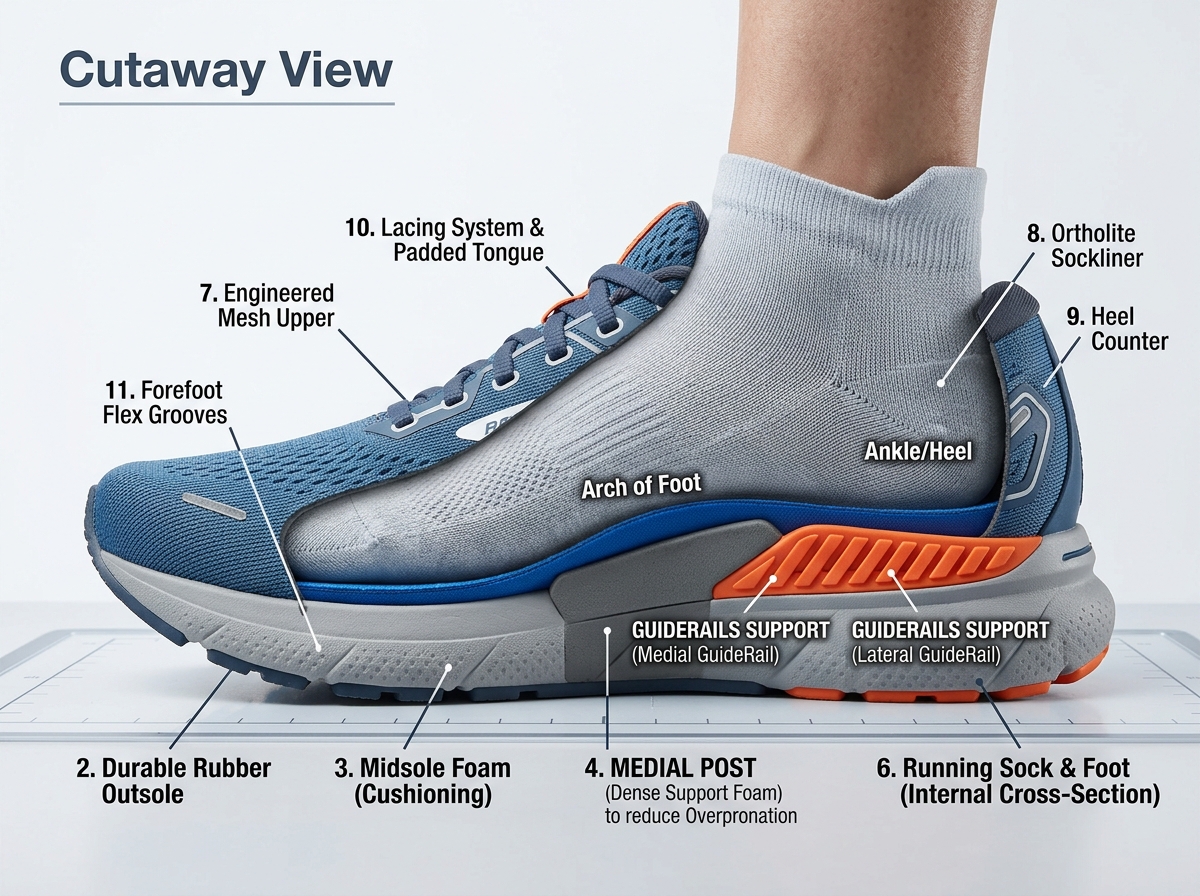
When we test the best shoes overpronation sufferers should wear, we look for specific engineering features that act like a “support system” for your foot. Modern stability tech has moved away from the “clunky” feel of the past toward more adaptive systems.
The Stability Toolkit
- Medial Posts: This is the traditional method—a firmer piece of foam located on the inside (medial) part of the midsole. It acts as a physical barrier to prevent the foot from rolling inward.
- GuideRails: Brands like Brooks use this “holistic” approach. Think of them like bowling alley bumpers; they only engage if your foot starts to veer out of its natural path.
- Heel Counters: A stiff, reinforced structure around the heel of the shoe. If the heel is locked in place, the rest of the foot is less likely to roll excessively.
- Torsional Rigidity: This refers to how much the shoe resists twisting. You can test this yourself by trying to wring the shoe like a towel. If it’s hard to twist, it’s better for overpronation.
- Wide Base: A wider platform provides a more stable “landing pad.” Lab tests show that shoes with a wider midfoot base significantly reduce the feeling of “wobbliness.”
- Structured Uppers: Stability isn’t just in the foam. A supportive upper with overlays helps keep the foot centered over the midsole.
For a deeper dive into these technologies, you can explore our curated tag/stability-shoes/ section.
Top Stability Running Shoes for 2025 and 2026
The landscape of stability shoes is changing. In 2025 and 2026, we are seeing a shift toward “adaptive stability.” This means the shoes feel like neutral trainers until you get tired and your form starts to break down—that’s when the support kicks in.
| Model | Stack Height (Heel/Forefoot) | Drop | Weight (Men’s 9) |
|---|---|---|---|
| ASICS Gel-Kayano 32 | 40mm / 32mm | 8mm | 10.6 oz |
| New Balance 860v14 | 35.5mm / 27.5mm | 8mm | 10.8 oz |
| Brooks Adrenaline GTS 25 | 36mm / 24mm | 12mm | 10.1 oz |
| Saucony Guide 18 | 35mm / 27mm | 8mm | 9.4 oz |
Top Performance Picks: Best Shoes Overpronation for Runners
ASICS Gel-Kayano 32
The Kayano remains the gold standard for many. The 32nd iteration uses a 4D Guidance System that provides adaptive stability. Instead of a hard post, it uses a softer foam insert under the arch that helps the foot return to a neutral position more quickly. It’s a premier trainer with a high-cushion feel thanks to the FF BLAST PLUS foam and PureGEL technology in the heel.
Brooks Adrenaline GTS 25
The Adrenaline is often called the “Go-To Shoe” (hence the GTS). It uses GuideRails technology to manage excess motion while keeping the knees in their natural path of motion. We often compare this model to its competitors in our saucony-vs-brooks-adrenaline/ head-to-head review. It’s a versatile daily trainer that works for almost everyone.
Hoka Arahi 8
If you want the “Hoka feel” (maximal cushioning) without the bulk, the Arahi 8 is the answer. It uses the J-Frame technology—a firmer foam that runs along the medial side and around the heel in a “J” shape. It’s remarkably lightweight for a stability shoe, making it a favorite for those who want to pick up the pace. You can find more details in our tag/hoka-arahi-8/ collection.
New Balance 860v14
New Balance has moved the 860v14 away from the traditional medial post and toward a more modern “CenterPath” technology. This involves higher sidewalls and a wider platform to center the foot. It’s a reliable workhorse that feels softer than previous versions but remains just as supportive.
Specialized Support for Severe Overpronators
For those whose feet roll inward significantly—or for heavier runners who need more structural integrity—maximum stability or “motion control” shoes are necessary.
- Brooks Beast 24 / Ariel 24: These are the “tanks” of the stability world. They offer a massive amount of support through a wide base and reinforced materials. They are heavy, but if you need maximum control, they are unbeatable.
- Saucony Omni 22: The Omni is designed specifically for those who need a generous fit and high-level stability. It features an 8mm offset and a broad platform that provides a very secure, grounded feel.
- New Balance Vongo v6: This is a unique beast. It’s a high-cushion stability shoe that uses an innovative “gradient” stability system—the foam is denser on the inside than the outside, guiding the foot without the harsh feel of a plastic post.
Best Shoes Overpronation: Casual, Walking, and Budget Picks
Support shouldn’t end when you finish your run. In fact, most of the damage from overpronation happens during the 8–10 hours a day we spend standing or walking at work. Finding the best shoes overpronation support for daily life is just as important as your running gear.
Everyday Comfort: Best Shoes Overpronation for Walking
Brooks Addiction Walker 2
This is essentially a “Beast” for walking. It features the same high-level support but with a leather upper that is durable and slip-resistant. It’s a favorite for healthcare workers and mail carriers who are on their feet all day.
ABEO MXV Shift
ABEO is a standout in the casual world because they offer built-in orthotics tailored to your foot type. The MXV Shift often receives 4.9/5 star ratings for its ability to alleviate foot pain through metatarsal support and a sturdy, non-slip outsole.
Dansko Paisley
For those who need a more “rugged” casual shoe, the Paisley is a waterproof sneaker with excellent arch support. It’s a great example of how you don’t have to sacrifice style for stability. For more lifestyle options, check our tag/pronation-support/ page.
Best Value and Budget-Friendly Options
Stability shoes are generally more expensive than neutral shoes—averaging around $130 compared to $113 for neutral models (a 17% “stability tax”). However, you can still find great deals.
- ASICS GT-1000 14: This is widely considered the best value stability shoe on the market. It offers the core ASICS stability tech at a significantly lower price point than the Kayano. It’s lighter and a bit firmer, but it gets the job done reliably.
- Saucony Guide 17 (Previous Model): When new models like the Guide 18 launch, the previous year’s version often drops below $100. Since the technology usually only changes incrementally, this is a fantastic way to get high-end support on a budget.
Frequently Asked Questions about Overpronation
Do stability shoes actually fix overpronation?
No, stability shoes do not “fix” or cure overpronation in the sense of permanently changing your foot’s bone structure. Instead, they manage the movement. They act as a guide to prevent the foot from rolling too far, which reduces the strain on your joints and muscles while you are wearing them. To actually improve your foot mechanics, you might need specific strengthening exercises for your glutes, hips, and foot arches.
How do I know if I need wide-width stability shoes?
Overpronators often have flatter feet, which naturally “splay” or spread out more when they hit the ground. If you feel pressure on the sides of your pinky toe or if your foot feels like it’s “muffin-topping” over the edge of the sole, you likely need a wide (D for women, 2E for men) or extra-wide (4E) width. Many stability shoes, like the ASICS Gel-Kayano 32, are specifically offered in “Extra Wide” versions to accommodate this.
Should I use custom insoles with stability shoes?
This is a common point of confusion. If you have a mild to moderate overpronation, a stability shoe alone is usually enough. If you have a prescription orthotic from a podiatrist, it is often recommended to put it in a neutral shoe. Putting a rigid orthotic into a high-stability shoe can sometimes provide “too much” support, which can lead to other issues like supination or ankle instability. Always consult with a specialist if you’re unsure.
Conclusion
Finding the best shoes overpronation requires a balance of science and personal comfort. Whether you are a marathoner looking for the adaptive support of the ASICS Gel-Kayano 32 or a retail worker needing the all-day reliability of the Brooks Addiction Walker 2, the right footwear is out there.
At On Clouder, we believe that the best shoe is the one that disappears on your foot, allowing you to move without thinking about pain. We’ve spent years analyzing stack heights, testing torsional rigidity, and listening to real-user feedback to bring you these rankings.
Don’t let overpronation keep you on the sidelines. Use the tools in this guide to assess your gait, identify the features you need, and step into a more stable, comfortable future. For more in-depth reviews and the latest performance rankings, keep exploring OnClouder.com.
