
Why the Right Arch Support Inserts for Sneakers Can Change How You Move
Arch support inserts for sneakers are removable insoles placed inside your shoes to support the arch of your foot, reduce pain, and improve alignment from the ground up.
Here’s a quick look at the top options to match your needs:
| Insert Type | Best For | Price Range | Top Brand |
|---|---|---|---|
| Full-length orthotic | Running, all-day wear | $13 – $60 | PowerStep, Superfeet |
| 3/4-length insert | Casual shoes, easy swapping | $15 – $45 | Archies, Dr. Scholl’s |
| Low-profile cushion | Slim sneakers, light support | $10 – $30 | Dr. Scholl’s |
| Performance insert | Running, high mileage | $35 – $60 | Superfeet, Run 619 |
You spend hours on your feet. Running. Working. Walking. And if your sneakers aren’t giving your arches the support they need, the rest of your body pays for it — your heels, knees, hips, and lower back all take the hit.
The problem isn’t always the shoes. As one foot health expert puts it, “it’s often the foot that’s going into the shoes that’s the real source of discomfort.” A great pair of sneakers can still leave you in pain if there’s nothing inside supporting your arch properly.
The good news? The right insert can make a real difference — whether you’re logging miles on the road, pulling a 12-hour shift, or just trying to get through the day without sore feet.
I’m Faisal S. Chughtai, a footwear comfort expert who has spent years helping people find the right fit for their feet — including matching arch support inserts for sneakers to the exact shoe type and foot condition that needs them most. In this guide, I’ll walk you through everything you need to pick the right insert for your sneakers.
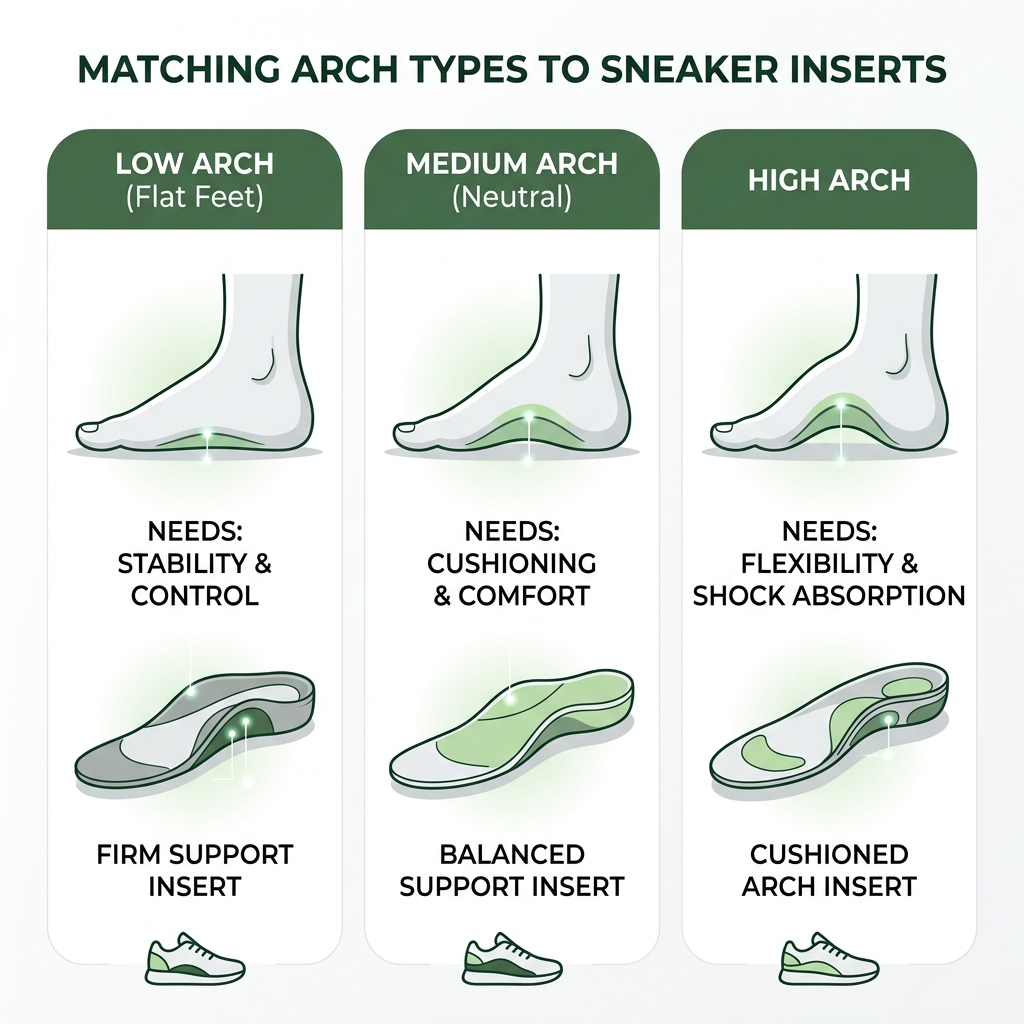
Arch support inserts for sneakers vocabulary:
Understanding Your Foot Type for Arch Support Inserts for Sneakers
Before you click “buy” on a pair of inserts, you need to know what’s happening under your socks. Not all feet are created equal, and putting a high-profile orthotic under a flat foot can feel like walking on a golf ball—not exactly the “cloud-like” experience we’re after.
The Three Main Arch Profiles
- Low Arches (Flat Feet): If your footprint looks like a solid pancake, you likely have low arches. This often leads to overpronation, where your feet roll inward excessively. You need structural support to prevent the arch from collapsing further.
- Medium Arches (Neutral): This is the most common foot type. Your footprint shows a distinct curve along the inside. You need a balance of cushioning and support to maintain finding your perfect fit.
- High Arches: If only your heel and the ball of your foot touch the ground, you have high arches. This can lead to supination (rolling outward). You need high-profile inserts to fill that gap and distribute pressure evenly.
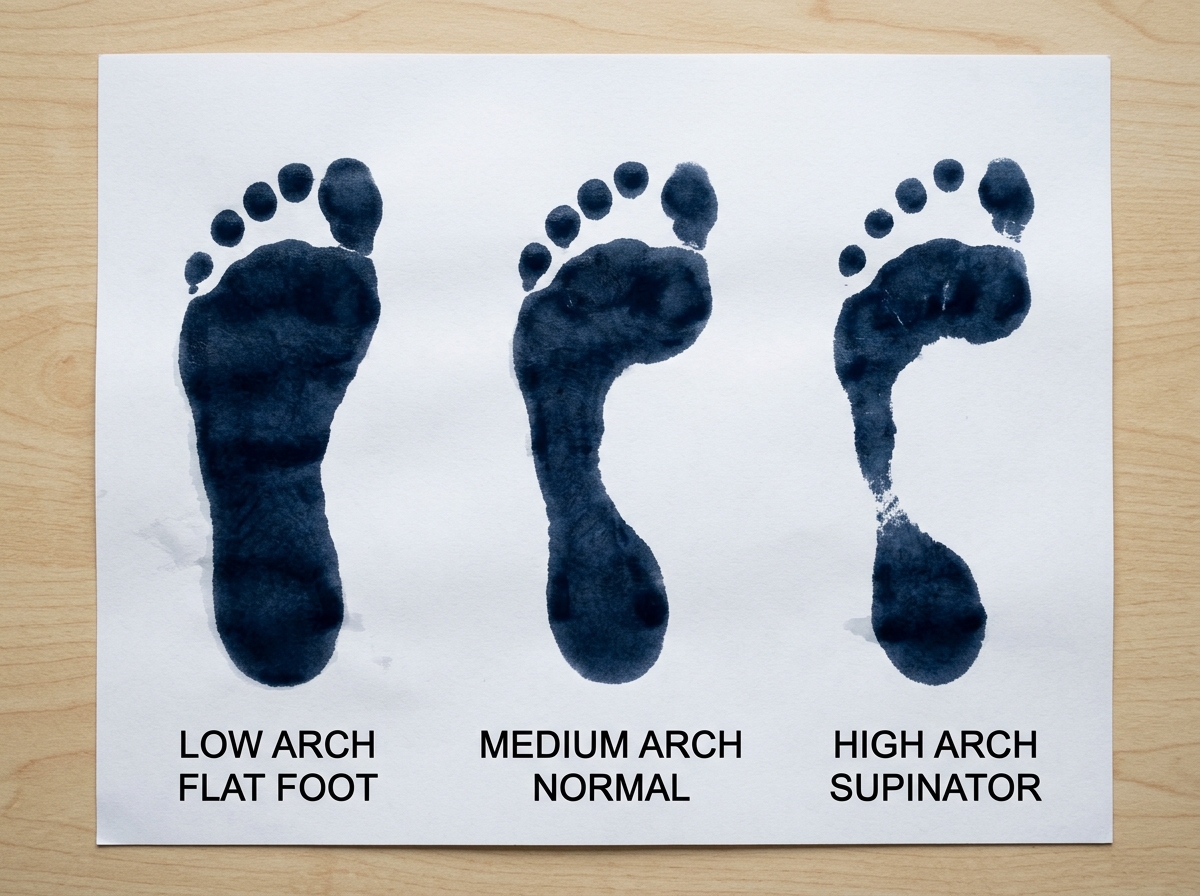
The “Wet Test” at Home
An easy way to check your arch type is the Wet Test. Wet the sole of your foot and step onto a piece of cardboard or a dark paper bag. Look at the imprint:
- Full imprint: Low arch.
- Half the arch visible: Medium/Neutral arch.
- Thin line or no arch visible: High arch.
Matching your arch support inserts for sneakers to your specific height is critical. Brands like PowerStep and Superfeet offer color-coded systems (like Superfeet Green for high arches or Blue for medium) to make this selection easier.
Essential Features and Materials for Sneaker Inserts
When shopping for inserts, you’ll encounter a dizzying array of materials. It’s not just about “softness”—in fact, too much softness can be a bad thing if it lacks structural integrity.
Material Breakdown
- EVA Foam: The industry standard for lightweight cushioning. It provides excellent “rebound” and energy return, which is perfect for running sneakers.
- PU (Polyurethane): Denser and more durable than EVA. You’ll often find this in heavy-duty inserts designed for workers standing on concrete all day.
- TPU Stabilizers: This is the hard plastic shell found on the bottom of many orthotics. It provides the “rigid” support needed to correct biomechanics.
- Gel Cushioning: Excellent for shock absorption, especially in the heel and forefoot. Dr. Scholl’s is a leader in using gel for all-day comfort.
Full-Length vs. 3/4-Length vs. Low-Profile
The length of your insert depends on your sneaker type and whether the original insole is removable.
| Feature | Full-Length | 3/4-Length | Low-Profile |
|---|---|---|---|
| Coverage | Heel to toe | Heel to ball of foot | Thin, minimal bulk |
| Best For | Running shoes, work boots | Casual sneakers, tight shoes | Dressy sneakers, racing flats |
| Removable Insole? | Yes, replace the original | No, fits on top of original | Either |
| Main Benefit | Maximum cushioning | Saves toe room | Fits in slim footwear |
One often overlooked benefit is that many arch supports are eligible for HSA/FSA reimbursement. Because they are considered a medical necessity for many foot conditions, you can often use your pre-tax health dollars to upgrade your sneaker comfort.
Addressing Foot Conditions and Performance Benefits
Why bother with arch support inserts for sneakers? For many of us, it’s about pain management. According to statistics, Dr. Scholl’s Heavy Duty Support orthotics have over 81,000 reviews, largely from people seeking relief from chronic conditions.
Common Conditions Helped
- Plantar Fasciitis: This is the big one. By supporting the arch and cradling the heel, inserts reduce the strain on the plantar fascia ligament, helping to eliminate that stabbing first-step-in-the-morning pain.
- Heel Spurs: A deep heel cup (like those found in PowerStep Pinnacle) helps redistribute pressure away from the heel bone.
- Metatarsalgia: If the balls of your feet burn after a long walk, look for inserts with a metatarsal pad to lift and spread the bones in the forefoot.
- Back and Knee Pain: Poor foot alignment travels up the kinetic chain. Correcting a rolling ankle with a TPU stabilizer can often alleviate mysterious lower back aches.
Performance Gains for Runners
For the athletes among us, inserts aren’t just about “fixing” problems—they’re about performance. High-performance options like the Run 619 MFM Performance Insoles or Superfeet Run Cushion use “Adaptive Comfort Technology.” These flex with your foot’s natural motion, providing a smooth heel-to-toe transition and better energy return. This can be a game-changer when looking for the best shoes for flat feet and high arches.
Proper Fitting, Trimming, and Maintenance
You’ve bought the inserts. Now what? Don’t just jam them into your sneakers and head out for a 5-mile run.
The Art of the Trim
Most high-quality arch support inserts for sneakers are “trim-to-fit.”
- Remove the existing factory insole from your sneaker.
- Line up the factory insole with your new arch support, matching the heels.
- Trace the outline of the toe area onto the new insert.
- Trim carefully with sharp scissors. It’s always better to cut too little than too much!
The Break-In Period
Your feet have likely been “misbehaving” for years. Forcing them into proper alignment with a firm orthotic takes time.
- Day 1-2: Wear them for 1-2 hours only.
- Day 3-5: Increase to 4-6 hours.
- Day 7+: Full-day wear. If you feel like there’s a “golf ball” in your shoe, that’s often just your arch being lifted back to where it belongs. However, if you experience sharp pain, stop and re-evaluate the arch height.
Lifespan and Maintenance
How long do they last? Most quality inserts like PowerStep or Superfeet are rated for 500 miles or about 6 to 12 months of daily wear.
- Cleaning: Never put them in the washing machine! Hand wash with mild soap and air dry.
- Check for Wear: If the foam looks compressed or the plastic shell feels flimsy, it’s time for a replacement. Even the best arch support shoes according to Reddit eventually need a fresh set of “shocks.”
Conclusion
At On Clouder, we believe that every step should be a comfortable one. Whether you are a nurse on a long shift, a marathoner, or a casual walker, arch support inserts for sneakers are one of the most cost-effective ways to upgrade your footwear.
While budget options from Amazon (like the highly-rated Dr. Scholl’s or generic Plantar Fasciitis brands) are excellent for general comfort, premium brands like PowerStep and Natural Foot Orthotics offer podiatrist-designed structures that can resolve more complex biomechanical issues.
Many top-tier brands offer a 60-day money-back guarantee. This is huge because it allows you to actually break in the product and see if it works for your unique foot shape. Don’t settle for “okay” sneakers when you can have a personalized, high-performance fit that protects your joints and boosts your energy.
Ready to take the next step? Explore more arch support for runners and find the perfect match for your favorite pair of kicks.
How long do arch support inserts for sneakers typically last?
On average, quality inserts last between 6 to 12 months or roughly 500 miles of use. The lifespan depends heavily on your activity level and the materials used. Soft gel inserts tend to bottom out faster than those with a rigid TPU (plastic) shell. If you notice the arch feels flatter or you start feeling old foot pains returning, it’s time to swap them out.
Can I move my arch support inserts for sneakers between different pairs?
Yes, you can! This is one of the biggest advantages of 3/4-length inserts or high-quality full-length orthotics. However, keep in mind that different sneakers have different internal volumes. An insert that fits perfectly in a roomy running shoe might make a slim casual sneaker feel too tight. For the best experience, we recommend having a dedicated pair for your primary “daily drivers.”
Do I need to buy a larger shoe size for inserts?
Usually, no. Most arch support inserts for sneakers are designed to replace the existing factory insole. By removing the original foam and sliding in the new orthotic, the volume remains roughly the same. If you are using a “low-profile” insert, you can often even place it on top of the existing insole in roomy shoes. If your sneakers are already very tight, you might consider a 3/4-length insert to save room in the toe box.
