
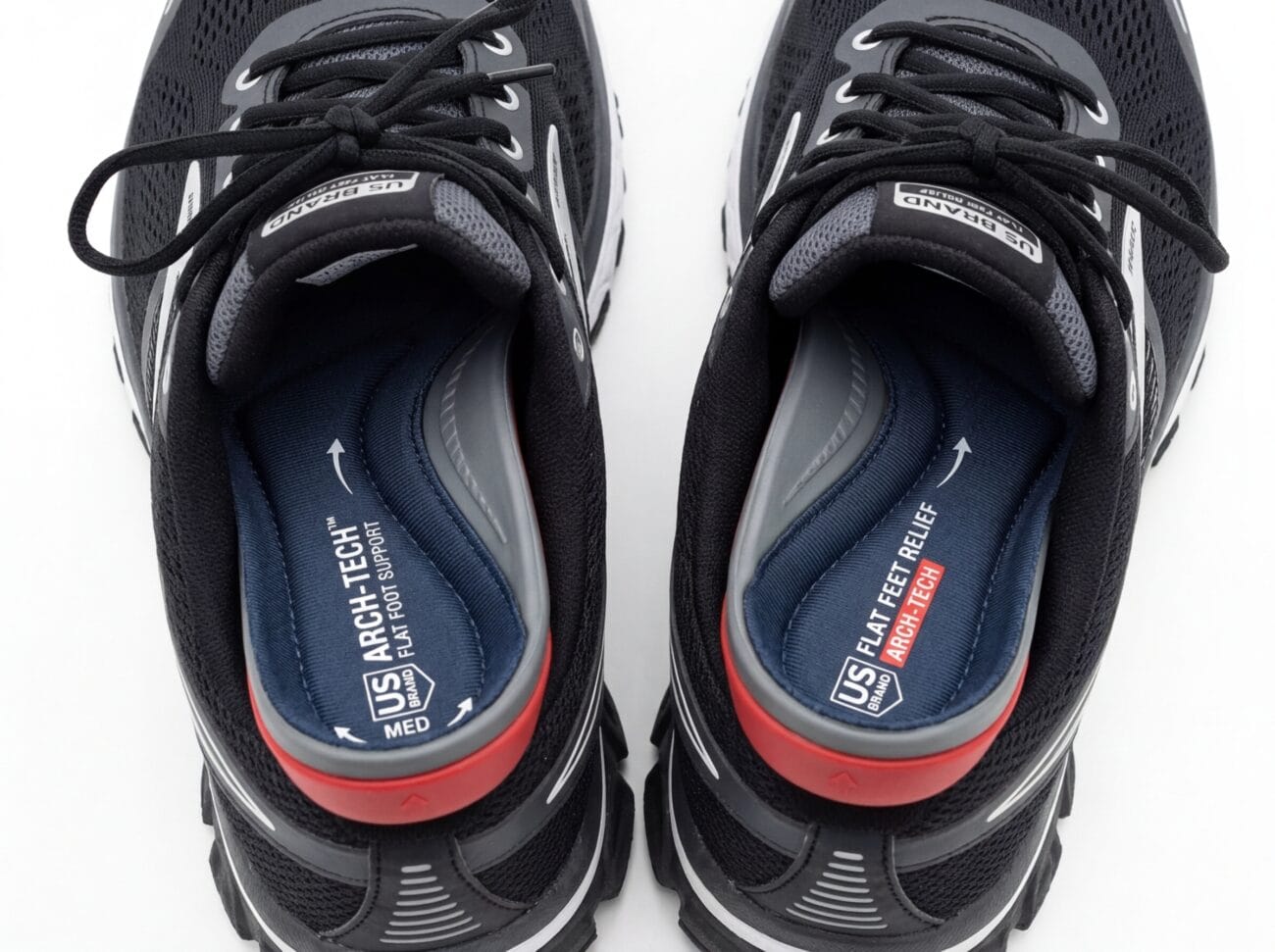
Understanding Flat Feet and the Need for Support
Arch support inserts for flat feet can make a real difference if you’re dealing with foot pain, tired legs, or aching knees after a long day on your feet.
Here are the top-rated options to consider:
| Insole | Best For | Arch Height | Key Feature |
|---|---|---|---|
| PowerStep Pinnacle Low | Everyday & athletic shoes | Low | Deep heel cradle, motion control |
| Superfeet Run Cushion Low Arch | Running & walking | Low | Adaptive foam, zero drop compatible |
| FitVille Arch Support | Casual & hiking | Low (3CM) | Metatarsal pad, U-deep heel |
Flat feet — also called fallen arches or pes planus — affect a surprising number of active adults. When your arch collapses, your foot rolls inward with every step. That inward rolling is called overpronation, and it puts extra stress on your ankles, knees, hips, and lower back.
The result? Pain that builds up slowly and gets harder to ignore.
If you’re a runner, nurse, or anyone who spends hours standing or moving, the wrong footwear can turn a manageable problem into a daily struggle. The right arch support insert can help correct your alignment, absorb shock, and take the load off joints that weren’t designed to carry it.
I’m Faisal S. Chughtai, a footwear comfort specialist with years of hands-on experience testing and reviewing insoles — including the best arch support inserts for flat feet on the market. In this guide, I’ll walk you through exactly what works, what doesn’t, and how to choose the right pair for your lifestyle.
Key arch support inserts for flat feet vocabulary:
When we talk about flat feet, we are describing a condition where the longitudinal arches of the feet have collapsed or were never present to begin with. In medical circles, this is known as pes planus. While some people are born with flat feet, many adults develop “fallen arches” over time due to age, weight gain, or the simple wear and tear of standing on hard surfaces for decades.
The real trouble with flat feet isn’t just the lack of a “curve” in the middle of your foot; it’s the overpronation that usually follows. When your arch hits the ground and flattens completely, your foot and ankle roll inward. This creates a kinetic chain reaction: your lower leg rotates, your knee misaligns, and your hips and lower back have to compensate for the instability.
Common symptoms we see in our community include:
- Arch and Heel Pain: Often felt as a dull ache or sharp pull in the midfoot or back of the heel.
- Knee, Hip, and Back Strain: Misalignment at the foundation (your feet) often leads to chronic pain further up the body.
- Shin Splints: Frequent among runners with flat feet who lack proper shock absorption.
This is where arch support inserts for flat feet come into play. A quality insole provides a firm but flexible structural “bridge” for your foot. By filling the gap between the shoe and your sole, these inserts stabilize the ankle and prevent that excessive inward roll. According to research from PowerStep, 98% of people felt less pain after just one week of using supportive bridge insoles. For more on the basics, check out our guide on shoe-inserts-for-flat-feet-101.
Top-Rated Arch Support Inserts for Flat Feet: A Comparison
Choosing the right insole can feel like a daunting task. Do you need maximum cushioning or rigid support? Low arch or medium? The goal for flat feet is generally to find a low arch height that provides a firm foundation without feeling like there is a “golf ball” under your foot.
Many of the top brands we recommend, such as Superfeet and PowerStep, have earned the American Podiatric Medical Association (APMA) Seal of Acceptance. This isn’t just a marketing badge; it means the products have been reviewed by podiatrists to ensure they promote good foot health.

| Feature | Superfeet All-Purpose Low | PowerStep Pinnacle Low | FitVille Arch Support |
|---|---|---|---|
| Best Activity | Everyday/Slim Shoes | Athletic/Work | Hiking/Standing |
| Cushioning | Firm | Dual-layer Foam | EVA + TPU |
| Arch Type | Low | Low | Low (3CM) |
| Durability | 12 Months | 6 Months | 6-9 Months |
Research shows that quality inserts don’t just feel good—they change behavior. In one study, 63% of consumers reported taking less pain medication after switching to supportive insoles. Whether you are looking for all-purpose support or something activity-specific, these three models represent the gold standard for flat feet.
PowerStep Pinnacle Low Arch Support Inserts for Flat Feet
The PowerStep Pinnacle Low is widely considered the #1 podiatrist-recommended brand for a reason. Unlike standard insoles that might be too high for someone with a collapsed arch, the Pinnacle Low features a support shell specifically contoured for flat feet.
What makes it effective is the combination of a firm but flexible arch and a deep heel cradle. The heel cradle is crucial for flat feet because it holds the fatty pad of your heel in place, increasing natural shock absorption and providing the motion control needed to stop overpronation. The dual-layer cushioning (foam top and EVA base) ensures that while you get the support you need, you don’t lose out on heel-to-toe comfort.
Superfeet Run Cushion Low Arch
If you are an athlete, the Superfeet Run Cushion Low Arch is a game-changer. These were previously known as the “ADAPT Run” series and are designed to flex and move with your foot rather than acting like a rigid cast.
They utilize Aerolyte™ Dual Comfort Foam and Adaptive Comfort Technology™ to provide biomechanical support that doesn’t alter how your running shoes were built to perform. They are also zero-drop compatible, making them a perfect fit for modern athletic footwear. Superfeet’s reputation is backed by clinical proof that their designs decrease fatigue and reduce injury risk for high-impact activities.
FitVille Arch Support Flat Feet Insoles
For those who need a bit more “structure” during long shifts or hiking trips, the FitVille Arch Support Flat Feet Insoles offer a unique 3CM arch height combined with a metatarsal pad.
These inserts use a mix of hard TPU for the arch and EVA foam for cushioning. The inclusion of a metatarsal pad is a nice touch for those who also experience pain in the ball of the foot. Users often report that these are a lifesaver for “long hours on feet,” especially when paired with shoes that have a wide toe box to allow for natural toe splay.
How to Properly Fit and Maintain Your Insoles
Buying the best arch support inserts for flat feet is only half the battle; you have to make sure they fit your shoes correctly. Most high-quality insoles are designed to be “trim-to-fit.”
- Remove the Factory Liner: Always take out the flimsy foam liner that came with your shoes. Putting an insole on top of another insole often creates too much bulk and can lead to blisters.
- Trace and Trim: Use your old liner as a template. Place it over the new insole, trace the toe area with a pen, and use sharp scissors to trim the excess.
- The Arch Test: When you stand on the insole, the arch should feel like it is sitting right under your natural arch. It should feel like a “supportive hug,” not a sharp pressure point.
- The Break-In Period: Don’t go for a 5-mile run on day one. Your feet and alignment need time to adjust. We recommend wearing them for 1-2 hours the first day, gradually increasing the time over a week. Most people fully adapt within 1 to 3 days.
Regarding maintenance, quality insoles generally last about 6 months with regular use. Superfeet products are known to last up to 12 months, but for most brands, you’ll notice the foam starts to compress or the fabric wears down around the half-year mark. If you start feeling that old familiar foot fatigue, it’s time for a replacement. For more tips, see our guide on arch-support-inserts-101 and why your flat feet crave these arch support insoles.
Frequently Asked Questions about Arch Support Inserts for Flat Feet
How long do arch support inserts for flat feet last?
The lifespan of an insole depends heavily on your activity level. If you are a nurse working 12-hour shifts or a marathon runner, you may need to replace them every 4 to 6 months. For casual, everyday wear, they can last up to a year. A good rule of thumb: if the cushioning feels flat or the arch support feels “mushy” compared to when they were new, they are no longer doing their job.
Can these inserts help with plantar fasciitis and overpronation?
Yes, absolutely. Plantar fasciitis is often caused by the repetitive stretching of the plantar fascia ligament due to the arch collapsing (flat feet). By providing a firm arch, the insole prevents that stretching and allows the ligament to heal. Similarly, by stabilizing the heel and arch, these inserts correct the inward rolling of overpronation, which can alleviate knee and back pain. You can find more scientific research on flat feet treatment to see how these biomechanical corrections work.
Do I need different insoles for running vs. walking?
While you can use the same pair, it’s often better to have activity-specific inserts. Running insoles, like the Superfeet Run Cushion, focus more on shock absorption and energy return (PowerStep’s energize foam offers 55% energy return!). Walking or work insoles often focus more on long-term static support and odor control for all-day wear. Additionally, running shoes often have more internal volume than slim-fitting dress shoes, so you might need a “thin” profile insole for your daily footwear.
Conclusion
At On Clouder, we believe that nobody should have to live with preventable foot pain. Whether you call them fallen arches, pes planus, or just “tired feet,” the reality is that your foundation matters. By investing in the right arch support inserts for flat feet, you are not just buying a piece of foam; you are investing in better posture, reduced joint strain, and the ability to stay active longer.
From the podiatrist-recommended PowerStep Pinnacle Low to the high-performance Superfeet Run Cushion, there is a solution for every foot type and activity. Remember to give your feet a few days to adjust to the new alignment, and don’t forget to replace them once they lose their “spring.”
Ready to take the next step? Step up your game with the best arch support inserts or find the best arch support for runners to keep you moving pain-free. Your feet—and your knees, hips, and back—will thank you.
