
The Best Running Shoes for Long Distance in 2026: Quick Answer
The best running shoes long distance runners can buy right now come down to a handful of standout models. Here’s a quick look at the top picks by category:
| Category | Top Pick | Why It Stands Out |
|---|---|---|
| Best Overall | ASICS Novablast 5 | Record 40.9mm stack, world-class shock absorption |
| Best Lightweight | Adidas Adizero Evo SL | Just 7.9 oz, 74% energy return |
| Best Max Cushion | Nike Vomero Plus | 45mm heel stack, 100% ZoomX foam |
| Best Stability | ASICS GEL-Kayano 32 | 4D guidance system, adaptive support |
| Best for Marathons | Saucony Endorphin Pro 4 | Near-legal stack, versatile for all footstrikes |
| Best Daily Trainer | New Balance 1080v14 | 400-mile lifespan, plush Fresh Foam X |
| Best Value | Adidas Adizero Evo SL | Premium ride at a lower price point |
Choosing the wrong shoe for a long run isn’t just uncomfortable — it can sideline you completely. After 10 miles, your muscles are fatigued, your feet have swelled, and every bit of cushioning and support your shoe can offer starts to matter a lot. The difference between a well-matched shoe and the wrong one shows up in your joints, your pace, and how you feel the next morning.
The good news? The 2025-2026 generation of long-distance shoes is genuinely exceptional. Stack heights are pushing the legal limits. Foams are lighter and bouncier than ever. And there’s a great option for nearly every runner type — whether you’re chasing a sub-4 marathon or just want to finish your first one pain-free.
I’m Faisal S. Chughtai, a footwear expert who has spent years testing and reviewing performance shoes, including the best running shoes for long distance across brands, budgets, and runner types. Let’s break down exactly what you need to know to find your perfect pair.
Best running shoes long distance word guide:
- Best running shoes for beginners
- Best running shoes women
- Running shoes for overpronators
What Makes the Best Running Shoes for Long Distance?
When we talk about the best running shoes long distance athletes rely on, we aren’t just looking for “soft” shoes. We are looking for a complex balance of mechanical properties that protect your body over thousands of repeated impacts.
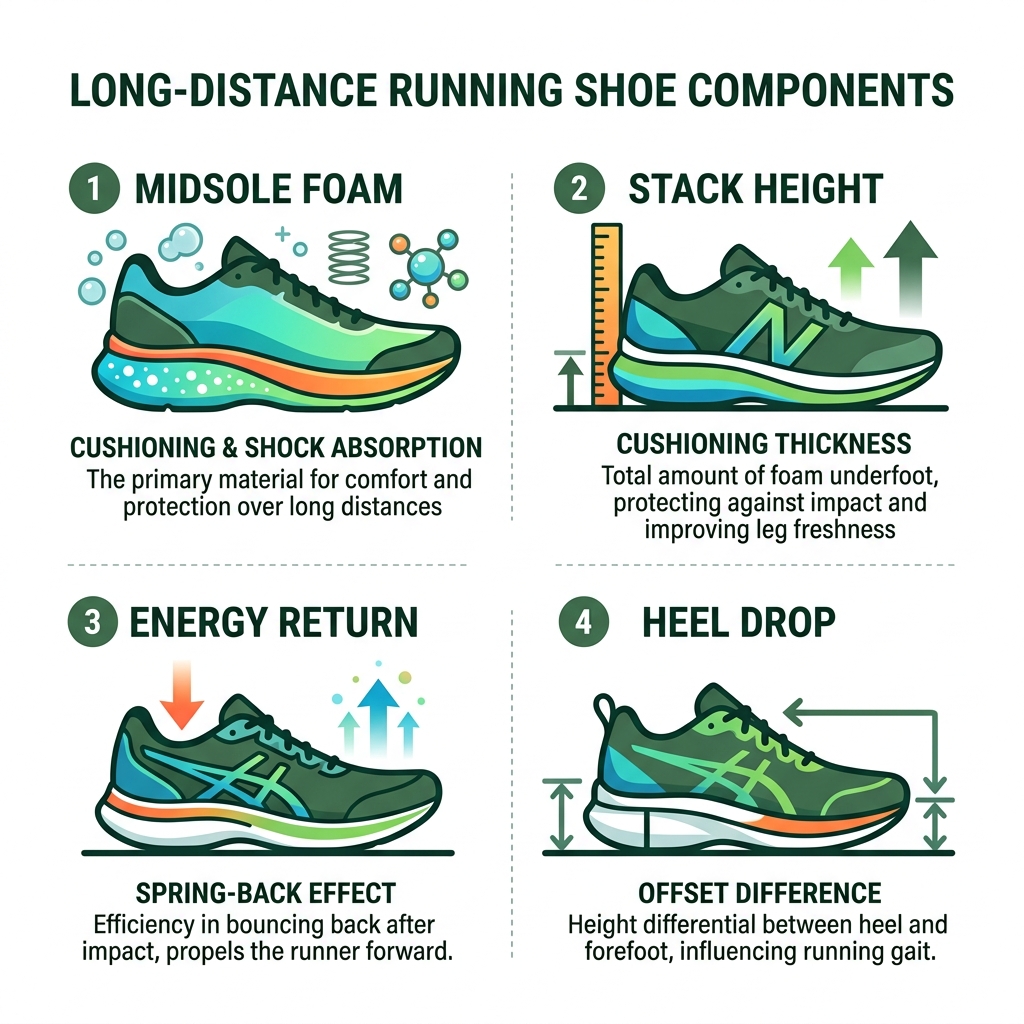
Shock Absorption and Energy Return
Shock absorption is the shoe’s ability to dampen the initial impact when your foot hits the pavement. In lab tests, the ASICS Novablast 5 recently shattered records with shock absorption scores of 141/134, making it a fortress for your joints. Energy return, on the other hand, is how much of that energy the foam “gives back” to help propel you forward. Modern super-foams like ZoomX or Lightstrike Pro now offer energy return rates between 70% and 95%.
Stack Height and Heel-to-Toe Drop
Stack height refers to the amount of material between your foot and the ground. Higher stacks (often 35mm to 45mm) provide more “meat” to absorb miles. The heel-to-toe drop is the difference in height between the heel and the forefoot. Most long-distance runners prefer an 8mm to 12mm drop because it relieves pressure on the Achilles tendon as they fatigue. According to scientific research on shoe comfort and injury prevention, the “comfort filter” is one of the best predictors of injury prevention—if it feels right, it usually is right.
Breathability and Upper Construction
On a 20-mile run, your feet generate a massive amount of heat. We look for circular knit uppers or engineered mesh that allow air to flow freely. This prevents “hot spots” and blisters. Brands like Saucony use FORMFIT technology to provide 360-degree cradling, while Nike’s latest circular knits offer lightweight containment without suffocating the foot.
Outsole Durability
High-mileage workhorses need tough outsoles. We look for high-abrasion rubbers like Saucony’s XT-900 or ASICSGRIP. A durable outsole ensures you don’t wear through the expensive midsole foam in just 100 miles. For those training for a sub-4 marathon, durability is key to ensuring your race-day shoes still have “pop” left after the training block.

Top-Rated Models for Marathons and High-Mileage Training
The 2026 market is dominated by “Super Trainers”—shoes that use race-day foams but are built with the durability of daily trainers. Here is how the top models stack up:
| Shoe Model | Heel Stack | Weight (Men’s US 9) | Key Technology |
|---|---|---|---|
| ASICS Novablast 5 | 40.9 mm | 9.0 oz | FF BLAST™ MAX |
| Adidas Adizero Evo SL | 39.0 mm | 7.9 oz | Lightstrike Pro |
| Nike Vomero Plus | 45.0 mm | 10.6 oz | 100% ZoomX |
| New Balance 1080v14 | 39.0 mm | 10.5 oz | Fresh Foam X |
| Saucony Endorphin Pro 4 | 39.5 mm | 7.5 oz | PWRRUN PB + Carbon |
ASICS Novablast 5
This is arguably the king of the best running shoes long distance category for 2026. With a record-shattering stack height of 40.9mm in the heel and 33.5mm in the forefoot, it provides a trampoline-like effect. It’s 26% more flexible than the average trainer, meaning it moves with your foot rather than fighting against it.
Adidas Adizero Evo SL
If you hate heavy shoes, this is your winner. At just 7.9 oz, it’s remarkably light for a shoe with a 39mm stack. It features the same Lightstrike Pro foam found in world-record-breaking racing shoes but without the stiff carbon plate, making it more comfortable for daily miles.
Nike Vomero Plus
Nike went “max” with the Vomero Plus. It features a massive 45mm heel stack and a 35mm forefoot. The entire midsole is made of 100% ZoomX foam—the same stuff used in the Alphafly. It is designed specifically for those 4+ hour marathon efforts where comfort is the only priority.
New Balance 1080v14
A true high-mileage legend. The 1080v14 has a median lifespan of 400 miles, significantly higher than many “super shoes.” It uses Fresh Foam X, which feels plush but doesn’t “bottom out” after the first 5 miles.
Saucony Endorphin Pro 4
For those who want to go fast, the Endorphin Pro 4 uses Speedroll technology—a geometric rocker that keeps you rolling onto your toes. It sits right at the World Athletics legal limit of 39.5mm, ensuring you get maximum cushion without being disqualified from elite events.
Best Running Shoes Long Distance for Neutral Runners
Neutral runners don’t need structural support to correct their gait. Instead, they need consistent, reliable cushioning.
- Brooks Ghost 17: This is the “Goldilocks” of running shoes. It’s not too soft, not too firm. For 2026, Brooks added 3mm of stack height to the heel, making it even better for those long Sunday Runday efforts.
- HOKA Clifton 10: HOKA updated the “ClifTEN” with a new last that offers a more accommodating fit in the toebox. If you’ve felt HOKAs were too narrow in the past, this version fixes that. It’s a walking on air experience that transitions perfectly from recovery walks to 15-mile training runs.
- On Cloudmonster 2: This shoe is a beast for high-mileage training. Its massive CloudTec pods provide a unique mechanical cushioning that feels distinct from traditional foams.
Best Running Shoes Long Distance for Stability Needs
If you overpronate (your feet roll inward excessively), you need a shoe that guides your foot back into a neutral position without feeling like a brick.
- ASICS GEL-Kayano 32: This shoe uses the 4D GUIDANCE SYSTEM™, which provides adaptive stability. Instead of a hard plastic post, it uses a softer foam under the arch that only engages when you need it. It also features PureGEL™ technology, which is 65% softer than standard gel.
- HOKA Arahi 8: A rare breed—a lightweight stability shoe. It uses a J-Frame of firmer foam to prevent the foot from rolling inward while maintaining the signature HOKA “marshmallow” feel.
- Brooks Adrenaline GTS 25: Known for its GuideRails technology, this shoe acts like bowling alley bumpers for your feet, keeping your knees and ankles aligned over long distances. For more details, check our guide for flat feet and high arches.
Performance Factors: Plated vs. Non-Plated Shoes
One of the biggest debates in the best running shoes long distance world is whether you need a plate.
Carbon-Plated Racers
Shoes like the Saucony Endorphin Pro 4 or ASICS Metaspeed Sky Tokyo contain a full-length carbon fiber plate. These plates act as a lever, providing massive propulsion and improving running economy by up to 4%. However, they can be stiff and taxing on the calves if you aren’t used to them. They are primarily marathon shoes meant for race day.
Super Trainers (Nylon and Fiberglass)
Shoes like the Brooks Hyperion Max 3 use nylon or fiberglass plates. These are more flexible than carbon, making them better suited for daily training miles. They provide a “pop” and reduce muscle fatigue without the harshness of a carbon racer.
Non-Plated Daily Trainers
For the majority of your miles, non-plated shoes like the New Balance 1080 or HOKA Clifton are often better. They allow your foot to move more naturally and are generally more comfortable for slower recovery paces.
Frequently Asked Questions about Long Distance Footwear
How long do the best running shoes for long distance typically last?
Most high-quality long-distance shoes have a median lifespan of 400 to 500 miles. However, “super shoes” with PEBA-based foams (like ZoomX) may start to lose their “pop” after 200–250 miles. You can tell a shoe is “dead” when the midsole feels flat, you notice new aches in your shins or knees, or the outsole tread has vanished. We always recommend a shoe rotation to give the foam time to decompress between runs, which can extend the life of each pair.
How should long-distance shoes fit to prevent blisters?
Your feet will swell during a marathon—sometimes by a full half-size. You should have a thumbnail’s width of space between your longest toe and the end of the shoe. Ensure there is no “spillover” at the sides and that your heel is locked down securely. Look for moisture-wicking uppers and consider using lock-lacing (the extra eyelet at the top) to prevent your foot from sliding forward on downhill sections.
What is the ideal stack height for marathon distances?
For most runners, a stack height between 35mm and 40mm is the “sweet spot.” This provides enough foam to reduce muscle vibration and impact stress without becoming so tall that the shoe feels unstable. The World Athletics legal limit for racing is 40mm, though “illegal” trainers like the ASICS Superblast 2 (45mm) are incredibly popular for training because they offer even more protection.
Conclusion
Finding the best running shoes long distance isn’t about finding the most expensive shoe on the shelf; it’s about matching the shoe’s technology to your specific biomechanics and goals. Whether you need the adaptive stability of the GEL-Kayano 32 or the pure speed of the Adizero Evo SL, the right footwear is your greatest ally on the road to 26.2 miles.
At On Clouder, we pride ourselves on providing expert shoe reviews and performance rankings to help you make an informed choice. Don’t forget to check out our comprehensive shoe comparison category to see how your favorite models stack up head-to-head. Happy running!
