
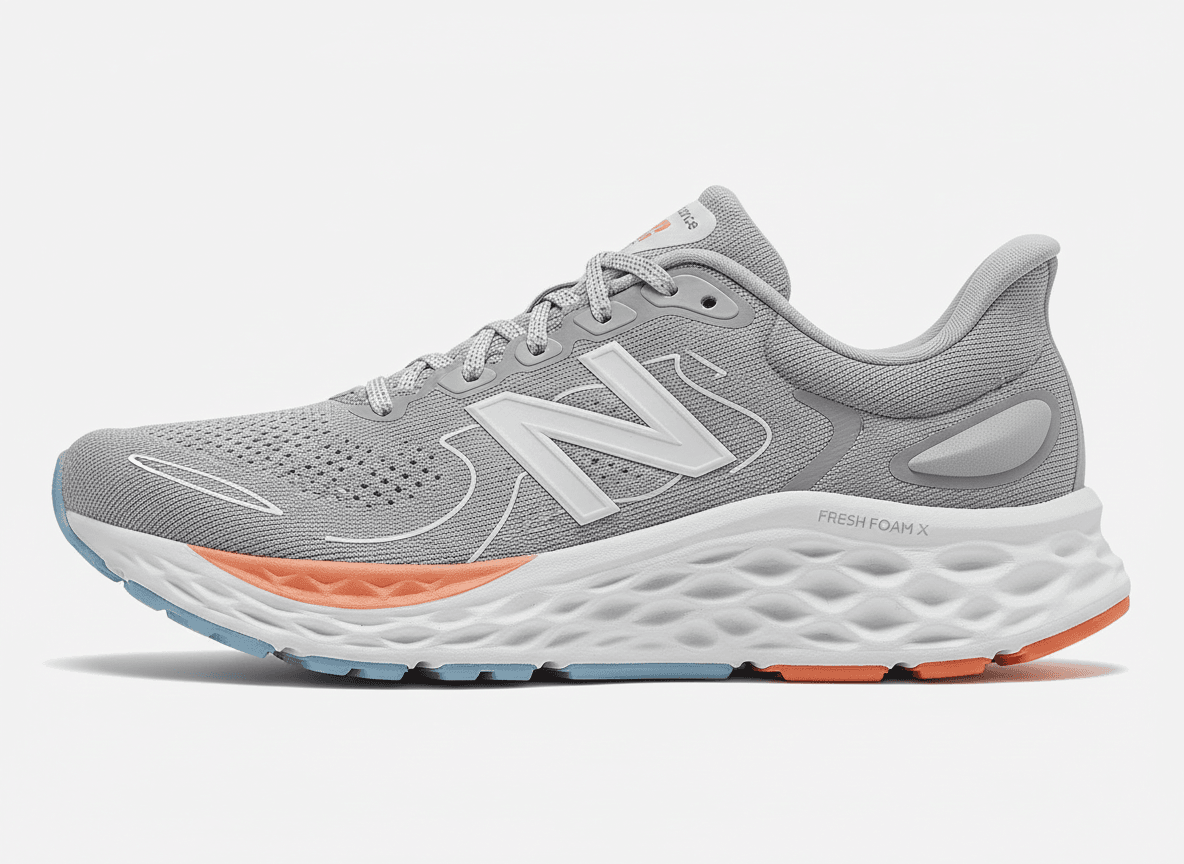
The Best New Balance Shoes for Standing All Day at Work
New Balance shoes for standing work are some of the most well-cushioned, supportive options available for professionals who spend long hours on their feet.
Here are the top picks at a glance:
| Model | Best For | Key Feature |
|---|---|---|
| Fresh Foam X 1080v15 | Best overall | 147 SA heel cushioning, 9.0 oz |
| Fresh Foam X More v6 | Maximum cushioning | 44mm heel stack, 152 SA |
| Fresh Foam X 860v14 | Flat feet / overpronation | Medial wedge, dual-density midsole |
| 928v3 | Motion control | ROLLBAR stability, ABZORB cushioning |
| Work Shoe Collection | Safety environments | Slip-resistant, composite toe |
Whether you’re a nurse pulling a 12-hour shift, a retail worker clocking miles on hard floors, or a factory worker who needs certified safety features — the right pair can make a real difference in how your feet, knees, and back feel by the end of the day.
Standing puts a surprising amount of stress on your body. Unlike walking, which distributes impact across each stride, standing keeps constant pressure on the same points. That’s why cushioning, arch support, and stability aren’t just nice-to-haves — they’re essential.
New Balance has built a strong reputation in this space, offering technologies like Fresh Foam, ROLLBAR, and ABZORB across a wide range of fits — from narrow (2A) to extra-wide (6E) — so you’re not forcing your foot into a shape it doesn’t want to be in.
I’m Faisal S. Chughtai, a footwear expert who has spent years evaluating comfort and performance footwear, including testing New Balance shoes for standing work across a range of professional environments. In this guide, I’ll walk you through the models that genuinely hold up — backed by real specs, not just marketing language.
Basic New Balance shoes for standing work glossary:
- Best Hoka shoe for standing all day
- Best Brooks shoe for standing all day
- Best comfortable shoes for work
Key Technologies in New Balance Shoes for Standing Work
When we look at why New Balance shoes for standing work consistently rank at the top of expert lists, it comes down to the “engine” under your feet. New Balance doesn’t just use one type of foam; they have a laboratory’s worth of materials designed to combat gravity.
Fresh Foam X and FuelCell
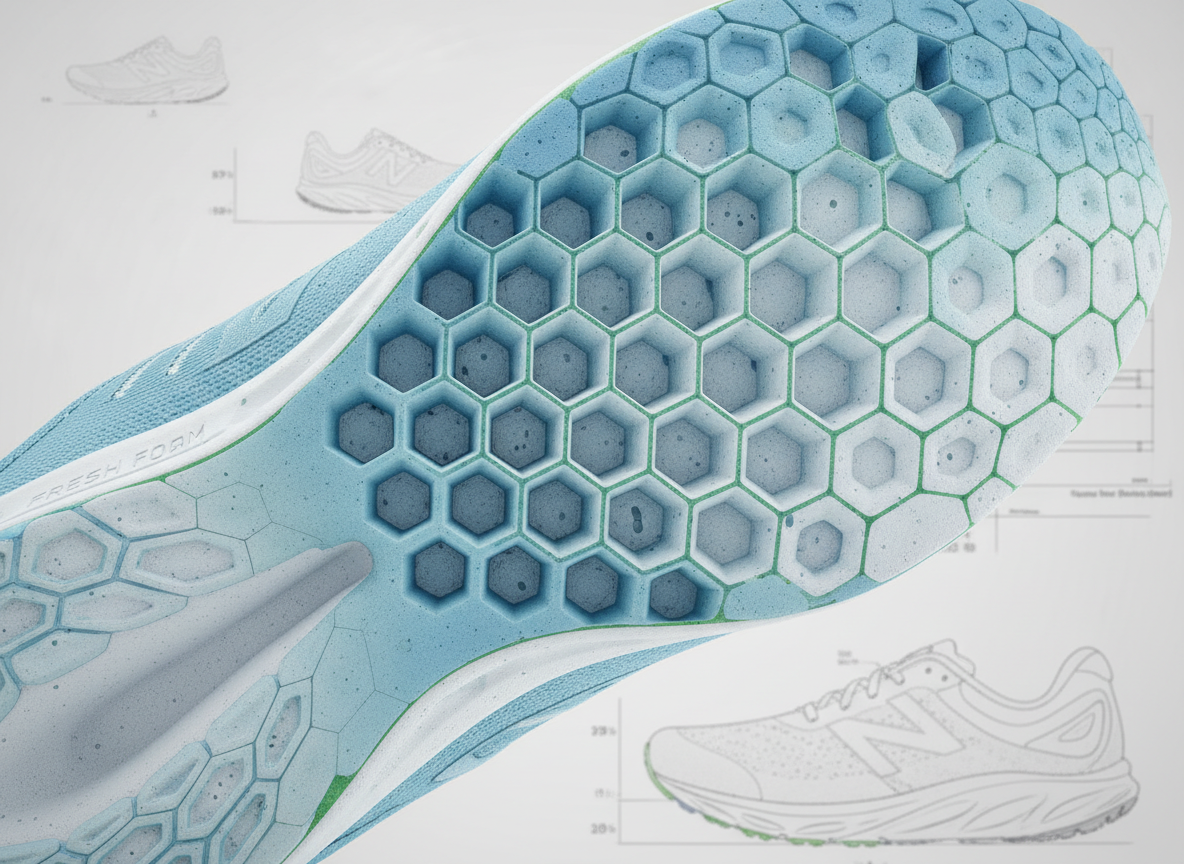
The star of the show is Fresh Foam X. Found in many walking shoes, this foam averages a 30 AC softness rating, which is significantly softer than the average walking shoe midsole. For those who want more “pop” or energy return, FuelCell provides a more responsive, nitrogen-infused ride.
ABZORB and ROLLBAR
For workers who need serious impact protection, ABZORB technology uses a blend of Isoprene rubber and proprietary foam to resist compression. It doesn’t just feel soft; it stays soft throughout a 12-hour shift. Meanwhile, the ROLLBAR stability post system is a lifesaver for those with severe overpronation, as it minimizes rear-foot movement to keep your gait aligned.
The New Infinion Midsole
Introduced in the latest 1080 models, the Infinion midsole is the next evolution of Fresh Foam X. It’s designed to be lighter and bouncier, providing a “cloud-like” touch that leaves your legs feeling fresh even after a long day of foot travel.
Scientific Specs and Safety
- Stack Height: Models like the More v6 offer up to 44mm of foam in the heel. This creates a massive buffer between you and the concrete floor.
- Shock Absorption (SA): Expert lab tests show that high-end New Balance models provide roughly 37.1% less load on the legs than the average shoe.
- ASTM Standards: Many New Balance work models meet ASTM F2913-19 for slip resistance and ASTM F2412-18a for electrostatic dissipative performance and composite toe safety.
Top New Balance Models for All-Day Comfort
Choosing the right New Balance shoes for standing work depends on your specific foot type. Whether you have high arches, flat feet, or just need pure, unadulterated squish, there is a model built for you.
| Model | Stack Height (Heel/Forefoot) | Weight | Shock Absorption (Heel) |
|---|---|---|---|
| 1080v15 | 40mm / 34mm | 9.0 oz | 147 SA |
| More v6 | 44mm / 40mm | 11.0 oz | 152 SA |
| 860v14 | 36mm / 28mm | 10.4 oz | 118 SA |
| 880v15 | 39.7mm / 35.4mm | 9.8 oz | 124 SA |
Best Overall: Fresh Foam X 1080v15
The Fresh Foam X 1080v15 is our top recommendation for most workers. It strikes the perfect balance between being incredibly lightweight (only 9.0 oz) and offering elite cushioning. With a 147 SA heel cushioning score—13.1% above the industry average—it’s like standing on a premium yoga mat.
The 1080v15 features the new Infinion midsole and a highly breathable upper (rated 4/5 in lab tests), which is crucial for preventing “hot feet” during a shift. If you’ve ever wondered how it compares to other premium brands, check out our On Cloud vs. New Balance 1080 comparison.
Best for Maximum Cushioning: Fresh Foam X More v6
If your job involves standing in one spot on a hard factory floor, the Fresh Foam X More v6 is the ultimate “max-stack” shoe. It boasts a staggering 44mm heel stack and 152 SA shock absorption—the highest in the New Balance lineup.
Despite its height, it’s surprisingly stable thanks to a wider-than-average outsole platform (122.5mm at the forefoot). The rocker design helps with smooth transitions if you do need to walk, but the pure volume of foam makes it the king of impact protection. You can find more about these high-volume walking shoes here.
Best New Balance Shoes for Standing Work with Flat Feet: 860v14
For those who suffer from flat feet or overpronation, the Fresh Foam X 860v14 is a game-changer. Unlike neutral shoes, the 860v14 uses a medial wedge—a denser piece of foam on the inner side of the shoe—to prevent your arches from collapsing inward.
It offers high torsional rigidity (rated 5/5), meaning the shoe won’t twist easily under pressure. This provides a stable “foundation” for your shift. We’ve covered the nuances of this support system in our New Balance 880 and 860 guide.
Best for Motion Control: 928v3
The 928v3 is a legendary “tank” in the walking world. It’s designed specifically for motion control, using the ROLLBAR technology to lock the heel in place. It features a durable leather upper, which is often preferred in healthcare or food service for its easy-to-clean nature.
The 928v3 also includes a removable PU foam footbed, allowing you to swap in custom orthotics if needed. It’s slightly heavier at 10.9 oz, but the stability it provides for those with severe foot alignment issues is unmatched.
Specialized New Balance Shoes for Standing Work Environments
Not all work environments are created equal. Some require more than just comfort; they require safety certifications.
Slip-Resistant and Safety Toe Options
For those in industrial, warehouse, or kitchen settings, the New Balance Work Shoe collection offers specialized protection.
- Traction: Outsoles are tested to ASTM F2913-19 standards, providing superior grip on oily or wet surfaces.
- Protection: Composite toe caps meet ASTM F2412-18a & F2413-18 I/75 C/75 standards for impact and compression, but they are much lighter and less cold-conductive than traditional steel toes.
- Comfort: These aren’t your typical clunky work boots. They often incorporate REVlite or Fresh Foam midsoles to ensure that safety doesn’t come at the cost of sore feet.
Finding the Perfect Fit for Long Shifts
One of New Balance’s biggest advantages is their commitment to widths. While most brands offer maybe two widths, New Balance offers up to six:
- 2A (X-Narrow)
- B (Standard Women’s)
- D (Standard Men’s / Wide Women’s)
- 2E (Wide)
- 4E (X-Wide)
- 6E (XX-Wide)
When you stand all day, your feet naturally swell. We recommend the “Thumbnail Rule”: ensure there is about a thumbnail’s width of space between your longest toe and the end of the shoe. If you’re stuck between sizes, our New Balance 2E vs 4E guide can help you decide. For more sizing tips, see our New Balance choosing guide.
Frequently Asked Questions about New Balance Shoes for Standing
How often should I replace my work shoes?
We generally recommend replacing your New Balance shoes for standing work every 300 to 500 miles, or every 6 to 12 months. Even if the tread looks fine, the internal foam (the part that actually protects your joints) loses its “rebound” over time. If you start feeling unusual aches in your knees or back at the end of a shift, it’s likely time for a new pair.
Are running shoes or walking shoes better for standing?
It depends on the model. Walking shoes are typically more flexible and designed for the specific heel-to-toe rolling motion of a walk. Running shoes, like the 1080v15, often have more advanced foam technology and better breathability. For pure standing, the high-stack running models often provide better impact protection, while dedicated walking models like the 928v3 offer better lateral stability and durability.
Which New Balance shoes are best for plantar fasciitis?
For plantar fasciitis, we look for three things: a higher heel-to-toe drop (usually 8mm+), high torsional rigidity (stiffness in the middle), and a stiff heel counter. The 860v14 and 928v3 are excellent choices because they prevent the arch from over-stretching and provide the necessary heel cushioning (100+ SA) to offload pressure from the fascia.
Conclusion
At On Clouder, we know that the right footwear isn’t a luxury—it’s a tool for your trade. Whether you are a nurse, a retail manager, or a warehouse associate, New Balance shoes for standing work provide the technological edge needed to survive long shifts pain-free.
If you want the plushest ride possible, go for the 1080v15 or More v6. If your feet need a bit more “discipline” and support, the 860v14 or 928v3 will be your best friends. Don’t let foot fatigue hold you back from your best performance.
Ready to make a choice? Find the best shoes for standing and give your feet the promotion they deserve!
