
Your First Step Starts With the Right Shoe
The best running shoes for beginners can make the difference between loving your first run and dreading your second. Whether you’re starting a couch-to-5K plan or just want to get outside more, the right pair protects your joints, keeps your feet comfortable, and makes the whole experience more enjoyable.
Here are the top picks to get you started:
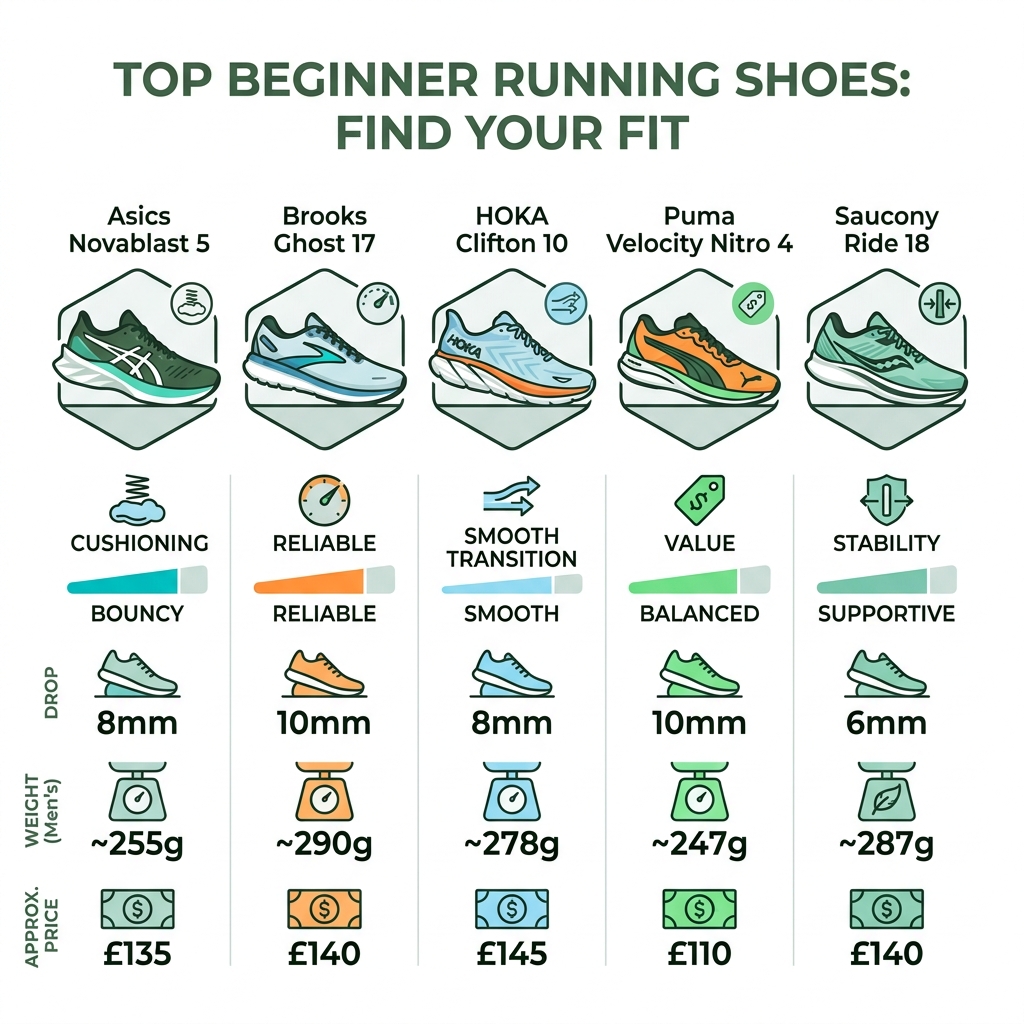
| Shoe | Best For | Drop | Weight (Men’s) | Approx. Price |
|---|---|---|---|---|
| Asics Novablast 5 | Bouncy cushioning | 8mm | 255g | £135 |
| Brooks Ghost 17 | Reliable daily miles | 10mm | ~290g | £140 |
| HOKA Clifton 10 | Smooth transitions | 8mm | 278g | £145 |
| Puma Velocity Nitro 4 | Best value | 10mm | 247g | £110 |
| Saucony Ride 18 | Beginner stability | 6mm | ~287g | £140 |
All five are versatile daily trainers — meaning you don’t need a fancy rotation or specialized knowledge to use them well.
Running is a high-impact activity. Every footstrike sends a force equal to roughly 2.5 times your bodyweight through your legs and joints. Everyday sneakers simply aren’t built to handle that, especially run after run. Proper running shoes absorb that impact, reduce fatigue, and lower your injury risk from the very first mile.
The good news? You don’t need to overthink this. As one common piece of advice from experienced runners goes: the best shoe is the one that feels good on your foot. This guide will help you figure out exactly what that means for you.
I’m Faisal S. Chughtai, a footwear expert who has spent years helping people find the perfect shoe for comfort and performance — including testing and reviewing the best running shoes for beginners across brands and budgets. Let’s walk through everything you need to know to make a confident first purchase.
Best running shoes for beginners word guide:
- Best running shoes women
- Running shoes for overpronators
Why Beginners Need Specialized Footwear
When we first catch the running bug, it is tempting to just grab the old sneakers from the back of the closet and hit the pavement. However, those “everyday trainers” are designed for walking or standing, not the repetitive, high-impact nature of running.
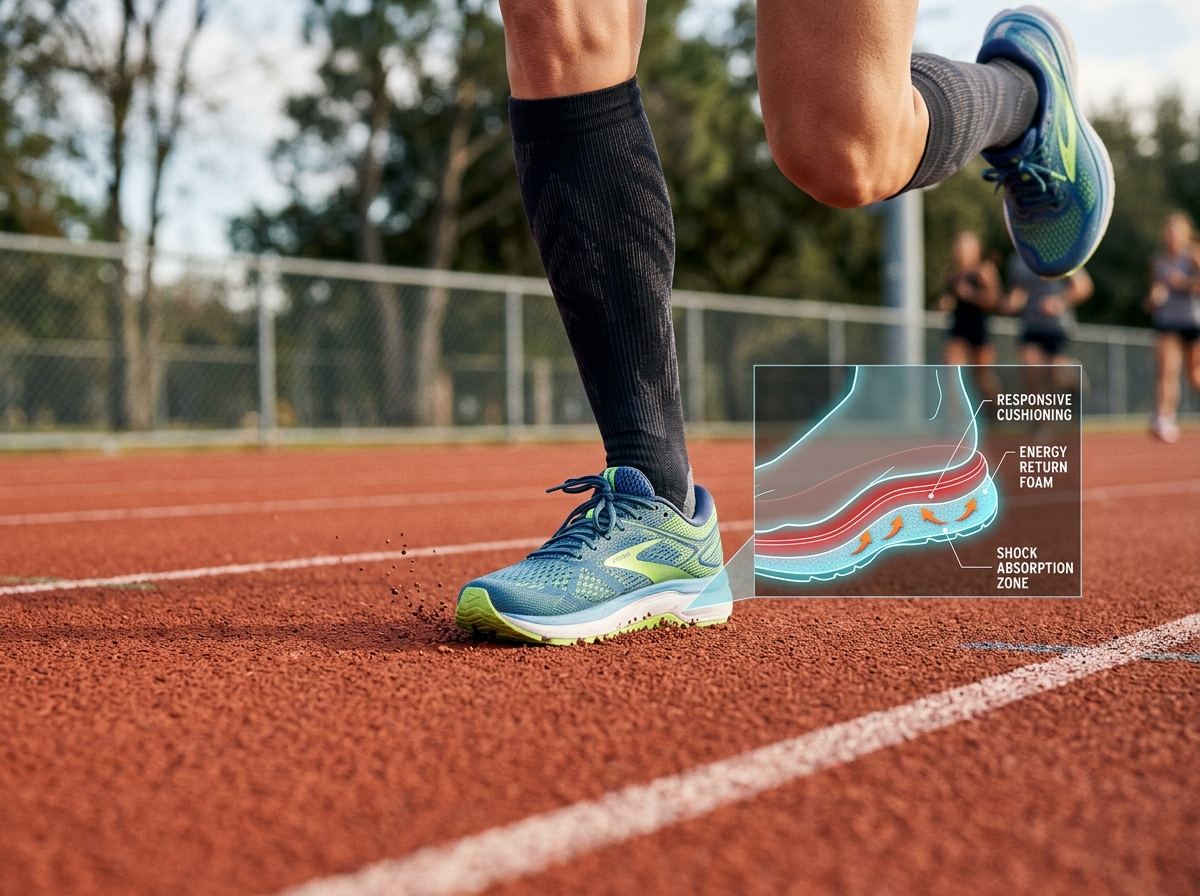
Every time your foot hits the ground, your body absorbs a force of about 2.5 times your body weight. Without the right tech underfoot, that force travels straight to your ankles, knees, and hips. Proper running shoes for beginners are engineered with specialized foam to provide shock absorption and energy return, essentially acting as a buffer for your skeletal system.
According to Scientific research on injury prevention, footwear that provides a stable base and appropriate cushioning can significantly help prevent common overuse injuries like shin splints or runner’s knee. Furthermore, specialized running shoes are built to last. While a standard fashion sneaker might lose its structural integrity after a few weeks of jogging, a dedicated running shoe is designed to maintain its support for approximately 500 miles.
Key Features to Look for in Your First Pair
Walking into a running store can feel like entering a laboratory. You’ll hear terms like “stack height,” “energy return,” and “torsional rigidity.” Don’t let the jargon scare you off! For a beginner, we want to focus on three main pillars: comfort, protection, and versatility.
The “midsole” is the most important part of the shoe. This is the layer of foam between your foot and the ground. Modern foams are lighter and bouncier than ever, designed to protect your joints while giving you a little “pop” with every step.
Another term you’ll see is “stack height.” This refers to the total amount of material between your foot and the road. Following the World Athletics stack height standards, most daily trainers fall between 30mm and 45mm. For beginners, a moderate stack height is usually best—it provides plenty of cushion without feeling like you’re balancing on marshmallows.
If you are looking for a deep dive into these technicalities, our beginner running guide breaks down every component from the laces to the outsole.
Understanding Gait and Pronation for the Best Running Shoes for Beginners
One of the first things we need to determine is your “gait,” or how your foot moves when you run. Most runners fall into one of three categories:
- Neutral: Your foot lands on the outside of the heel and rolls slightly inward to absorb shock. This is the most common gait.
- Overpronation: Your foot rolls inward excessively. This is common in people with flat or low arches.
- Supination (Underpronation): Your foot doesn’t roll inward enough, often associated with high arches.
To figure this out at home, try the “Wet Foot Test.” Wet the bottom of your foot and step onto a piece of cardboard or dark paper. If you see a full footprint, you likely have flat arches (overpronation). If you only see the heel and the ball of your foot with a thin line connecting them, you have high arches (supination).
While many “stability” shoes exist for overpronators, recent expert consensus suggests that for beginners, the most important factor is actually comfort. If a neutral shoe feels better than a stability shoe, go with what feels natural!
Finding the Perfect Fit and Toe Box Space for the Best Running Shoes for Beginners
The biggest mistake we see beginners make? Buying shoes that are too small. Your feet will naturally swell when you run due to increased blood flow and the heat of the activity. If your shoes are a perfect “walking size,” they will likely be too tight by mile three.
Always aim for the “Rule of Thumb.” There should be about a thumb’s width of space between your longest toe and the end of the shoe. This prevents black toenails and blisters. Also, ensure the “toe box” (the front part of the shoe) is wide enough for your toes to splay out naturally. We often recommend going up a half or even a full size from your casual shoe size.
If you have wider feet, look for brands that offer specific “Wide” (D for women, 2E for men) versions of their popular models. Finding the best running shoes for beginners is as much about the shape of the shoe as it is about the foam inside.
Top-Rated Models: Comparing the Best Running Shoes for Beginners
For your first pair, we highly recommend a “daily trainer.” These are the Swiss Army knives of the running world—durable enough for long walks, cushioned enough for recovery runs, and light enough for your first 5K race.
As we look toward the best running shoes 2026, the technology has reached a point where even “entry-level” shoes feature premium materials.
Best for Bouncy Cushioning: Asics Novablast 5
The Asics Novablast has quickly become a favorite for those who want a “fun” ride. It features the new FF Blast Max foam, which is incredibly energetic.
- Weight: 255g (UK 8)
- Drop: 8mm
- Stack Height: 40.5mm (heel) / 32.5mm (forefoot)
- Price: £135 at Asics
This shoe is perfect if you want to feel a trampoline-like effect. It’s soft enough for slow jogs but responds beautifully when you decide to pick up the pace.
Best for Reliable Daily Miles: Brooks Ghost 17
If the Novablast is a sports car, the Brooks Ghost is a reliable SUV. It is consistently rated as one of the best everyday running shoes because it just works. It uses DNA Loft v3 foam, which is nitrogen-infused for a “Goldilocks” feel—not too soft, not too firm.
- Weight: ~290g
- Drop: 10mm
- Best For: Neutral runners who want a traditional, dependable feel.
The 10mm drop (the height difference between the heel and toe) is great for beginners as it takes some of the strain off the Achilles tendon and calves.
Best for Smooth Transitions: HOKA Clifton 10
HOKA changed the game with their “maximalist” look, but the Clifton 10 is surprisingly lightweight. It features a “Meta-Rocker” geometry, which is essentially a curved sole that helps roll your foot forward.
- Weight: 278g (Men’s)
- Drop: 5mm
- Key Feature: Early-stage Meta-Rocker for a smooth, rolling gait.
This is a fantastic choice if you find that your feet feel “slappy” or heavy when you run. The rocker shape does some of the work for you, making transitions feel effortless.
Best Value for New Runners: Puma Velocity Nitro 4
You don’t always have to spend £150 to get a great shoe. The Puma Velocity Nitro 4 is often cited as the best value on the market. It uses Nitro foam (high-end tech) and features the “Pumagrip” outsole, which is arguably the best rubber in the industry for running on wet pavement.
- RRP: £110
- Weight: 247g (UK 9)
- Drop: 10mm
- Price: £110 at Puma
For beginners who might be running in the rain or on slick sidewalks, the grip on these is a massive confidence booster.
Practical Tips for Buying and Maintenance
Once you’ve found your perfect pair, how do you take care of them? Here are a few “pro tips” we’ve gathered over the years:
- The 500-Mile Rule: Most running shoes have a lifespan of 300 to 500 miles. For a beginner running 10 miles a week, that’s about a year. You’ll know it’s time to replace them when the foam feels “dead” (less bouncy) or you start feeling new aches in your joints.
- Dry Them Naturally: Never put your running shoes in the dryer! The high heat can melt the glues and deform the foam. If they get wet, stuff them with newspaper and let them air dry.
- Men’s vs. Women’s Fit: Women’s shoes aren’t just smaller; they are often built on a different “last” (foot mold). Women’s models typically have a narrower heel and a wider forefoot relative to the heel. Men’s shoes are usually wider overall.
- Track Your Progress: Use an app or a simple notebook to track your mileage. It helps you stay motivated and tells you exactly when to shop for our best running shoes for beginners 2026 update.
Frequently Asked Questions about Beginner Running Shoes
How much should I spend on my first pair of running shoes?
Most high-quality beginner shoes fall between £110 and £150. While you can find “budget” shoes for £50, they often lack the advanced foam technology needed to protect your joints during high-impact running. Think of it as an investment in your health—it’s cheaper than a physio appointment!
Should I invest in multiple pairs or start with one versatile shoe?
Start with one! As a beginner, your feet and legs need time to adapt to one type of movement. A versatile daily trainer like the ones mentioned above can handle everything from slow walks to your first 5K. Once you are running 3-4 times a week consistently, you might consider adding a second pair to your “rotation.”
Can I wear my running shoes for walking or casual use?
Absolutely. Running shoes are some of the most comfortable walking shoes on the planet. However, keep in mind that every mile you walk in them counts toward that 500-mile lifespan. If you use them for 8 hours a day at work and then go for a run, the foam won’t have time to “decompress,” which might make them wear out faster.
Conclusion
At On Clouder, we believe that the journey of a thousand miles begins with a single, comfortable step. Choosing the best running shoes for beginners doesn’t have to be a daunting task. Focus on how the shoe feels the moment you put it on—if it pinches, rubs, or feels “stiff,” keep looking.
The “perfect” shoe is the one that makes you want to get out the door and run. Whether you choose the bouncy Novablast, the reliable Ghost, or the grippy Velocity Nitro, you are making a great choice for your future self.
Ready to see how these stack up against more advanced models? Check out more info about shoe comparisons on our blog. Happy running!
