
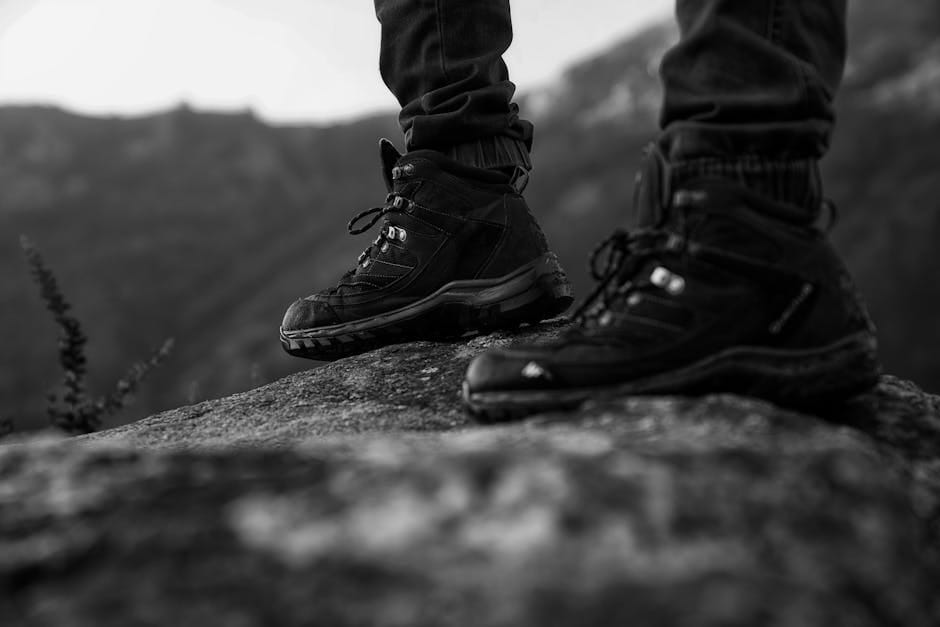
Why Your Toes Deserve More Room on the Trail
The best wide toe box hiking boots give your feet the space they need to splay naturally, reducing blisters, hot spots, and toe pain on long hikes.
Here are the top picks for 2026:
| Boot | Toe Box Width | Best For |
|---|---|---|
| KEEN Targhee III Waterproof Mid | 106.4 mm | Overall wide-fit hiking |
| KEEN Voyageur Mid | ~106 mm (6.5 mm wider than avg) | Breathable day hiking |
| Adidas Terrex Free Hiker 2 | 97.9 mm | Cushioned all-day comfort |
| Salomon Quest 4 GTX | 98.3 mm | Technical terrain |
| KEEN Pyrenees | ~106 mm (6.5 mm wider than avg) | Heavy backpacking |
| Lowa Renegade Evo GTX Mid Wide | Wide-fit last | Multi-day trekking |
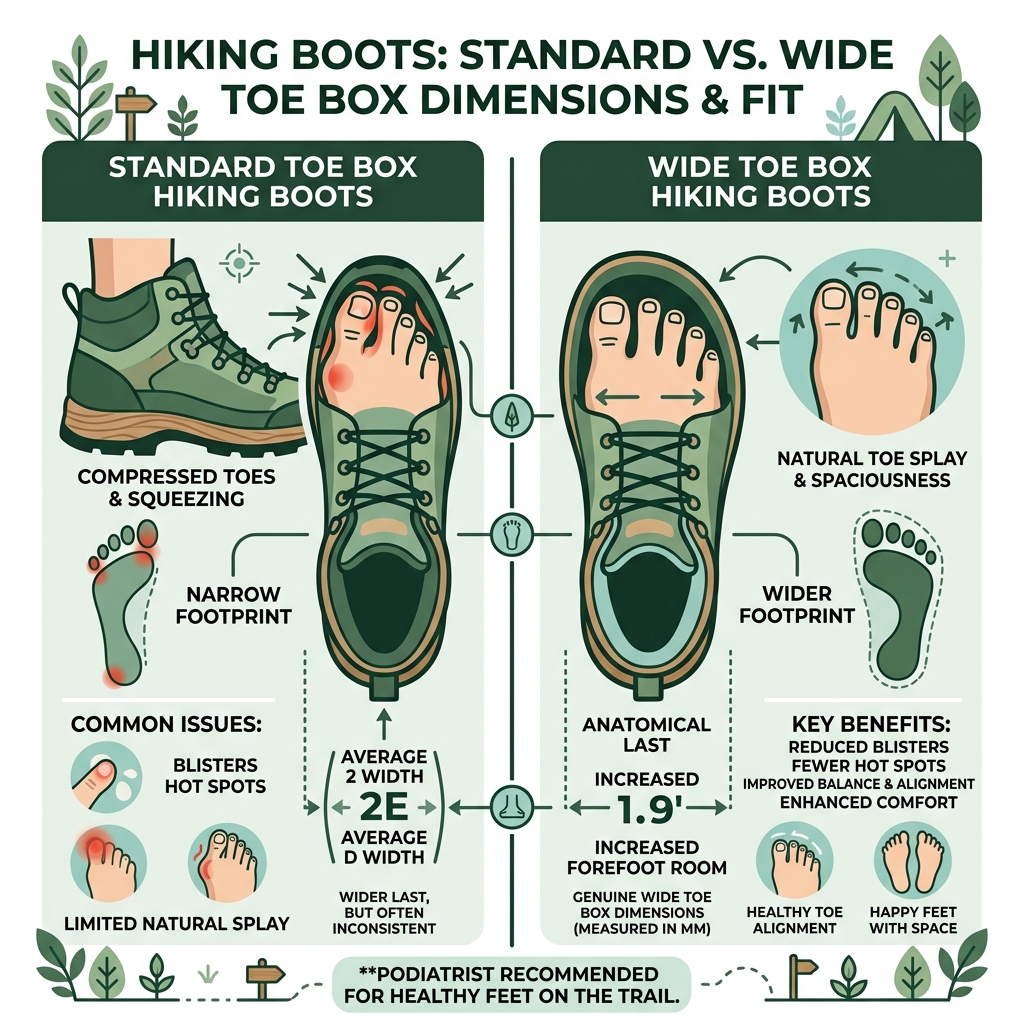
Most people never realize their boots are too narrow until the blisters show up. Standard hiking boots are built on narrow lasts — especially European brands — which squeezes your toes together with every step. Over miles of trail, that adds up fast.
A wide toe box fixes this. It lets your toes spread out naturally, the way your foot actually moves when you walk. Podiatrists consistently recommend this shape for better alignment and fewer injuries. According to the American Podiatric Medical Association, proper footwear is essential for preventing long-term foot deformities and maintaining mobility.
The catch? Not all boots labeled “wide” actually are. Width labels like 2E or 4E for men and D or 2E for women vary wildly between brands. Some boots marketed as wide are barely medium when you measure them.
That’s why real toe box measurements — in millimeters — matter more than any label.
I’m Faisal S. Chughtai, a footwear expert with a career dedicated to helping people find the right fit for comfort and performance, including identifying the best wide toe box hiking boots for every foot type and trail condition. In the sections below, I’ll break down exactly which boots deliver real width, which are worth the money, and how to find your perfect fit.
Basic best wide toe box hiking boots glossary:
Top Recommended Best Wide Toe Box Hiking Boots for 2026
Finding the perfect balance between a spacious forefoot and a secure heel is the “holy grail” of hiking. For 2026, the market has shifted toward anatomical shapes that respect the human foot’s natural design. We have analyzed lab data and trail performance to narrow down the absolute leaders in the category.
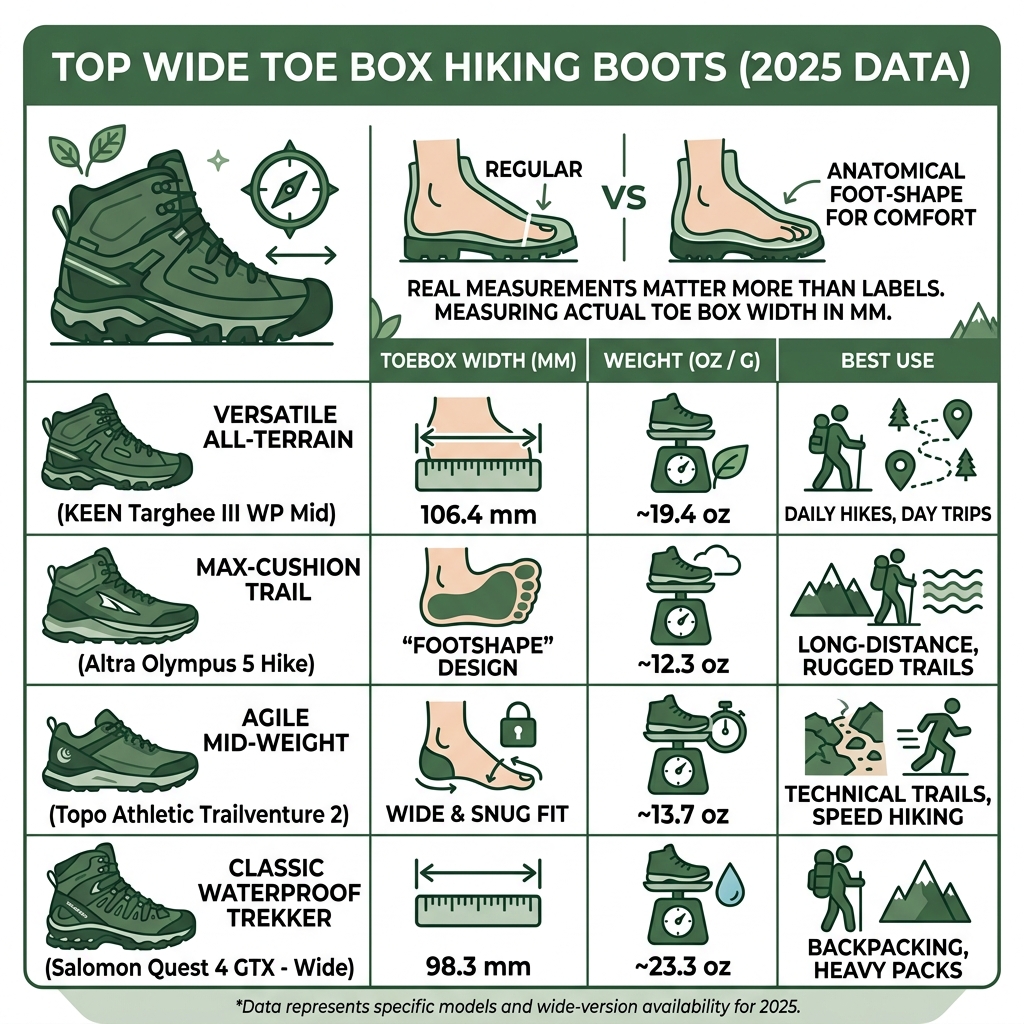
Versatile All-Terrain Hiker: KEEN Targhee III Waterproof Mid
The KEEN Targhee III remains the gold standard for those seeking a “foot-shaped” feel without going full minimalist. Lab measurements show a staggering 106.4 mm wide toebox at its widest point. This isn’t just marketing fluff; it provides roughly 6.5 mm more space than the industry average. It’s also 31.8% more flexible than typical boots, making it feel broken-in right out of the box. More info about roomy hikers.
Max-Cushion Trail Boot: Altra Olympus 5 Hike
If you want the “king of wide toe boxes,” look no further than Altra. The Olympus 5 Hike features a massive 33mm stack height, providing plush protection against sharp rocks. Unlike traditional boots that taper at the toes, Altra uses a “FootShape” design that allows the big toe to remain straight for maximum power during toe-off. It’s an ideal choice for hikers with bunions or those who experience significant foot swelling on long days.
Agile Mid-Weight Option: Topo Athletic Trailventure 2
Topo Athletic has earned the American Podiatric Medical Association (APMA) Seal of Approval for a reason. The Trailventure 2 combines a wide, roomy toe box with a secure, snug fit through the waist and heel. This prevents your foot from sliding forward on descents—a common pitfall of poorly designed wide boots. It features an aggressive Vibram Megagrip outsole, making it a favorite for technical trails where you need both space and “stickiness.”
Classic Waterproof Trekker: Salomon Quest 4 GTX
While many European brands run narrow, the Salomon Quest 4 GTX (available in wide versions) breaks the mold. It measures 98.3 mm wide—about 5 mm wider than average—and offers a 5/5 torsional rigidity score. This makes it a beast on uneven terrain where you need the boot to do the work of stabilizing your ankle.
Best for Backpacking: Heavy-Duty Wide Toe Box Hiking Boots
When you’re hauling a 30-40 lb pack, a flimsy boot won’t cut it. You need a firm midsole to prevent “foot fatigue” and a chassis that won’t twist under pressure.
- KEEN Durand II: This is arguably the sturdiest wide toe box option for heavy backpacking. It is made with a dual-compound rubber outsole and a supportive mid-cut height. Its midsole is significantly firmer than average, providing the “platform” feel required for multi-day expeditions.
- Lowa Renegade Evo GTX Mid (Wide): Lowa uses a higher-volume “Wide Last” that provides extra room in the forefoot and instep. It features the Monowrap frame, which cradles the foot for stability on uneven surfaces without adding excessive weight.
- Hanwag Makra Trek SF Extra GTX: This model uses the “StraightFit Extra Last.” It’s a specialized design that combines a wide toe box with additional forefoot room while maintaining a firm, narrow midfoot support. It is specifically built for multi-day tours with heavy loads in difficult terrain.
For those ready to upgrade their gear, you can shop wide hiking options to find these heavy-duty performers.
Best Lightweight Options: Best Wide Toe Box Hiking Boots for Fast-Packing
Fast-packing requires a blend of trail runner agility and hiking boot protection. If you’re moving quickly, you want high breathability and a lower weight to reduce leg fatigue.
- Adidas Terrex Free Hiker 2: This boot is a standout for shock absorption, with a 121 SA rating that makes it 31.5% more protective than average hikers. At 97.9 mm wide, it offers a modern, sneaker-like fit that still respects the need for toe splay.
- KEEN Voyageur Mid: If you hike in hot, dry climates, the Voyageur is your best friend. It trades a waterproof membrane for mesh windows, offering 4/5 breathability. It retains that signature KEEN width (6.5 mm wider than average) and features 4.6 mm deep lugs for excellent traction on loose dirt.
- Lems Boulder Boot Grip: A favorite in the barefoot community, the Boulder Boot Grip offers a generous fit and strikes a great balance between flexibility and traction. It’s incredibly lightweight, making it feel like an extension of your foot.
For more insights on choosing nimble footwear, check out our more info on hiking boots for outdoor adventures.
Understanding Width: Lab Measurements vs. Industry Labels
Don’t let the “Wide” tag on the box fool you. In the footwear industry, width labels are notoriously inconsistent. A “2E” width in one brand might be narrower than a “Standard” width in another.
The Millimeter Truth
Lab measurements are the only way to truly determine if a boot is wide. We look at two key areas: the widest point of the forefoot and the width at the big toe.
- Average Hiking Boot: ~93-94 mm
- KEEN Targhee III: 106.4 mm
- Salomon Quest 4 GTX: 98.3 mm
Deciphering the Labels
- Men’s Labels: D (Medium), 2E (Wide), 4E (Extra Wide).
- Women’s Labels: B (Medium), D (Wide), 2E (Extra Wide).
However, some brands like Danner might label a boot 2E, but lab tests show it fits more like a medium. Conversely, brands like Altra and Topo don’t always use “Wide” labels because their standard shape is already wider than most competitors’ “Extra Wide” models.
Toebox Height and Volume
Width isn’t the only factor in “the squeeze.” Toebox height (vertical space) is crucial for preventing “black toenails” on steep descents. High-volume feet—those that are thick from top to bottom—need a boot with a taller ceiling. Boots like the Lowa Ranger GTX Wide utilize a bespoke wide fit last specifically to increase volume for conditions like hallux valgus (bunions) or flat feet.
Need more help with sizing? Read our expert guide to fitting hiking boots.
Foot-Shaped and Zero-Drop vs. Traditional Wide Fits
There is a major distinction between a “wide version” of a traditional boot and a “foot-shaped” boot.
Traditional Wide Fits
Traditional boots (like those from Scarpa or Lowa) are built on a “last” that is generally symmetrical. When they make a “wide” version, they often just add more material to the upper or slightly widen the platform. However, the boot still usually tapers toward a point at the front.
Foot-Shaped Designs
Brands like Altra, Vivobarefoot, and Freet design their boots to mimic the actual shape of a human foot. This means the widest part of the boot is at the tips of the toes, not the ball of the foot. This allows for natural splay, which improves balance and allows your arch to function as a natural shock absorber.
The Zero-Drop Factor
Many foot-shaped boots are also zero-drop, meaning the heel and the forefoot are at the same height.
- Pros: Encourages a more natural gait, strengthens calf muscles, and aligns the spine.
- Cons: Requires a transition period. If you switch from a traditional boot (with a 10-15mm drop) to a zero-drop boot overnight, you risk Achilles tendon strain.
If you are new to this style, we recommend wearing them for short walks before hitting a 10-mile trail. For a deeper dive into these categories, see our hiking shoe guide.
How to Choose and Fit Your Wide Hiking Boots
Fitting the best wide toe box hiking boots requires a different approach than buying casual sneakers.
- Shop Late in the Day: Your feet can swell up to half a size after a day of walking. Fitting your boots when your feet are at their largest prevents buying a pair that feels like a vice grip four miles into a hike.
- Wear Your Hiking Socks: Don’t test boots in thin cotton socks. Bring the thick wool or synthetic socks you actually plan to wear. This ensures the “volume” of the boot is correct.
- The Thumb Rule: With your heel pushed firmly to the back of the boot, you should have about one thumb’s width of space between your longest toe and the front of the boot.
- Check the “Heel Lock”: While the front should be roomy, the heel must be snug. If your heel lifts or slides, you will get blisters. Use “heel lock” lacing techniques if you have narrow heels but need a wide toe box.
- The Ramp Test: Most outdoor stores have a small wooden ramp. Walk down it. If your toes jam into the front of the boot, you need a different size or a model with better midfoot lockdown.
Wondering how other popular brands stack up? Check out our review of On Cloud hiking performance.
Frequently Asked Questions about Wide Toe Box Boots
Are wide toe box boots good for bunions?
Yes, they are the preferred choice for hikers with bunions. Bunions occur when the big toe is pushed toward the second toe. A wide toe box, especially “foot-shaped” ones like Altra or Topo, allows the big toe to sit straight, reducing pressure and pain on the joint.
What is the difference between a wide fit and a wide toe box?
A “wide fit” (like a 2E) usually means the entire shoe is wider, including the heel and the midfoot. A “wide toe box” specifically refers to the front of the shoe. Many hikers have a “duck-shaped” foot—narrow at the heel and wide at the toes. These hikers need a wide toe box but a standard or narrow heel to prevent slipping.
Can I use wide boots if I have narrow heels?
Absolutely. Look for boots with “Zone Lacing” or “Lace-to-Toe” systems. These allow you to tighten the laces significantly around the ankle and heel while leaving the laces over the toe box loose. Brands like Scarpa and La Sportiva often feature lacing that extends far down toward the toes for this exact purpose.
Conclusion
At On Clouder, we believe that trail time should be defined by the views, not the pain in your feet. Choosing the best wide toe box hiking boots is an investment in your long-term foot health and trail performance. Whether you opt for the rugged stability of the KEEN Durand II for heavy backpacking or the nimble, foot-shaped feel of the Topo Trailventure 2, giving your toes room to breathe is the first step toward a better hiking experience.
Don’t settle for the “squeeze.” Measure your feet, look at the millimeter data, and find a boot that respects the shape of your foot. Your toes will thank you at the end of every mile.
Ready to find your perfect fit? Explore our dedicated guides for women’s wide toe box options and start your next adventure in comfort.
