
Why Finding a Good Shoe for Standing All Day Can Save Your Feet (and Your Body)
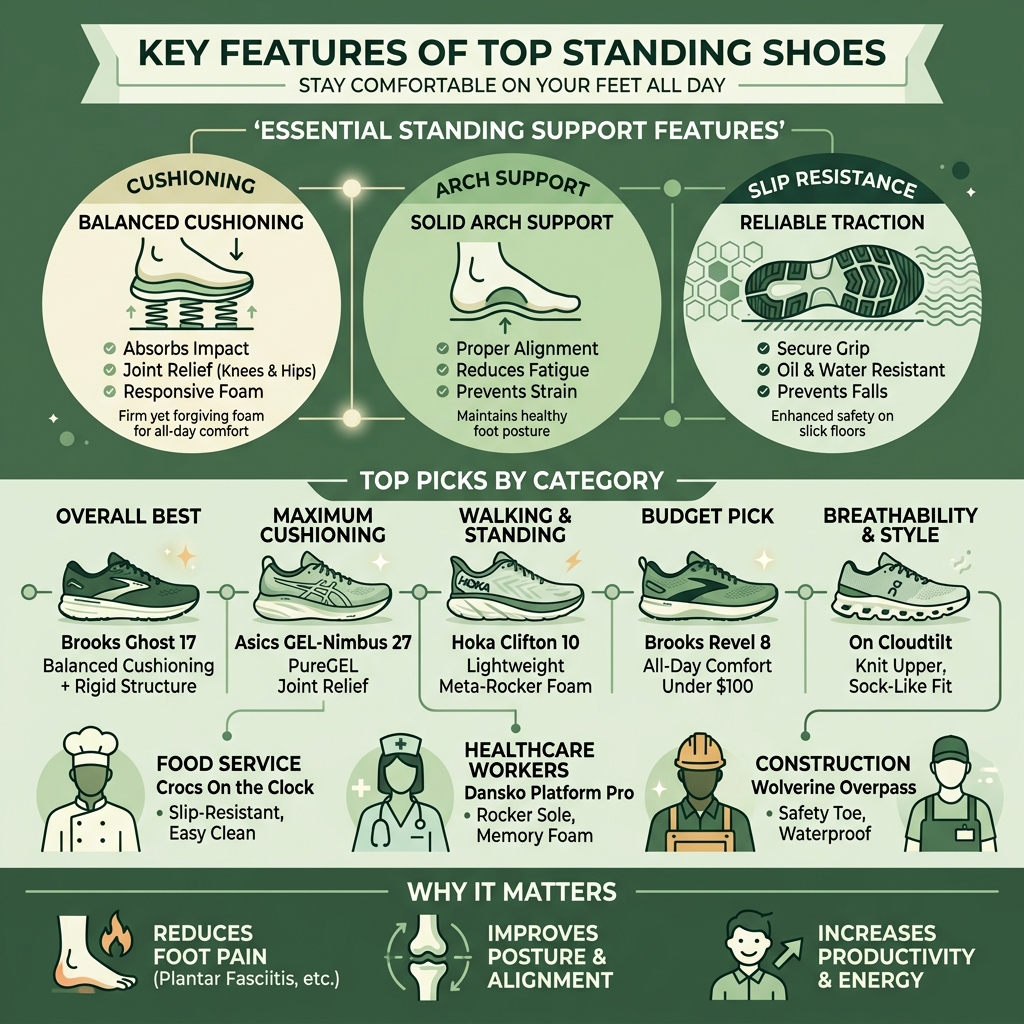
A good shoe for standing all day is one that combines firm cushioning, solid arch support, a stable heel counter, and slip-resistant outsoles — here are the top picks:
| Shoe | Best For | Key Feature |
|---|---|---|
| Brooks Ghost 17 | Overall best | Balanced cushioning + rigid structure |
| Asics GEL-Nimbus 27 | Maximum cushioning | PureGEL joint relief |
| Hoka Clifton 10 | Walking and standing | Lightweight Meta-Rocker foam |
| Brooks Revel 8 | Budget pick | All-day comfort under $100 |
| On Cloudtilt | Breathability and style | Knit upper, sock-like fit |
| Crocs On the Clock | Food service and cafeterias | Slip-resistant, easy to clean |
| Dansko Platform Pro | Healthcare workers | Rocker sole, memory foam |
| Wolverine Overpass | Construction and outdoors | Safety toe, waterproof |
When you stand for hours on hard floors, your body takes a real beating. The pressure travels from your feet up through your ankles, knees, hips, and lower back. Over time, the wrong shoes make it worse — not just sore arches at the end of a shift, but conditions like plantar fasciitis and metatarsalgia that can take months to recover from.
The numbers back this up. Up to 30% of people experience foot pain, and poor footwear is a major reason why. More than 2 million people deal with plantar fasciitis, often triggered by standing long hours in unsupportive shoes. And between 63–72% of people are wearing shoes that don’t even fit their feet properly — the wrong length, the wrong width, or both.
The good news? The right shoe genuinely makes a difference. This guide cuts through the noise and shows you exactly what to look for and which shoes hold up when you’re on your feet all day.
I’m Faisal S. Chughtai, a footwear expert with years of hands-on experience testing and reviewing shoes — including what makes a good shoe for standing all day across demanding work environments. With that background, I’ll walk you through the best options available right now, so you can find the right fit for your specific needs.
A good shoe for standing all day word list:
- Best Adidas for Standing All Day
- Best ASICS Shoes for Standing All Day
- Best HOKA Shoe for Standing All Day
Essential Features of a Good Shoe for Standing All Day
When we search for a good shoe for standing all day, we aren’t just looking for “softness.” In fact, a shoe that is too soft can be just as damaging as one that is too hard. To protect your body during an eight or twelve-hour shift, several technical components must work in harmony.
Cushioning and Shock Absorption
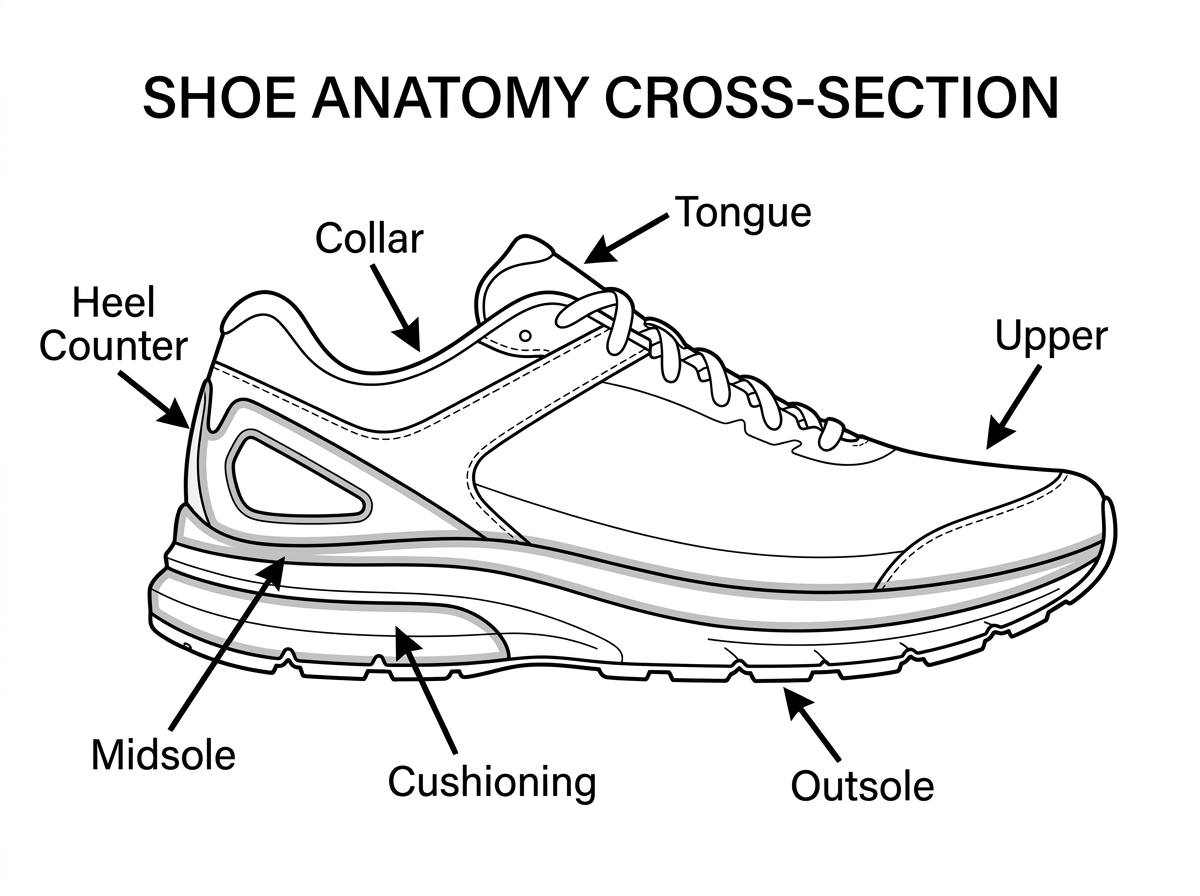
The primary role of cushioning is to absorb the impact of your body weight. Research indicates that incorrectly fitted footwear is a leading cause of corns, calluses, and toe deformities. For standing, we look for “resilient” cushioning—foam that compresses to take the edge off the floor but doesn’t “bottom out” or feel like you’re sinking into quicksand.
Arch Support and Rigidity
A shoe needs enough structural integrity to support your natural arch. If a shoe can be easily folded in half or twisted like a dishcloth, it probably won’t support you for ten hours. We recommend a shoe with a certain level of torsional rigidity—meaning it resists twisting—to keep your foot aligned. This is crucial because musculoskeletal disorders are highly prevalent in occupations involving prolonged standing, often affecting the lower back and feet.
The Heel Counter and Heel Wedge
The heel counter is the stiff cup at the back of the shoe. A firm heel counter keeps your foot locked in place, preventing the side-to-side “wobble” that leads to ankle fatigue. Furthermore, podiatrists often recommend a slight “heel wedge” or drop (around 0.5 inches). A completely flat shoe can actually increase strain on the Achilles tendon and plantar fascia.
Breathability and Slip-Resistance
If you are working in a kitchen, hospital, or warehouse, slip-resistance is non-negotiable. Beyond safety, breathability is a comfort essential. Feet tend to swell throughout the day; a breathable mesh or knit upper allows for this expansion while preventing the heat buildup that causes blisters.
Top-Rated Footwear for Prolonged Standing
Finding the right balance of these features can be tricky. Through our extensive testing at On Clouder, we’ve identified several models that consistently outperform the rest when it comes to long-term comfort and support.
Brooks Ghost 17: A Good Shoe for Standing All Day Overall
The Brooks Ghost has long been a favorite for its “Goldilocks” approach—not too soft, not too firm. The updated Ghost 17 features DNA Loft v3 cushioning, which provides a plush feel without sacrificing the rigid structure necessary for standing. It’s a neutral shoe that offers a very stable platform, making it an excellent choice for those who don’t need heavy stability but want a reliable, daily workhorse. You can find more details in our guide on the best Brooks shoes for standing all day in 2025.
Asics GEL-Nimbus 27: Best for Maximum Cushioning
If you spend your entire day on punishingly hard concrete, the Asics GEL-Nimbus 27 is a top contender. It utilizes PureGEL technology in the heel to provide significant joint relief. Unlike some high-stack shoes that feel “mushy,” the Nimbus 27 maintains a firm heel counter and a supportive midsole that doesn’t compress too quickly. For more specific options on hard surfaces, check out our review of the best Asics shoes for standing on concrete all day.
Hoka Clifton 10: Best for Walking and Standing
Hoka is famous for its maximalist cushioning, and the Clifton 10 is the pinnacle of their everyday lineup. It features an early-stage Meta-Rocker, which helps transition your weight smoothly if you alternate between standing and walking. While some Hokas can feel too flexible, the Clifton 10 provides a balanced bed of foam that is surprisingly lightweight. See how it compares to other models in our breakdown of the best Hoka shoes for standing all day in 2025.
Brooks Revel 8: Best Budget-Friendly Option
You don’t always have to spend $160 to get a quality shoe. The Brooks Revel 8 is a fantastic value option, often found around the $100 mark. It offers a sleeker, more “lifestyle” look than the Ghost, but still packs enough responsive cushioning to handle a full work day. It’s an ideal choice for retail workers or teachers who want a shoe that looks good with jeans but protects their feet.
On Cloudtilt: Best for Breathability and Style
For those who prioritize a modern aesthetic and a sock-like fit, the On Cloudtilt is a standout. It features a breathable knit upper made from recycled materials, making it a favorite for those whose feet tend to overheat. The “Cloud” elements provide localized cushioning that reacts to your movement. It’s a highly popular choice for healthcare professionals; you can read more in our guide to On Cloud shoes for nurses and teachers.
Specialized Shoes for Different Work Environments
Not every “standing” job happens in an office or a carpeted hallway. Some environments require specific safety standards or materials that can withstand spills and heavy-duty use.
Crocs On the Clock: Best for Food Service and Cafeterias
In restaurant service and cafeteria work, spills are inevitable. The Crocs On the Clock work sneaker is designed specifically for these high-mess environments. It features the “Crocs Lock” slip-resistant tread and a synthetic Nubuck upper that is easy to wipe clean. Unlike the classic Crocs clogs, these have a closed heel and toe to meet workplace safety requirements while providing the lightweight comfort the brand is known for.
Dansko Platform Pro: Best for Healthcare Professionals
Dansko clogs have been the unofficial uniform of the medical world for decades, and for good reason. The Platform Pro features a signature rocker sole that promotes a natural walking motion and takes pressure off the forefoot. With a memory foam footbed and an easy-to-clean leather upper, it’s a shoe built to survive 12-hour hospital shifts.
Wolverine Overpass: Best for Outdoor and Construction
For those on construction sites or working in warehouses, a standard sneaker won’t cut it. The Wolverine Overpass combines the comfort of a sneaker with the protection of a work boot. It features a CarbonMax composite safety toe, which is lighter than steel but just as strong. It’s also waterproof and offers electrical hazard protection, making it a rugged, all-day solution for tough environments.
Saucony Guide 18: Best for Overpronators
If your feet tend to roll inward (overpronation), you need a shoe with “medial support.” The Saucony Guide 18 uses a structured cradle system to keep your foot in a neutral alignment. This prevents the uneven wear on the shoe and the subsequent knee and hip pain that often accompanies overpronation during long hours of standing.
Maintaining Foot Health and Shoe Longevity
Even the best shoe won’t last forever. Understanding how to care for your feet and when to swap out your footwear is just as important as the initial purchase.
Running Shoes vs. Work Shoes
Many people wonder if they should just wear their gym shoes to work. While running shoes offer great cushioning, they are designed for forward motion. Work-specific shoes often have more durable outsoles and better lateral stability for static standing.
| Feature | Running Shoes | Work/Standing Shoes |
|---|---|---|
| Cushioning | Dynamic/Springy | Even/Stable |
| Outsole | Lightweight Rubber | Slip-Resistant/Durable |
| Upper | Thin Mesh | Reinforced/Easy-Clean |
| Stability | Forward Motion | All-Directional |
The Importance of Shoe Rotation
We highly recommend rotating between two different pairs of shoes. This allows the foam in the midsole to fully decompress and “recover” between wears. In fact, shoe rotation is a recommended strategy for preventing plantar fasciitis in the workplace.
When to Replace Your Shoes
Most high-quality walking or standing shoes should be replaced every 300 to 500 miles. If you are standing 8 hours a day, that usually translates to every 6 to 9 months. Signs that it’s time for a new pair include:
- Visible compression lines in the midsole foam.
- The tread on the bottom is worn smooth.
- You start feeling new aches in your feet, knees, or back at the end of the day.
Frequently Asked Questions
How to Tell if a Good Shoe for Standing All Day Has Proper Arch Support
You can use the “Wet Foot Test” to determine your arch type: wet your foot and step on a piece of cardboard. A thick imprint suggests flat feet, while a very thin line suggests high arches. When shopping, perform the “Flex Test”: push the toe of the shoe toward the heel. It should only bend at the ball of the foot, not in the middle of the arch. Finally, feel the inside—there should be a noticeable “bump” or rise where your arch sits.
Are cushioned running shoes better than traditional work shoes for standing?
It depends on the job. For a nurse who is constantly moving, a cushioned running shoe like the Brooks Ghost is often superior because it handles the “stop-and-go” movement well. However, for someone standing in one spot (like a security guard or a line cook), a traditional work shoe or clog provides better “static” support and usually features superior slip-resistance and easier-to-clean materials.
How often should I replace my shoes if I stand all day?
A general rule of thumb is every 6 months if you are wearing them 40+ hours a week. Midsole foam loses its ability to “bounce back” long before the outside of the shoe looks worn out. If you press your thumb into the side of the sole and it feels hard and brittle rather than springy, the cushioning has likely collapsed.
Conclusion
At On Clouder, we know that the “best” shoe is ultimately the one that fits your unique foot shape and work environment. Whether you need the high-tech joint relief of the Asics GEL-Nimbus, the rugged protection of a Wolverine boot, or the easy-clean convenience of Crocs, investing in a good shoe for standing all day is an investment in your long-term health.
Don’t wait until the pain starts to take your foot health seriously. Use the tests we’ve mentioned, consider your specific workplace needs, and remember to rotate your pairs. To explore more expert rankings and find your perfect fit, find the best shoes for standing in our expanded collections. Your feet—and your back—will thank you.
